
H2S in Oil and Gas: Why Every Hand on Location Wears a Monitor
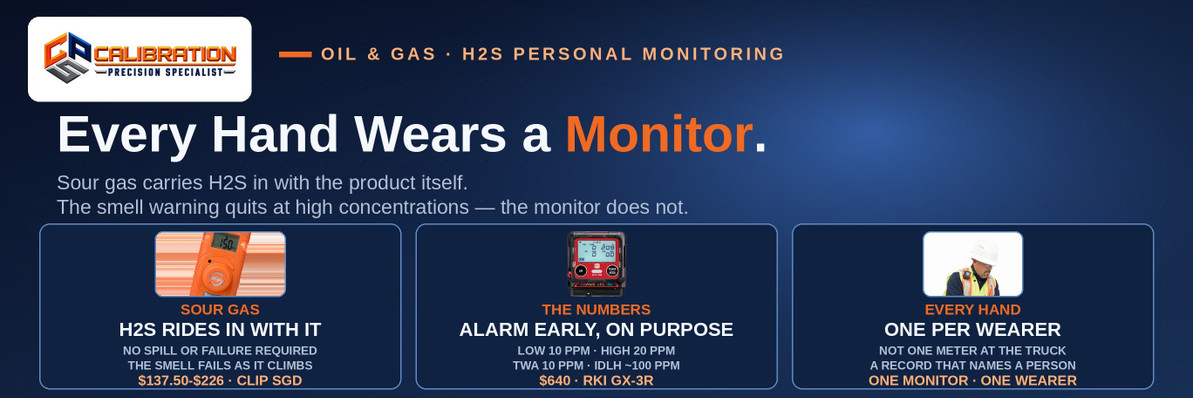
Every hand on an oil and gas location wears a personal H₂S monitor because hydrogen sulfide in sour gas can deaden a worker's sense of smell and overwhelm them at concentrations a shared meter sitting at the truck will never register in time — personal monitors are worn in the breathing zone and typically alarm at 10 ppm (low) and 20 ppm (high), with a 10 ppm time-weighted average, far below the roughly 100 ppm level considered immediately dangerous to life and health.
This post opens our oil and gas series, and it starts with the gas that shapes every other decision in it. H₂S is not the only hazard on a location — it is the one that punishes the "we have a meter" shortcut hardest, because its warning system fails, its safe-looking concentrations move, and its exposure belongs to a person, not a place. Here is the case, the numbers, and the equipment call.
What Is Sour Gas?
Natural gas is called sour when it carries hydrogen sulfide in it; gas without it is sweet. The distinction is not academic — it changes how a location is run:
- H₂S comes up with the product. It is present in the formation and arrives with the gas, oil, and produced water a crew handles every day. No spill, rupture, or mistake is required to bring a hand into contact with it — opening, gauging, transferring, and servicing equipment on sour production can each present it.
- It is released where the work is. The gas shows up at the points people physically touch: wellheads, separators, tanks, transfer points, and low spots where it can collect. That is a map of tasks, not of fixed points — and tasks move with the worker.
- Sour changes the paperwork as well as the PPE. Sour service is why locations run H₂S training, contingency thinking, and documented monitoring in the first place. A crew's monitor program is part of that record, not an accessory to it.
The practical translation: on sweet production, an H₂S monitor is a precaution. On sour production, it is as basic as boots — because the hazard is in the product itself.
Why Can't You Just Smell It?
Hydrogen sulfide is famous for its rotten-egg smell, and that fame has hurt people, because the smell is a warning that withdraws itself:
- At low concentrations, you can smell it. That early warning is real — and it trains workers to trust their nose.
- As concentrations climb, H₂S deadens the sense of smell. Olfactory fatigue sets in: the odor seems to fade or disappear precisely because the gas is overwhelming the sense that detected it. A worker can read that fading smell as "it cleared up" when the opposite is true.
- Around 100 ppm, H₂S is considered immediately dangerous to life and health (IDLH). Between "I can smell it" and that level there is no reliable human instrument — the nose reports least when the danger is greatest.
This is the whole argument for the instrument in one paragraph: the only H₂S warning that does not quit at high concentrations is a monitor. Everything in the rest of this post — every hand wearing one, where it is worn, how it is documented — is built on that fact.
Why Every Hand — Not Just the Hands Doing the "Gassy" Jobs?
Because on location, exposure follows the person, not the job title:
- People move; H₂S accumulates where it will. A hand crosses low ground, steps into a cellar area, leans over a tank, or walks downwind of a vent on the way to an unrelated task. The exposure happens on the route, not only at the workface.
- Conditions change mid-shift. Wind shifts, a process upsets, a vessel is opened that was not on the morning plan. A monitor issued "for the gassy job" is in the truck for all of that.
- Rescue is the trap. The worker most at risk in an H₂S event is often the second one — the hand who goes in after a colleague without knowing why he went down. Monitors on everyone are what turn a collapse into information ("his meter is in alarm — nobody enters unprotected") instead of a second casualty.
- An exposure record names a person. When a reading is questioned later, "the location's meter said…" is not an answer. A worn monitor's record belongs to the wearer whose dose it was.
Where the monitor sits matters as much as that it exists: clipped in the breathing zone, on the collar, lapel, or upper chest — the rule, the failures of belt and pocket placement, and the pumped exception are in where should you wear a portable gas detector?
The Alarm Numbers: 10, 20, and the TWA Underneath
Typical factory settings on a personal H₂S monitor are:
| Setting | Typical factory value | What it means |
|---|---|---|
| Low (instantaneous) alarm | 10 ppm | The first action alarm — H₂S is present at a level that demands response now, not at the end of the task |
| High (instantaneous) alarm | 20 ppm (some fleets set 15 ppm) | The escalation alarm — leave the area; this is not a finish-and-report concentration |
| TWA alarm | 10 ppm | Your average exposure across the shift has hit its ceiling — dose, not just this moment's reading |
| IDLH (for scale) | ~100 ppm | The level considered immediately dangerous to life and health — note how far above the alarms it sits |
Read the table the way it was designed: the alarms are set far below the lethal neighborhood on purpose. A monitor alarming at 10 or 20 ppm is not crying wolf; it is giving the wearer the entire distance between 20 and 100 ppm to act in. Two cautions belong with any printed numbers: setpoints are configurable, fleets differ, and your site's settings govern — confirm the values on your own instruments before training anyone on them; and a TWA alarm can arrive on a day when no instantaneous alarm ever sounded, because it is accounting for the shift, not the spike.
Clip-On Single-Gas vs. a Shared Meter at the Truck
This is the equipment argument on most locations, so here is both sides honestly:
| Personal clip-on, one per hand | Shared meter at the truck | |
|---|---|---|
| What it measures | The breathing zone of its wearer, everywhere he goes | The air at the truck, and wherever someone remembers to carry it |
| Who is covered | That wearer, all shift | Whoever currently holds it — everyone else, nobody |
| Exposure record | One wearer per instrument | Several people's exposure mixed in one log |
| Cost shape | Per person — a disposable Crowcon Clip SGD is $137.50–$226; a serviceable Crowcon Gasman is $333.96–$1,693.32 | One instrument, cheapest line on the quote — the RKI GX-3R at $640 covers four gases for whoever holds it |
| Best role | The personal H₂S layer for every hand | A crew's shared 4-gas or pumped instrument for testing and entry work |
Use a personal clip-on when the hazard being covered is H₂S on a person — which on a sour location is every hand, every shift. The disposable Clip SGD ($137.50–$226) is the usual answer for contractors, visitors, and high-turnover crews: it turns on, it is worn, it alarms, and there is nothing to service or swap. The serviceable Gasman ($333.96–$1,693.32) is the answer when a core crew will keep the same instrument for years and a replaceable sensor beats replacing the whole unit.
Keep a shared meter — in its proper job. A shared 4-gas or pumped instrument at the truck is a legitimate tool for pre-entry testing and investigation. It fails only when it is asked to be personal protection for people who are not holding it. The failure is arithmetic: one meter cannot be in six breathing zones.
Step up to a personal 4-gas when the location's hazards go past H₂S alone — oxygen displacement, combustible gas, or carbon monoxide plausibly in the same work. That is GX-3R territory ($640) on each wearer, and the selection sequence is in how to choose a portable gas detector.
Bump It, Calibrate It, and Be Able to Prove Both
Oil and gas runs on documentation — permits, JSAs, training records — and H₂S monitoring either fits that culture or gets found out by it. The program that holds up:
- Bump test before use. A quick exposure to known gas proving the sensor responds and the alarms fire, before the day's work — the same before-each-day's-use discipline OSHA guidance, following ISEA, calls for on portable monitors generally. A monitor that fails comes out of service; it does not go on location anyway.
- Full calibration on schedule, and after a failed bump. Calibration is what makes the 10 and 20 ppm alarms mean 10 and 20 ppm. Sent in-house to CPS, calibration runs $55 for a single-gas instrument and $90 for a four- or five-gas — and we calibrate every channel on the instrument, not a sample of them. On-site service is quoted in writing, because site conditions set the real price.
- The gas itself carries its paperwork. Every cylinder of calibration gas CPS sells carries a QR code that pulls up that bottle's Safety Data Sheet and Certificate of Analysis — the lot-specific proof an auditor, a company man, or an incident review actually asks for. Scan the bottle, get the SDS and the COA. CPS charges no hazmat fee on calibration gas; we absorb it. Matching a monitor to its correct mixture is what the Calibration Gas Finder is for.
- Keep the records with the fleet, not in someone's memory. Bump and calibration history per instrument, by serial number, is what turns "we monitor for H₂S" from a statement into a demonstrable program when a customer, an insurer, or a regulator asks.
Frequently Asked Questions
Why do oil and gas workers wear H2S monitors?
Because hydrogen sulfide in sour gas can deaden the sense of smell as concentrations rise and overwhelm a worker without a reliable warning — the rotten-egg odor fades precisely when the danger grows. A personal monitor worn in the breathing zone is the only warning that keeps working at high concentrations, alarming typically at 10 ppm low and 20 ppm high, far below the roughly 100 ppm level considered immediately dangerous to life and health.
What is sour gas?
Sour gas is natural gas that contains hydrogen sulfide (H₂S); gas without it is called sweet. Sour production changes how a location is run because H₂S arrives with the product itself — no spill or failure is required — and is released at the wellheads, separators, tanks, and transfer points where hands physically work. That is why sour locations run H₂S training, documented personal monitoring, and contingency thinking as standard practice.
What ppm does an H2S monitor alarm at?
Typical factory settings are a low instantaneous alarm at 10 ppm and a high instantaneous alarm at 20 ppm — some fleets set the high alarm at 15 ppm — plus a time-weighted average (TWA) alarm at 10 ppm that tracks the wearer's accumulated exposure across the shift. Setpoints are configurable and differ between fleets and sites, so confirm the values on your own instruments; the design intent everywhere is the same — alarm far below the ~100 ppm IDLH.
Can you smell H2S before it becomes dangerous?
At low concentrations, yes — H₂S has a strong rotten-egg odor. The trap is that as concentrations climb, H₂S deadens the sense of smell, so the odor seems to fade or vanish while the gas is actually getting more dangerous. A worker who trusts the fading smell can conclude the area cleared at the moment it became worst. Smell is never a monitoring method for H₂S; an instrument is.
At what concentration is H2S immediately dangerous?
Around 100 ppm is considered immediately dangerous to life and health (IDLH) for hydrogen sulfide. Context matters here: personal monitors typically alarm at 10 ppm (low) and 20 ppm (high) precisely so the wearer acts with the whole distance between the alarm and 100 ppm still available. An alarm at 10 or 20 ppm is an early, deliberate warning — not a false alarm and not a signal to finish the task first.
Is a clip-on H2S detector enough, or do I need a 4-gas monitor?
A clip-on single-gas H₂S detector is enough for the H₂S hazard itself — it is the standard personal layer on sour locations, as a disposable (Crowcon Clip SGD, $137.50–$226) or a serviceable unit (Crowcon Gasman, $333.96–$1,693.32). Step up to a personal 4-gas monitor such as the RKI GX-3R ($640) when the same work can plausibly present oxygen displacement, combustible gas, or carbon monoxide as well — a detector cannot alarm on a gas it has no sensor for.
Can workers share one H2S meter between them?
Not as personal protection. A shared meter measures the breathing zone of whoever is holding it; everyone else on the location is unmonitored, and the instrument's log mixes several people's exposures into one record that cannot be attributed later. Sharing is legitimate for a crew's 4-gas or pumped testing instrument used for pre-entry checks — a different job. Personal H₂S coverage is one monitor per hand.
How much does a personal H2S monitor cost?
A disposable single-gas H₂S monitor, the Crowcon Clip SGD, runs $137.50–$226 and is replaced whole at the end of its service life. A serviceable single-gas instrument, the Crowcon Gasman, runs $333.96–$1,693.32 depending on gas and configuration, and stays in service for years with sensor replacements. A full 4-gas personal monitor, the RKI GX-3R, is $640. Ownership adds bump and calibration gas and, for serviceable models, scheduled calibration — $55 per single-gas instrument in-house at CPS.
Do disposable H2S monitors need to be bump tested or calibrated?
They need to be bump tested — a bump test is a functional check with known gas proving the sensor responds and the alarms fire, and it applies to disposable and serviceable monitors alike, before the day's use. What a disposable does not take is a calibration adjustment: there are no sensors to swap and no adjustments to make, which is the point of the format. Serviceable monitors get full calibrations on schedule; in-house, CPS calibrates every channel on the instrument.
What records should an H2S monitor program keep?
Per instrument, by serial number: bump test results before use, full calibration dates and results, and the wearer the instrument was issued to — so an exposure record names one person. Keep the calibration gas documentation with it: CPS calibration gas cylinders carry a QR code linking to that bottle's SDS and Certificate of Analysis, so the gas used to prove the monitor can itself be proved, lot by lot, when a customer, insurer, or auditor asks.
The Bottom Line
Sour gas puts H₂S in the product, in the tasks, and at concentrations where the human warning system — smell — switches itself off. The response that matches that hazard is not a meter at the truck; it is a monitor in every hand's breathing zone, alarming at a typical 10 ppm low and 20 ppm high with a 10 ppm TWA underneath, bump tested before use, calibrated on schedule, and documented well enough to prove all of it. One monitor per hand is not the expensive version of the program. It is the program.
Outfitting a crew, or auditing the program you have? Call 865-900-8844 or reach us through Contact Us. Browse single-gas monitors, portable multi-gas monitors, calibration gas, and our calibration services.
CPS Calibrations · 109 S. Front Street, Rockwood, TN 37854 · Calibration Gas · Calibration Services · Contact Us
Need a calibration you can file?
In-house calibration at CPS in Rockwood, Tennessee — $55 for single-gas instruments, $90 for 4- and 5-gas — every channel, as-found and as-left data, full certificate.
See Calibration Servicesor call 865-900-8844
Recent Posts
-

What Is Remote Monitoring for Fixed Gas Detection?
Remote monitoring for fixed gas detection means a fixed system's live readings, trends, and alarm hi …Nov 23rd 2026 -

What Are the Key Differences Between the GX-6000 and GX-6100?
The RKI GX-6100 is the current replacement for the discontinued GX-6000: both are pumped 6-gas monit …Nov 22nd 2026 -

How to Read a PID Correction Factor Chart
To read a PID correction factor chart, find your vapor’s row, take the factor under your own lamp en …Nov 21st 2026