
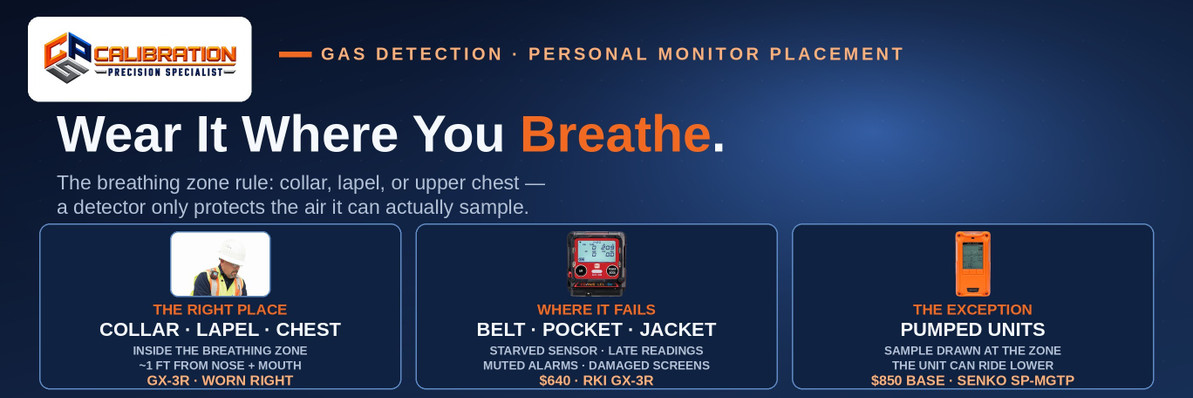
Where Should You Wear a Portable Gas Detector? The Breathing Zone Rule
Wear a portable gas detector on your collar, lapel, or upper chest — inside the breathing zone, the roughly 1-foot hemisphere of air around your nose and mouth — with the sensor inlet uncovered and facing outward. A diffusion monitor only samples the air that actually reaches its sensors, so a detector worn on a belt, carried in a pocket, or covered by a jacket can sit in cleaner air than the wearer is breathing and alarm late, quietly, or not at all.
This is the shortest safety rule in gas detection and the one we see broken most often in the field. The monitor is on the worker, switched on, in date — and in the wrong place, which quietly cancels most of what the first three facts were supposed to guarantee. Here is why the rule exists, exactly where the detector belongs, the placements that fail and how they fail, and the one real exception.
What Is the Breathing Zone?
The breathing zone is the air immediately around your nose and mouth — conventionally framed as a hemisphere roughly 1 foot (about 30 cm) out from the face. It is the sample that matters because it is, within seconds, the air in your lungs.
That framing drives the whole placement rule. A personal monitor is not measuring "the area," "the room," or "the job site." It is measuring one small body of air at one point on one person. If that point sits inside the breathing zone, the reading and the wearer's exposure are the same thing. If it sits a foot and a half lower, behind fabric, they are two different measurements — and the wearer is betting the difference never matters.
Why Does Placement Matter So Much on a Diffusion Monitor?
Most personal monitors — the standard 4-gas instrument like the RKI GX-3R ($640), a serviceable single-gas unit like the Crowcon Gasman ($333.96–$1,693.32), or a disposable clip like the Crowcon Clip SGD ($137.50–$226) — are diffusion instruments. They have no pump. Gas reaches the sensors only by drifting across the inlet on whatever air movement happens to pass.
That design is exactly right for personal wear — light, simple, no hoses — but it makes the instrument completely dependent on placement:
- It cannot pull air to itself. A cover, a pocket, or the wearer's own body between the hazard and the inlet means the sample has to fight its way in.
- Air is not uniform. Concentrations change over short distances — a heavier-than-air gas pooling low, a leak jetting past at head height, clean air moving along one side of a worker's body. A foot and a half of vertical distance is not a rounding error; it can be a different atmosphere.
- Response is not instant even when placement is perfect. Sensors need time to react to gas that reaches them. Poor placement adds avoidable delay on top of the instrument's own response time — delay spent breathing the difference.
Choosing the instrument itself is a separate decision, covered in how to choose a portable gas detector. Whatever model that process lands on, this rule applies to it unchanged: a $640 monitor and a $137.50 disposable fail in exactly the same way from inside a pocket.
Where Exactly Should You Clip It?
In order of preference, on the upper body, inlet uncovered:
- Collar or lapel. Closest to the nose and mouth, high on the body, inlet clear of most work gear. The default answer for most wearers.
- Upper chest. Chest strap, harness strap, or the upper chest of a shirt or vest — still inside or at the edge of the breathing zone, and where the worker in this post's photo is wearing his GX-3R.
- Shoulder strap. Acceptable and common with harnesses and straps, provided the inlet faces outward and straps or tools do not cover it.
Three checks, every time it goes on:
- Inlet visible and uncovered. You should be able to see the sensor inlet. If you cannot see it, air is not reaching it freely either.
- Display and alarms reachable. The wearer should be able to see the screen without removing the unit, and the audible and vibrating alarms should not be muffled against the body.
- It stays put through the actual work. Bending, climbing, and crawling move clips. If the job knocks a collar clip loose, fix the mounting — a stronger clip, a strap, a lanyard — rather than accepting a lower placement.
Teaching this placement is part of the 15-minute new-hire lesson in how to train a new hire to use a gas detector — because a new hire clips it where they were shown, once, and then does it that way for years.
Why Do Belt Clips Fail?
The belt clip is the most common wrong answer, because the clip is right there and the placement feels tidy. A diffusion monitor on a belt fails four ways at once:
| Failure | What actually happens |
|---|---|
| Starved sensor | The body, a tool belt, or a tucked shirt crowds the inlet. Air exchange at the sensor slows, and gas that is present at head height may barely reach the instrument. |
| Lagging or missed readings | The belt is roughly a foot and a half below the breathing zone, often on the far side of the body from the source. The reading describes the air at the wearer's hip — later, lower, or both — not the air being inhaled. |
| Muted alarms | The audible alarm sounds against the body and under clothing layers, and the vibration is felt — if at all — as one more buzz among tools and movement. The two alarm modes the wearer depends on are both damped at once. |
| Damage and loss | Belts are where monitors get sat on, leaned against rails, caught on ladders, and dragged across surfaces — cracked screens, damaged housings, and units knocked off and left behind. |
None of these is a maybe. They are geometry and clothing, and they happen on every shift a monitor rides on a belt, whether or not gas is ever present to expose the difference.
Why Are Pockets Worse?
A pocket takes every belt problem and encloses it. Fabric covers the inlet completely, the air inside a pocket exchanges slowly with the air outside it, the display cannot be read, and the audible alarm is muffled by cloth on all sides. A chest pocket is not the exception that saves the idea — it puts the unit at the right height while still starving the sensor and hiding the screen behind fabric, which are the failures that matter.
The honest version: a detector in a pocket is being carried, not worn. If the hazard was worth issuing a monitor for, it is worth the two seconds it takes to clip the monitor on outside the clothing.
Cold and rain change nothing about this rule, by the way — they explain it. A monitor worn under a jacket or rain gear for protection from the weather is in the same position as one in a pocket: covered inlet, muffled alarm, stale sample. Wear it outside the outermost layer.
The Pumped-Unit Exception: When the Unit Can Ride Lower
There is one placement that looks like a rule-break and is not. A pumped monitor draws its sample through a hose — which means the sample point, not the instrument body, is what has to be at the breathing zone (for personal sampling) or inside the space being tested (for pre-entry work).
So a pumped instrument like the SENKO SP-MGTP ($850 base, up to six gases) can ride on a belt or in a hand while its sample line and inlet sit up at the collar, or reach into the space ahead of the worker — because that is where the air being measured actually comes from. The rule has not been relaxed; it has moved to the end of the hose.
Two cautions keep the exception honest:
- The diffusion monitor in the same crew gets no exception. If it has no pump and no hose, its body is the sample point, full stop.
- A pumped unit with its hose coiled and capped is a diffusion unit with extra weight. The exception exists only while the sample is actually being drawn from the zone.
What About Hard-Hat Mounts?
A manufacturer hard-hat mount puts the detector on the head — above the breathing zone rather than inside it, but close to it, high on the body, and with the inlet clear. Use this when your instrument's manufacturer offers a mount for your model and your work makes chest mounting impractical — some harness, climbing, and rescue work qualifies.
The trade-offs, honestly stated: the detector sits a little farther from the nose and mouth than a collar clip, it takes the knocks the hat takes, and heat and sun exposure at the top of the head are harsher than at the chest. Follow the manufacturer's mounting guidance for your model, keep the inlet unobstructed, and treat the hat mount as a deliberate second choice — not a reason to skip checking that the sample still tracks what the wearer breathes.
What About a Detector in the Truck, or Sitting on a Dock?
A monitor left on a dashboard, a seat, or a charging dock is measuring the air in the truck or at the dock. That is a real measurement — it is just not a personal one. It will not follow the driver into the pit, the vault, or the far side of the plant, and its alarm will sound, if it sounds, where nobody is wearing it.
Use this when: never, as a substitute for wearing the instrument. A vehicle cab can be its own monitored space in a complete program — but that is a vehicle measurement added to personal monitoring, not a replacement for it. The monitor protects the person it is worn on, in the place the person is standing, and no other arrangement of the same hardware produces the same protection.
Placement at a Glance: Use This When
| Placement | Verdict | Use this when |
|---|---|---|
| Collar / lapel | First choice | Default for almost every wearer, almost every job |
| Upper chest / shoulder strap | Correct | Harnesses, vests, and straps make collar mounting impractical |
| Manufacturer hard-hat mount | Acceptable, deliberate | The maker offers it for your model and chest mounting genuinely does not work |
| Belt, diffusion monitor | Fails | Never as personal protection — see the four failures above |
| Any pocket, or under a jacket | Fails | Never — the unit is being carried, not worn |
| Belt or hand, pumped monitor | Correct — with the hose at the zone | The sample line is drawing from the breathing zone or the space being tested |
Frequently Asked Questions
Where should you wear a portable gas detector?
On your collar, lapel, or upper chest — inside the breathing zone, the roughly 1-foot hemisphere of air around your nose and mouth — with the sensor inlet uncovered and facing outward. That placement makes the air the detector samples the same air you are breathing, which is the entire point of a personal monitor. A pumped unit is the exception: it can ride lower because its hose draws the sample at the zone.
What is the breathing zone in gas detection?
The breathing zone is the small body of air immediately around a worker's nose and mouth, conventionally framed as a hemisphere roughly 1 foot (about 30 cm) out from the face. It is the reference volume for personal monitoring because it is the air about to be inhaled. A detector worn inside it reports the wearer's actual exposure; a detector worn outside it reports some other air nearby.
Can you wear a gas detector on your belt?
Not as personal protection for a diffusion monitor. A belt puts the sensor roughly a foot and a half below the breathing zone, crowded by the body and clothing so gas reaches it slowly or not at all, muffles both the audible and vibrating alarms, and exposes the screen and housing to knocks, scrapes, and being sat on. The exception is a pumped monitor, which may ride on a belt while its sample hose draws air from the breathing zone.
Can you keep a gas detector in your pocket?
No. A pocket — including a chest pocket at the right height — covers the sensor inlet with fabric, slows the exchange of air to the sensor until readings lag the real atmosphere, hides the display, and muffles the alarm. The detector is then being carried rather than worn, and it can read the stagnant air inside the pocket while the wearer breathes something entirely different outside it.
Does it matter if a jacket or rain gear covers my gas detector?
Yes — a covered detector has the same failures as one in a pocket: a starved sensor inlet, a stale sample, and a muffled alarm. Weather protection for the instrument never outranks the sample. Wear the monitor outside the outermost layer of clothing, where its inlet is exposed to the same air you are breathing, and use the mounting the manufacturer provides to keep it secure in that position.
Can you wear a gas detector on a hard hat?
Yes, with a manufacturer mount made for your model — it is a legitimate second choice when chest or collar mounting genuinely does not work, as in some harness, climbing, or rescue work. The trade-offs are real: the detector sits slightly above and farther from the nose and mouth than a collar clip, takes the knocks the hat takes, and sees harsher heat and sun. Keep the inlet unobstructed and follow the maker's mounting guidance.
Where do you wear a pumped gas detector?
Wherever it is secure — belt, hand, or chest — because placement follows the sample, not the instrument. A pumped monitor draws air through a hose, so what matters is that the end of the sample line is at the breathing zone for personal sampling, or inside the space being tested for pre-entry work. Coil the hose up or cap the inlet and the exception disappears: the unit is then only sampling the air at its own body.
How close to your face does a gas detector need to be?
Close enough that its inlet sits inside the breathing zone — roughly within 1 foot of the nose and mouth — which in practice means the collar, lapel, upper chest, or shoulder strap. That distance is why a belt fails: it is well outside the zone, at a different height, often on the far side of the body from the source, sampling air the wearer may never breathe.
Can I leave my gas detector on the dashboard and still be protected?
No. A detector on a dashboard measures the air in the cab, alarms where no one is wearing it, and stays in the truck when you walk to the work — the pit, vault, tank, or far side of the site where your exposure actually happens. Vehicle air can be monitored as part of a wider program, but a parked or charging monitor is never a substitute for a monitor worn in the breathing zone.
What happens if you wear a gas detector in the wrong place?
The monitor keeps working — that is the dangerous part. It powers on, passes its checks, and displays readings for the air at the wrong location: lower, later, or cleaner than the air you are breathing, with alarms muffled against your body or clothing. Nothing announces the failure. Wrong placement does not make a detector stop protecting you loudly; it makes it stop protecting you while looking exactly as if it still is.
The Bottom Line
A portable gas detector protects the air at its sensor — so put the sensor where your lungs are: collar, lapel, or upper chest, inside the roughly 1-foot breathing zone, inlet uncovered, worn outside every layer of clothing. Belt clips and pockets fail a diffusion monitor on geometry alone — starved sensor, lagging readings, muted alarms, damaged screens — and the only honest exception is a pumped instrument, whose sample hose, not its body, has to reach the zone.
Choosing the unit, or training the crew that wears it? See how to choose a portable gas detector and how to train a new hire to use a gas detector, browse portable multi-gas monitors and single-gas monitors, or call 865-900-8844. CPS calibrates in-house at $55 for a single-gas instrument and $90 for a four- or five-gas — and we calibrate every channel on the instrument. On-site service is quoted in writing. Calibration gas ships with no hazmat fee from CPS — we absorb it.
CPS Calibrations · 109 S. Front Street, Rockwood, TN 37854 · Calibration Gas · Calibration Services · Contact Us
Need a calibration you can file?
In-house calibration at CPS in Rockwood, Tennessee — $55 for single-gas instruments, $90 for 4- and 5-gas — every channel, as-found and as-left data, full certificate.
See Calibration Servicesor call 865-900-8844
Recent Posts
-

What Is Remote Monitoring for Fixed Gas Detection?
Remote monitoring for fixed gas detection means a fixed system's live readings, trends, and alarm hi …Nov 23rd 2026 -

What Are the Key Differences Between the GX-6000 and GX-6100?
The RKI GX-6100 is the current replacement for the discontinued GX-6000: both are pumped 6-gas monit …Nov 22nd 2026 -

How to Read a PID Correction Factor Chart
To read a PID correction factor chart, find your vapor’s row, take the factor under your own lamp en …Nov 21st 2026