
CGA-330 vs. CGA-600: Which Regulator Fitting Does Your Cylinder Need?
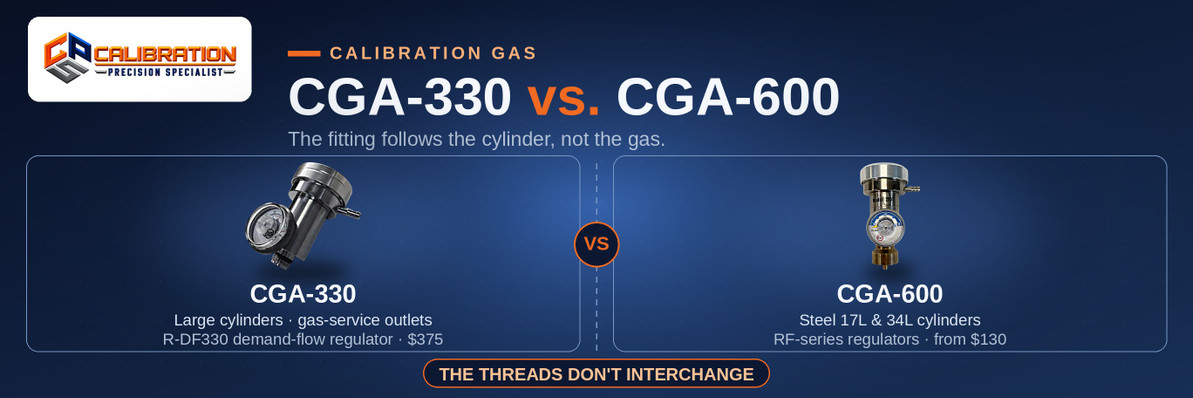
On CPS's ISG calibration gas cylinders, the fitting follows the cylinder, not the gas: the steel 17L and 34L cylinders take a CGA-600 regulator, the steel 103L and the aluminum cylinders (34L–120L) take a C-10 regulator, and CGA-330 fits neither — it is a gas-specific outlet for large cylinders, served at CPS by the R-DF330 demand-flow regulator at $375. If you are outfitting a standard calibration cylinder, your real choice is CGA-600 vs. C-10, and the cylinder's size, material, and SKU tell you which in about ten seconds.
That surprises people, because the two numbers in the title look like neighboring sizes of the same thing. They are not. CGA-330 and CGA-600 are two different standardized valve outlets, they fit two different families of cylinders, and on the small disposable cylinders most gas-detector users actually own, one of them never appears at all. This guide works through what the numbers mean, which CPS cylinder takes which fitting, and the regulators that match — with live prices.
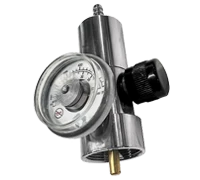
CGA-600 Fixed Flow Calibration Gas Regulator – Nickel-Plated Brass
CGA-330 vs. CGA-600 regulator fittings: CPS steel 17L/34L cylinders take CGA-600, the 103L and aluminum cylinders take C-10, and CGA-330 is R-DF330 at $375.
$130
See the CGA-600What Does "CGA" Mean, and What Does the Number Specify?
CGA is the Compressed Gas Association, the body that standardizes cylinder valve outlet connections in the United States (its standard is CGA V-1, Compressed Gas Cylinder Valve Outlet Connections). A CGA number is not a size grade or a quality tier. Each number encodes a specific physical connection — the thread's outside diameter, threads per inch, right-hand or left-hand direction, and internal or external form — so that a regulator and a cylinder either match exactly or do not connect at all.
That non-interchangeability is the point. The University of Southern California's environmental health and safety guidance puts it plainly: male and female fittings will only connect if they have the same CGA number, which minimizes the likelihood of using an incompatible regulator with gases that have special hazards — corrosive, toxic, flammable, or oxidizing. Different numbers exist precisely so the wrong pairing cannot be screwed together.
Two consequences follow:
- The number belongs to the valve, not the gas mixture. The same calibration mix can ship in cylinders with different outlets (you will see a live example below), so "what gas is it?" never answers "what regulator do I need?" — "what cylinder is it in?" does.
- A bigger number is not a bigger fitting. CGA-330 (a 0.825″-14 NGO, left-hand-thread outlet in the CGA charts, listed there for hydrogen chloride service) is not a step down from CGA-600, and CGA-600 is not a heavier-duty CGA-330. They are unrelated outlets for unrelated cylinder families.
CGA-330 vs. CGA-600 at a Glance
| CGA-600 | CGA-330 | |
|---|---|---|
| What it is | A standardized CGA valve outlet used on small calibration cylinders | A standardized CGA valve outlet (0.825″-14 NGO, left-hand) assigned by gas service |
| Where you meet it | Small steel disposable cylinders — at CPS, the steel 17L and 34L sizes | Large cylinders in specific gas services; other makers' catalogs pair CGA-330 demand regulators with 650L-class cylinders |
| At CPS | Fixed-flow regulators RF-01–RF-60 at $130 (brass) and RF-01SS–RF-60SS at $205 (stainless); demand-flow RF-DF at $275 and RF-DFSS at $325 | No fixed-flow version. One demand-flow regulator: R-DF330 at $375, a variant of the stainless CGA-specific demand-flow listing |
| Fits the aluminum CPS cylinders? | No — they are C-10 | No |
| Fits the CPS 103L steel cylinder? | No — it is C-10 | No |
Read the last two rows again, because they are the most useful lines in this post: the two biggest families of CPS calibration cylinders — the aluminum disposables and the 103L steel — use neither of the fittings in the title. They use C-10, which is covered next, after the full cylinder map.
Which CPS Cylinder Takes Which Fitting?
This table is built from CPS's live ISG calibration gas listings — the connection printed on each size's variant is the specification the cylinder ships with.
| CPS cylinder | How to recognize it | Connection | Matching CPS regulator |
|---|---|---|---|
| Steel 17L | Plain size-first SKU, e.g. 17-21-0100 | CGA-600 | RF-series fixed-flow ($130) or RF-DF demand ($275) |
| Steel 34L | Plain size-first SKU, e.g. 34-21-0100 | CGA-600 | RF-series fixed-flow ($130) or RF-DF demand ($275) |
| Steel 103L | Plain size-first SKU, e.g. 103-21-0100 | C-10 | R-series fixed-flow ($130) or R-DF demand ($275) |
| Aluminum 34L, 44L, 60L, 66L, 120L | FX-prefixed SKU, e.g. FX34-, FX60-, FX120- | C-10 | R-series fixed-flow ($130) or R-DF demand ($275) |
| Aluminum 11L | FX11-prefixed SKU | Trigger valve — no threaded regulator connection | None; the 11L uses its trigger valve (minimum order of 6 on CPS listings) |
| Steel 221L | Plain size-first SKU, e.g. 221-21-0100 | CGA-165 | R-DF165 demand-flow ($375) |
| Steel 680L | Plain size-first SKU, e.g. 680-21-0100 | CGA-specific — the outlet follows the gas service | CGA-specific demand-flow listing ($375) |
| Large cylinder with a CGA-330 outlet | Valve outlet is CGA-330 for its gas service | CGA-330 | R-DF330 demand-flow ($375) |
Two patterns in that table are worth memorizing:
Size alone does not decide it — size plus material does. A 34L cylinder is CGA-600 in steel and C-10 in aluminum. CPS's own listings prove the point inside a single product: the isobutylene 100 ppm calibration gas is sold as a 34L steel cylinder with a CGA-600 connection, a 103L steel cylinder with a C-10 connection, and aluminum cylinders with C-10 connections — same gas, three SKUs, two fittings. The methane 5 ppm calibration gas repeats the same 34L CGA-600 / 103L C-10 split.
The SKU tells you the material. On CPS's ISG listings, an FX-prefixed SKU (FX34, FX60, FX120…) is an aluminum cylinder; a plain size-first SKU (17-, 34-, 103-, 221-, 680-) is a steel cylinder. Combine the prefix with the size and the table above resolves every standard case. The full range is in our calibration gas category, and every product page prints the connection on each size's variant — go by that variant line for the exact size you are ordering.
The C-10 in the Room: Why Most CPS Cylinders Use Neither Number
C-10 is not a CGA number at all. It is the calibration industry's name for the other standard small-cylinder outlet: a 5/8″-18 UNF connection — that thread is how valve makers specify the C-10 outlet, and it is the "standard regulator" thread in manufacturer catalogs such as Dräger's, which lists its CGA-600 regulator separately for 17/34L cylinders. Honeywell's support documentation describes the two common calibration-cylinder connections exactly this way: CGA-600 (female) and C-10 (male) — the visible difference at the valve is part of the 10-second check below.
Why does C-10 dominate the CPS range? Because it is the outlet on the aluminum disposable cylinders (34L through 120L) that most bump-and-calibration work runs on, and on the 103L steel cylinder as well. If your fleet is standard aluminum disposables, you may go years without touching a CGA-numbered fitting — until the day a steel 34L lands on the bench and your C-10 regulator will not start on its valve. That day is what this post is for.
Can You Use an Adapter Between CGA-330 and CGA-600 — or Any Two Fittings?
No. This is the one firm rule in the whole topic, and it comes from safety guidance, not from CPS. USC's EHS guidance states it in capitals in the original: never use an adapter to connect a regulator to a cylinder with a different CGA fitting — the specificity of the fittings exists for a reason, and using a regulator with an incompatible gas or an incompatibly high cylinder pressure can result in catastrophic failure. The University of Virginia's compressed-gas guidance says the same thing from the other side: use matched connectors and the proper CGA regulator, and never install cylinder adapters on a regulator.
The pressure numbers on CPS's own listings show why this is not pedantry. The CGA-600 fixed-flow regulators are rated to a maximum inlet pressure of 600 PSIG; the C-10 fixed-flow regulators are rated to 1,200 PSIG. A fitting system designed to keep those apart is doing work. If a regulator will not connect, the connection is telling you something — buy the regulator that matches the valve, in the material your gas requires, and leave adapters out of calibration work entirely.
Check Your Cylinder in 10 Seconds
- Read the variant line. On any CPS calibration gas listing, each size's variant prints its connection — "CGA-600 Connection," "C-10 Connection," "CGA-165 Connection," or "Trigger Valve." That line is the answer; everything below is the cross-check.
- Read the SKU. FX prefix = aluminum = C-10 (34L–120L). Plain size-first SKU = steel: 17L and 34L are CGA-600, 103L is C-10, 221L is CGA-165, 680L is CGA-specific.
- Look at the valve. Per Honeywell's documentation, the CGA-600 connection is female and the C-10 connection is male — if the outlet you are holding does not match the pattern for your SKU, stop and re-check before ordering.
- For a large or unfamiliar cylinder, match the number, not the family. CGA-330 and its neighbors (165, 350, 580, 590, 660) are gas-service outlets. The regulator's CGA number must equal the valve's — if the valve's number is not legible, do not guess from the cylinder's size.
- Still unsure? Give us the cylinder size and SKU and we will name the regulator before you order — call 865-900-8844.
The Matching CPS Regulators, With Live Prices
Every regulator below is a live CPS listing, priced as shown today. The pattern in ISG's part numbers is easy to read once you see it: R- = C-10, RF- = CGA-600, SS = stainless steel, DF = demand flow.
| Fitting | Regulator | SKUs | Live price |
|---|---|---|---|
| CGA-600, fixed flow, nickel-plated brass (non-reactive gases) | CGA-600 Fixed Flow Regulator – Nickel-Plated Brass | RF-01, RF-02, RF-025, RF-03, RF-05, RF-10, RF-15, RF-60 (0.1–6.0 LPM) | $130 |
| CGA-600, fixed flow, stainless steel | CGA-600 Fixed Flow Regulator – Stainless Steel | RF-01SS–RF-60SS (0.1–6.0 LPM) | $205 |
| CGA-600, demand flow, nickel-plated brass | CGA-600 Demand Flow Regulator – Nickel-Plated Brass | RF-DF | $275 |
| CGA-600, demand flow, stainless steel | CGA-600 Demand Flow Regulator – Stainless Steel | RF-DFSS | $325 |
| C-10, fixed flow, nickel-plated brass (non-reactive gases) | C-10 Fixed Flow Regulator – Nickel-Plated Brass | R-01–R-60 (0.1–6.0 LPM, including 0.75 LPM) | $130 |
| C-10, fixed flow, stainless steel (reactive gases) | C-10 Fixed Flow Regulator – Stainless Steel | R-01SS–R-60SS (0.1–6.0 LPM) | $205 |
| C-10, demand flow, nickel-plated brass | C-10 Demand Flow Regulator – Nickel-Plated Brass | R-DF | $275 |
| C-10, demand flow, stainless steel | C-10 Demand Flow Regulator – Stainless Steel | R-DFSS | $325 |
| CGA-330, demand flow, stainless steel | CGA-Specific Demand Flow Regulator – Stainless Steel | R-DF330 (same listing also offers R-DF165, R-DF350, R-DF580, R-DF590, R-DF660) | $375 |
Material follows the gas, on both fittings: the nickel-plated brass versions are listed for non-reactive mixtures and the stainless versions for reactive mixtures, so a reactive gas in a steel 34L cylinder means the stainless CGA-600 regulator (RF-series SS, $205 fixed / RF-DFSS, $325 demand), not the brass one. Flow choice is the second decision, and it is independent of the fitting: fixed-flow regulators deliver a preset rate for diffusion instruments and calibration caps, while demand-flow regulators let a pumped instrument draw what it needs — our fixed-flow vs. demand-flow regulators guide works through that choice in full.
The Honest Limits
- CGA-330 is the odd one out in this comparison. It is a legitimate, standardized outlet, but it belongs to large cylinders in specific gas services — it is not a small-calibration-cylinder fitting, there is no fixed-flow CGA-330 regulator in the CPS range, and if your cylinder is a disposable, CGA-330 is never the answer.
- The same size can carry two fittings. A 34L cylinder is CGA-600 in steel and C-10 in aluminum; a product family can span both. Never order a regulator from the size alone — the material and SKU are part of the spec.
- The variant line outranks everything else. Product descriptions summarize; the connection printed on the exact size variant you are ordering is what the cylinder ships with. Check it on the listing before checkout.
- An unreadable valve is a stop, not a guessing game. If a large cylinder's outlet number cannot be identified, do not match by trial fitting. Identify it from the cylinder's paperwork or supplier first.
- Fitting first, then material, then flow. A regulator has to match all three — the valve (this post), the gas's reactivity (brass for non-reactive, stainless for reactive, per the listings), and the instrument's flow requirement. Getting only the fitting right still leaves two ways to order wrong.
The Bottom Line
CGA-330 vs. CGA-600 is not a close call once the cylinder is identified: CGA-600 serves the small steel cylinders — CPS's steel 17L and 34L, with RF-series regulators at $130 fixed-flow and $275–$325 demand — while CGA-330 is a gas-specific large-cylinder outlet served by a single stainless demand-flow regulator, the R-DF330 at $375. Most calibration work at CPS runs on neither: the aluminum cylinders (34L–120L) and the steel 103L use the C-10 connection and the R-series regulators at the same $130 / $275–$325 price points. Read the SKU, read the variant line, and the fitting question answers itself in about ten seconds.
Ordering gas or a regulator and want the pairing checked first? Tell us the cylinder size and SKU — or send the calibration gas listing you are looking at — and we will confirm the matching regulator before you order: call 865-900-8844 or reach us through Contact Us. We calibrate every channel of the instruments these cylinders serve, and a two-minute check beats a regulator that will not thread on.
Frequently Asked Questions
What is the difference between CGA-330 and CGA-600?
They are two different standardized Compressed Gas Association valve outlets that fit two different cylinder families, and they are not interchangeable. CGA-600 is the outlet on small steel calibration cylinders — at CPS, the steel 17L and 34L cylinders, served by RF-series regulators at $130 (fixed flow) to $325 (stainless demand flow). CGA-330 is a 0.825″-14 NGO left-hand-thread outlet assigned by gas service on large cylinders; at CPS it is served by one stainless demand-flow regulator, the R-DF330 at $375. Neither fits the other's cylinder, and adapters between different CGA fittings should never be used.
Which regulator fits a 34 liter calibration gas cylinder?
It depends on the cylinder's material. A steel 34L cylinder from CPS (plain SKU, e.g. 34-21-0100) has a CGA-600 connection and takes an RF-series regulator — $130 fixed-flow in nickel-plated brass, $205 in stainless, $275–$325 demand-flow. An aluminum 34L cylinder (FX34-prefixed SKU) has a C-10 connection and takes an R-series regulator at the same prices. Check the SKU prefix or the variant line on the listing; size alone does not decide it.
Do steel and aluminum calibration gas cylinders use the same regulator?
Not always. In CPS's ISG range, aluminum cylinders (FX-prefixed SKUs) use the C-10 connection at every threaded size — 34L, 44L, 60L, 66L, and 120L — while steel cylinders split by size: 17L and 34L steel are CGA-600, and 103L steel is C-10. So a steel 34L and an aluminum 34L need different regulators (CGA-600 vs. C-10), while a steel 103L and an aluminum 60L share the C-10 regulator family. The 11L aluminum cylinder is the exception on the aluminum side: it uses a trigger valve and no threaded regulator.
What regulator does a 103 liter cylinder need?
A C-10 regulator. CPS's steel 103L cylinders (plain SKUs, e.g. 103-21-0100) carry a C-10 connection — not CGA-600 and not CGA-330. The matching regulators are the R-series: R-01–R-60 fixed-flow at $130 in nickel-plated brass or $205 in stainless steel, and the R-DF demand-flow at $275 in brass or $325 in stainless. Choose brass for non-reactive mixtures and stainless for reactive ones, per the listings.
What is a C-10 connection on a calibration gas cylinder?
C-10 is the calibration industry's name for the standard small-cylinder outlet with a 5/8″-18 UNF thread — it is not a CGA number. Honeywell's support documentation describes the two common calibration-cylinder connections as CGA-600 (female) and C-10 (male). At CPS, C-10 is the connection on all aluminum cylinders from 34L to 120L and on the steel 103L cylinder, and it is served by the R-series regulators: fixed-flow at $130 (brass) or $205 (stainless), demand-flow at $275 (brass) or $325 (stainless).
Is C-10 the same as CGA-600?
No. C-10 (5/8″-18 UNF, described by Honeywell as the male connection) and CGA-600 (the female connection in Honeywell's documentation) are two different outlets, and a regulator made for one will not connect to a cylinder made for the other. They serve overlapping cylinder sizes, which is where the confusion comes from: at CPS a 34L cylinder is CGA-600 in steel and C-10 in aluminum. Match the regulator to the connection printed on your cylinder's variant line, and do not use an adapter to bridge the two.
Can I use an adapter to connect a CGA-600 regulator to a CGA-330 cylinder?
No. University safety guidance is explicit: USC's EHS guidance says never use an adapter to connect a regulator to a cylinder with a different CGA fitting, because the fittings are gas- and pressure-specific by design, and the University of Virginia's guidance likewise says to use matched connectors and never install cylinder adapters on a regulator. The ratings differ for a reason — CPS's CGA-600 fixed-flow regulators are rated to 600 PSIG maximum inlet pressure while its C-10 fixed-flow regulators are rated to 1,200 PSIG. Buy the regulator that matches the valve: for a CGA-330 cylinder, that is the R-DF330 demand-flow regulator at $375.
How do I know which CGA fitting my cylinder has?
Use three checks, in this order. First, the listing: on CPS calibration gas product pages, every size variant prints its connection (CGA-600, C-10, CGA-165, or trigger valve). Second, the SKU: an FX prefix means aluminum, which is C-10 at threaded sizes; a plain size-first SKU means steel — 17L and 34L are CGA-600, 103L is C-10, 221L is CGA-165. Third, the valve itself: Honeywell documents CGA-600 as the female connection and C-10 as the male. For large cylinders with gas-service outlets such as CGA-330, match the regulator's number to the valve's number exactly — if the number is not legible, identify the cylinder from its paperwork rather than guessing.
How much does a CGA-600 regulator cost?
At CPS, CGA-600 regulators run $130 to $325 depending on type and material. Fixed-flow models are $130 in nickel-plated brass (RF-01–RF-60, 0.1–6.0 LPM) and $205 in stainless steel (RF-01SS–RF-60SS). Demand-flow models are $275 in nickel-plated brass (RF-DF) and $325 in stainless steel (RF-DFSS). The brass versions are listed for non-reactive gas mixtures and the stainless versions for reactive mixtures, which — not the fitting — is what moves the price.
Does CPS sell a CGA-330 regulator?
Yes — one. The R-DF330 is a stainless steel demand-flow regulator at $375, sold as the CGA 330 variant of CPS's CGA-Specific Demand Flow Regulator listing, which also offers CGA 165, 350, 580, 590, and 660 variants (R-DF165, R-DF350, R-DF580, R-DF590, R-DF660) at the same $375. There is no fixed-flow CGA-330 regulator in the CPS range, because CGA-330 serves large cylinders in specific gas services rather than the small disposable cylinders that fixed-flow regulators are built for. If your cylinder is a small steel or aluminum disposable, the regulator you need is CGA-600 or C-10, not CGA-330.
CPS Calibrations · 109 S. Front Street, Rockwood, TN 37854 · Calibration Gas · Calibration Services · Contact Us
Need a calibration you can file?
In-house calibration at CPS in Rockwood, Tennessee — $55 for single-gas instruments, $90 for 4- and 5-gas — every channel, as-found and as-left data, full certificate.
See Calibration Servicesor call 865-900-8844
Recent Posts
-

What Is Remote Monitoring for Fixed Gas Detection?
Remote monitoring for fixed gas detection means a fixed system's live readings, trends, and alarm hi …Nov 23rd 2026 -

What Are the Key Differences Between the GX-6000 and GX-6100?
The RKI GX-6100 is the current replacement for the discontinued GX-6000: both are pumped 6-gas monit …Nov 22nd 2026 -

How to Read a PID Correction Factor Chart
To read a PID correction factor chart, find your vapor’s row, take the factor under your own lamp en …Nov 21st 2026