
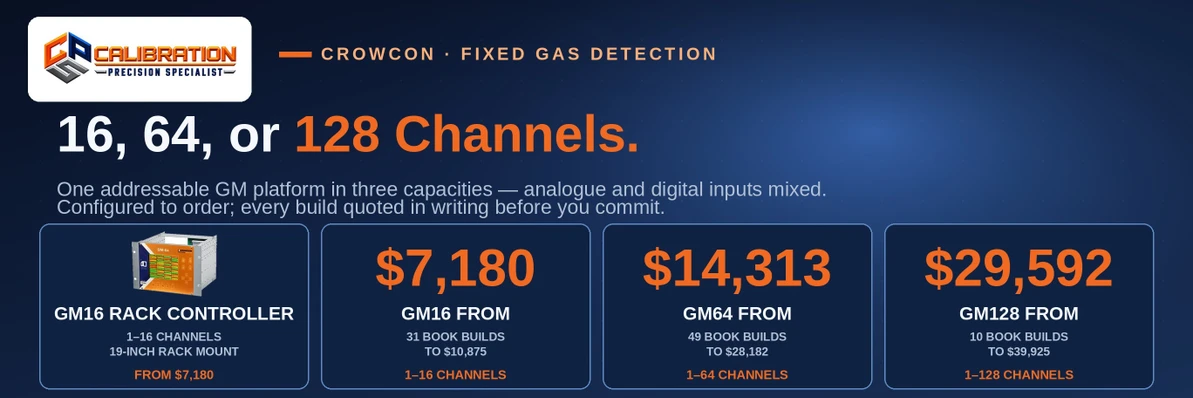
Crowcon GM Rack Controllers: GM16, GM64, and GM128 Compared by Channel Count
Crowcon's GM controllers are one addressable platform in three capacities: the GM16 takes 1–16 channel inputs (priced from $7,180), the GM64 takes 1–64 (from $14,313), and the GM128 takes 1–128 (from $29,592) — identical functionality, modular builds configured to order, with analogue 4-20mA/mV inputs and digital addressable detector loops mixable in the same controller. The model decision is therefore not about features; it is about channel count, wiring architecture, and how much growth to buy in advance.
Most fixed-system quotes fail in the same place: the controller is chosen by counting today's detectors, and the wiring is priced as if cable pulls itself. The GM family is Crowcon's answer to both problems — a rack platform where addressable detectors share communication loops instead of each demanding a home run, and where capacity comes in three honest steps. This guide covers what the platform does, when a rack controller beats a wall-mount panel, and how the three capacities divide real sites. CPS's wider controller coverage includes the Crowcon GMS post and our fixed system installation service; the three GM listings are the GM16, GM64, and GM128.
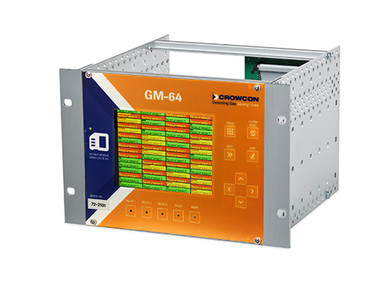
Crowcon GM16 Rack Gas Detection Controller
Modular addressable rack controller for 1–16 channels — analogue and digital inputs, configured to order.
$7,180
See the GM16What Makes the GM Platform Different from a Conventional Panel?
Three things. Addressable loops: multiple fixed detectors share a single communications loop, which drastically reduces cabling, labor, and installation time against traditional home-run wiring — every detector not home-run is conduit, cable, and terminations not bought. Mixed inputs: 4-20mA analogue, mV, and digital addressable channels can coexist in one controller, so an existing analogue installed base is not orphaned by a new addressable build — the migration can be phased room by room. Modularity: each controller is configured to the site — channel count, input types, relay outputs, mounting, power supply — including only what the application needs, and it can be upgraded with additional functionality after installation. Around that core sits the operating layer: channels grouped into zones, all active channels viewable on one screen (from 3-minute trends of a single channel to analysis of up to 16 at a time), and a direct-to-web-page live feed for remote viewing and configuration. Outputs cover the integration bases: 4-20mA, RS-485 Modbus RTU, relay contacts (5A, 30V), and an RJ45 network connection.
GM16, GM64, or GM128 — How Does the Channel Math Work?
Count channels, then count growth:
- GM16 — 1–16 channels, from $7,180. The FY27 book lists 31 configured builds for it, $7,180–$10,875. It is the single-process-area controller: a compressor building, a water-treatment chemical room cluster, a boiler plant — one zone of responsibility with up to sixteen points. 19-inch rack mount, with fibreglass NEMA 4X enclosure options (small 16.00 × 13.16 × 8.50 in. / large 24.11 × 27.06 × 9.51 in.) when there is no rack room.
- GM64 — 1–64 channels, from $14,313. 49 configured builds, $14,313–$28,182. The plant-scale step: multiple process areas under one controller, zoned, with the same enclosure options as the GM16. Most mid-size industrial sites that outgrow a wall panel land here.
- GM128 — 1–128 channels, from $29,592. 10 configured builds, $29,592–$39,925. The site-scale controller — refineries, large chemical plants, marine and offshore installations — where detector counts run to three figures and a single configuration/web view of the whole system is the requirement. Rack mounted; the enclosure options listed for its smaller siblings do not apply.
Every figure above is a *from* price for a configured-to-order instrument: the exact build — your channel count, input mix, relay complement, mounting, and power supply — is quoted in writing before you commit. Anyone quoting a GM off a single headline number without your I/O list is guessing with your money.
When Does a Rack Controller Beat a Wall-Mount Panel?
Use a rack controller when the channel count is past a dozen or headed there; when detectors spread across areas that zoning should mirror; when the site has (or is building) a rack room or control room where the system belongs; when addressable wiring can replace long home runs — the cabling saving is frequently the largest line in the comparison; and when remote viewing matters, because the GM's web feed puts live readings and configuration on any screen on the network. Typical power draw without detector heads is a modest 20–50 W, and the operating range (−20 to +50 °C, 0–90% humidity non-condensing) suits control-room and enclosure duty.
A wall-mount panel still wins when the system is small and stable — a handful of detectors in one room, no growth story, no control room. The GM platform's modularity means you pay for what the application needs, but engineering a 128-capable architecture for four detectors is not thrift. The honest dividing line is trajectory: buy the wall panel for the system you have; buy the rack for the system you are becoming. And whichever you install, plan its service from day one — fixed systems are calibrated on site at your facility, quoted in writing, and CPS's fixed system installation team designs, installs, and maintains systems of exactly this class.
Frequently Asked Questions
How much do the Crowcon GM controllers cost?
They are configured to order, priced from the lowest configured build in Crowcon's current book: GM16 from $7,180 (book builds run to $10,875), GM64 from $14,313 (to $28,182), GM128 from $29,592 (to $39,925). Your exact build — channel count, input types, relays, mounting, power — is quoted in writing by CPS before you commit. Call 865-900-8844 with your detector count and input types.
What is the difference between the GM16, GM64, and GM128?
Capacity only — the functionality is identical across the range. The GM16 accepts 1–16 channel inputs, the GM64 accepts 1–64, and the GM128 accepts 1–128. All three are modular, mix analogue and addressable inputs, group channels into zones, and offer the same outputs and web feed. Choose by channel count plus the growth you honestly expect.
What does 'addressable' mean on a gas detection controller?
Detectors on an addressable loop share one communications run and are individually identified on it, instead of each detector getting its own home-run cable back to the panel. That sharing drastically cuts cabling, labor, and installation time on multi-detector systems — and the GM range can mix addressable channels with conventional 4-20mA/mV analogue inputs in the same controller.
Can a GM controller take my existing analogue detectors?
Yes — analogue and addressable inputs can be mixed in one GM controller, with 4-20mA and mV input types selectable per build. That is the phased-migration path: keep sound analogue detectors working, add addressable points where expansion happens, and run both from one panel with one zone map.
How are GM controllers mounted?
They are 19-inch rack-mounted controllers. For the GM16 and GM64, fibreglass enclosure options are available (NEMA 4X — a small enclosure at 16.00 × 13.16 × 8.50 in., 7.7 kg, and a large at 24.11 × 27.06 × 9.51 in., 25 kg) for sites without a rack room. Front-panel navigation keeps configuration time in the field short.
What outputs does a GM controller provide?
4-20mA (2-wire current sink and 3-wire current source), RS-485 Modbus RTU for plant-system integration, relay outputs rated 5A at 30V, and an RJ45 network connection supporting the direct-to-web-page live feed. In practical terms: local alarming, PLC/SCADA integration, and browser-based remote viewing are all covered by the platform.
Can I view GM readings remotely?
Yes — the range provides a direct-to-web-page live feed: live data and configuration from a fixed screen or mobile device on the network. All active channels can be viewed on one screen, from 3-minute trends of a single channel to analysis of up to 16 channels at a time.
What industries use GM controllers?
The listed applications are oil & gas, petrochemical, chemical plants, water and wastewater, steel, power generation, and marine & offshore — the common thread is detector counts and distances that punish home-run wiring, plus a control room that wants one view of the whole system.
Can a GM controller be expanded later?
Yes. The design is fully modular — the controller includes only what the application needs at purchase, reducing complexity and cost, and additional functionality can be added after installation. Buy the capacity step that fits your trajectory; the configuration can grow inside it.
Who installs and services a GM system?
Fixed gas detection is installed and calibrated on site at your facility — CPS designs and installs fixed systems and calibrates what it sells, with on-site work quoted in writing (the published $55/$90 rates are in-house bench rates for portables and never on-site prices). Start with the fixed system installation page or call 865-900-8844 to scope the build.
The Bottom Line
One platform, three capacities: GM16 from $7,180 for up to 16 channels, GM64 from $14,313 for up to 64, GM128 from $29,592 for up to 128 — addressable loops that cut the cabling bill, mixed analogue inputs that protect the installed base, and a build configured and quoted exactly for your site. Choose the capacity your trajectory needs, not just the count you have today.
Scoping a fixed system? Call CPS Calibrations at 865-900-8844 with your detector count, input types, and relay needs — we will spec the GM build and quote it in writing.
--- CPS Calibrations · 109 S. Front Street, Rockwood, TN 37854 · Crowcon GM16 · Crowcon GM64 · Fixed System Installation
Need a calibration you can file?
In-house calibration at CPS in Rockwood, Tennessee — $55 for single-gas instruments, $90 for 4- and 5-gas — every channel, as-found and as-left data, full certificate.
See Calibration Servicesor call 865-900-8844
Recent Posts
-

What Is Remote Monitoring for Fixed Gas Detection?
Remote monitoring for fixed gas detection means a fixed system's live readings, trends, and alarm hi …Nov 23rd 2026 -

What Are the Key Differences Between the GX-6000 and GX-6100?
The RKI GX-6100 is the current replacement for the discontinued GX-6000: both are pumped 6-gas monit …Nov 22nd 2026 -

How to Read a PID Correction Factor Chart
To read a PID correction factor chart, find your vapor’s row, take the factor under your own lamp en …Nov 21st 2026