
Crowcon TXgard-IS+: The Intrinsically Safe Fixed Detector Built for Zone 0
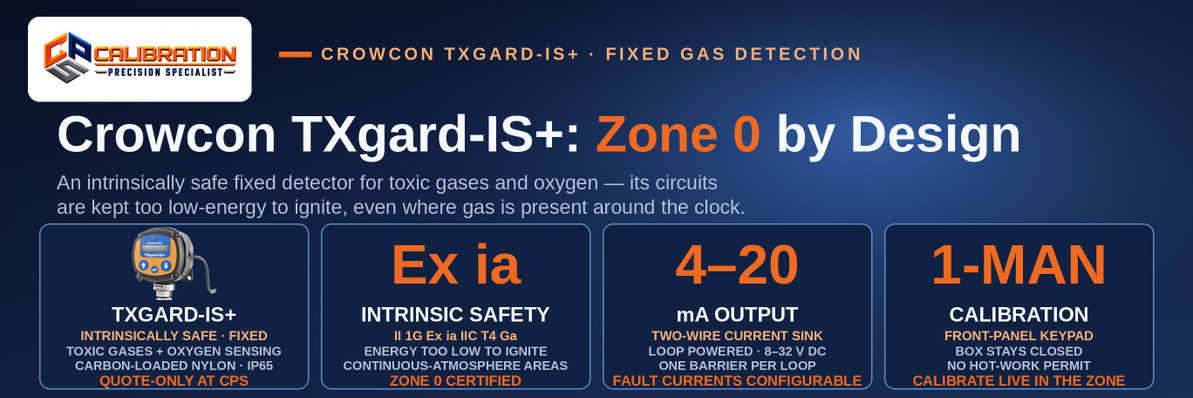
The Crowcon TXgard-IS+ is an intrinsically safe fixed gas detector for toxic gases and oxygen, certified II 1G Ex ia IIC T4 Ga for Zone 0 — the areas where a flammable atmosphere can be present continuously. It runs on a two-wire, loop-powered 4-20 mA sink signal through a single Zener barrier or galvanic isolator, covers 14 gases with electrochemical sensors, and calibrates from a front-panel keypad without opening its enclosure — so one person can calibrate it live in the zone, with no hot-work permit.
What the TXgard-IS+ Is
The TXgard-IS+ is a fixed, wall-mounted point detector: a carbon-loaded nylon junction box (160 × 123 × 92 mm, 0.7 kg) with a 2 × 16-character LCD and a three-button keypad on the front, and the gas sensor underneath in a reusable bayonet housing that screws into the box's M20 entry. It is IP65 sealed, so it shrugs off washdowns and weather, and it is built for the toxic-gas and oxygen points — a CO point near a boiler, an H₂S point at a sump, an oxygen point watching a nitrogen-blanketed vessel — that sit inside classified areas.
Inside, a Personality Module matched to the sensor (one version for toxics, one for oxygen) holds that sensor's calibration data. That detail matters later: when a sensor reaches end of life, the module stays, the new sensor twists in, and you rezero and recalibrate. Parts replacement on this platform is deliberately simple, because the places it works are places you don't want to spend extra time.
It has no relays and no local alarm sounder. The TXgard-IS+ is a measuring point: it reports gas concentration to a control panel as a 4-20 mA signal, and the panel — a Crowcon Vortex, Gasmaster, Gasmonitor or Gasflag, or any third-party panel that accepts a 4-20 mA sink input — does the alarming, logging, and shutdown work.
Why Intrinsic Safety? The Zone 0 Problem
Hazardous-area classifications are really a statement about how often gas is there. Zone 2 means a flammable atmosphere is unlikely and brief. Zone 1 means it can occur in normal operation. Zone 0 means it is present continuously, or for long periods — inside tanks and vessels, at open process points, in the headspace above liquids. A detector that lives in Zone 0 cannot rely on "the gas probably isn't here right now." It has to be incapable of igniting the atmosphere even when the atmosphere is definitely there, and even when something inside the detector fails.
There are two classic ways to make electrical equipment safe in those areas, and they work in opposite directions:
- Flameproof (Ex d) — the Xgard approach — builds a heavy enclosure strong enough to contain an internal explosion and cool the escaping gases so they can't ignite the atmosphere outside. The energy inside is unrestricted; the box does the protecting.
- Intrinsic safety (Ex i) removes the energy instead. The circuit is designed and certified so that the electrical energy available — in normal operation and under fault conditions — is below what could produce an ignition-capable spark or hot surface. The "ia" grade on the TXgard-IS+ is the highest of the three intrinsic-safety levels: protection maintained with up to two countable faults, which is what qualifies it for Zone 0 (the "Ga" equipment protection level in its code, next to IIC — the most demanding gas group, which includes hydrogen and acetylene).
That design choice cascades into everything else about the instrument. Because nothing inside can ignite anything, the enclosure doesn't need to be a cast-alloy pressure vessel — hence a 0.7 kg carbon-loaded nylon box instead of a multi-kilogram flameproof housing. Because the circuit is safe by energy rather than by containment, the front panel can carry a live display and keypad, and a technician can open menus, zero, and calibrate at the detector without isolating it or raising a hot-work permit. And because the energy limit has to be enforced end-to-end, the detector is only certified as a system — TXgard-IS+ plus a suitable Zener barrier or galvanic isolator in the safe area, which is what keeps fault energy on the field wiring below the limit too.
When is flameproof the right call instead? Where the gas load or the measurement needs more power than intrinsic safety allows — catalytic flammable sensors at percent-LEL across the full hydrocarbon range, infrared sensors, heated or pumped assemblies — or where the area is Zone 1 or 2 and a heavier, relay-equipped detector earns its keep. That's the territory of Crowcon's Xgard family, covered in our Crowcon Xgard spotlight. Intrinsic safety wins where the classification is Zone 0, the gases are toxics or oxygen, and live maintenance without permits is worth real money.
The Sensors: Toxics, Oxygen — and Hydrogen Without a Pellistor
Every TXgard-IS+ sensor is electrochemical, which is exactly what an energy-limited circuit can drive — and electrochemical is the right technology for ppm-level toxics anyway, because occupational exposure limits live in parts per million, not percent. One detector measures one gas; you order it configured for yours. Crowcon's ordering information lists these configured ranges:
| Gas | Configured ranges |
|---|---|
| Oxygen (O₂) | 0–25 %vol |
| Carbon monoxide (CO) | 0–250, 0–500 ppm |
| Hydrogen sulfide (H₂S) | 0–25, 0–50, 0–100, 0–200 ppm |
| Sulfur dioxide (SO₂) | 0–10, 0–20, 0–30 ppm |
| Nitrogen dioxide (NO₂) | 0–10 ppm |
| Chlorine (Cl₂) | 0–5, 0–10, 0–20 ppm |
| Chlorine dioxide (ClO₂) | 0–1 ppm |
| Ozone (O₃) | 0–1 ppm |
| Hydrogen cyanide (HCN) | 0–25 ppm |
| Ammonia (NH₃) | 0–50, 0–100, 0–1000 ppm |
| Hydrogen fluoride (HF) | 0–10 ppm |
| Phosgene (COCl₂) | 0–1 ppm |
| Hydrogen (H₂) | 0–2000 ppm, 0–50 %LEL, 0–100 %LEL |
Two things to notice. First, the breadth: this is one of the widest toxic menus on any fixed platform — the water-treatment pair (Cl₂, ClO₂, O₃), the semiconductor and chemical exotics (HF, phosgene, HCN), ammonia at three ranges for refrigeration and fertilizer work, all on the same junction box, the same loop, the same calibration routine.
Second, the hydrogen rows. Hydrogen is the gas that breaks the usual rules — infrared can't see it at all, and the default answer is a catalytic pellistor, which needs power an IS circuit would rather not spend and can be poisoned. The TXgard-IS+ reads hydrogen with an electrochemical sensor instead, in ppm for leak-level detection or directly in %LEL up to full scale. If your Zone 0 problem is a hydrogen problem, this is one of the very few intrinsically safe ways to watch it with a fixed point.
Response is quick for an electrochemical platform — T90 of roughly 20 seconds for most toxic sensors and about 10 seconds for oxygen — with repeatability of ±2% of full scale. Crowcon is equally plain in the manual about the family limitation: electrochemical sensors can be cross-sensitive to other gases, so if your process has interfering gases, that's a selection conversation, not a surprise to discover after install.
One Barrier, Two Wires: The 4-20 mA Loop
Most fixed detectors need three or four wires: power in, signal out, sometimes more. The TXgard-IS+ needs two. It is loop-powered — the same pair that carries its 4-20 mA signal carries the 8–32 V dc that runs it — and the output is a current sink, the format the Crowcon manual's wiring appendix sets up for its Vortex, Gasmonitor, Gasmaster, and Gasflag panels.
The elegant part is what Crowcon squeezed onto that pair: the LCD and keypad run on the loop too. As the manual puts it, most 4-20 mA detectors with a display and keypad need separate power — the TXgard-IS+ combines power and signal in two wires, so only one barrier or isolator is required per point. Across a plant with dozens of Zone 0 toxic points, one barrier channel per detector instead of two is a real panel-cost and panel-space saving.
Two commissioning details reward a mention. The 4-20 mA output is factory pre-calibrated — the manual is explicit that the mA does not need re-calibrating in the field, because the current-setting circuit is independent of the gas-measuring circuit. And the keypad menus include a "ramp mA" function that forces a known current onto the loop, so the panel end can be scaled and proved without gas on the sensor. Fault and inhibit currents are configurable too (Crowcon offers minimum, 3 mA, 24 mA, or normal-signal options), so the detector fails in the direction your panel logic expects.
Calibration Without a Hot-Work Permit
On a flameproof detector, opening the enclosure in a classified area means isolating power and, on most sites, a hot-work permit. The TXgard-IS+ was designed to make that someone else's problem. Zero and span are done from the three buttons on the front panel, through a password-protected menu, with the junction box closed — Crowcon calls it true one-person calibration, and its datasheet states plainly that calibration can be performed locally without the need for hot work permits.
The routine itself is standard electrochemical practice: fit the calibration adaptor, apply span gas at 0.5 litres per minute (1 litre per minute for the sticky gases — chlorine, nitrogen dioxide, ozone — that adsorb onto pipe walls), adjust the reading to the cylinder value, done. Oxygen units don't even need a manual zero; the menu calibrates them at 20.9% in clean air. During calibration the output sits at its configured inhibit current, so the panel doesn't trip the plant while you work.
Sensor life is the consumable reality behind the routine. Crowcon's manual sets expectations at 2–3 years for toxic sensors and 2 years for oxygen, under normal conditions with six-monthly calibration — and warns that a sensor stored unpowered for more than three months may not reach its full life, which is why spares for these detectors should be bought to a plan, not shelved "just in case." CPS calibrates fixed detectors as part of our calibration services — and on a detector designed so one person can do the whole job at the point, that service is fast.
The Honest Limits
- Electrochemical only. Beyond the hydrogen sensor, there is no general flammable-gas channel on this platform — no catalytic %LEL for hydrocarbons, no infrared. A Zone 0 point watching for methane needs a different answer.
- The barrier is not optional. The Zone 0 certification exists only with a suitable Zener barrier or galvanic isolator in the loop. Budget for it, and for the panel channel behind it.
- The sensor is where the box is. There is no remote sensor head option — the sensor mounts on the junction box, pointing down so dust and water don't collect on it. Placement follows the gas (high for lighter-than-air, low for heavier, breathing height for H₂S), and Crowcon offers a duct-mounting plate and a flow adaptor for sampled points — but you cannot put the electronics here and the sensor 10 metres away.
- The display has a cold limit. The detector is certified intrinsically safe from −40 °C to +65 °C and keeps measuring across that span, but the LCD blanks at about −20 °C. In a cold store or a northern winter, read the panel, not the detector face.
- Alarms happen elsewhere. No relays, no sounder, no beacon on the detector itself. If the point needs local alarm action, it comes from the control panel or a separate device.
End of Production — and Why This Detector Still Matters
Honesty about status, because it changes what you should buy: after 25 years in production, Crowcon issued Technical Note GEN127 in October 2025 discontinuing the TXgard-IS+. New units stopped being available to purchase on 31 December 2025 — component obsolescence, including the detector's microcontroller, forced the decision. Crowcon committed to supporting the installed base for the following three years, and the support chain is real: Crowcon's current price book still lists the TXgard-IS+ sensor assemblies, Personality Modules, baseboards, and keypads, which is why CPS quotes TXgard-IS+ spares, sensors, and service rather than putting a cart price on a detector that is no longer built.
For the very large installed base, that support window is the story: these detectors have years of certified life left in them, and keeping them calibrated and re-sensored is cheaper than re-engineering the point. When a point does need replacing, Crowcon names the Xgard Type 1 as the direct successor — same intrinsic-safety concept, same Ex ia IIC T4 Ga Zone 0 rating, same two-wire sink output — so a TXgard-IS+ loop, barrier included, carries over. And where a replacement point is Zone 1 and wants flameproof construction, relays, or a wider flammable menu, that's the Xgard conversation. Talk to CPS about which side of that line your points fall on — and for new fixed installations generally, our turnkey fixed system installation service covers siting, wiring, barriers, panels, and commissioning as one job.
Specifications
| Size | 160 × 123 × 92 mm |
| Weight | 0.7 kg (1.5 lb) |
| Enclosure | Carbon-loaded nylon junction box; ABS plastic sensor housing |
| Ingress protection | IP65 |
| Power | 8–32 V dc, loop-powered (2-wire) |
| Output | 4–20 mA current sink; configurable fault and inhibit currents |
| Display | 2 × 16-character LCD; 3-button front-panel keypad |
| Operating temperature | −20 °C to +55 °C (IS certification spans −40 °C to +65 °C; LCD blanks below ≈ −20 °C) |
| Humidity | 15–90% RH, non-condensing |
| Response time (T90) | ≈ 20 s for most toxic sensors; ≈ 10 s for oxygen |
| Repeatability | ±2% FSD; zero drift ±2% FSD over 6 months (typical) |
| Cable entry | 1 × M20 (½ in NPT with adaptor); terminals for cable up to 2.5 mm² |
| Approvals | II 1G Ex ia IIC T4 Ga (−40 °C to +65 °C); UL/cUL Class I, Division 1, Groups A, B, C and D |
| Performance / EMC | Tested to EN 60079-29-1; EN 50270 |
| Sensor life (typical) | Toxics 2–3 years; oxygen 2 years (with 6-monthly calibration) |
Frequently Asked Questions
What is the Crowcon TXgard-IS+? The TXgard-IS+ is an intrinsically safe fixed gas detector for toxic gases and oxygen. It mounts at the point of risk inside a classified area, measures one gas with an electrochemical sensor, and reports the concentration to a control panel as a 4-20 mA signal. It is certified for Zone 0, 1, and 2 and for Class I, Division 1 or 2 locations, provided it is wired through a suitable Zener barrier or galvanic isolator.
What does "intrinsically safe" mean on the TXgard-IS+? It means the detector's circuits are energy-limited by design: even under fault conditions, they cannot release enough electrical or thermal energy to ignite the surrounding atmosphere. The TXgard-IS+ carries the highest intrinsic-safety grade, "ia" — protection maintained with up to two faults — under the code II 1G Ex ia IIC T4 Ga, certified to the intrinsic-safety standard EN 60079-11. Unlike flameproof equipment, it doesn't contain an explosion; it makes ignition impossible.
Can the TXgard-IS+ be installed in Zone 0? Yes — Zone 0 is exactly what it was built for. Its II 1G / Ga rating covers areas where a flammable atmosphere is present continuously or for long periods, and its UL/cUL listing covers Class I, Division 1, Groups A–D. The condition is the system around it: the loop must run through a suitable Zener barrier or galvanic isolator, installed per the recognised standards for the site.
What gases does the TXgard-IS+ detect? Fourteen, one per detector, all electrochemical: oxygen (0–25 %vol), carbon monoxide, hydrogen sulfide, sulfur dioxide, nitrogen dioxide, chlorine, chlorine dioxide, ozone, hydrogen cyanide, ammonia (three ranges up to 0–1000 ppm), hydrogen fluoride, and phosgene — plus hydrogen, in ppm or directly in %LEL up to 100 %LEL, which is unusual: electrochemical hydrogen sensing avoids the catalytic bead that most %LEL hydrogen measurements rely on.
Does the TXgard-IS+ need a Zener barrier or galvanic isolator? Yes. Intrinsic safety is a system property, not just a detector property — the barrier or isolator in the safe area limits the energy that can reach the field wiring under a fault, and the Zone 0 certification only applies with one fitted. The good news is the count: because the TXgard-IS+ powers its display and keypad from the same two wires as its signal, each detector needs only one barrier channel.
How do you calibrate a TXgard-IS+ — and does it need a hot-work permit? No hot-work permit: calibration is non-intrusive. One person works from the three-button front-panel keypad, through a password-protected menu, with the junction box closed — zero in clean air, then span with calibration gas applied at 0.5 L/min through the calibration adaptor while the output holds at its inhibit current. Nothing is opened, nothing is isolated, and Crowcon designed it as true one-person calibration.
What signal does the TXgard-IS+ send to a control panel? A two-wire, loop-powered 4-20 mA current sink signal on an 8–32 V dc loop — one pair of wires carries both power and signal. Fault and inhibit currents are configurable (minimum, 3 mA, 24 mA, or normal signal), the output is factory pre-calibrated so the mA never needs field re-calibration, and a "ramp mA" menu function can force a known current for panel setup. Crowcon's manual documents wiring to its Vortex, Gasmonitor, Gasmaster, and Gasflag panels; any panel that accepts a 4-20 mA sink input can read it.
How long do TXgard-IS+ sensors last? Crowcon's manual gives 2–3 years for toxic sensors and 2 years for oxygen sensors, under normal conditions with calibration every six months. The sensor lives in a reusable bayonet housing and twists out for replacement; the Personality Module that stores its calibration data stays with the detector. One caution from the same manual: an unpowered sensor stored longer than three months may not achieve its full life, so buy spares against a replacement plan.
How much does a Crowcon TXgard-IS+ cost? There is no published CPS list price for the complete detector, and this post won't invent one: Crowcon's current price book prices the TXgard-IS+ spares and sensor assemblies, not complete units, so CPS quotes TXgard-IS+ business — spares, sensors, service, and replacement systems — per requirement. Call 865-900-8844 with the gas, range, and area classification for the point, and you'll get a written quote.
Is the TXgard-IS+ discontinued — and what replaces it? Yes. Crowcon's Technical Note GEN127 (October 2025) ended TXgard-IS+ production after 25 years; new units were no longer available to purchase after 31 December 2025, because key components including its microcontroller became obsolete. Crowcon committed to supporting the installed base for three years, and the spares chain is still priced in the current book. Crowcon names the Xgard Type 1 — also intrinsically safe, Ex ia IIC T4 Ga, Zone 0, two-wire sink — as the direct replacement, designed to carry over the existing loop and barrier.
The Bottom Line
The TXgard-IS+ earned its 25-year run by solving the hardest placement problem in gas detection — a toxic or oxygen point inside Zone 0 — the elegant way: limit the energy, keep the box light, run the whole instrument down two wires through one barrier, and let one technician calibrate it in place without a permit. Production has ended, but the installed base has a committed support window, a live spares chain, and a named like-for-like successor in the Xgard Type 1. Whether you're keeping TXgard-IS+ points calibrated and re-sensored, planning their replacement, or designing new Zone 0 coverage, CPS can help: call 865-900-8844 or visit us at 109 S. Front Street, Rockwood, TN 37854 — and for the calibration side of fixed systems, start with our calibration services.
Need a calibration you can file?
In-house calibration at CPS in Rockwood, Tennessee — $55 for single-gas instruments, $90 for 4- and 5-gas — every channel, as-found and as-left data, full certificate.
See Calibration Servicesor call 865-900-8844
Recent Posts
-

Can You Add a Pump to a SENKO SGT-P or MGT?
Yes — SENKO's SP-Pump101 external sampling pump ($330, part AAA006000) fits the SGT, SGT-P, and MGT, …Nov 12th 2026 -

What Refrigerant Detection Does a Grocery Store Need?
A grocery store needs refrigerant detection in three places: low-mounted carbon dioxide (R-744) sens …Nov 11th 2026 -

What Is LEL and UEL? The Explosive Range, Gas by Gas
The LEL is the lowest concentration of a gas in air that can explode, and the UEL is the highest: me …Nov 10th 2026