
Crowcon Xgard Bright: The Fixed Detector With Display, Relays, and HART Built In
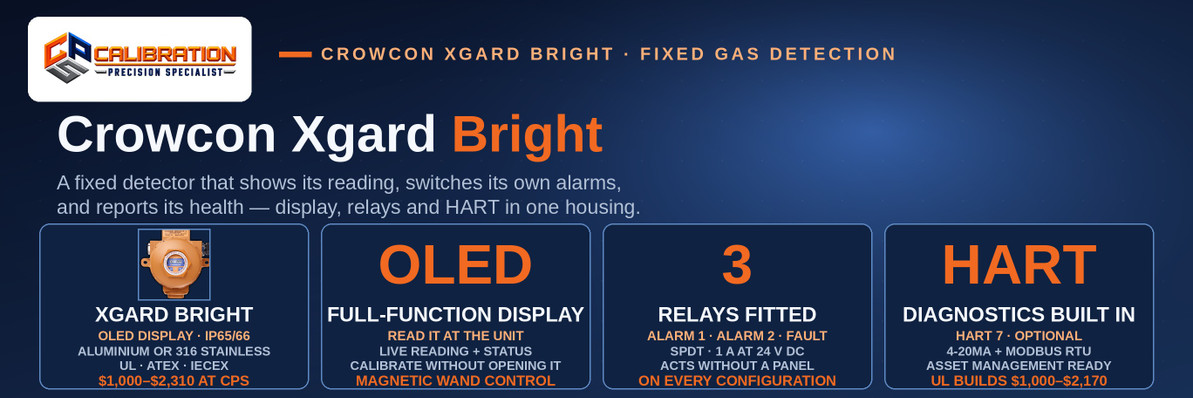
The Crowcon Xgard Bright is a flameproof fixed gas detector that adds the three things a standard fixed transmitter leaves out: a large OLED display that shows the live gas reading and status at the unit, three built-in relays (Alarm 1, Alarm 2, and Fault, SPDT contacts rated 1 A at 24 V DC) that can act on an alarm without a control panel, and an optional HART 7 interface on top of its standard 4-20mA and RS-485 Modbus RTU outputs. It detects flammable gases, toxic gases, and oxygen in an aluminium or 316 stainless steel housing rated IP65/66, with UL, ATEX, and IECEx versions. CPS has scoped 151 configurations in Crowcon's current price book at $1,000–$2,310; the 22 UL-certified builds run $1,000–$2,170.
A conventional fixed detector is a blind box. It measures gas faithfully and sends a 4-20mA signal down a cable, but standing in front of it you learn nothing — no reading, no alarm state, no fault information — unless you open a flameproof enclosure in a classified area or walk back to the panel. The Xgard Bright exists for the plants where that walk, and that wait, are the problem. This post covers what the display, the relays, and HART actually change in day-to-day operation, what the CPS configurations cost, and where a plain transmitter is still the smarter buy.
What the Xgard Bright Is
The Xgard Bright is Crowcon's display-and-relay member of the Xgard fixed detector family. The hardware facts, from Crowcon's published specifications:
- Housing: ADC 12 aluminium alloy or 316 stainless steel, flameproof (Ex db) construction, sealed to IP65/66. The UL aluminium version weighs 1.5 kg (3.31 lb); stainless runs to 3.5 kg (7.72 lb).
- Power and wiring: 12–30 V DC, 3 W maximum, through two cable entries (M20 or ½″ NPT).
- Outputs, standard: 3-wire 4-20mA (sink or source) and RS-485 Modbus RTU. A sounder output (high-side switch, 24 V nominal) can drive a local beacon or horn.
- Outputs, optional: HART 7 communications over the analogue signal.
- Relays, standard: Alarm 1, Alarm 2, and Fault — SPDT contacts rated 1 A at 24 V DC.
- Operating range: −40 °C to +70 °C on ATEX/IECEx versions; −40 °C to +60 °C on UL versions. Humidity 0–95% RH non-condensing. Repeatability ±2% of full scale.
- Approvals: UL 1203 (Class I Division 1, Groups B, C, D; Class II Division 1, Groups E, F, G), ATEX II 2 G Ex db IIC T6 Gb with dust approval Ex tb IIIC, and IECEx — certified for Zone 1 and Zone 2, or Zone 21 and Zone 22 areas.
- Warranty: 2 years on the transmitter; the MPS flammable and long-life O₂ sensors carry 5-year warranties, IR flammable sensors 2 years.
The Display: Why "Bright" Is the Point
The large OLED display is not decoration — it changes three routine jobs:
Rounds get faster. An operator walking a unit can read the actual gas concentration and the detector's status at the point of detection, instead of radioing the control room to ask what channel 14 is reading. A detector drifting high, sitting in fault, or showing a calibration-due state announces itself where it stands.
Commissioning gets simpler. During installation you can watch the reading respond as you work — confirming the sensor sees test gas, checking the 4-20mA loop against the displayed value — without a second person at the panel.
Calibration stops being an enclosure-opening exercise. The Bright is operated by a magnetic wand through the window, so calibration and setup are non-intrusive: the flameproof housing stays closed, which keeps people out of the hot-work-permit loop for routine calibrations and reduces the time anyone spends working in the hazardous area. For a detector mounted in a Zone 1 area, that is a real operational saving every single calibration cycle.
Relays That Act Without a Panel
Every Xgard Bright configuration CPS scoped has relays fitted — Alarm 1, Alarm 2, and Fault, SPDT contacts rated 1 A at 24 V DC. That matters because a blind transmitter can only report; something else has to decide and act. The Bright can do the acting itself at the point of detection:
- Alarm 1 can start local notification — a beacon or horn driven directly or through the sounder output.
- Alarm 2 can escalate: start exhaust ventilation, shut a process valve through an interposing relay, or signal a shutdown input.
- Fault can tell maintenance the detector itself needs attention, instead of a failed sensor sitting silent until the next proof test.
For a single-point application — one compressor, one battery room, one loading bay — a Bright with its own relays and a beacon can be the complete detection-and-response system, with no separate controller to buy, mount, and wire. The relay rating is the honest limit: 1 A at 24 V DC is a signal-level contact, made for beacons, panel inputs, and interposing relays — not for switching motor starters or large fan loads directly.
HART and Modbus: Diagnostics, Not Just a Number
A 4-20mA loop tells a control system one thing: the gas reading (and, by convention, a fault if the current drops out). HART 7 — the Bright's factory communications option — overlays digital data on that same loop, so a HART asset-management system or handheld communicator can pull the detector's identity, configuration, and diagnostic state without a site visit to the unit. On a site with dozens of detectors, that is the difference between a planned maintenance list and a clipboard walkdown.
If you don't run HART, the standard RS-485 Modbus RTU output does the multi-drop version of the same job: the Bright is an addressable detector, so multiple units can share a Modbus trunk to a panel or PLC instead of every detector home-running its own analogue loop — which is how the Bright holds installation cabling down on larger systems. In the CPS configuration codes, the choice is explicit: HART and non-HART builds are separate configurations, so it is a decision to make at order time, not a licence to add later.
Sensors: One Housing, Most of the Gas List
The Bright takes Crowcon's plug-in sensor modules across four technologies:
- Electrochemical — toxic gases and oxygen: carbon monoxide (ranges up to 0–2,000 ppm), hydrogen sulfide (25–200 ppm), ammonia, chlorine, hydrogen cyanide, sulfur dioxide, ozone, and oxygen 0–25% vol, including Crowcon's lead-free long-life O₂ sensor with its 5-year warranty.
- Catalytic (pellistor) — flammable gases 0–100% LEL: methane, propane, LPG, pentane, hydrogen.
- Infrared — flammable gases 0–100% LEL where a catalyst would struggle, plus carbon dioxide 0–5% vol.
- MPS™ and PID — an MPS flammable sensor (TrueLEL™ multi-gas accuracy, poison-immune, no calibration needed across its life) and a PID option for VOCs 0–1,000 ppm.
One caution that belongs in any honest write-up: Xgard Bright sensor modules are not interchangeable with classic Xgard sensor modules. The Bright is its own platform — spares and replacement sensors have to be Bright modules.
What It Costs at CPS
CPS scoped 151 complete Xgard Bright configurations in Crowcon's FY27 book, priced $1,000–$2,310. The choice axes are the ones you'd expect: housing (aluminium costs less than 316 stainless), certification (ATEX or UL), communications (HART or non-HART), and the gas/sensor — with relays fitted on every one of them.
The US-relevant subset is the 22 UL-certified builds, $1,000–$2,170:
- Aluminium UL builds start at $1,000, with non-HART aluminium builds from $1,191 and HART-equipped aluminium builds from $1,331.
- The infrared-sensor UL builds sit at $1,779–$1,919.
- The stainless-steel UL build tops the subset at $2,170.
The full 151-row range, including the ATEX configurations, tops out at $2,310. These are CPS list prices from the FY27 book scoping — when the store product goes live, the listing is the number to trust, and CPS quotes fixed installations in writing before any work starts.
Bright or Classic Xgard?
The classic Xgard is a blind transmitter: no display, and in most configurations the alarm decision lives in a separate gas detection controller. That design is not obsolete — it is often the right one:
- Choose the classic Xgard + controller when detectors report to a central panel anyway, when one controller is supervising many points with common alarm logic, or when the budget has to cover the maximum number of detection points and local readouts add nothing.
- Choose the Xgard Bright when a point must protect on its own (relays acting locally), when operators do rounds and need readings at the unit, when calibration access is difficult or permit-heavy, or when HART/Modbus diagnostics feed how your site actually runs maintenance.
CPS's fixed system installation work starts from that design question — where the points go and what each one has to do — before anyone talks about models.
Calibration and Service from CPS
A display and a magnetic wand make the Bright easier to calibrate; they don't remove the need. Electrochemical and catalytic sensors still drift and still need scheduled calibration with the correct gas — only the MPS sensor option is calibration-free across its life. CPS calibrates fixed detectors in-house and on site, and every channel we put our name on gets verified, not just zeroed. See our calibration services for how ship-in and on-site work runs, or call 865-900-8844. CPS Calibrations, 109 S. Front Street, Rockwood, TN 37854.
Frequently Asked Questions
What is the Crowcon Xgard Bright?
The Xgard Bright is Crowcon's fixed gas detector with a built-in OLED display, three relays, and optional HART communications, in a flameproof aluminium or stainless steel housing. It detects flammable gases, toxic gases, and oxygen, and outputs 4-20mA and RS-485 Modbus RTU as standard. CPS scoped 151 configurations at $1,000–$2,310 in Crowcon's FY27 book.
Does the Xgard Bright have a display?
Yes. A large OLED display on the front of the unit shows the live gas reading and detector status locally, so operators can check a detector during rounds without opening the housing or calling the control room. Setup and calibration are done through the display with a magnetic wand — the enclosure stays closed.
Does the Xgard Bright have relays?
Yes — three relays are fitted as standard on every configuration CPS scoped: Alarm 1, Alarm 2, and Fault, with SPDT contacts rated 1 A at 24 V DC. They can drive beacons and horns, start ventilation through an interposing relay, or signal a panel or PLC, so a single Bright can protect a point without a separate controller.
Does the Xgard Bright support HART?
Yes, as a factory communications option: HART 7 is available on HART-coded configurations, overlaid on the standard 3-wire 4-20mA output. Every Bright also provides RS-485 Modbus RTU as standard. In the CPS configurations, HART and non-HART builds are separate order codes, so the choice is made when you order.
What gases can the Xgard Bright detect?
Flammable gases 0–100% LEL (methane, propane, LPG, pentane, hydrogen and more) by catalytic, infrared, or MPS sensor; toxic gases and oxygen by electrochemical sensor — CO up to 2,000 ppm, H₂S 25–200 ppm, ammonia, chlorine, HCN, SO₂, ozone, and O₂ 0–25% vol including a long-life lead-free oxygen sensor; carbon dioxide 0–5% vol by infrared; and VOCs 0–1,000 ppm by PID.
Is the Xgard Bright UL certified?
Yes. UL versions are certified to UL 1203 — Class I Division 1, Groups B, C, D and Class II Division 1, Groups E, F, G — for an operating range of −40 °C to +60 °C. ATEX and IECEx versions (Ex db IIC T6) cover Zone 1/2 and Zone 21/22 areas. CPS scoped 22 UL configurations at $1,000–$2,170.
How much does a Crowcon Xgard Bright cost?
Across all 151 configurations in Crowcon's FY27 book, $1,000–$2,310 at CPS list. The 22 UL-certified builds run $1,000–$2,170: aluminium builds start at $1,000, infrared-sensor builds are $1,779–$1,919, and the stainless-steel UL build is $2,170. Price depends on housing, certification, HART, and the gas sensor fitted.
Can you calibrate an Xgard Bright without opening it?
Yes. The Bright is configured and calibrated non-intrusively with a magnetic wand working through the display window, so the flameproof housing is never opened in the field. That removes the hot-work permit step from routine calibration and shortens the time technicians spend in the hazardous area. The MPS sensor option goes further — it needs no calibration across its life.
What is the difference between the Xgard Bright and the standard Xgard?
The standard Xgard is a blind transmitter: it sends 4-20mA to a controller and shows nothing locally. The Xgard Bright adds the OLED display, three fitted relays, a sounder output, and optional HART, so it can display, decide, and act at the point of detection. Their sensor modules are not interchangeable — Bright modules only fit the Bright.
Does the Xgard Bright need a controller?
Not for standalone protection: with its own Alarm 1, Alarm 2, and Fault relays plus a sounder output, one Bright can run local beacons, horns, and ventilation interlocks by itself. A controller or PLC is still the right call when many points need common alarm logic, central logging, or voting — and the Bright's 4-20mA, Modbus, and optional HART outputs connect to one whenever you're ready.
The Bottom Line
The Xgard Bright is what a fixed detector becomes when you stop treating the wall unit as a dumb sensor: it shows its reading on a large OLED display, carries Alarm 1, Alarm 2, and Fault relays that can act without a panel, calibrates through its window with a magnetic wand, and — with the HART option — reports diagnostics your maintenance system can actually use. At CPS list prices of $1,000–$2,310 across 151 configurations (UL builds $1,000–$2,170), you are paying a premium over a blind transmitter, and on a point that only ever reports to a controller, that premium buys nothing. On a point that has to stand on its own, be read on rounds, or be calibrated in a classified area, it buys exactly the right things. Talk to CPS about which points those are: 865-900-8844, 109 S. Front Street, Rockwood, TN 37854.
Need a calibration you can file?
In-house calibration at CPS in Rockwood, Tennessee — $55 for single-gas instruments, $90 for 4- and 5-gas — every channel, as-found and as-left data, full certificate.
See Calibration Servicesor call 865-900-8844
Recent Posts
-

What Is Remote Monitoring for Fixed Gas Detection?
Remote monitoring for fixed gas detection means a fixed system's live readings, trends, and alarm hi …Nov 23rd 2026 -

What Are the Key Differences Between the GX-6000 and GX-6100?
The RKI GX-6100 is the current replacement for the discontinued GX-6000: both are pumped 6-gas monit …Nov 22nd 2026 -

How to Read a PID Correction Factor Chart
To read a PID correction factor chart, find your vapor’s row, take the factor under your own lamp en …Nov 21st 2026