
Crowcon XSafe and XSafe Bright: Safe-Area Gas Detection for Plant Rooms and Labs
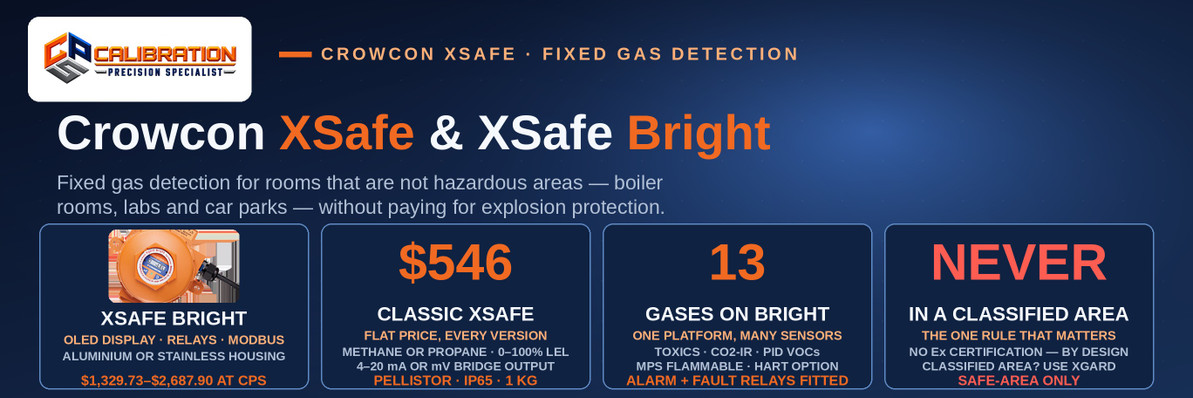
The Crowcon XSafe and XSafe Bright are fixed gas detectors built for safe areas — spaces that are not classified as hazardous locations — so they skip explosion-protection certification and the cost that comes with it. The classic XSafe is a pellistor flammable-gas detector for methane or propane (0–100% LEL) with a 4–20 mA or mV bridge output, and CPS sells all 12 configurations at one flat price: $546. The XSafe Bright adds an OLED display, alarm and fault relays, Modbus, and a sensor menu covering toxics, CO₂ and VOCs, at $1,329.73–$2,687.90. The trade is absolute: neither detector is certified for a classified (hazardous) area, and neither may ever be installed in one.
Fixed gas detection pricing is driven less by the sensor than by the certification wrapped around it. A flameproof, ATEX- or UL-certified detector has to prove it can contain an explosion inside its own housing — heavier castings, certified cable glands, third-party testing. That proof is essential where the area classification demands it. In a boiler room, a laboratory, or an underground car park that is not classified, it buys nothing. The XSafe line is Crowcon's answer for those rooms: the same detector engineering, without the certified electronics. Here is what each model does, what CPS's configurations cost, where safe-area detection is the right spend, and the one limitation that decides everything.
Why Safe-Area Detectors Cost Less
Crowcon describes the classic XSafe as having "a tough alloy housing and the same standard of design and reliability as Crowcon hazardous area detectors but without the extra cost of certified electronics." That sentence is the whole proposition. The sensing, the housing, and the build quality are detector-grade; what you are not paying for is the explosion-protection certification — the Ex d flameproof enclosure, the intrinsic-safety barriers, the approval testing — because a non-classified area does not require any of it.
That is also why the classification question has to be answered before the product question. If your facility has classified the space — Class I Division 1 or 2, ATEX Zone 1 or Zone 2 — the XSafe line is disqualified no matter how well its specs fit. If the space is unclassified, a certified detector still works, but you are paying a premium for protection the location never calls for.
The Classic XSafe: One Job, One Price
The classic XSafe does one thing: it watches for flammable gas in a safe area and reports the reading to a control panel. Its specification, from Crowcon's official datasheet:
- Gas and range: methane or propane, 0–100% LEL, measured by a catalytic pellistor sensor with a typical T90 response under 15 seconds
- Outputs: two versions — a 3-wire 4–20 mA output (current sink or source), or a 3-wire mV bridge output (typical signal 12–15 mV per %LEL of methane) for panels with mV sensor inputs
- Housing: aluminium junction box, 156 × 166 × 111 mm, 1 kg, sealed to IP65 (IP66 with the weatherproof cap)
- Cable entry: one M20 or 1/2" NPT entry
- Power: 10–30 V dc on the mA version (50 mA at 24 V dc, 1.2 W); 2.0 V dc on the mV version
- Operating range: −40 °C to +55 °C (mA version) or +80 °C (mV version), 0–99% RH non-condensing
- Approvals: none for hazardous areas — Crowcon's datasheet states it plainly: "Not certified for use in a hazardous environment." EMC compliance is EN 50270.
There is no display and there are no alarm relays on the classic XSafe. It is a sensor and transmitter: the reading, the alarming, and the response all happen at the control panel it is wired to. Repeatability is better than 2% of full scale, with zero drift under 2% of full scale per month — which is why pellistor detectors still need routine calibration even though nothing about them feels "electronic."
CPS sells the classic XSafe in 12 configurations — methane or propane × mA or mV output × M20 or 1/2" NPT entry — and every one is $546. There is no price ladder to climb: pick the gas, the output your panel accepts, and the thread your conduit uses.
XSafe Bright: The Same Idea, Fully Featured
The XSafe Bright takes the safe-area concept and puts it on Crowcon's Bright platform — the same enclosure, OLED display, and electronics family as the certified Xgard Bright, in a non-certified safe-area build. What that adds:
- OLED display — a bright local readout of gas level and units, readable in a dark plant room, with full menus for setup and diagnosis
- Non-intrusive operation — zero, calibration, and setup are done through the display with a magnetic wand, without opening the housing
- Outputs — analogue 4–20 mA and RS-485 Modbus RTU as standard, with HART available on the HART builds; the 3-wire addressable design lets multiple detectors share a Modbus loop instead of home-running every cable
- Relays — Alarm 1, Alarm 2, and Fault relays (SPST contacts rated 1 A at 30 V dc) plus a sounder output, so a Bright can drive local beacons, shut down equipment, or start ventilation on its own — no separate controller required for a simple system
- Housing — aluminium alloy (stainless steel on the S-series builds), 156 × 166 × 109 mm, IP65/IP66 with the weatherproof cap, M20 or 1/2" NPT entries
- Power and environment — 10–30 V dc, 3 W maximum; −40 °C to +70 °C operating (sensor-dependent), 0–95% RH non-condensing
The bigger difference is the sensor menu. Where the classic XSafe is flammable-only, CPS's XSafe Bright configurations cover:
- Toxic gases (electrochemical): hydrogen sulfide 0–10 ppm, chlorine 0–5 and 0–10 ppm, chlorine dioxide 0–1 ppm, ammonia 0–50 and 0–100 ppm, nitric oxide 0–50 ppm, nitrogen dioxide 0–5 ppm, sulfur dioxide 0–10 ppm, hydrogen cyanide 0–25 ppm, hydrogen peroxide 0–5 ppm, and ozone 0–1 ppm
- Carbon dioxide (infrared): 0–5% volume — the build Crowcon's own brewery case studies use for cellar and fermentation-area CO₂ monitoring
- VOCs (PID): 0–1,000 ppm photoionization detection for solvent vapors
- Flammables (MPS): 0–100% LEL on Crowcon's molecular property spectrometer sensor, which reads multiple flammable gases — including hydrogen — accurately from one factory calibration
CPS sells the XSafe Bright in 47 configurations at $1,329.73–$2,687.90. The spread is sensor and build: an aluminium toxic-gas unit with relays starts the range, HART and stainless steel add cost, and the PID builds sit at the top ($2,608.99 in aluminium with HART; $2,687.90 in stainless).
XSafe vs. XSafe Bright, Side by Side
| Classic XSafe | XSafe Bright | |
|---|---|---|
| Purpose | Flammable gas in safe areas | Flammable, toxic, CO₂, VOC and oxygen-hazard monitoring in safe areas |
| Gases | Methane or propane | 13 sensor options: H₂S, Cl₂, ClO₂, NH₃, NO, NO₂, SO₂, HCN, H₂O₂, O₃, CO₂-IR, PID VOCs, MPS flammable |
| Range | 0–100% LEL | Gas-dependent (e.g. CO₂ 0–5% vol, PID 0–1,000 ppm) |
| Display | None | OLED, with magnetic-wand setup |
| Outputs | 4–20 mA or mV bridge | 4–20 mA + RS-485 Modbus; HART optional |
| Relays | None — reports to a panel | Alarm 1, Alarm 2, Fault + sounder output |
| Housing | Aluminium, IP65 | Aluminium or stainless steel, IP65/IP66 |
| Power | 10–30 V dc (mA) / 2.0 V dc (mV) | 10–30 V dc, 3 W max |
| CPS configurations | 12 | 47 |
| CPS price | $546 — every configuration | $1,329.73–$2,687.90 |
| Hazardous-area certification | None — safe area only | None — safe area only |
Where Safe-Area Detection Is the Right Spend
The pattern in every good XSafe application is the same: a real gas hazard in a room nobody has classified — where the risk is a leak hurting people or building up unnoticed, not an explosive atmosphere that needs certified equipment.
- Boiler and plant rooms. A methane leak at a boiler, furnace, or gas train is the classic XSafe job: a classic XSafe at $546 wired to the panel, alarming long before the room approaches a dangerous concentration. Propane versions cover LPG-fired plants.
- Laboratories. Labs hold toxic and asphyxiant hazards — H₂S from drains and processes, CO₂ from cylinders and dry ice, solvent vapors — in rooms full of people. The XSafe Bright's toxic and CO₂-IR builds, with local display and relays, fit here; Crowcon aimed the Bright platform at laboratory oxygen-depletion and toxic monitoring from its launch.
- Car parks. Underground and enclosed parking structures need CO and NO₂ monitoring to run ventilation on demand instead of flat-out. Those are unclassified commercial spaces, and the Bright's NO and NO₂ builds with Modbus tie straight into building systems.
- Breweries and food production. CO₂ is the silent hazard of fermentation cellars and bright-beer areas. Crowcon's own published case study put an Xsafe Bright IR CO₂ — addressable output into a central controller — into a global brewer's UK plant for exactly this.
- Commercial and institutional spaces. Mechanical rooms, kitchens with propane or natural gas, wastewater plant offices and unclassified process rooms, battery rooms watching hydrogen on the MPS build — anywhere gas is present but the area classification is not.
The Honest Limits — Read This Before You Specify One
Neither XSafe model may ever be installed in a classified (hazardous) location. This is not fine print; it is the product definition. The classic XSafe's datasheet says "Not certified for use in a hazardous environment," and the XSafe Bright's safe-area design (the "03" block in its part number) carries no ATEX, IECEx, or UL explosion-protection certification either. If the space is Class/Division or Zone classified — or if it could be reclassified later — installing an XSafe there is a code violation and a genuine ignition risk, because nothing in the unit is designed to contain or prevent an ignition. Classified area? The detector you need is the certified line — start with our Crowcon Xgard spotlight, and talk to us about the installation through our fixed system installation service.
Three more honest limits:
- The classic XSafe cannot alarm on its own. No display, no relays, no sounder — it only sends a signal. Budget for the control panel (or choose the Bright, which carries its own relays).
- Safe-area does not mean maintenance-free. The classic's pellistor and the Bright's electrochemical sensors drift and age like any other detector's. They need the same bump testing and calibration discipline as a certified unit — CPS handles that through our calibration services.
- The Bright's menu is wide but not endless. It is a single-gas point detector: one sensor, one gas per unit. Multi-gas points mean multiple detectors — which is exactly what its addressable Modbus loop is built to make cheap.
Frequently Asked Questions
What is a safe-area gas detector?
A safe-area gas detector is a fixed gas detector built for locations that are not classified as hazardous areas, so it does not carry explosion-protection certification. Crowcon's XSafe is the example: it uses the same alloy housing and detector engineering as Crowcon's hazardous-area detectors, without the cost of certified electronics. The sensing is full-strength; only the certification — which an unclassified room does not require — is left out.
Can a Crowcon XSafe be installed in a hazardous area?
No — never. Neither the classic XSafe nor the XSafe Bright carries ATEX, IECEx, or UL explosion-protection certification, and Crowcon's datasheet for the classic XSafe states it is "not certified for use in a hazardous environment." Installing one in a Class/Division or Zone classified location would be a code violation and an ignition risk. Classified areas need a certified detector such as the Crowcon Xgard.
What gases does the Crowcon XSafe detect?
The classic XSafe detects flammable gas only: methane or propane, 0–100% LEL, on a pellistor sensor. The XSafe Bright covers much more — CPS's configurations include hydrogen sulfide, chlorine, chlorine dioxide, ammonia, nitric oxide, nitrogen dioxide, sulfur dioxide, hydrogen cyanide, hydrogen peroxide, and ozone, plus carbon dioxide at 0–5% volume on an infrared sensor, VOCs at 0–1,000 ppm on a PID sensor, and flammables at 0–100% LEL on an MPS sensor.
How much does a Crowcon XSafe cost?
At CPS, every classic XSafe configuration is $546 — all 12 versions (methane or propane, mA or mV output, M20 or 1/2" NPT entry) are the same price. The XSafe Bright runs $1,329.73–$2,687.90 across 47 configurations, with the price set by the sensor, housing, and communications: aluminium toxic-gas builds start the range, and the PID builds in stainless steel top it at $2,687.90.
What is the difference between the XSafe and the XSafe Bright?
The classic XSafe is a flammable-only sensor/transmitter: no display, no relays, a 4–20 mA or mV bridge output to a control panel, $546. The XSafe Bright is a full detector on Crowcon's Bright platform: an OLED display with magnetic-wand setup, Alarm 1/Alarm 2/Fault relays, 4–20 mA plus RS-485 Modbus (HART optional), and a sensor menu spanning toxics, CO₂, VOCs, and MPS flammables — at $1,329.73–$2,687.90.
Does the Crowcon XSafe have a display or alarm relays?
The classic XSafe has neither — it is a sensor and transmitter that reports to a control panel, which handles display and alarming. The XSafe Bright has both: an OLED display for local readings and setup, and Alarm 1, Alarm 2, and Fault relays (SPST, 1 A at 30 V dc) plus a sounder output, so it can drive local alarms and equipment directly.
Where should a safe-area gas detector be installed?
Wherever a real gas hazard exists in a space that is not classified as a hazardous location: boiler and plant rooms (methane or propane), laboratories (toxics and CO₂), enclosed car parks (CO and NO₂ for ventilation control), brewery cellars (CO₂), and commercial mechanical rooms. The detector goes near the likely leak source and at the height the gas's density dictates — high for methane, low for propane and CO₂.
Does a safe-area gas detector still need calibration?
Yes. Safe-area certification status changes nothing about sensor behavior: the classic XSafe's pellistor drifts (Crowcon specifies zero drift under 2% of full scale per month) and the XSafe Bright's electrochemical sensors age and drift as well. Both need the same bump testing and periodic calibration as certified detectors — the only difference is that the Bright can be calibrated non-intrusively through its display without opening the housing.
What outputs does the XSafe Bright have?
The XSafe Bright provides analogue 4–20 mA and RS-485 Modbus RTU as standard, with HART available on the HART configurations CPS lists. It is a 3-wire addressable detector, so multiple units can share a Modbus loop — the brewery installation Crowcon published ran an Xsafe Bright IR CO₂ on an addressable output into a central controller.
Should I buy an XSafe or an Xgard?
Let the area classification decide. If the location is not classified as a hazardous area and never will be, the XSafe line gives you Crowcon detection without paying for explosion protection — $546 for the classic, $1,329.73–$2,687.90 for the Bright. If the location is classified, or could be reclassified, you must use a certified detector from the Xgard line. When in doubt, ask before you buy — CPS will help you match the detector to the classification.
The Bottom Line
The XSafe line exists because certification is expensive and most rooms don't need it. The classic XSafe is the simplest fixed flammable-gas protection Crowcon makes — methane or propane, wired to your panel, $546 flat. The XSafe Bright is the fully featured version — display, relays, Modbus, and a genuinely wide sensor menu — for labs, car parks, breweries, and plant rooms at $1,329.73–$2,687.90. Both come with one non-negotiable condition: safe areas only, forever. Get the classification right and these are the best-value fixed detectors in the Crowcon range; get it wrong and no detector choice can fix it.
CPS Calibrations sells and services the full Crowcon fixed range, and we calibrate every channel of what we sell. Tell us the room and the gas — we'll tell you honestly whether an XSafe belongs there or whether you need Xgard. Call 865-900-8844 or visit us at 109 S. Front Street, Rockwood, TN 37854. Start with our calibration services page, or contact us for a fixed-system quote.
Need a calibration you can file?
In-house calibration at CPS in Rockwood, Tennessee — $55 for single-gas instruments, $90 for 4- and 5-gas — every channel, as-found and as-left data, full certificate.
See Calibration Servicesor call 865-900-8844
Recent Posts
-

Can You Add a Pump to a SENKO SGT-P or MGT?
Yes — SENKO's SP-Pump101 external sampling pump ($330, part AAA006000) fits the SGT, SGT-P, and MGT, …Nov 12th 2026 -

What Refrigerant Detection Does a Grocery Store Need?
A grocery store needs refrigerant detection in three places: low-mounted carbon dioxide (R-744) sens …Nov 11th 2026 -

What Is LEL and UEL? The Explosive Range, Gas by Gas
The LEL is the lowest concentration of a gas in air that can explode, and the UEL is the highest: me …Nov 10th 2026