
Fixed-Flow Regulator Flow Rates: 0.25, 0.5, or 1.0 L/min — Which Does Your Calibration Need?
The fixed-flow regulator your calibration needs is the one whose preset rate matches your instrument manual's specified flow — for most portable multi-gas calibrations that is 0.5 L/min, with 0.25 L/min serving low-flow procedures and 1.0 L/min serving instruments whose manuals call for a full liter. There is no adjustment to make later: a fixed-flow regulator is built at one rate, so the purchase is the decision. Too little flow starves the instrument — worst on a pumped meter, whose pump then fights the regulator for gas — and too much wastes calibration gas on every bump test and can push gas at a diffusion sensor harder than it would ever draw it in service. Our CGA-600 fixed-flow regulators are built in your selected rate: stainless steel at $205, nickel-plated brass at $130.
Of every buying decision in a calibration kit, the regulator's flow rate is the one most often made by habit — 'we have always used the half-liter' — and the one with the least room for habit to hide in. The rate is printed in the instrument's calibration procedure because the procedure was validated at that flow: the sensor's response, the timing the instrument expects, and the pass/fail judgment all assume gas arriving at the specified rate. Change the flow and you have changed the test, quietly, in a way no certificate will mention.
This post works through the three common rates — 0.25, 0.5, and 1.0 L/min — what each is for, and what the wrong rate does to a calibration. The two regulators it prices are the CGA-600 fixed-flow regulator in stainless steel at $205 and the nickel-plated version at $130 — same fitting, gauge, and 600 PSIG inlet rating, each built in your selected rate (0.1 to 6.0 LPM). If your question is fixed-flow versus demand-flow, that argument lives in fixed-flow vs. demand-flow regulators — this post sizes the fixed-flow decision.
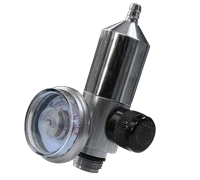
CGA-600 Fixed Flow Calibration Gas Regulator – Stainless Steel
Preset-flow CGA-600 regulator with integrated pressure gauge — built at the flow rate you select.
$205
See the stainless regulatorThe Three Common Rates, and What Each Is For
0.5 L/min is the standard calibration rate for portable instruments — the flow the majority of portable multi-gas calibration procedures are written around, and the size to buy when the manual's specified range centers on it. The worked example from this site's own bench writing: the Honeywell BW MicroClip procedure calls for gas applied at 250 to 500 ml/min, and the 0.5 L/min fixed-flow regulator is the standard choice for it — the top of the specified range, delivered steadily. When a manual gives a range, a fixed rate inside that range is a correct regulator; 0.5 sits inside more portable-instrument ranges than any other single rate, which is why it is the shelf standard.
0.25 L/min serves low-flow procedures — instruments and docking procedures whose manuals specify delivery down in the quarter-liter band. The honest reason to own one is a manual that asks for it, not gas savings: throttling a calibration below the specified flow to stretch a cylinder trades a few dollars of gas for a test performed outside its validated conditions. And 1.0 L/min serves the instruments whose manuals call for a full liter — higher-draw procedures where a half-liter regulator would leave the instrument underfed for the entire span. The pattern across all three is the post's whole thesis, and it is worth stating flatly: the rate is a specification to match, not a preference to have. Two otherwise identical regulators at different rates are not interchangeable tools; for a given instrument, one of them is the right tool and the others are wrong ones with the same fitting.
What the Wrong Rate Actually Does
Too little flow starves the instrument. A diffusion sensor fed below its procedure's rate sees gas arriving slower than the test assumes; response lags, readings can sit low, and a span can complete against a concentration the sensor never fully experienced. The failure turns serious on a pumped instrument: the pump is drawing its own sample at its own rate, and a regulator that cannot keep up puts the pump and the regulator in a fight the sensor loses — the sample arriving at the sensors is throttled, diluted, or pulsed, and every channel's calibration inherits the error at once. A starved calibration does not announce itself. It produces a certificate, a due-date sticker, and numbers that were never true.
Too much flow wastes gas and can falsify the test the other way. Double the specified flow is roughly double the gas consumed — across a fleet and a year, real money spent on nothing. Worse, excess flow pushes gas at a diffusion sensor under pressure it would never see in service, and a channel can be spanned to a response it will not reproduce in still air on a worker's chest. Neither error direction shows up afterward — the only defense is matching the rate before the gas flows, which is a purchase specification, not a bench technique.
Buying the Regulator: Rate First, Then Material
Selection order matters. First, the rate: read it from the manual of the instrument the regulator will serve — or the fleet's manuals, if one regulator will serve several models, in which case the rate must sit inside every served instrument's specified range, and instruments whose ranges do not overlap need their own regulators. Second, the fitting: both regulators priced here are CGA-600, the connection on the standard disposable calibration-gas cylinders they serve — confirm your cylinders' fitting before ordering any regulator, because a correct rate on the wrong fitting is a paperweight. Third, the material, which is where the two priced options actually differ:
- Stainless steel — $205. The stainless CGA-600 fixed-flow regulator is the durable buy: stainless construction, integrated pressure gauge, 600 PSIG maximum inlet pressure, specified for non-reactive calibration gas mixtures. For a regulator that will live in a calibration kit for years of daily bumps, the material is the longevity story.
- Nickel-plated brass — $130. The nickel-plated brass CGA-600 fixed-flow regulator carries the same fitting, the same integrated gauge, the same inlet rating, and the same flow-rate choices at a lower price — the sensible buy for a second kit, a spare, or a single-instrument shop where the stainless premium buys less.
- Both are preset at the rate you select. Available rates run 0.1, 0.2, 0.25, 0.3, 0.5, 1.0, 1.5, and 6.0 LPM — select at purchase, because a fixed-flow regulator's rate is its construction, not a dial. If you are unsure which rate your instrument specifies, call 865-900-8844 and name the model: a two-minute check against the manual beats a return.
One last boundary: both regulators are specified for non-reactive gas mixtures, which covers the standard multi-gas and single-gas cylinders most portable fleets calibrate with. Reactive-gas work is a different regulator conversation — ask before ordering rather than discovering the distinction at the bench.
Frequently Asked Questions
What flow rate does my gas detector calibration need?
The rate in your instrument's manual — that document, and nothing else, is the authority. Most portable multi-gas procedures are written around 0.5 L/min, low-flow procedures sit in the 0.25 L/min band, and some instruments specify a full 1.0 L/min. If the manual gives a range, any fixed rate inside the range is correct: the BW MicroClip procedure, for example, specifies 250 to 500 ml/min, making the 0.5 L/min regulator its standard choice. If you cannot find the figure, call 865-900-8844 and name the model before ordering — the rate is the regulator's construction, so the time to get it right is before the purchase.
What happens if my regulator's flow is too low?
The instrument is starved during its own calibration: gas arrives slower than the procedure assumes, response lags, and spans can complete against concentrations the sensors never fully saw. On a pumped instrument it is worse — the pump draws against a regulator that cannot keep up, and the throttled, uneven sample degrades every channel's calibration simultaneously. The dangerous property of a starved calibration is that it looks successful: the instrument passes, the sticker prints, and the numbers were never true. Matching the manual's rate is the entire defense.
What happens if the flow is too high?
Two costs. The visible one is gas: bump tests and calibrations consume roughly in proportion to flow, so double the rate is roughly double the cylinder spend across a fleet's year, paid for nothing. The invisible one is test validity — excess flow pushes gas at a diffusion sensor under pressure it would never experience in service, and a channel can be spanned to a response it will not reproduce in still air. A calibration that only holds while gas is being forced at the sensor is not a calibration of the instrument your worker wears.
Is 0.5 L/min right for every detector?
No — it is right for the many portables whose procedures center on it, and wrong for the rest. Low-flow instruments specify rates down at 0.25 L/min; higher-draw procedures specify 1.0 L/min. 'Most' is a buying hint, not a specification. The discipline this post teaches is to buy against your manual's figure — and, if one regulator will serve a mixed fleet, to confirm the chosen rate sits inside every served model's specified range, buying a second regulator for any instrument whose range does not overlap rather than calibrating it at a compromise flow.
Can I adjust a fixed-flow regulator to a different rate?
No. Fixed-flow means the rate is the regulator's construction — a preset orifice, not a dial. That is the design's virtue (nothing to drift, bump, or set wrong in the field) and its constraint (the purchase is the decision). An adjustable-flow or demand-flow regulator is a different tool for a different setup; the comparison is worked through in fixed-flow vs. demand-flow regulators. If your fleet genuinely needs two rates, the fixed-flow answer is two regulators, each correct — still simple, still drift-proof.
Stainless steel or nickel-plated brass — which should I buy?
Both carry the same CGA-600 fitting, integrated gauge, 600 PSIG inlet rating, non-reactive-gas specification, and preset-rate menu — the difference is construction and price. Stainless at $205 is the longevity buy for a kit that works daily for years; nickel-plated brass at $130 is the value buy for a spare or lighter duty. Rate first, fitting second, material third.
What flow rates are available in these regulators?
0.1, 0.2, 0.25, 0.3, 0.5, 1.0, 1.5, and 6.0 LPM — you select the rate when you order, and the regulator is built at that preset flow. The common calibration choices are 0.25, 0.5, and 1.0 L/min; the wider menu exists for specialty applications with their own specified draws. If your instrument's manual names a rate that is not the one you were about to order out of habit, the manual wins — that sentence is the whole post in miniature.
Does flow rate matter for a bump test, or only for calibration?
Both, for the same reason: a bump test is a verification, and a verification performed at the wrong flow verifies the wrong conditions. A bump at starved flow can fail a good instrument — or delay its response past the check's timing — while a bump at excessive flow can hurry a sluggish sensor into looking healthy. The instrument's procedures specify flow for the gas applications they cover, bump and span alike. Using the manual's regulator for both keeps the daily check and the periodic calibration telling the same story about the same instrument.
Will one regulator work for my whole fleet?
Only if every model's specified range contains the regulator's rate. Mixed fleets often qualify — many portables share the half-liter convention — but 'often' has to be verified model by model against the manuals, not assumed from the brand. One incompatible instrument in the fleet means one more regulator, at $130–$205, which is cheap insurance next to a fleet-wide habit of calibrating that model out of specification. When you call 865-900-8844 to order, name the fleet; the overlap check takes minutes and settles the question with documents instead of optimism.
What if my gas is a reactive mixture?
Stop and ask before ordering. Both regulators priced in this post — stainless at $205 and nickel-plated brass at $130 — are specified for non-reactive calibration gas mixtures, which covers the standard multi-gas and toxic cylinders most portable fleets use. Reactive gases attack regulator internals and demand materials and designs chosen for them. Tell us the gas and the instrument at 865-900-8844 and the regulator will be matched to both — the flow-rate discipline in this post still applies, but material compatibility gets decided first.
The Bottom Line
0.25, 0.5, or 1.0 is not a preference — it is a specification printed in your instrument's manual, and the regulator you buy is built at that rate for life. Match it, and every bump and calibration your fleet performs is the test the manufacturer validated. Miss it, in either direction, and the paperwork still prints while the numbers quietly stop meaning anything. Stainless at $205 or nickel-plated brass at $130, the right rate is the whole purchase.
Not sure which rate your instrument specifies? Call CPS Calibrations at 865-900-8844 and name the model — or see calibration services if you'd rather the bench own the whole question. Rockwood, Tennessee: 109 S. Front Street, Rockwood, TN 37854.
--- CPS Calibrations · 109 S. Front Street, Rockwood, TN 37854 · CGA-600 Fixed-Flow Regulator — Stainless · Fixed-Flow vs. Demand-Flow Regulators · Calibration Services
Need a calibration you can file?
In-house calibration at CPS in Rockwood, Tennessee — $55 for single-gas instruments, $90 for 4- and 5-gas — every channel, as-found and as-left data, full certificate.
See Calibration Servicesor call 865-900-8844
Recent Posts
-

What Is Remote Monitoring for Fixed Gas Detection?
Remote monitoring for fixed gas detection means a fixed system's live readings, trends, and alarm hi …Nov 23rd 2026 -

What Are the Key Differences Between the GX-6000 and GX-6100?
The RKI GX-6100 is the current replacement for the discontinued GX-6000: both are pumped 6-gas monit …Nov 22nd 2026 -

How to Read a PID Correction Factor Chart
To read a PID correction factor chart, find your vapor’s row, take the factor under your own lamp en …Nov 21st 2026