
Fixed Gas Detection for Compressor Stations
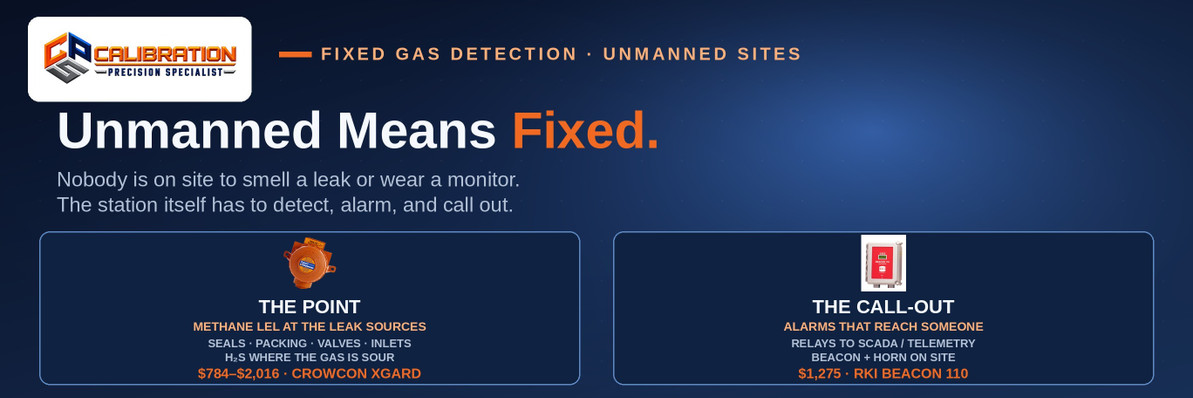
An unmanned compressor station needs fixed gas detection more than a staffed facility does, not less: with nobody on site to smell a leak, hear a hiss, or wear a portable monitor, only fixed methane (LEL) points near compressor seals and packing, valve areas, and building inlets — plus hydrogen sulfide (H₂S) points where the gas is sour — can catch a release when it starts and send the alarm to someone who is not there, through a controller relay to SCADA or telemetry, with a beacon and horn on site.
Every other gas detection decision starts with people. A compressor station inverts it: the defining fact of the site is that people are usually absent. Rounds may come daily, weekly, or less; between visits, the equipment runs unattended, and every leak scenario plays out in an empty building or an empty yard. This post works through what that changes — where the points go, what they must sense, how an alarm at an empty site reaches a human being, and how the system stays calibrated when nobody walks past it every day. For the general framework behind it, start with fixed vs. portable gas detection — this post is that framework applied to the site where fixed wins by default.
Why Does an Unmanned Site Need Fixed Detection More, Not Less?
Strip the staffing away and every layer of a conventional gas safety program goes with it:
- No noses, no ears. In a staffed plant, the first detector for many leaks is a person — odor, sound, a frost line on a fitting. At an unmanned station that layer does not exist for most of the hours in a week.
- No portables on site. A portable detector protects the person wearing it. Unworn monitors in a cabinet — or back at the shop — detect nothing at the station, ever. Portable-only protection at an unmanned site is, in effect, no protection between visits.
- No one to act on an alarm. Even a detector that alarms locally accomplishes little if the only output is a horn in an empty building. The alarm has to travel: to a control room, a SCADA system, or an on-call phone.
- Arriving personnel walk in blind. The next human event at the station is a technician arriving — potentially into an atmosphere that has been building since the last visit. A beacon at the entrance and a call-out before dispatch are what convert that arrival from an exposure into a response.
The conclusion runs opposite to the intuition that "nobody's there, so nobody's at risk." The asset is at risk continuously, the neighbors and the environment are downwind continuously, and the first person to arrive inherits whatever the site has been doing unattended. Fixed detection is the only layer that works the site's actual schedule: all of it.
Where Do Gas Detectors Go in a Compressor Station?
Place points at the leak sources, at the height the gas occupies, and at the doors people enter through. In practice, for a compressor station:
| Location | Why a point goes there | Gas and height |
|---|---|---|
| Compressor seals and packing | The highest-wear, highest-leak-probability components on the machine; rod packing and seals leak as a matter of service life | Methane (LEL) — mounted high or at the source, as methane rises |
| Valve areas, flanges, and fittings | Every threaded and flanged connection is a potential release point, and stations concentrate them | Methane (LEL) near the cluster |
| Enclosure and building inlets | Gas entering or accumulating in an enclosed compressor building changes the risk for anyone who opens the door; fresh-air inlets can also pull outside gas in | Methane (LEL) inside the enclosure and at inlets |
| Sour gas handling areas | Where the stream is sour, H₂S is the acute-toxicity hazard for arriving personnel | H₂S at breathing-zone height |
| The entrance itself | A beacon and horn at the door warn the arriving technician before entry — the last point of protection is information at the threshold | Alarm output, driven by the points above |
Two placement truths from fixed-system work generally apply with force here. First, a point protects a radius, not a building — a single detector centered in a large enclosure will under-read a leak at the far seal until the gas has spread, which is why points belong at sources, not at geometric centers. Second, mount for the gas: methane is lighter than air and collects high, so LEL points go above and around the source; H₂S points for personnel protection go at breathing-zone height where people actually stand. The full placement method is in our fixed systems range — detector heads and stand-alone detectors.
Use this layout when: any enclosed or partially enclosed compressor installation, and any open-air installation where the consequence of an undetected leak — asset loss, a cloud reaching a road or residence, an arriving technician's exposure — justifies source-level points. Open-air sites dilute faster, which argues for points closer to the source, not for no points.
Methane First — and H₂S Where the Gas Is Sour
The default compressor-station gas is methane: the product itself, measured as a percentage of the lower explosive limit. The detector question at most stations is not whether to monitor LEL but how many LEL points the seal, valve, and enclosure layout requires — hardware like the Crowcon Xgard family ($784–$2,016 per point depending on configuration) or the SENKO SI-200E ($950) exists for exactly this duty.
Sour service adds the second gas. Where the stream carries H₂S, the hazard ranking flips for personnel: methane threatens the asset by explosion, H₂S threatens the arriving technician by toxicity, at concentrations far below anything flammable. Sour stations need H₂S points at breathing-zone height in the areas people enter and work — and the visiting crew's personal monitors to match, because a fixed point still cannot follow a technician around the site. Sweet or sour is a property of your stream, not a preference: check the gas analysis, and instrument for what is actually in the pipe.
How Does an Alarm Reach Someone When Nobody Is There?
This is the design question that separates a compressor-station system from a detector bolted to a wall. The signal path has to end at a person:
- Point to transmitter to controller. The detector reports to a controller — a unit like the RKI Beacon 110 ($1,275, single channel) for a small station, or transmitter outputs — the RKI M2A-XL ($1,320 explosion-proof / $1,270 non-explosion-proof) — wired directly into an existing panel.
- Relay out to SCADA or telemetry. The controller's relays are the product. A gas alarm — and equally important, a fault alarm — must land in the system the operator actually watches: SCADA, a telemetry unit, an autodialer, whatever carries the site's other call-outs. A gas alarm that only displays on a panel in an empty building is a log entry, not an alarm.
- Beacon and horn on site. Local output still matters — for the arriving technician. A beacon visible at the entrance on approach says "the building is in alarm" before the door opens, which is the single most valuable message the system can send a person.
- Alarms someone owns. Decide, in writing, who receives the call-out, what they do at 2 a.m. versus 2 p.m., and at what reading a visit becomes a no-entry until ventilated and tested. The electronics are the easy half of this step; the roster is the half that fails.
Ventilation and Shutdown: The Interlock Philosophy
At a general level, fixed detection at a compressor station is usually asked to do three escalating things, in this order:
- Alarm and report — the base case above: detect, call out, beacon on site.
- Ventilate — start or boost enclosure ventilation on a gas alarm, so an enclosed building purges itself while help is still deciding what to do. Ventilation is the interlock with no downside in most designs: it only ever makes the atmosphere better.
- Shut down — trip the compressor, close valves, or de-energize equipment on a confirmed high alarm, removing the leak's energy and ignition sources together. Shutdown philosophy — which readings, how many points must agree, what stays running for safety — is a site engineering decision, made with the operator's process and risk people, not a catalog setting. What detection owes that decision is honest, calibrated points whose readings a shutdown can safely be trusted to act on.
The sequence matters more than any step: a station that can detect and report is protected in the way that matters most — a human knows. Ventilation and shutdown then buy time and reduce consequence. Skipping detection to argue about interlocks is building the roof before the foundation.
What Does Fixed Detection for a Compressor Station Cost?
The hardware half is knowable; the installation half is site work, and any honest quote separates them:
- Per point: $784–$2,016 for the Crowcon Xgard family, $950 for a SENKO SI-200E, $1,270–$1,320 for an RKI M2A-XL transmitter — depending on gas, housing, and explosion-proof requirements.
- Controller and alarming: $1,275 for a single-channel RKI Beacon 110, scaling with channel count, plus the beacon, horn, and telemetry tie-in hardware your call-out path needs.
- Installation: cable or conduit in a classified area, mounting, the SCADA/telemetry integration, commissioning, and startup calibration. This depends entirely on the station — distances, classification, existing panels — and is quoted in writing after a site review. Anyone who totals an installed compressor-station system without seeing the site is guessing, and the guess will be settled later at your expense.
Headcount does not soften this number the way it does for portables — an unmanned site has no portable alternative to price against. The comparison that matters is system cost versus one undetected leak's outcome: the machine, the building, the cleanup, or the arriving technician. Priced against that list, detection is the cheap line item.
How Do Remote Fixed Points Stay Calibrated?
A fixed sensor drifts like any other sensor — and at a remote site, drift has no witnesses. Nobody notices a sluggish point at a station nobody visits, which is why the calibration program has to be designed, not assumed:
- Schedule by route, not by memory. Group remote points into calibration routes on fixed intervals, so every station gets touched on a calendar — not when someone happens to be nearby.
- Calibrate every channel, in place. Each point, each gas, at the manufacturer's interval, with the readings recorded per point. CPS calibrates every channel — a point that was only span-checked on one gas is not a calibrated point.
- Use the fault outputs. A supervised system reports sensor faults to the same SCADA path as gas alarms. A fault at an unmanned station is a dispatch item, not a footnote, because until it is cleared the site has a hole in its coverage and does not know it.
- Keep gas and access planned. Remote calibrations fail on logistics — no calibration gas on the truck, no access, no time. CPS calibration gas ships with a QR code on every cylinder linking to its SDS and Certificate of Analysis, CPS never charges a hazmat fee, and the program behind the points is part of calibration services.
And when the crew does visit, the layering rule from fixed vs. portable gas detection applies unchanged: fixed points watch the place, and the arriving technician still wears a personal monitor and tests before entry work — the fixed system tells them what the building has been doing, not what the air at their next task is.
Frequently Asked Questions
Do compressor stations need fixed gas detection?
If the station is unmanned or lightly attended, fixed detection is the only detection that is actually present. Portable monitors protect people who are wearing them; at a station nobody visits daily, there is usually nobody to wear one, so leaks go undetected between visits. Fixed methane LEL points at the leak sources, H₂S points where the gas is sour, and alarms relayed to SCADA or telemetry are what close that gap.
Where should gas detectors be placed in a compressor station?
At the leak sources, at the height the gas occupies, and at the entrances. Methane LEL points go near compressor seals and packing, valve and flange clusters, and inside enclosures and at building inlets — mounted high, because methane rises. H₂S points on sour service go at breathing-zone height where arriving personnel stand and work. A beacon at the entrance, driven by those points, warns the next technician before the door opens.
What gas do compressor station detectors monitor — methane or H₂S?
Usually methane first: it is the product, it is flammable, and it is measured as a percentage of the LEL. Where the gas stream is sour, hydrogen sulfide is added — at breathing-zone height — because H₂S is acutely toxic to the personnel who visit the site at concentrations far below flammable levels. Sweet or sour is determined by your gas analysis, and the detector layout should follow it.
How does anyone know about a gas alarm at an unmanned compressor station?
Through the alarm path, which has to be designed to end at a person: the detector reports to a controller, the controller's relays feed SCADA, telemetry, or an autodialer that reaches the operator or on-call staff, and a beacon and horn on site warn anyone who arrives. A detector that only alarms inside an empty building has not alarmed anyone — relaying the signal out is the core of an unmanned-site design.
Can fixed gas detection shut down a compressor?
Yes — through controller or transmitter relays, a confirmed high gas reading can trip equipment, close valves, and start ventilation. How far to take it is a site engineering decision: ventilation on alarm is nearly universal because it only improves the atmosphere, while shutdown logic — which readings, how many points must agree — belongs to the operator's process and risk review. Detection's job in that decision is to provide readings honest enough to act on, which is a calibration question as much as a hardware one.
How much does fixed gas detection for a compressor station cost?
Detector hardware runs $784–$2,016 per point for the Crowcon Xgard family, $950 for a SENKO SI-200E, and $1,270–$1,320 for an RKI M2A-XL transmitter, plus a controller — $1,275 for a single-channel RKI Beacon 110 — plus beacons, telemetry tie-in, and installation. Wiring or conduit in a classified area, commissioning, and startup calibration depend on the site and are quoted in writing after a review; there is no honest installed total without seeing the station.
How often do fixed gas detectors at remote sites need calibration?
At the manufacturer's recommended interval, for every point and every channel — scheduled as a route, because remote sites get skipped when calibration depends on someone remembering or passing by. CPS calibrates every channel in place and records the result per point. A drifted point at an unmanned station is a particular risk: nobody is present to notice it reading wrong, and every alarm and shutdown decision downstream trusts it.
Can portable detectors replace fixed detection at an unmanned site?
No. A portable detector only samples where its wearer is, while it is worn, charged, and turned on. At an unmanned station that coverage is zero for most of the week — the leak runs until the next visit, and the visiting technician arrives without warning at the door. Portables remain essential for the crew when they are on site; they are the personal layer on top of fixed coverage, not a substitute for it.
Do open-air compressor stations need gas detection?
Often, yes — with points placed closer to the sources. Open air dilutes a leak faster than an enclosure does, which lowers accumulation risk but also means a distant detector may never see a leak at all. Enclosed buildings, compressor enclosures, and low or sheltered areas where gas can collect are the priority locations; whether open-air seal and valve areas also get points is a site assessment based on leak consequence — asset, road or residence downwind, and arriving-personnel exposure.
What happens if a fixed detector fails at an unmanned station?
In a properly supervised design, the failure itself is reported: controllers and transmitters provide fault outputs that should be wired into the same SCADA or telemetry path as gas alarms, so a dead or faulted point generates a call-out instead of failing silently. That supervision is a design choice — ask for it explicitly. An unsupervised failed point is the worst state a remote system can be in: the site believes it is monitored, and it is not.
The Bottom Line
An unmanned compressor station is not a site with less exposure — it is a site with no witnesses. Give it the witnesses that work unattended: methane LEL points at the seals, packing, valves, and inlets; H₂S points at breathing height where the gas is sour; a controller whose relays reach SCADA or telemetry and a beacon at the door; and a calibration route that keeps every point honest between visits. The station nobody visits daily needs fixed detection more, not less — because on every other site, the people are part of the detection system, and here there are no people.
Planning detection for an unmanned or lightly attended station? Call 865-900-8844 or reach us through Contact Us. We will work through the point layout and alarm path with you — fixed systems, controllers, calibration gas, and the calibration services that keep remote points reading true.
CPS Calibrations · 109 S. Front Street, Rockwood, TN 37854 · Calibration Gas · Calibration Services · Contact Us
Need a calibration you can file?
In-house calibration at CPS in Rockwood, Tennessee — $55 for single-gas instruments, $90 for 4- and 5-gas — every channel, as-found and as-left data, full certificate.
See Calibration Servicesor call 865-900-8844
Recent Posts
-

What Is Remote Monitoring for Fixed Gas Detection?
Remote monitoring for fixed gas detection means a fixed system's live readings, trends, and alarm hi …Nov 23rd 2026 -

What Are the Key Differences Between the GX-6000 and GX-6100?
The RKI GX-6100 is the current replacement for the discontinued GX-6000: both are pumped 6-gas monit …Nov 22nd 2026 -

How to Read a PID Correction Factor Chart
To read a PID correction factor chart, find your vapor’s row, take the factor under your own lamp en …Nov 21st 2026