
Gas Detection in Cannabis Grow and Extraction Facilities
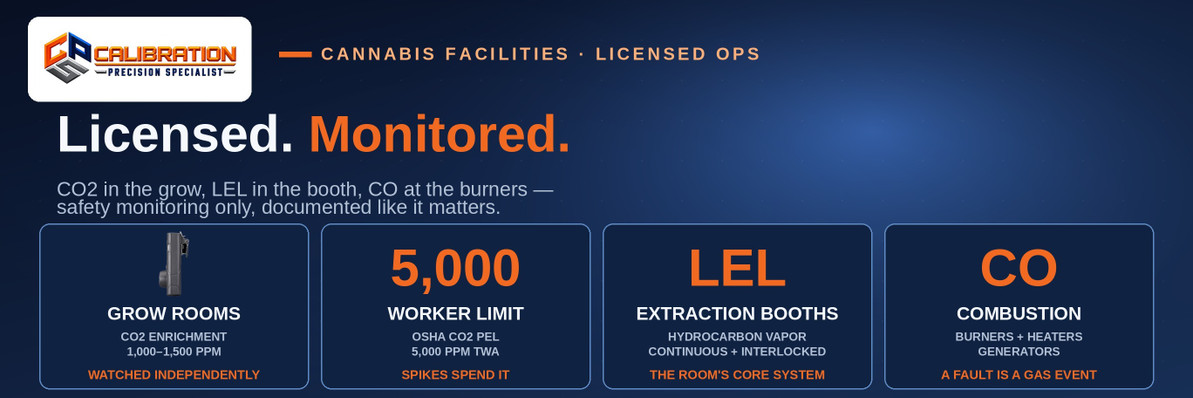
A licensed cannabis facility has three distinct gas-detection jobs: CO₂ enrichment in grow rooms — dosed to roughly 1,000–1,500 ppm for the plants while employees work under OSHA's 5,000 ppm TWA limit, so the dosing system itself needs an independent watch; combustible-gas (LEL) monitoring in hydrocarbon extraction booths, where butane and propane are the working solvents and vapor control is the room's reason to exist; and carbon monoxide watch wherever combustion equipment — CO₂ burners, heaters, generators — serves the building. Same license, three different physics, three different placements.
This post covers licensed, regulated facilities only, and covers safety monitoring only — detection, placement, alarming, and calibration. It is not a guide to extraction or cultivation technique. What a licensed operation gets from treating detection seriously goes beyond the hazards themselves: in a regulated industry, the monitoring system and its calibration records are part of the facility's compliance posture, inspected like everything else on the premises.
Grow Rooms: Enrichment Gas With People Inside
Grow rooms run the greenhouse play: CO₂ held around 1,000–1,500 ppm for the crop, with gardeners, scouts, and technicians working full shifts inside the band. The safety design mirrors any enriched workplace: independent monitoring beyond the dosing controller's own sensor (the failure to fear is the dosing system), breathing-height sensing where staff work, entrance indication for rooms that can spike while unoccupied, and bulk CO₂ storage — cylinders or bulk tanks feeding the rooms — watched low, because CO₂ pools and displaces oxygen at floor level.
The limits frame the alarm logic: alarm with margin above the enrichment band and margin below the 5,000 ppm PEL, remembering the PEL is a time-weighted average and spikes spend it. Our CO₂ in food processing post covers the storage-and-pooling side of CO₂ in a different industry; the physics at the tank does not care what the gas feeds.
Extraction Booths: LEL Is the Room's Operating System
Hydrocarbon extraction works with butane and propane as solvents, inside booths and rooms engineered around that fact — ventilation, classified electrical, and continuous combustible-gas monitoring are the booth's core systems, not its accessories. LEL detection in that environment has one job: sense vapor at the earliest stage and drive the response the room was designed for — alarm, ventilation state, and process shutdown — long before vapor can find an ignition source or a concentration worth fearing.
Placement follows the solvents' behavior and the equipment: at the extraction equipment itself, at solvent storage and recovery points, and at the low places a heavier-than-air vapor will travel to and collect in. Because jurisdictions license these facilities individually, setpoints, interlocks, and design specifics belong to the facility's licensed engineers and its authority having jurisdiction — what this post insists on is the principle: the monitoring is continuous, it is interlocked with the response, and its calibration records are inspection-grade, because in a licensed facility they will be inspected.
The Supporting Cast: CO, Storage, and the Rest of the Building
Facilities make CO₂ and heat with combustion — burner-style CO₂ generators, unit heaters, emergency generators — and each is a carbon monoxide source with a fault mode. CO monitoring belongs in the air those appliances serve and in the work areas around them, and a generator fault belongs on the gas-event list, not the HVAC list. Solvent and gas storage beyond the booth — solvent rooms, CO₂ storage, compressed-gas cages — extends the same logic: detection matched to what is stored, at the height the gas will occupy, alarming where staff will actually receive it.
And the personal layer: technicians doing maintenance on extraction and grow systems work in the building's in-between moments, when rooms are open, systems are down, and fixed coverage is at its weakest. Portable gas detection — LEL/O₂/CO/H₂S multi-gas for maintenance work — is the instrument set that follows the person into those windows.
Calibration and Records: The Compliance Half
In an unregulated workshop, a drifted detector is a safety gap. In a licensed facility, it is also a documentation gap: calibration records for gas detection are the kind of paper an inspector, an insurer, or an incident review asks for by name. Every fixed head and portable in the building belongs on a calibration schedule with certificates that show as-found and as-left data — proof the instrument read true, not merely that a sticker says a date.
CPS calibrates in-house at $55 single-gas and $90 for 4- and 5-gas instruments with that full certificate, and supplies fixed and portable detection — see calibration services or call 865-900-8844. Design, licensing, and code compliance for grow and extraction spaces sit with the facility and its engineers; the instruments and their upkeep are the part we do.
Frequently Asked Questions
What gas detection does a licensed grow facility need?
Three jobs. CO₂ safety monitoring in enriched grow rooms (dosed ~1,000–1,500 ppm for plants; workers under a 5,000 ppm TWA limit), with independent sensing beyond the dosing controller and low-level monitoring at bulk CO₂ storage. LEL monitoring in extraction and solvent areas. And CO monitoring around combustion equipment — CO₂ burners, heaters, generators — plus portables for maintenance.
Why can't the CO2 dosing controller double as the safety monitor?
Because the hazard is the dosing system itself failing — a stuck valve or a dosing sensor reading low while injection runs hard. A controller trusting its own failed sensor reports comfort during the exact event monitoring exists to catch. Safety sensing is independent: its own sensor, its own alarm, ideally its own authority to shut injection down.
What does LEL monitoring do in an extraction booth?
It watches continuously for hydrocarbon vapor — butane/propane — and drives the booth's designed response: alarm, ventilation, and process shutdown at the earliest stage of a release. In a licensed extraction space, the monitoring is a core, interlocked system of the room, not an add-on — and its setpoints and interlocks are set by the facility's licensed engineers under its jurisdiction's rules.
Where do extraction-area sensors belong?
At the vapor's sources and destinations: the extraction equipment, solvent storage and recovery points, and the low areas where heavier-than-air hydrocarbon vapor travels and collects. Placement follows the solvent's behavior in that specific room, which is why booth design — not a generic template — fixes final positions.
What CO2 level should a grow room alarm at?
With margin on both sides: clearly above the ~1,000–1,500 ppm enrichment band so normal production doesn't cry wolf, and clearly below OSHA's 5,000 ppm TWA worker limit so the alarm means act now. Remember the limit is a time-weighted average — hard spikes spend exposure budget even if the daily average looks acceptable afterward.
Is CO a real concern in a grow facility?
Wherever combustion serves the building, yes: CO₂ generators burn fuel to make their gas, heaters burn to warm, and backup generators burn during outages. Each has a fault mode that produces carbon monoxide. CO monitoring in the served air and work areas, and treating burner faults as gas events, are the matched controls.
Do maintenance techs need portable monitors in a facility with fixed detection?
Yes. Fixed systems guard rooms in their normal state; maintenance happens in abnormal states — equipment open, systems down, booths entered for service. A multi-gas portable (LEL, O₂, CO, H₂S) follows the technician into those windows and verifies air at the point of work, which no wall-mounted head can do.
How do calibration records matter for licensing?
Licensed facilities live under inspection — by regulators, insurers, and their own compliance programs. Gas-detection calibration records with as-found/as-left data are the documentary proof the safety systems actually worked. CPS calibrations produce exactly that: a full certificate per instrument, every channel, with the calibration gas's CoA trail.
Can CPS design our facility's gas detection?
CPS supplies, services, and calibrates fixed and portable gas detection and can advise on instrument selection (865-900-8844). Facility design — booth engineering, setpoints, interlocks, licensing, and code compliance — belongs to the operator's licensed engineers and authority having jurisdiction. We keep the instruments honest; the design authority stays where the license puts it.
What is the most common detection gap in these facilities?
The seams: bulk CO₂ storage without low-level monitoring, combustion appliances treated as HVAC instead of CO sources, and extraction-area sensors whose calibration lapsed because production never pauses. The grow rooms usually get the attention; the support spaces are where unmonitored gas actually accumulates.
The Bottom Line
Licensed grow and extraction facilities run three gas stories at once — enrichment CO₂ worked around people, hydrocarbon vapor engineered around ignition, combustion CO managed around equipment faults — and the detection for each is placed by that gas's physics, alarmed to a response, and calibrated to an inspection-grade record. In a regulated building, the paperwork is part of the safety system.
Outfitting or calibrating a licensed facility's detection? Call CPS Calibrations at 865-900-8844 — 109 S. Front Street, Rockwood, TN 37854.
--- CPS Calibrations · 109 S. Front Street, Rockwood, TN 37854 · CO2 in Food Processing · Portable Gas Detection · Calibration Services
Need a calibration you can file?
In-house calibration at CPS in Rockwood, Tennessee — $55 for single-gas instruments, $90 for 4- and 5-gas — every channel, as-found and as-left data, full certificate.
See Calibration Servicesor call 865-900-8844
Recent Posts
-

What Is Remote Monitoring for Fixed Gas Detection?
Remote monitoring for fixed gas detection means a fixed system's live readings, trends, and alarm hi …Nov 23rd 2026 -

What Are the Key Differences Between the GX-6000 and GX-6100?
The RKI GX-6100 is the current replacement for the discontinued GX-6000: both are pumped 6-gas monit …Nov 22nd 2026 -

How to Read a PID Correction Factor Chart
To read a PID correction factor chart, find your vapor’s row, take the factor under your own lamp en …Nov 21st 2026