
CO2 in Food Plants: Carbonation, Packaging, and Dry Ice
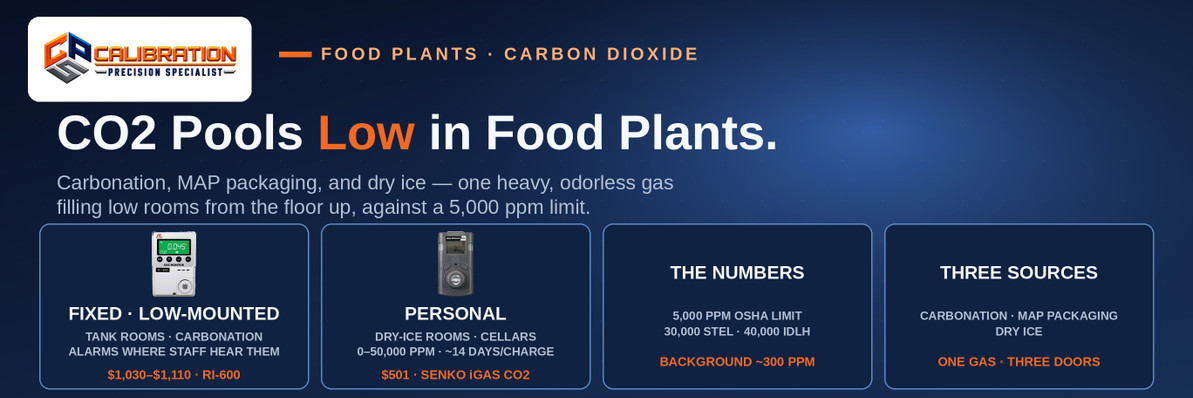
Food plants bring CO2 in on purpose three ways — beverage carbonation, modified-atmosphere packaging, and dry ice — and in all three it behaves the same way: CO2 is odorless and about 1.5 times heavier than air, so it pools at floor level in tank rooms, packaging cellars, and dry-ice storage, against an OSHA limit of 5,000 ppm, a NIOSH short-term limit of 30,000 ppm, and an IDLH of 40,000 ppm. Every room where CO2 is stored or used needs a fixed monitor mounted low, and every person entering those rooms needs a personal CO2 monitor.
Most plant gases are contaminants to be kept out. CO2 is inventory — purchased, piped, and packed into the product — which makes its hazard easy to file under "supplies" and forget. But the physics does not care why the gas is in the building. A carbonation line, a packaging gassing station, and a dry-ice bunker are three doors into the same room-filling, floor-pooling hazard, and the monitoring answer is the same at each one. This post is the CO2 chapter of our plant-wide map, what gas detection a food processing plant needs — and the same physics drives CO2 outside the plant, in restaurants with bulk CO2 tanks and in distilleries, where fermentation does the filling.
The Numbers: Why 5,000 ppm Is Closer Than It Feels
| CO2 level | What it is |
|---|---|
| ~300 ppm | Normal background in fresh air (NIOSH) |
| 5,000 ppm (0.5%) | OSHA PEL and NIOSH REL — the shift-average limit |
| 30,000 ppm (3%) | NIOSH short-term limit (15 minutes) |
| 40,000 ppm (4%) | NIOSH IDLH — immediately dangerous to life or health |
Two features of that table do the damage. First, the distance from normal (300 ppm) to the limit (5,000 ppm) is small in absolute terms — a modest leak into a small room covers it. Second, CO2 is a toxic gas in its own right, not just an oxygen displacer: NIOSH's symptom list runs from headache, dizziness, restlessness, and breathing difficulty up through increased heart rate and malaise to asphyxia, convulsions, and coma at high concentrations. And because the gas is odorless at every concentration, symptoms are the only built-in alarm — arriving, by definition, after exposure. The instrument has to notice first.
Placement follows from the density. At a relative gas density of 1.53, leaked CO2 sinks, spreads across the floor, and fills a space from the bottom up. The air at a standing person's head near a door can test fine while the air at the floor — where a worker kneels at a low valve, or where a below-grade room's whole volume sits — is past the short-term limit. Sensors mount low, in the layer the gas actually occupies.
Carbonation: Bulk CO2 at Beverage Plants
A carbonation plant's CO2 system is a pressure system: bulk liquid CO2 storage, vaporizers, regulators, and piping feeding the carbonators, plus cylinder backups. The monitored points:
- The tank and vaporizer room — the fittings, valves, and relief devices where a leak starts, in a room that is typically closed and unoccupied for long stretches. This is the plant's equivalent of the restaurant tank room, at larger scale: it gets a fixed low-mounted monitor alarming where staff will hear it.
- The carbonation hall itself, at low points along the line — pits, trenches, and below-grade runs where piped CO2 would collect.
- Range selection is the quiet decision. A monitor configured 0–5,000 ppm reads beautifully right up to the OSHA limit — and then pegs. It cannot show you the 30,000 ppm short-term limit or tell a bad leak from a catastrophic one. The configuration that covers the whole hazard table is the 0–5% volume (0–50,000 ppm) range: less resolution at the bottom, the full story at the top. For permitted beverage systems the fire code's alarm structure (IFC §5307: supervisory alarm at 5,000 ppm, in-room alarm at 30,000 ppm for beverage dispensing systems) effectively makes that choice for you — one instrument has to speak both numbers.
The fixed unit built for this duty is the RKI RI-600, configured at $1,030–$1,110 depending on range and power: NDIR sensing, continuous LCD readout with audible alarm and a display that changes color on alarm, two preset alarms, relay contacts for remote alarms or ventilation, and a 4–20 mA output. It is one of the stand-alone room monitors we place wherever one room has one gas.
MAP Packaging: CO2 by the Thousands of Small Releases
Modified-atmosphere packaging swaps the air inside a package for a controlled gas mix — CO2 is a standard component alongside nitrogen — at production-line speed, all shift long. The hazard profile differs from carbonation: instead of one bulk system, there are gassing stations, manifolds, and supply lines distributed across the packaging hall, and the releases are small, frequent, and close to where people stand. Two consequences:
- Ventilation is the first control, detection is the proof. A packaging hall is a big, busy air volume, and general ventilation usually holds CO2 near background. The fixed monitor's job is to prove it — and to catch the day a gassing station leaks into a still corner, a below-grade section of the hall, or an enclosed mezzanine under the line.
- The supply end concentrates the risk. Where the bulk CO2 and the gas-mixing equipment live — the tank, the mixer room, the manifold — the monitoring logic is the carbonation logic again: fixed, low, alarming to an attended point.
Dry Ice: The Room That Fills Itself Overnight
Dry ice is solid CO2, and it does one thing from the moment it is made: it turns back into CO2 gas, continuously, warming or not, attended or not. A dry-ice storage room, bunker, or blast-freezing area is therefore the one room in the plant that manufactures its own hazardous atmosphere on a schedule nobody sets — including overnight, over a weekend, in a sealed room opened by the first person on the early shift.
That pattern dictates the monitoring:
- A fixed low-mounted monitor in the dry-ice room, alarming outside the door as well as inside it — the person who needs the warning most is the one who has not entered yet.
- A personal monitor on the person going in. The SENKO iGas CO2, $501, is a dedicated personal CO2 detector: NDIR sensing across 0–50,000 ppm — the full span from background through the IDLH — with audible, visual, and vibration alarms, STEL and TWA tracking, and a rechargeable battery good for about 14 days per charge. It reads the air at the wearer's breathing zone as they step down into the pool, which is the only reading that describes their actual exposure.
- The discipline that the door reading is not the room reading. CO2 stratifies. A fixed sensor at the door and a quick glance are not a survey of the floor layer, the far corner, or the pit — the personal monitor goes where the person goes.
Calibration: An NDIR Sensor Drifts Like Any Other
The sensing here is NDIR — infrared — which is stable, but not immortal: it drifts, and a drifted CO2 monitor fails in the dangerous direction, reading low against limits that start at 5,000 ppm. Fixed points are calibrated in place on the manufacturer's schedule; CPS services installed systems on-site, quoted in writing. Personal iGas CO2 units calibrate on the Rockwood bench at the published $55 single-gas in-house rate. We calibrate every channel, repairs are quoted in writing before work, and every instrument's certificate and due date live in the CPS Calibration Program. Questions start at calibration services or 865-900-8844.
Frequently Asked Questions
Why is CO2 a hazard in food plants if it's a normal ingredient?
Because of concentration and place, not chemistry class. CO2 is odorless, colorless, and about 1.5 times heavier than air, so leaks and dry-ice off-gassing pool it at floor level in closed rooms. OSHA's limit is 5,000 ppm over a shift, NIOSH's short-term limit is 30,000 ppm, and 40,000 ppm is immediately dangerous to life or health — levels a small, low, unventilated room can reach silently. It is also toxic in its own right, with symptoms from headache and dizziness up to asphyxia at high concentrations.
What are the CO2 exposure limits for food plant workers?
OSHA's permissible exposure limit is 5,000 ppm as an 8-hour time-weighted average. NIOSH recommends the same 5,000 ppm average, adds a short-term limit of 30,000 ppm over 15 minutes, and rates 40,000 ppm (4 percent) as the IDLH — immediately dangerous to life or health. Normal fresh air sits around 300 ppm, so the whole distance from "fine" to "over the limit" is a few thousand ppm in a closed room.
Where does CO2 collect in a food plant?
Low — always low. At about 1.5 times the density of air, CO2 sinks and fills spaces from the floor up: dry-ice storage rooms, bulk tank and vaporizer rooms, below-grade packaging areas, pits, trenches, and cellars. The dangerous geometry is a small, closed, low room with a CO2 source in it or draining into it. That is why sensors mount near the floor in the rooms where CO2 is stored and used, and why a reading at head height by the door does not clear the room.
Does dry ice create a CO2 hazard in storage?
Yes — dry ice is solid carbon dioxide, and it sublimates back into CO2 gas continuously, including overnight and over weekends in a closed storage room. The room effectively manufactures its own atmosphere, and the first person to open the door in the morning meets whatever accumulated. Dry-ice rooms get a fixed low-mounted monitor alarming outside the door, and the person entering wears a personal CO2 monitor reading the air at their own breathing zone.
What CO2 monitor range should a food plant choose?
One that can read the whole hazard table. A 0–5,000 ppm configuration is precise at the OSHA limit but pegs at the top of its scale — it cannot display the 30,000 ppm short-term limit or distinguish a serious leak from a worse one. The 0–5 percent volume configuration (0–50,000 ppm) covers background, the 5,000 ppm limit, the 30,000 ppm short-term point, and the 40,000 ppm IDLH in a single instrument, which is why the RKI RI-600 configured at $1,030–$1,110 is usually specified in the percent range for storage and dry-ice rooms.
What is the fire code's role in food plant CO2 monitoring?
For beverage dispensing systems, International Fire Code Section 5307 requires mechanical ventilation or gas detection for insulated liquid CO2 systems over 100 lb, with sensors within 12 inches of the floor, a supervisory alarm at 5,000 ppm, and an in-room alarm at 30,000 ppm. Plant-scale liquid CO2 storage sits under the broader compressed-gas provisions and the local authority having jurisdiction — but the physics the code is built on, and the OSHA exposure limits, are identical in a plant tank room and a restaurant storeroom.
Do packaging lines with MAP need CO2 monitoring?
The packaging hall itself is usually held near background by ventilation — the monitor's job there is proof, plus coverage of the still corners and below-grade sections where CO2 can settle. The concentrated monitoring belongs at the supply end: the bulk tank, gas-mixing equipment, and manifolds, which follow the same fixed, low-mounted, attended-alarm pattern as a carbonation plant's tank room. The personal-monitor rule applies wherever a worker enters a low space the hall's ventilation doesn't reach.
What personal CO2 monitor should food plant staff wear?
A dedicated CO2 personal detector, not a 4-gas with CO2 assumed. The SENKO iGas CO2 ($501) is built for exactly this: NDIR sensing from 0 to 50,000 ppm, audible/visual/vibration alarms, STEL and TWA tracking, and roughly 14 days of runtime per charge. It belongs on the dry-ice room run, the tank-room entry, and the cellar check — anywhere the wearer is descending into air a wall monitor may not be sampling.
How often does a CO2 monitor need calibration?
On the manufacturer's specified interval. NDIR sensors are among the more stable gas sensors, but they still drift, and a CO2 monitor drifting low quietly inflates every limit it guards — a 5,000 ppm alarm that actually trips at 6,000. Fixed points are calibrated in place (CPS on-site service is quoted in writing); personal units calibrate at the Rockwood bench for $55 at published in-house rates. Each calibration produces a certificate with as-found and as-left readings and a due-date reminder.
What should a worker do if a CO2 alarm sounds in a dry-ice or tank room?
Leave, and keep everyone else out — including would-be rescuers. CO2 gives no smell and its early symptoms are easy to misread, so the rule is mechanical: exit to fresh air, do not re-enter for a fallen coworker, ventilate only from outside the space, and call emergency services for anyone symptomatic or unaccounted for. Re-entry happens when a calibrated instrument — not a guess and not a timer — reads the room back near normal background through its whole depth, floor layer included.
The Bottom Line
A food plant's CO2 comes in through three doors — carbonation, MAP packaging, and dry ice — and pools through all of them the same way: low, silent, and odorless, against limits of 5,000, 30,000, and 40,000 ppm. The answer is a fixed monitor mounted low in every CO2 room, ranged to read the short-term limit and not just the average, a personal CO2 monitor on everyone who enters, and calibration records behind both. CPS Calibrations sells, calibrates, and repairs that whole setup from Rockwood, Tennessee.
Food or beverage plant in East Tennessee with CO2 on site? Call CPS Calibrations at 865-900-8844 — tell us where the CO2 lives and we'll spec the fixed points, the personal monitors, and the calibration plan.
CPS Calibrations · 109 S. Front Street, Rockwood, TN 37854 · Calibration Services · The CPS Calibration Program · What Gas Detection Does a Food Processing Plant Need?
Need a calibration you can file?
In-house calibration at CPS in Rockwood, Tennessee — $55 for single-gas instruments, $90 for 4- and 5-gas — every channel, as-found and as-left data, full certificate.
See Calibration Servicesor call 865-900-8844
Recent Posts
-

What Is Remote Monitoring for Fixed Gas Detection?
Remote monitoring for fixed gas detection means a fixed system's live readings, trends, and alarm hi …Nov 23rd 2026 -

What Are the Key Differences Between the GX-6000 and GX-6100?
The RKI GX-6100 is the current replacement for the discontinued GX-6000: both are pumped 6-gas monit …Nov 22nd 2026 -

How to Read a PID Correction Factor Chart
To read a PID correction factor chart, find your vapor’s row, take the factor under your own lamp en …Nov 21st 2026