
What Gas Detection Does a Food Processing Plant Need?
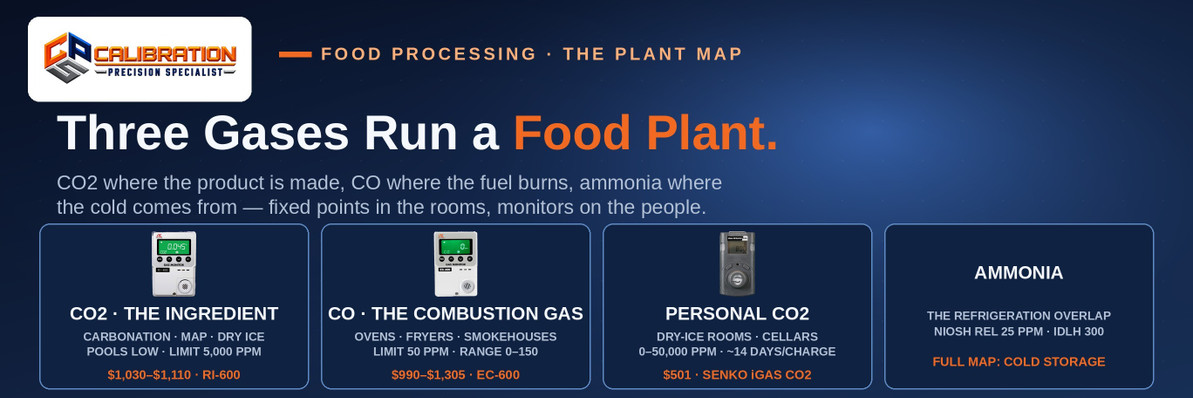
A food processing plant needs detection for three working gases, area by area: carbon dioxide at carbonation, modified-atmosphere packaging, and dry-ice storage (OSHA limit 5,000 ppm, and it pools at floor level), carbon monoxide at gas-fired ovens, fryers, smokehouses, and forklifts (OSHA limit 50 ppm), and ammonia at the refrigeration system (NIOSH recommended limit 25 ppm) — fixed monitors in the rooms where each gas lives, plus personal monitors for the people who enter them.
Food plants rarely call themselves gas plants, which is exactly why their gas hazards get under-monitored. The CO2 system is "the beverage equipment," the ammonia system is "the refrigeration," and the ovens are just the ovens — until a dry-ice room, a smokehouse, or a machinery room puts somebody on the floor. This post maps the plant the way the gases see it: by area, with the exposure limits that set the alarms and the instruments that fit each job. Ammonia gets a pointer to its own full treatment, and CO2 gets a companion deep dive at CO2 in food plants.
CO2: The Gas the Product Is Made With
Carbon dioxide is an ingredient in food plants, not a contaminant: it carbonates beverages, it is the protective atmosphere inside modified-atmosphere packaging, and as dry ice it is the refrigerant that keeps product cold in transit. It is also odorless, colorless, and — at a relative density of 1.53 — about one and a half times heavier than air, so every release pools at floor level and fills low spaces from the bottom up.
The limits (NIOSH Pocket Guide): OSHA PEL 5,000 ppm as a shift average, NIOSH short-term limit 30,000 ppm, and IDLH 40,000 ppm. Those are not distant numbers in a dry-ice storage room, a carbonation hall with a leaking fitting, or a below-grade packaging cellar — small, closed, low rooms are where CO2 incidents happen. The detection pattern:
- Fixed CO2 points in the rooms where CO2 is stored and used — bulk tank rooms, carbonation areas, dry-ice storage — mounted low, where the gas collects. The RKI RI-600, configured at $1,030–$1,110, is the stand-alone wall unit built for this, part of the stand-alone room monitors family.
- A personal CO2 monitor for the person entering the low room. The SENKO iGas CO2, $501, reads 0–50,000 ppm on the person walking into the dry-ice room or the cellar — the reading that matters is the one at their breathing zone as they descend into the pool, not the one at the door. The full CO2 story — carbonation, MAP, and dry ice, room by room — is in the companion post.
CO: The Gas the Cooking Makes
Everything in a food plant that burns fuel makes carbon monoxide when it burns imperfectly: gas-fired ovens and fryers, smokehouses and smoke generators, boilers, and the propane forklifts moving product between them. CO is colorless and odorless, mixes freely with air, and its limits are tight relative to how casually it is produced — OSHA PEL 50 ppm TWA, NIOSH REL 35 ppm with a 200 ppm ceiling, IDLH 1,200 ppm.
- Fixed CO points where combustion runs indoors — oven halls, smokehouses, boiler rooms, enclosed loading areas with forklift traffic. The RKI EC-600, configured at $990–$1,305, is a stand-alone CO monitor ranged 0–150 ppm — a range that brackets the working limits instead of wasting its scale on concentrations far past them.
- Personal 4-gas for maintenance and entries. The mechanic entering a pit, a vessel, or a utility tunnel needs the standard four — LEL, O₂, CO, H₂S (sumps and drains generate H₂S in food plants just as they do everywhere wet and organic). The SENKO SP-MGT, configured at $514–$735, covers that personal layer.
Ammonia Refrigeration: The Plant's Biggest Chemical Inventory
Most mid-size and large food plants refrigerate with anhydrous ammonia, and that system is usually the largest toxic-gas inventory on the site. Its limits: OSHA PEL 50 ppm TWA, NIOSH REL 25 ppm TWA with a 35 ppm short-term limit, IDLH 300 ppm — and at 10,000 lb of anhydrous ammonia, the plant's refrigeration process is inside OSHA's process safety management standard, with the hazard analysis, mechanical integrity, and documentation program that follows. Machinery-room fixed detection, relief and ventilation interlocks, and personal NH₃ monitors for the refrigeration crew are a discipline of their own, and we have written it in full: ammonia detection in cold storage covers the machinery room map, the alarm logic, and the calibration program. The food-plant point here is simply not to leave refrigeration off the detection map because it is "the cold side" — it is the side with the PSM file.
The Supporting Cast: Nitrogen, Sanitation Chemicals, and Sumps
- Nitrogen and oxygen deficiency. Liquid nitrogen storage and nitrogen-flushed packaging displace oxygen quietly and without odor. Air below 19.5 percent oxygen is oxygen-deficient by OSHA's definition, and the watch near LN2 storage and fill points is an oxygen monitor — a fixed O₂ point such as the RKI OX-600, configured at $820–$1,140, where the gas is stored and used.
- Sanitation chemicals. Food plants clean aggressively, and the classic sanitation accident is a mix: chlorine-based sanitizer meeting an acid descaler releases chlorine gas — the gas with a 1 ppm OSHA ceiling and a 10 ppm IDLH. Chemical storage and mixing areas deserve the same respect as a chemical plant's, including detection where bulk mixing happens and training that makes the mix impossible.
- Sumps, drains, and wastewater. Organic load plus standing water generates H₂S and displaces oxygen below grade. Pumped 4-gas before and during any entry, every time — the rule does not bend because the pit is "just a drain."
Calibration: The Part of the Map With Dates on It
Every point above is a sensor that drifts. CPS Calibrations covers the food plant's whole list from one bench: we sell the fixed CO, CO2, and O₂ room monitors and the personal instruments; we calibrate them at published in-house rates — $55 single-gas, $90 for 4- and 5-gas — and we calibrate every channel the instrument has. Fixed systems tied into alarms and ventilation are serviced on-site, quoted in writing; repairs are quoted in writing before work. Every instrument enters the CPS Calibration Program with a certificate, a due date, and a reminder — so the machinery-room audit, the insurance walk-through, and the PSM file all read the same record. Start at calibration services or call 865-900-8844.
Frequently Asked Questions
What gases need monitoring in a food processing plant?
Three working gases cover most of the map: carbon dioxide (carbonation, modified-atmosphere packaging, dry ice — OSHA limit 5,000 ppm, pools at floor level), carbon monoxide (gas-fired ovens, fryers, smokehouses, boilers, forklifts — OSHA limit 50 ppm), and ammonia (refrigeration — NIOSH recommended limit 25 ppm). Around them sit oxygen deficiency near liquid nitrogen, chlorine risk where sanitation chemicals are mixed, and H₂S in sumps and drains.
Is gas detection in a food plant a food-safety (FDA/USDA) requirement?
The duties that drive it are worker-protection duties — OSHA's exposure limits for CO2, CO, and ammonia apply to the plant's employees whatever the product is. There is no separate food-safety rule that substitutes for them. In practice the same records serve several audiences: OSHA exposure compliance, the ammonia PSM file where the plant is covered, insurer and auditor walk-throughs, and customer food-safety audits that ask how the plant controls chemical hazards around its people.
Why is CO2 dangerous in a food plant if it's in soda?
Dose and place. CO2 is odorless and about 1.5 times heavier than air, so a leak or a subliming dry-ice load fills a low, closed room from the floor up. OSHA's limit is 5,000 ppm averaged over a shift; NIOSH's short-term limit is 30,000 ppm and 40,000 ppm is immediately dangerous to life or health. A dry-ice storage room or a below-grade packaging area can reach those levels without any smell or visible sign — which is why the rooms get fixed low-mounted monitors and the people entering them get personal ones.
Where does carbon monoxide come from in a food plant?
Any fuel burning imperfectly: gas-fired ovens and fryers, smokehouses and smoke generators, boilers and water heaters, and propane forklifts working indoors. CO is colorless and odorless, with an OSHA limit of 50 ppm as a shift average and a NIOSH ceiling of 200 ppm. Fixed CO monitors belong in oven halls, smokehouses, boiler rooms, and enclosed forklift areas; a stand-alone unit ranged 0–150 ppm, like the RKI EC-600 at $990–$1,305 configured, reads the range where the limits actually sit.
Does a food plant's ammonia refrigeration fall under process safety management?
It does when the system holds 10,000 lb or more of anhydrous ammonia, the Appendix A threshold in OSHA's PSM standard (29 CFR 1910.119) — a line many mid-size and large food plants cross. Below that line the exposure limits still apply (OSHA 50 ppm TWA; NIOSH 25 ppm recommended) and machinery-room detection is still the standard of care. The full machinery-room map is in our ammonia detection in cold storage post.
What gas detector should a worker wear in a food plant?
Match the monitor to the errand. Dry-ice rooms, carbonation areas, and cellars call for a personal CO2 monitor (the SENKO iGas CO2, $501, reading 0–50,000 ppm). Refrigeration rounds call for an ammonia-capable monitor. Maintenance and any below-grade entry call for a 4-gas (LEL, O₂, CO, H₂S) like the SENKO SP-MGT at $514–$735 configured, pumped for entries. The fixed room monitors protect the space; the personal monitor protects the person who walks into it.
Can cleaning chemicals create a gas hazard in a food plant?
Yes — the classic sanitation accident is a chemical mix. Chlorine-based sanitizers combined with acidic descalers release chlorine gas, which carries a 1 ppm OSHA ceiling and a 10 ppm IDLH. Bulk chemical storage and mixing areas deserve separation of incompatibles, ventilation, training, and — where mixing is routine — detection, with the same seriousness a chemical plant gives its chlorine areas, because the gas does not care what industry produced it.
Why monitor oxygen in a food plant?
Because food plants store and use inert gases. Liquid nitrogen for freezing and nitrogen flushing for packaging displace oxygen without color, odor, or irritation — a person can be overcome in an oxygen-deficient room with no warning sensation at all. Air under 19.5 percent oxygen is oxygen-deficient by definition, so LN2 storage and use points get fixed oxygen monitoring (an RKI OX-600 configures at $820–$1,140), and entries into nitrogen-blanketed spaces are treated as the confined-space events they are.
How much does gas detection for a food plant cost?
At CPS list prices, room by room: a fixed CO2 point (RKI RI-600) configures at $1,030–$1,110; a fixed CO point (RKI EC-600) at $990–$1,305; a fixed oxygen point (RKI OX-600) at $820–$1,140. Personal instruments: iGas CO2 at $501; 4-gas SP-MGT at $514–$735 configured. Calibration is the recurring line: $55 per single-gas instrument and $90 per 4- or 5-gas instrument at published in-house rates, with records and reminders included.
Who calibrates a food plant's gas detectors?
CPS Calibrations does — the fixed room monitors, the personal CO2 and 4-gas instruments, and the refrigeration crew's ammonia monitors, on one program with one record per instrument. Portables are calibrated on the Rockwood bench at published in-house rates; installed fixed systems are serviced on-site, quoted in writing. Every calibration returns a certificate with as-found and as-left readings and a reminder before the next due date — call 865-900-8844.
The Bottom Line
A food plant's gas map is three gases deep: CO2 pooling in the low rooms where the product is carbonated, packed, and frozen; CO coming off every burner in the building; and an ammonia refrigeration system big enough to carry a federal safety program — plus nitrogen, sanitation chemistry, and sumps around the edges. Fixed points in the rooms, personal monitors on the people, and calibration records that prove both. CPS Calibrations covers the whole map from one bench in Rockwood, Tennessee.
Food plant in East Tennessee building or fixing its detection map? Call CPS Calibrations at 865-900-8844 — tell us the areas and we'll price the points, the portables, and the calibration plan together.
CPS Calibrations · 109 S. Front Street, Rockwood, TN 37854 · Calibration Services · The CPS Calibration Program · Ammonia Detection in Cold Storage
Need a calibration you can file?
In-house calibration at CPS in Rockwood, Tennessee — $55 for single-gas instruments, $90 for 4- and 5-gas — every channel, as-found and as-left data, full certificate.
See Calibration Servicesor call 865-900-8844
Recent Posts
-

What Is Remote Monitoring for Fixed Gas Detection?
Remote monitoring for fixed gas detection means a fixed system's live readings, trends, and alarm hi …Nov 23rd 2026 -

What Are the Key Differences Between the GX-6000 and GX-6100?
The RKI GX-6100 is the current replacement for the discontinued GX-6000: both are pumped 6-gas monit …Nov 22nd 2026 -

How to Read a PID Correction Factor Chart
To read a PID correction factor chart, find your vapor’s row, take the factor under your own lamp en …Nov 21st 2026