
Stand-Alone Room Monitors: OX-600, EC-600, RI-600, and PS 2
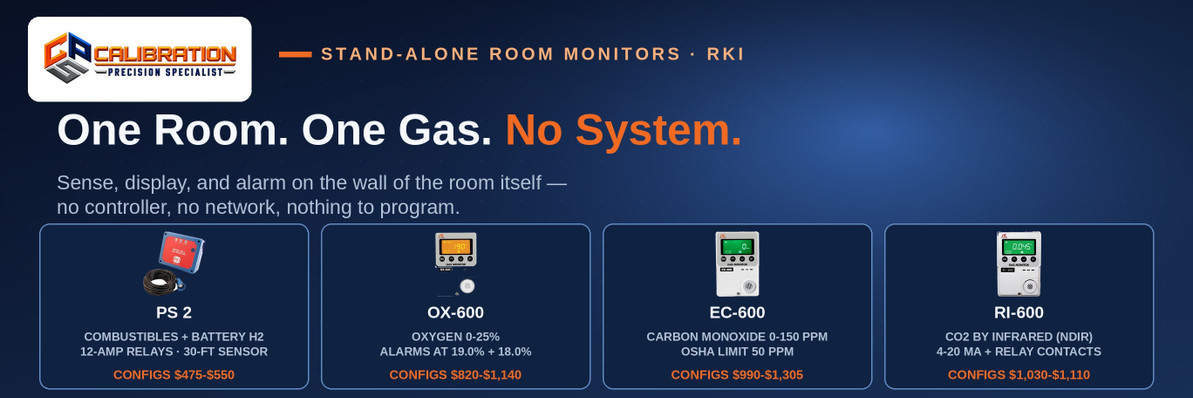
A stand-alone room monitor watches one room for one gas with no controller and no system around it: RKI's OX-600 guards oxygen (0–25%, preset alarms at 19.0% and 18.0%; listed at $785, configured builds $820–$1,140), the EC-600 guards carbon monoxide (0–150 ppm; listed $945, configured $990–$1,305), the RI-600 guards carbon dioxide by infrared (ranges to 5% volume; listed $980, configured $1,030–$1,110), and the PS 2 guards combustibles at LEL or ppm levels (listed $450, configured $475–$550).
Not every gas problem is a system. A cylinder-storage room that needs an oxygen watch, a lab with a carbon monoxide source, a beverage cellar where CO2 pools, a battery room making hydrogen — each is one room, one gas, and one question that needs an instrument answering it continuously. That is the stand-alone monitor's job: sense, display, and alarm right on the wall of the room it protects, with nothing to engineer, network, or program. RKI's four cover the four gases that account for most single-room jobs. This post walks each one — what it senses, how it alarms, what it costs configured — and the honest limits that tell you when a room has outgrown a stand-alone and needs a system.
RKI OX-600 Indoor Stand Alone Oxygen 0-25% Monitor
One room, one gas, no system: RKI's OX-600 oxygen monitor (alarms at 19.0%/18.0%; listed $785), EC-600 CO monitor 0–150 ppm (listed $945), RI-600 infrared CO2 monitor (listed $980), and PS 2 combustible/hydrogen monitor (listed $450) — what each watches, how each alarms, configured prices, and when a room has outgrown a stand-alone.
$820–$1,140 configured
See the OX-600The OX-600: The Oxygen Watch
The OX-600 is an indoor stand-alone oxygen monitor reading 0–25.0% volume in 0.1% increments — the instrument for any room where stored or piped inert gas (nitrogen, argon, helium, CO2) can displace the air: cylinder stores, labs, cryogenic and gas-manifold rooms. Its two preset alarms sit at 19.0% and 18.0% oxygen — warning before, and at, the point where the air itself is the hazard (OSHA treats below 19.5% as oxygen-deficient). The tri-color display changes color as levels reach each alarm, backed by an audible tone. Its galvanic cell sensor is plug-in style and field-replaceable with no special tools, and it can be remotely mounted on an optional sensor cable — 3, 5, 10, or 20 meters — so the sensor sits in the low corner where displaced air pools while the display stays at the door. Power is your choice: alkaline batteries, 24 VDC, or 115 VAC. Listed at $785; configured builds run $820–$1,140 by power source and cable length.
The EC-600: Carbon Monoxide in Occupied Rooms
The EC-600 watches carbon monoxide from 0–150 ppm in the rooms people actually work in — laboratories, mechanical rooms, commercial spaces near combustion equipment. CO is the exposure with an OSHA limit of 50 ppm as an 8-hour average, and it gives no warning of its own: no color, no smell. The EC-600's electrochemical sensor is fast-responding, plug-in style, and field-replaceable with no tools; the multicolored LED display and audible alarm announce a rise in the room itself. It comes ready to operate with a wall-mount bracket and a 10-foot power cord, on alkaline, 24 VDC, or 115 VAC power. Listed at $945; configured builds run $990–$1,305, the spread driven by the same power and remote-cable choices as its oxygen sibling.
The RI-600: Carbon Dioxide, by Infrared
The RI-600 measures CO2 with a non-dispersive infrared (NDIR) sensor — the right principle for a gas that fermentation, dry ice, beverage carbonation, and CO2 cooling systems all release into rooms where it pools low and displaces oxygen. Five ranges cover the applications: 0–2,000 ppm, 0–5,000 ppm, and 0–10,000 ppm for occupied-space and process monitoring, and 0–2% and 0–5% volume for richer atmospheres. It carries two preset alarms with an audible tone and multicolored display, and it is the most system-friendly of the four: a 4–20 mA output and gas alarm relay contacts let it report outward and switch ventilation, on 115 VAC or 24 VDC power. Listed at $980; configured builds run $1,030–$1,110.
The PS 2: The Combustible Point
The PS 2 is the combustible member of the family — a multipurpose monitor on a metal-oxide (MOS) sensor for LEL-level or ppm-level detection of flammable gases and solvent vapors, and RKI's low-cost answer for hydrogen detection in battery rooms. Two alarm levels track rising gas, and each level activates a 12-amp relay inside the unit — terminals are provided to switch an external alarm or a ventilation fan directly — alongside a built-in 85 dB audible alarm and Pilot/Alarm 1/Alarm 2 lights. The standard build puts the sensor on the end of a 30-foot cable, so the sensing point sits where the gas collects while the unit mounts where people can see and reach it. Power is 115 VAC or 24 VDC standard, 48 VDC optional. Listed at $450; configured builds run $475–$550 — the least expensive fixed combustible point in this family.
When Is a Stand-Alone Enough — and When Is It Not?
A stand-alone is enough when the job is genuinely one room and one gas, the alarm needs to be heard in or at that room, and nobody needs the reading logged centrally. The data-center map makes the pattern concrete — battery-room hydrogen on a PS 2, generator-room CO on an EC-600, suppression-hall oxygen on an OX-600, CO2 cooling on an RI-600 are the worked examples in what gas detection a data center needs, and the full range sits under stand-alone detectors.
Step up to a system when the count or the consequences grow: several points that need one display and shared alarm logic belong on a Beacon controller; a classified-area point that must alarm and report belongs on a transmitter like the M2A-XL; and a point that cannot be wired belongs on the wireless platform. The monitor on the wall is not a lesser instrument — it is the right-sized one, until the job outgrows the room.
Calibration still applies — it is the whole ballgame at this scale. A stand-alone has no controller double-checking it; its sensor's drift is the room's risk. We calibrate every channel on monitors like these, with the same as-found/as-left documentation a system gets, through calibration services.
Frequently Asked Questions
What is a stand-alone gas monitor?
A fixed gas detector that needs nothing around it: it senses one gas in one room, displays the reading on its own face, and alarms on its own — no controller, no network, no system programming. RKI's room-monitor family covers the four common single-room gases: oxygen (OX-600), carbon monoxide (EC-600), carbon dioxide (RI-600), and combustibles (PS 2). Each is a complete instrument on the wall of the room it protects.
How much do stand-alone room monitors cost?
At live CPS list prices: the PS 2 combustible monitor is listed at $450 with configured builds at $475–$550; the OX-600 oxygen monitor is listed at $785, configured $820–$1,140; the EC-600 CO monitor is listed at $945, configured $990–$1,305; and the RI-600 CO2 monitor is listed at $980, configured $1,030–$1,110. On the 600-series units the spread is power source (alkaline, 24 VDC, or 115 VAC) and remote-sensor cable length.
At what oxygen level does the OX-600 alarm?
Its two preset alarms are 19.0% and 18.0% oxygen by volume. The first alarm warns as air goes oxygen-deficient — OSHA defines a deficient atmosphere as below 19.5% — and the second marks a deeper displacement. The OX-600 reads 0–25.0% in 0.1% increments, its tri-color display changes color at each alarm level, and an audible tone sounds with it.
Why does the EC-600 only read to 150 ppm of CO?
Because it is an occupied-room exposure monitor, not a process instrument. Carbon monoxide's OSHA permissible exposure limit is 50 ppm as an 8-hour average, so a 0–150 ppm range covers the concentrations that matter for warning people in labs, mechanical rooms, and commercial spaces — with resolution where the exposure decisions live, around and above that 50 ppm limit.
What CO2 ranges does the RI-600 come in?
Five: 0–2,000 ppm, 0–5,000 ppm, and 0–10,000 ppm for occupied spaces and process areas, plus 0–2% and 0–5% by volume for richer CO2 atmospheres. All use a non-dispersive infrared (NDIR) sensor, carry two preset alarms, and — unlike the simpler room monitors — the RI-600 also provides a 4–20 mA output and alarm relay contacts, so it can report to other systems and switch ventilation.
Can the PS 2 detect hydrogen in a battery room?
Yes — RKI positions the PS 2 as a low-cost solution for exactly that job: hydrogen detection in battery rooms, along with LEL or ppm-level detection of flammable and solvent vapors in general industry. Its MOS sensor drives two alarm levels; each level activates a 12-amp relay (wired to an external alarm or a ventilation fan), with an 85 dB built-in audible alarm, and the standard sensor sits on a 30-foot cable so it can hang where hydrogen collects.
Can one stand-alone monitor watch two gases?
No. Each of these monitors is built around one sensor and one gas — an OX-600 reads oxygen only, an EC-600 carbon monoxide only. A room with two gas hazards takes two monitors, which is still often the simplest correct answer; several rooms or several gases that need central display, shared alarms, or logging are where a controller-based system takes over.
What is a remote sensor cable for?
Placement. The gas and the reader rarely want to be in the same spot: displaced oxygen pools low, CO2 sinks, hydrogen rises. On the OX-600 and EC-600, an optional remote sensor cable (3, 5, 10, or 20 meters) puts the sensor at the height and corner where the gas actually collects, while the display and alarm stay at the door where people will see them. The PS 2 builds the idea in — its sensor comes on a 30-foot cable as standard.
How are stand-alone monitors powered?
By model: the OX-600 and EC-600 offer three options — alkaline batteries, 24 VDC, or 115 VAC — chosen at configuration. The RI-600 runs on 115 VAC or 24 VDC. The PS 2 is 115 VAC or 24 VDC standard, with a 48 VDC version available. The power choice is one of the options that moves the configured price on the 600-series units.
Do stand-alone room monitors need calibration?
Yes — arguably more than system heads, because nothing else checks them. A stand-alone's display and alarms are only as true as its one sensor, and electrochemical, galvanic, MOS, and infrared sensors all drift on their own schedules. Keep each monitor on a written calibration schedule with as-found and as-left readings; CPS calibrates these units with the same documentation standard as a full system.
The Bottom Line
One room, one gas, no system: oxygen on an OX-600, CO on an EC-600, CO2 on an RI-600, combustibles and battery-room hydrogen on a PS 2 — listed from $450 to $980 before configuration options. When the job grows past one room, the same gases scale up to transmitters and controllers; until then, the monitor on the wall is the right-sized instrument.
Watching one room that needs a gas answer? Call CPS Calibrations at 865-900-8844 — stand-alone monitors, fixed systems, installation, and calibration, backed by the CPS Calibration Program, from Rockwood, Tennessee.
CPS Calibrations · 109 S. Front Street, Rockwood, TN 37854 · Calibration Services · The CPS Calibration Program
Need a calibration you can file?
In-house calibration at CPS in Rockwood, Tennessee — $55 for single-gas instruments, $90 for 4- and 5-gas — every channel, as-found and as-left data, full certificate.
See Calibration Servicesor call 865-900-8844
Recent Posts
-

What Is Remote Monitoring for Fixed Gas Detection?
Remote monitoring for fixed gas detection means a fixed system's live readings, trends, and alarm hi …Nov 23rd 2026 -

What Are the Key Differences Between the GX-6000 and GX-6100?
The RKI GX-6100 is the current replacement for the discontinued GX-6000: both are pumped 6-gas monit …Nov 22nd 2026 -

How to Read a PID Correction Factor Chart
To read a PID correction factor chart, find your vapor’s row, take the factor under your own lamp en …Nov 21st 2026