
CO2 in Distilleries: The Fermentation Gas That Pools in Barrel Warehouses
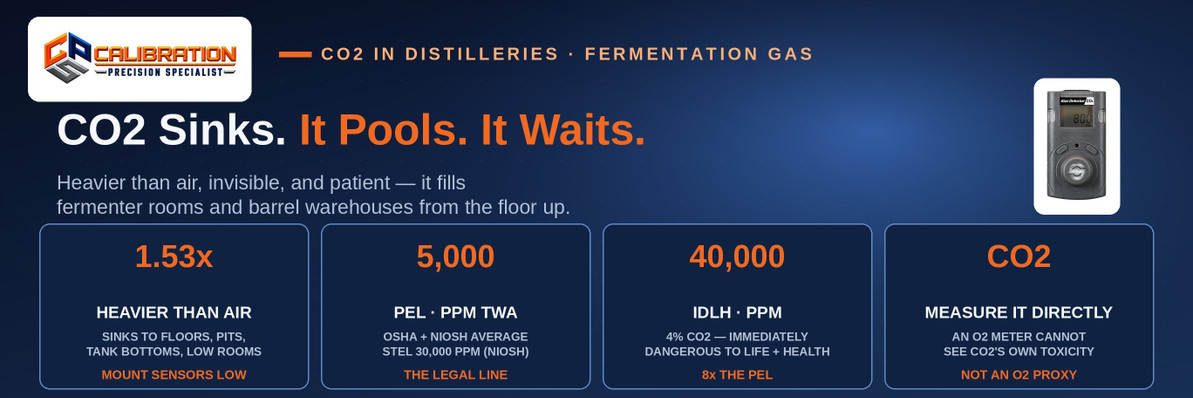
Carbon dioxide is the distillery hazard that behaves like a liquid: fermentation releases it in volume, it is 1.53 times heavier than air, and it sinks to pool in fermenter rooms, pits, tank bottoms, and the low corners of barrel warehouses — against an OSHA PEL of 5,000 ppm, a NIOSH short-term limit of 30,000 ppm, and an IDLH of 40,000 ppm. Because CO2 is colorless, odorless, and toxic on its own — not merely an oxygen displacer — it must be measured directly, with fixed sensors mounted low and a personal CO2 monitor on anyone who works in the low air.
This is the deep dive behind the distillery hub post, what gas detection does a distillery need? — one gas, covered completely: where it comes from, where it goes, what the limits mean, and where the detectors belong.
Where Does Distillery CO2 Come From?
Fermentation is the headline source: yeast converting sugar produces ethanol and carbon dioxide together, continuously, for as long as the fermenter is active — and a distillery's fermenters are active in rotation, which makes CO2 a standing condition of the building rather than an occasional release. It leaves the process through airlocks and vents, open fermenter tops, racking and transfer operations, and CIP cycles.
Fermentation is not the only source. Add carbonation and CO2 blanketing where they are practiced, bulk CO2 storage and its piping, and dry ice used in cooling and shipping. Every one of those releases lands in the same low places, which is why the map of sources matters less than the map of where the gas ends up.
Why Does CO2 Pool Instead of Dispersing?
Density and still air. CO2's relative gas density is 1.53 — half again heavier than air — so released gas falls, flows along floors like a slow liquid, and fills low volumes from the bottom up: pits first, then tank and vessel bottoms, then below-grade rooms, then the floor layer of any quiet space. Barrel warehouses and rickhouses are near-perfect collectors: large volumes, minimal mechanical ventilation, infrequent entry, and workers whose tasks — moving, sampling, and repairing barrels — put their heads at floor level, in the deepest part of the pool.
Stratification is the trap inside the trap. The layer boundary can sit anywhere, so air sampled at standing head height tells you almost nothing about the air at the bottom of the pit or inside the tank. A room is not "tested" because a reading at the door was clean.
What Are the CO2 Exposure Limits?
Verified against the NIOSH Pocket Guide:
- OSHA PEL: 5,000 ppm as an 8-hour time-weighted average — the enforceable limit.
- NIOSH REL: 5,000 ppm TWA, with a short-term limit of 30,000 ppm over 15 minutes.
- NIOSH IDLH: 40,000 ppm — 4% CO2 is immediately dangerous to life or health.
Read the shape of those numbers: the short-term ceiling sits six times above the daily average, and the IDLH eight times above it. CO2 exposure in a distillery is a peak problem — a worker is rarely over-exposed by a slightly elevated room average; he is over-exposed by descending into a pocket where the concentration is an order of magnitude higher than the room's. That is why continuous direct measurement, not periodic room checks, is the control that matches the hazard. The related oxygen rule: an atmosphere under 19.5% oxygen is oxygen-deficient under OSHA's confined-space standard — but as the next section explains, watching oxygen alone is the classic mistake with this gas.
Why Isn't an Oxygen Monitor Enough for CO2?
Because CO2 harms you two ways, and an oxygen sensor only sees one of them. CO2 does displace breathable air — that part an O2 channel can catch. But CO2 is also directly toxic at concentrations far below the IDLH: it drives breathing rate, headaches, confusion, and impaired judgment on its own account, which is precisely why OSHA and NIOSH publish CO2 limits (5,000 ppm) that trigger long before displacement alone would push oxygen anywhere near 19.5%. Air can read acceptably on oxygen while its CO2 content is already several times the exposure limit. A standard 4-gas monitor (LEL/O2/CO/H2S) has no CO2 channel at all — in a fermenter room it can show a clean screen in genuinely dangerous air. Measure CO2 directly or do not claim to have measured it.
Where Do Fixed CO2 Sensors Belong in a Distillery?
Low, at the pool, not at the ceiling. Fixed CO2 points earn their keep in fermenter rooms (near floor level and near pits), at the bottoms of below-grade spaces, in barrel warehouses and rickhouses, and around bulk CO2 storage and dry-ice handling — wired to local audible/visual alarms positioned so the warning is heard before entry, and to ventilation where the design calls for it. A sensor mounted at head height in a stratified room is a sensor installed in the wrong layer of air. CPS designs and installs these systems through fixed system installation — sensor placement at the gas's actual level is the whole craft of the install.
Fixed detection guards the space. It does not guard the worker who leaves the space's coverage — into a tank, a pit the fixed point does not see into, or a warehouse aisle between sensors. That worker carries the second layer.
What Personal CO2 Monitor Do Distillery Workers Carry?
A dedicated infrared CO2 instrument worn in the breathing zone. The SENKO iGas Detector CO2 ($501) is the personal CO2 monitor CPS sells for exactly this work — a single-gas IR instrument that reads CO2 in ppm continuously and alarms on the way into a pocket, not after. Honest ownership math belongs in the open: the IR sensor is the wear part on any CO2 instrument, and SENKO's replacement CO2 IR sensor runs $335.80 when the day comes — budget for it the way you budget for sensors in any 4-gas fleet. The personal monitor pairs with the fixed system, and both pair with calibration: we calibrate every channel, iGas included, through calibration services.
Frequently Asked Questions
Why is CO2 dangerous in distilleries?
Fermentation releases CO2 continuously, and the gas is 1.53 times heavier than air, so it sinks and pools in fermenter rooms, pits, tanks, and barrel warehouses. It is colorless and odorless — no sight or smell warning — and it is directly toxic as well as an oxygen displacer. OSHA's PEL is 5,000 ppm (8-hour average), NIOSH's short-term limit is 30,000 ppm, and the IDLH is 40,000 ppm.
Where does CO2 collect in a distillery?
In the lowest still air available: fermentation pits and trenches, the bottoms of tanks and fermenters, below-grade cellar rooms, floor-level layers of barrel warehouses and rickhouses, and around dry-ice storage and bulk CO2 equipment. Because CO2 stratifies, the dangerous layer can be knee-deep or room-deep — air at standing head height can test clean over a dangerous pool.
What is the OSHA limit for CO2?
5,000 ppm as an 8-hour time-weighted average under 29 CFR 1910.1000. NIOSH recommends the same 5,000 ppm average and adds a 30,000 ppm short-term exposure limit over 15 minutes. NIOSH's IDLH for CO2 — the concentration immediately dangerous to life or health — is 40,000 ppm (4%).
Can an oxygen monitor detect a CO2 problem?
Not reliably, and that gap is the classic distillery mistake. An O2 sensor only shows displacement; CO2 reaches its own toxic limits — 5,000 ppm PEL, symptoms building well below the 30,000 ppm short-term limit — at concentrations where the oxygen reading has barely moved, because CO2 is directly toxic, not just a displacer. A standard 4-gas monitor has no CO2 channel. CO2 must be measured with a CO2 sensor.
Where should CO2 detectors be mounted in a fermenter room?
Low — near floor level, at pits and low corners, where the gas actually pools — with alarms audible and visible at the room's entrances so the warning lands before entry. Ceiling- or head-height mounting samples the wrong layer in a stratified room. Fixed points cover the space continuously; workers entering pits, tanks, or low areas still carry a personal CO2 monitor.
What is the best personal CO2 monitor for distillery work?
A dedicated single-gas infrared CO2 instrument worn in the breathing zone — CPS sells the SENKO iGas Detector CO2 at $501 for this application. Whatever the brand, the buying criteria are the same: a true IR CO2 channel reading in ppm (not an O2-only proxy), audible/visual/vibrating alarms, datalogging for exposure records, and a calibration routine your shop will actually keep.
Are barrel warehouses and rickhouses dangerous for CO2?
Yes — quietly. Rickhouses ventilate slowly, are entered infrequently, and put workers at floor level moving and sampling barrels, which is exactly the deepest part of any CO2 pool that has migrated in from fermentation or formed around stored product. Fixed low-mounted CO2 detection, or a personal CO2 monitor required for entry, is the control; "the door was open for a while" is not a test.
How much does a personal CO2 monitor cost to own?
The SENKO iGas CO2 is $501 to buy. The honest running costs: calibration at $55 per single-gas instrument in-house at CPS, and eventual IR sensor replacement — SENKO's CO2 IR sensor is $335.80 — when the fitted sensor reaches end of life. That is still the cheapest layer of the system: one personal monitor covers one worker in every low space he enters, including the pits and tanks no fixed sensor can see into.
Do CO2 detectors need calibration?
Yes — IR CO2 sensors drift like any other channel, and a drifted CO2 reading is worst-direction wrong: it reports the pool as shallower than it is. Follow the manufacturer's calibration interval and bump-check per your program. CPS calibrates CO2 instruments in-house at 109 S. Front Street, Rockwood, TN, or by ship-in, at the $55 single-gas rate.
What should you do if a CO2 alarm sounds in a fermenter room or warehouse?
Leave the low air — move up and out to fresh air immediately, warn others, and do not re-enter or attempt a rescue into the pooled area without supplied air and a confined-space procedure. CO2's danger profile (odorless, fastest at floor level, judgment impaired early) is built to catch would-be rescuers. Ventilate, test from outside the space with a pumped instrument or the fixed system, and only re-enter when direct CO2 readings — not just oxygen — are back within limits.
The Bottom Line
CO2 in a distillery is a floor-level hazard with ceiling-level consequences: 1.53 times heavier than air, pooled in fermenter rooms, pits, and barrel warehouses, limited at 5,000 ppm on average and immediately dangerous at 40,000 ppm — and invisible to the oxygen channel of a standard 4-gas monitor. Measure it directly, mount fixed sensors low, carry a personal CO2 monitor into the low air, and keep every channel calibrated.
Setting up CO2 detection for a distillery? Call CPS Calibrations at 865-900-8844 — personal monitors, fixed systems, and the CPS Calibration Program behind them, from Rockwood, Tennessee.
CPS Calibrations · 109 S. Front Street, Rockwood, TN 37854 · Calibration Services · The CPS Calibration Program
Need a calibration you can file?
In-house calibration at CPS in Rockwood, Tennessee — $55 for single-gas instruments, $90 for 4- and 5-gas — every channel, as-found and as-left data, full certificate.
See Calibration Servicesor call 865-900-8844
Recent Posts
-

What Is Remote Monitoring for Fixed Gas Detection?
Remote monitoring for fixed gas detection means a fixed system's live readings, trends, and alarm hi …Nov 23rd 2026 -

What Are the Key Differences Between the GX-6000 and GX-6100?
The RKI GX-6100 is the current replacement for the discontinued GX-6000: both are pumped 6-gas monit …Nov 22nd 2026 -

How to Read a PID Correction Factor Chart
To read a PID correction factor chart, find your vapor’s row, take the factor under your own lamp en …Nov 21st 2026