
What Gas Detection Does a Distillery Need?
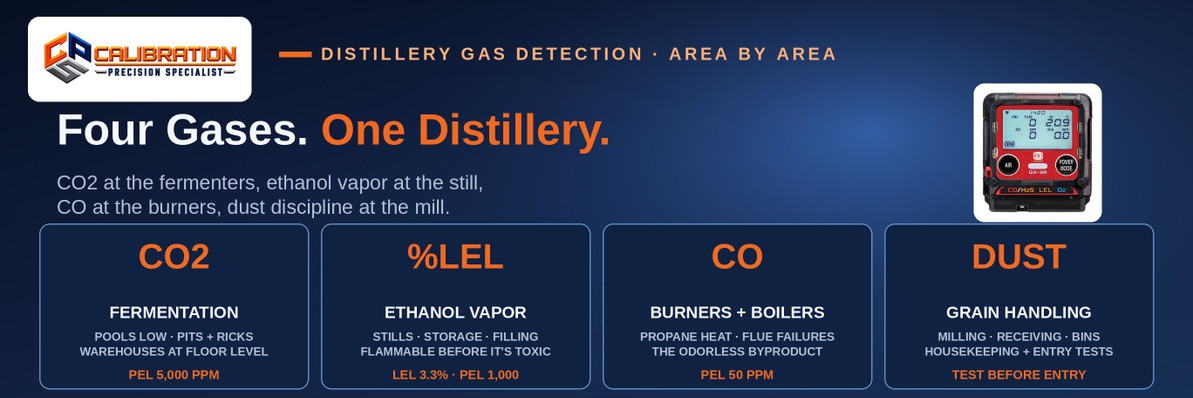
A distillery needs carbon dioxide detection at fermenters, pits, and barrel warehouses — CO2 pours off fermentation, is about 1.5 times heavier than air, and pools low against an OSHA PEL of 5,000 ppm and an IDLH of 40,000 ppm — plus %LEL monitoring for ethanol vapor at stills, spirit storage, and filling lines (ethanol PEL 1,000 ppm, LEL 3.3%), carbon monoxide monitoring at propane-fired burners and boilers (PEL 50 ppm), and personal 4-gas monitors for the people who enter those rooms. Fixed detectors guard the spaces; portable monitors guard the workers; both layers are standard practice, not alternatives.
A distillery is a food plant, a chemical plant, and a warehouse sharing one roof — and each part makes a different gas. This post maps the hazards area by area: fermenter rooms and rickhouses, the still and filling line, grain handling, and the boiler room, with the verified exposure limits for each gas and the instruments that cover them. The deepest single hazard gets its own post: CO2 in distilleries.
Which Gases Does a Distillery Produce?
Four, in normal operation:
- Carbon dioxide (CO2) — released in large volume by fermentation, and again wherever dry ice, carbonation, or CO2 blanketing is used. Colorless, odorless, heavier than air.
- Ethanol vapor — evaporates at the still, in spirit storage, and at filling. The toxic limit is 1,000 ppm, but the working hazard is flammability: ethanol's lower explosive limit is 3.3% by volume, so vapor is monitored as %LEL long before toxicity is the concern.
- Carbon monoxide (CO) — the product of incomplete combustion at propane or gas-fired still burners, boilers, and heaters. PEL 50 ppm; IDLH 1,200 ppm.
- Fuel gas itself — a leaking propane line or valve is a %LEL event in the boiler room (propane LEL 2.1%, PEL 1,000 ppm), separate from the CO its burner can make.
Add a fifth condition rather than a fifth gas: oxygen displacement. Any room where CO2 collects is a room where breathable air is being pushed out — OSHA treats an atmosphere below 19.5% oxygen as oxygen-deficient, and fermentation cellars are exactly where that happens.
What Gas Detection Do Fermenter Rooms and Barrel Warehouses Need?
CO2, measured directly, mounted low. Fermentation converts sugar to ethanol and CO2 continuously while a fermenter is active, and the gas leaves through airlocks, open tops, and CIP operations into rooms that are often below grade or poorly ventilated. Because CO2's relative density is 1.53, it sinks and stratifies: the air at head height can test fine while the air at the bottom of a pit, a tank, or a low warehouse corner is dangerous. Barrel warehouses and rickhouses add a slower version of the same problem in large, quiet, seldom-ventilated volumes.
The practical build is two layers. Fixed CO2 detection — sensors mounted near floor level in fermenter rooms, pits, and warehouses, tied to audible/visual alarms and ventilation — watches the space around the clock, including the hours nobody is in it; CPS designs and installs those systems through fixed system installation. Personal CO2 monitors protect the individual worker who descends into a pit or opens a tank — the fixed sensor on the far wall cannot speak for the air inside the vessel. Placement, limits, and the oxygen-monitor trap are covered in full in CO2 in distilleries: the fermentation gas that pools in barrel warehouses.
What Gas Detection Do Stills, Spirit Storage, and Filling Lines Need?
%LEL, first and always. Ethanol is a Class IB flammable liquid with a 55°F flash point, and the vapor space around a running still, a spirit tank, or a filler can reach a flammable mixture from a leak or spill long before anyone's 1,000 ppm toxic exposure is the issue — 10% of ethanol's LEL is 3,300 ppm, which NIOSH uses as its IDLH basis for ethanol. Fixed LEL detection near stills and storage, and personal monitors with an LEL channel for operators, are how that vapor is caught at alarm fractions of the LEL instead of by smell or luck.
The instrument most distilleries standardize on for people is a portable multi-gas monitor reading LEL, O2, CO, and H2S together — the RKI GX-3R runs $590–$690 depending on configuration, and the SENKO SP-MGT runs $514–$735. One worn instrument covers the still floor, the boiler room, and the fermenter-room door check in a single walk.
What About Grain Dust and the Boiler Room?
Grain handling — receiving, milling, and mash areas — is primarily a combustible-dust housekeeping problem: settled grain dust kept off surfaces, ignition sources controlled, and atmospheric testing (oxygen and %LEL) before anyone enters a bin, silo, or pit as a confined space. Dust is controlled with housekeeping and ventilation; the gas detection contribution is the pre-entry test and the monitor worn inside.
The boiler room and burner spaces are CO territory. A propane burner that is out of tune, a blocked flue, or a cracked heat exchanger puts carbon monoxide into the room — the 50 ppm PEL gas with no color and no odor. A fixed CO point or a diligent personal-monitor habit covers it; a burner room that also stores the propane supply adds %LEL coverage for the fuel leak that precedes the fire risk. Forklifts running on propane inside warehouses belong in the same CO conversation.
Does a Small Craft Distillery Need the Same Detection as a Large One?
The gases do not scale down with the still. A 500-gallon craft fermenter releases the same CO2 per gallon of wash as an industrial fermenter; a two-person operation has fewer people to notice a coworker down in a pit, not less gas. What scales is the build: a small distillery may cover fermenter and warehouse spaces with personal CO2 monitors and a 4-gas unit per shift instead of a full fixed system at first — and add fixed points as production grows. What never scales away is calibration: we calibrate every channel on the instruments above, in-house at our Rockwood, Tennessee shop or shipped in, through calibration services. Tennessee whiskey country is our backyard — CPS is in Rockwood, an easy drive from the distilleries of Lynchburg, Cascade Hollow, and the craft houses across East Tennessee.
Frequently Asked Questions
What gas detection does a distillery need?
Four coverage areas: CO2 detection (fixed points mounted low plus personal monitors) at fermenters, pits, and barrel warehouses, against a 5,000 ppm OSHA PEL and 40,000 ppm IDLH; %LEL monitoring for ethanol vapor at stills, spirit storage, and filling lines (ethanol LEL 3.3%, PEL 1,000 ppm); carbon monoxide monitoring at propane burners and boilers (PEL 50 ppm); and personal 4-gas monitors (LEL/O2/CO/H2S) for workers moving between areas and making confined-space entries.
Why is CO2 dangerous in a distillery?
Fermentation produces CO2 in large volume, and CO2 is about 1.5 times heavier than air (relative density 1.53), so it sinks and pools in fermenter rooms, pits, tanks, and low corners of barrel warehouses. It is colorless and odorless, so there is no warning by sight or smell. OSHA's PEL is 5,000 ppm as an 8-hour average; NIOSH sets the IDLH at 40,000 ppm — the level at which the atmosphere is immediately dangerous to life or health.
Do distilleries need fixed gas detectors or personal monitors?
Both, doing different jobs. Fixed detectors watch a space continuously — including nights and weekends — alarm locally, and can start ventilation; they are the right layer for fermenter rooms, warehouses, and still areas. Personal monitors travel with the worker into pits, tanks, and rooms the fixed system does not cover, and they measure the air the worker is actually breathing. A fixed sensor across the room cannot certify the air inside a fermenter.
What gas monitor should distillery workers wear?
For general work, a 4-gas personal monitor reading %LEL, oxygen, carbon monoxide, and hydrogen sulfide — the configuration carried by instruments like the RKI GX-3R ($590–$690 by configuration) and the SENKO SP-MGT ($514–$735). For fermenter, pit, and warehouse work, add a dedicated personal CO2 monitor such as the SENKO iGas CO2 ($501), because a standard 4-gas instrument has no CO2 channel.
Is ethanol vapor monitored in ppm or %LEL?
Both scales exist, but %LEL is the working one. Ethanol's toxic exposure limit is 1,000 ppm (OSHA PEL and NIOSH REL), while its lower explosive limit is 3.3% by volume — 33,000 ppm. Flammability alarms are set as fractions of the LEL (commonly 10–20% LEL, i.e., 3,300–6,600 ppm) so a leak is caught as a fire risk at concentrations where the toxic limit has also not yet been reached over a shift.
Does a distillery need CO monitoring?
Yes, anywhere fuel burns: propane or gas-fired still burners, boilers, water heaters, and space heaters can all produce carbon monoxide when combustion is incomplete or venting fails, and propane forklifts add CO in warehouse air. OSHA's CO PEL is 50 ppm as an 8-hour average and the IDLH is 1,200 ppm. A 4-gas personal monitor already carries a CO channel; burner rooms are also common fixed-CO locations.
What gas hazards are in grain milling and mash rooms?
The primary hazard is combustible grain dust — controlled by housekeeping, ventilation, and ignition-source control rather than by a gas sensor. The gas detection role in grain areas is atmospheric testing around confined spaces: bins, silos, and pits are tested for oxygen (below 19.5% is oxygen-deficient under OSHA's confined-space rules) and combustible gas before and during entry, with the entrant wearing a personal monitor.
Are barrel warehouses and rickhouses a CO2 risk?
They can be. Warehouses sit low, ventilate slowly, and are entered infrequently — the profile where heavy gases accumulate unnoticed. CO2 migrates from adjacent fermentation and collects at floor level, and a worker kneeling to move barrels breathes the lowest air in the building. Fixed low-mounted CO2 detection with alarms, or a personal CO2 monitor as a condition of entry, is how that risk is covered.
What does distillery gas detection cost?
Personal instruments are the entry point: roughly $514–$735 for a 4-gas monitor like the SENKO SP-MGT, $590–$690 for an RKI GX-3R, and $501 for a dedicated personal CO2 monitor (SENKO iGas CO2). Fixed systems are quoted per site — sensor count, alarm and ventilation tie-ins, and installation drive the price, and CPS quotes them in writing after a site look. Calibration runs $55 per single-gas instrument and $90 per 4- or 5-gas instrument in-house.
How often do distillery gas detectors need calibration?
Follow the manufacturer schedule for full calibration and bump-test before each use or shift per your program — fermentation areas are hard on sensors, and a CO2 or LEL channel that has drifted reads low exactly when accuracy matters. CPS calibrates distillery instruments in-house at 109 S. Front Street, Rockwood, TN, or by ship-in from anywhere, and the CPS Calibration Program keeps due dates tracked so instruments come back on schedule instead of on failure.
The Bottom Line
A distillery needs CO2 detection where fermentation gas pools (PEL 5,000 ppm, IDLH 40,000 ppm), %LEL detection where ethanol vapor can gather (LEL 3.3%), CO detection where fuel burns (PEL 50 ppm), and calibrated personal monitors on the people who move between all three — fixed systems for the spaces, portables for the workers, in Tennessee whiskey country and every craft distillery beyond it.
Mapping detection for a distillery? Call CPS Calibrations at 865-900-8844 — monitors, fixed systems, and the CPS Calibration Program behind them, from Rockwood, Tennessee.
CPS Calibrations · 109 S. Front Street, Rockwood, TN 37854 · Calibration Services · The CPS Calibration Program
Need a calibration you can file?
In-house calibration at CPS in Rockwood, Tennessee — $55 for single-gas instruments, $90 for 4- and 5-gas — every channel, as-found and as-left data, full certificate.
See Calibration Servicesor call 865-900-8844
Recent Posts
-

What Is Remote Monitoring for Fixed Gas Detection?
Remote monitoring for fixed gas detection means a fixed system's live readings, trends, and alarm hi …Nov 23rd 2026 -

What Are the Key Differences Between the GX-6000 and GX-6100?
The RKI GX-6100 is the current replacement for the discontinued GX-6000: both are pumped 6-gas monit …Nov 22nd 2026 -

How to Read a PID Correction Factor Chart
To read a PID correction factor chart, find your vapor’s row, take the factor under your own lamp en …Nov 21st 2026