
Do Restaurants Need a CO2 Monitor? Bulk CO2 Tanks, Leak Alarms, and Calibration
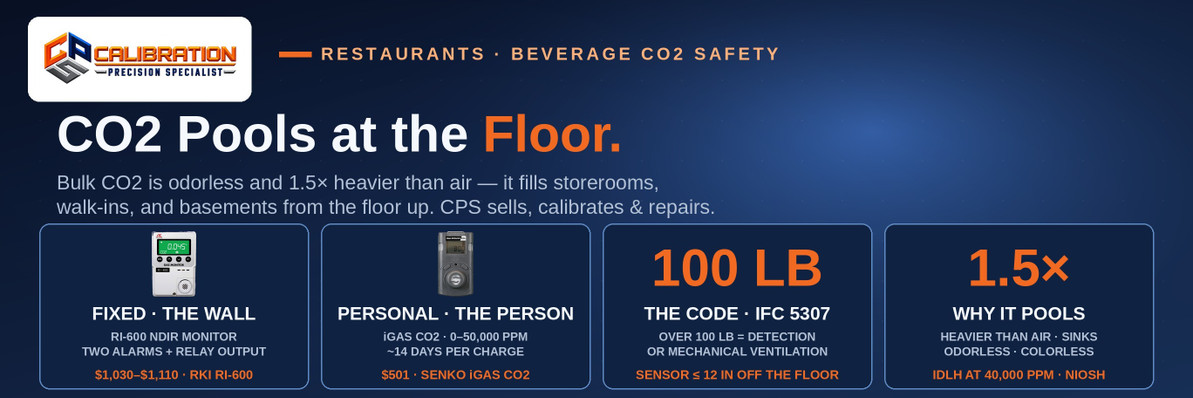
Yes — if your restaurant's beverage CO2 system holds more than 100 lb of CO2, the International Fire Code (Section 5307) requires mechanical ventilation or a gas detection system with sensors within 12 inches of the floor, a supervisory alarm at a normally attended location at 5,000 ppm, and an alarm in the room at 30,000 ppm. CO2 is odorless and about 1.5 times heavier than air, so a leaking tank or line pools it at floor level in storerooms, walk-ins, and basements — past OSHA's 5,000 ppm exposure limit with no smell to warn anyone.
Every restaurant with a soda fountain or draft system has the tank: a bulk liquid CO2 vessel, commonly a few hundred pounds, sitting in a back room feeding the carbonators. It is quiet, it never complains, and the beverage company swaps or fills it on a route. It is also the one piece of equipment in the building that can fill a small room with air nobody can breathe — and because CO2 has no odor and no color, the first symptom is the person who walks into it. This post is the restaurant version of the CO2 story: the hazard, the code, the monitors that fit, and the calibration that keeps them honest.
Why Is CO2 the Gas a Restaurant Can't Detect on Its Own?
Because human senses get no vote. CO2 is colorless and odorless (CDC/NIOSH Pocket Guide), and at a relative gas density of 1.53 it is about one and a half times heavier than air. Released gas does not rise and dissipate — it sinks, spreads across the floor, and fills a room from the bottom up: storerooms, walk-in coolers, basements, and any low pocket the lines pass through. A person standing in the doorway breathes the clean layer on top; a person who kneels at a low shelf, or walks down into a basement, is in the pool.
CO2 is also not merely an oxygen-displacer — it is toxic in its own right, and the exposure limits are lower than most people guess:
| CO2 level | What it is |
|---|---|
| ~300 ppm | Normal background in fresh air (NIOSH) |
| 5,000 ppm (0.5%) | OSHA permissible exposure limit and NIOSH recommended limit — the most a worker should average over a shift |
| 30,000 ppm (3%) | NIOSH short-term exposure limit (15 minutes) — and the fire code's in-room alarm point |
| 40,000 ppm (4%) | NIOSH IDLH — immediately dangerous to life or health |
NIOSH's symptom list starts with headache, dizziness, restlessness, and breathing difficulty, and ends with asphyxia, convulsions, and coma. The gap between "the soda system is leaking a little" and "the storeroom is at the short-term limit" is one stuck valve or one disconnected line in a small, closed room.
This has already happened, in a restaurant, during business hours. On September 7, 2011, at a McDonald's in Pooler, Georgia, a CO2 line that was supposed to carry excess gas outdoors came disconnected. CO2 from the back-room tanks flowed into the wall cavity beside the women's restroom instead. Ten people were sickened; two women were found unconscious in the restroom; Anne Felton, 80, died the next day of asphyxiation. The Pooler police chief's explanation is the whole hazard in four words: the gas "displaces oxygen." OSHA investigated. The fire-code rules in the next section exist because of incidents like this one — they were added to the International Fire Code beginning with the 2015 edition.
What Does the Fire Code Require for Restaurant CO2?
The governing text is International Fire Code Section 5307, which covers compressed gases generally and beverage CO2 specifically. The pieces a restaurant owner needs:
- The 100-lb line. Section 5307.3 applies to insulated liquid CO2 systems with more than 100 lb of CO2 used in beverage dispensing. The 100 lb is the total in the building — the tank in use plus stored cylinders count together — so a "small" cylinder setup with spares can cross it, and a typical bulk tank crosses it several times over.
- Ventilation, or detection instead. Rooms holding the tanks, cylinders, piping, and equipment — and any other area where leaked CO2 is expected to accumulate — must have mechanical ventilation designed to keep the room at negative pressure. The code then offers the exception most restaurants actually use: a gas detection system is permitted in lieu of that mechanical ventilation.
- If you detect, detect to the code's numbers. Section 5307.3.2 puts CO2 sensors within 12 inches of the floor in the area where the gas is expected to accumulate, and requires two alarm levels: an audible and visible supervisory alarm at a normally attended location at 5,000 ppm, and an audible and visible alarm in the room itself at 30,000 ppm. The first alarm tells a person who can act; the second tells anyone about to enter — or already inside — that the room is at the short-term exposure limit.
- NFPA 55 is the companion standard for liquid CO2 storage and use, and adopting jurisdictions attach permits and fire inspections to systems over the threshold.
One honest caveat: codes are adopted and enforced locally, edition by edition. The text above is the IFC framework your system was almost certainly inspected against, but the edition your fire marshal enforces — and how your jurisdiction handles existing systems — is a question for your local authority having jurisdiction. What does not change by jurisdiction is the physics, or the OSHA exposure limits your employees work under.
What Kind of CO2 Monitor Does a Restaurant Need?
Two shapes cover nearly every restaurant: a fixed monitor on the storeroom wall, and a personal monitor on the person who goes into the low places.
The fixed answer: a stand-alone CO2 monitor at floor level. The RKI RI-600 is built to exactly this duty: an NDIR (infrared) CO2 sensor in a wall-mount box with a continuous LCD readout, two preset alarms with an audible tone and a display that changes color on alarm, relay contacts to drive a remote alarm or ventilation, and a 4–20 mA output if the building system wants the number. It runs on 115 VAC with the included cord or on 24 VDC, and it is part of the stand-alone room monitors family we recommend wherever one room has one gas. Configured, it runs $1,030–$1,110 depending on range and power.
Choose the range against the code's alarm points: the 0–5,000 ppm configuration reads right up to the OSHA limit and the code's first alarm; the 0–5% volume (0–50,000 ppm) configuration covers both code alarm levels — 5,000 and 30,000 ppm — in one unit, which is the configuration we steer permitted systems toward. Mount it within 12 inches of the floor where CO2 would accumulate, and put the supervisory alarm where a person on shift will actually see and hear it.
The personal answer: a clip-on CO2 detector for walk-ins and basements. The SENKO iGas CO2, $501, is a dedicated personal CO2 monitor: the same NDIR sensing, a 0–50,000 ppm range, audible, visual, and vibration alarms, STEL and TWA tracking, and a rechargeable battery that runs about 14 days per charge. It is the right tool for the employee restocking the walk-in, the manager checking the basement, and the technician servicing the tank — the places a wall monitor in the storeroom does not cover. We covered it in depth in the iGas CO2 spotlight. The same pooling behavior drives the refrigerant side of cold storage, too — see Freon and halocarbon leaks in cold storage.
Already Have a CO2 Monitor? It Still Needs Calibration
Here is the part of the conversation we have with restaurants across East Tennessee: many already have a CO2 monitor — the beverage or gas supplier installed one, or a previous inspection required one — and it has not been calibrated since the day it went on the wall. An NDIR sensor drifts like any other sensor. A monitor that reads 20% low turns the code's 5,000 ppm alarm into a 6,000 ppm alarm without telling anyone, and a monitor that has drifted far enough is wall decoration with a power cord.
This is the work CPS Calibrations does every day, and it is the reason for this post:
- We calibrate CO2 monitors — including the one you already own. Our bench in Rockwood calibrates gas monitors across the brands restaurants actually have, not only the brands on our shelves; service coverage is broader than our stocking list. If it measures gas, bring it to the bench — we calibrate every channel it has. Published in-house rates are $55 for a single-gas instrument and $90 for 4- and 5-gas instruments.
- We sell the monitors. The RI-600 for the wall and the iGas CO2 for the person, sized and ranged for your system, from the calibration services shop that will still be here when they need service.
- We repair them. A monitor that fails calibration or takes damage gets diagnosed on the bench; repairs are quoted in writing before any work is done, so the decision is always yours.
- We keep the records and the reminders. Every instrument we calibrate goes into the CPS Calibration Program: one record per instrument, a certificate with as-found and as-left readings, and a reminder before the next calibration comes due — no contract, no monthly fee. When the fire inspector asks for the calibration record, it is one link, not a drawer.
- Installed systems get on-site service. A fixed CO2 point tied into alarms and ventilation is calibrated where it sits; on-site work is quoted in writing for the job. Ship-in and drop-off calibration at the Rockwood bench runs at the published in-house rates.
If you run a restaurant, bar, brewery taproom, or convenience store in East Tennessee with a bulk CO2 tank in the back, the checklist is short: confirm whether you are over 100 lb, confirm the room has code ventilation or a working detector at floor level, and confirm that detector has a calibration date you can prove. If any of the three is a shrug, call us — 865-900-8844 — and we will sell you the monitor, calibrate the one you have, or repair the one that failed. That is the whole lifecycle, from one bench.
Frequently Asked Questions
Does my restaurant legally need a CO2 monitor?
If your beverage CO2 system holds more than 100 lb of CO2, the International Fire Code (Section 5307.3) requires the rooms holding the system to have mechanical ventilation — or, as the exception most restaurants use, a gas detection system instead. The 100 lb counts everything in the building: the tank in use plus stored spare cylinders. Detection means sensors within 12 inches of the floor, a supervisory alarm at a normally attended location at 5,000 ppm, and an alarm in the room at 30,000 ppm. Codes are adopted locally, so your fire marshal's edition governs the details — but OSHA's 5,000 ppm employee exposure limit applies everywhere regardless.
How much CO2 does a restaurant soda system actually hold?
Usually well over the code line. Bulk liquid CO2 tanks — the insulated vessels beverage suppliers install and refill on a route — commonly hold a few hundred pounds of CO2. Cylinder setups look smaller, but a 50-lb cylinder in service with two spares stored beside it is 150 lb in the building, which is also over the 100-lb threshold in Section 5307.3. If you do not know your total, add the nameplate capacity of the tank plus every stored cylinder; that total is the number the fire code counts.
What does CO2 do to a person at high levels?
CO2 is a toxic gas in its own right, not just an oxygen displacer. NIOSH lists headache, dizziness, restlessness, and breathing difficulty as the early symptoms, progressing to increased heart rate, sweating, and confusion — and at high concentrations, asphyxia, convulsions, and coma. The occupational limits mark the slope: 5,000 ppm is OSHA's limit for a full-shift average, 30,000 ppm is NIOSH's 15-minute short-term limit, and 40,000 ppm (4%) is rated immediately dangerous to life or health. Because the gas is odorless, symptoms are the first warning — which is exactly why the code wants an instrument doing the noticing.
Why can't employees just smell a CO2 leak?
Because there is nothing to smell. CO2 is colorless and odorless at every concentration — that is a physical property, not a training gap. It is also about 1.5 times heavier than air, so it pools at floor level and fills low rooms from the bottom up while the air at standing height near the door still seems fine. In the 2011 Pooler, Georgia McDonald's incident, CO2 leaking into a restroom wall cavity sickened ten people and killed one customer, and the first explanations chased cleaning chemicals — nobody could smell the actual cause. An instrument is the only sense that works on this gas.
Where should a CO2 sensor be mounted in a restaurant?
Low — the fire code is explicit. Section 5307.3.2 requires CO2 sensors within 12 inches of the floor in the area where the gas is expected to accumulate: the tank room or storeroom, and any connected low area a leak would drain into, such as a basement or walk-in. A sensor mounted at thermostat height reads the last air in the room to go bad. The alarm side matters as much as the sensor: a supervisory alarm where staff on shift will see and hear it at 5,000 ppm, and an alarm in the monitored room itself at 30,000 ppm.
How much does a CO2 monitor for a restaurant cost?
At CPS list prices: a fixed wall-mount RKI RI-600 configured for restaurant duty runs $1,030–$1,110 depending on measuring range and power option — the 0–5% volume configuration ($1,110 on 115 VAC) is the one that covers both fire-code alarm points, 5,000 and 30,000 ppm, in a single unit. A personal SENKO iGas CO2 for walk-in and basement work is $501. Calibration is the recurring cost to budget: our published in-house rate is $55 for a single-gas instrument. A permitted system may also carry local permit and inspection fees, which vary by jurisdiction.
How often does a CO2 monitor need to be calibrated?
On the interval the manufacturer specifies for that monitor — no fire code sets a universal number, and anyone who gives you one without naming the manual is guessing. What is universal is the failure mode: an NDIR sensor drifts silently, so an uncalibrated monitor can read low for months while the room believes it is protected. The iGas CO2 has built-in calibration and bump-test reminders; fixed monitors belong on a written calibration schedule with records you can hand an inspector — which is what the CPS Calibration Program keeps automatically for every instrument we service.
Can CPS calibrate the CO2 monitor I already have, even if it's another brand?
Yes. Our Rockwood bench calibrates gas monitors across the brands restaurants actually run — the monitor a beverage supplier installed, the alarm a previous inspection required — not only the RKI and SENKO instruments we sell. Service coverage is broader than our stocking list: send it in or bring it in, and it comes back with a certificate showing as-found and as-left readings on every channel it measures. Single-gas in-house calibration is $55 at published rates.
What should staff do if the CO2 alarm goes off?
Get out first, and keep others out. CO2 alarms at the code's levels mean the room's air cannot be trusted: leave the area, do not send anyone back in to check, ventilate only if it can be done from outside the space, and call 911 or the fire department for a confirmed high reading or anyone feeling symptoms — headache, dizziness, and breathing difficulty are the early ones. Nobody re-enters until the room has been ventilated and a calibrated instrument — not a timer and not a nose — shows the level back down near normal background, a few hundred ppm.
Do bars, breweries, and convenience stores need CO2 monitoring too?
Yes — the code threshold follows the gas, not the business type. Any beverage dispensing operation with more than 100 lb of CO2 in the building is inside Section 5307.3: bars and taprooms with bulk tanks, breweries carbonating and purging with CO2, convenience stores with fountain systems and stored cylinders, and commissaries all count their total the same way. Breweries add fermentation CO2 on top of the beverage system, which is its own monitoring conversation — but the tank room rule is identical.
The Bottom Line
A restaurant's CO2 tank is a few hundred pounds of odorless, floor-pooling gas behind a door nobody thinks about: over 100 lb, the fire code wants ventilation or a floor-level detector alarming at 5,000 and 30,000 ppm — and that detector only counts if it is calibrated. CPS Calibrations sells the monitors, calibrates the one you already own, repairs the one that failed, and keeps the records, from one bench in Rockwood, Tennessee.
Restaurant, bar, or taproom in East Tennessee? Call CPS Calibrations at 865-900-8844 — tell us what's in the back room and we'll tell you exactly where you stand.
CPS Calibrations · 109 S. Front Street, Rockwood, TN 37854 · Calibration Services · The CPS Calibration Program · Stand-Alone Room Monitors
Need a calibration you can file?
In-house calibration at CPS in Rockwood, Tennessee — $55 for single-gas instruments, $90 for 4- and 5-gas — every channel, as-found and as-left data, full certificate.
See Calibration Servicesor call 865-900-8844
Recent Posts
-

What Is Remote Monitoring for Fixed Gas Detection?
Remote monitoring for fixed gas detection means a fixed system's live readings, trends, and alarm hi …Nov 23rd 2026 -

What Are the Key Differences Between the GX-6000 and GX-6100?
The RKI GX-6100 is the current replacement for the discontinued GX-6000: both are pumped 6-gas monit …Nov 22nd 2026 -

How to Read a PID Correction Factor Chart
To read a PID correction factor chart, find your vapor’s row, take the factor under your own lamp en …Nov 21st 2026