
Gas Detection in Hospitals: EtO Sterilizers, Nitrous Oxide, and Bulk Oxygen
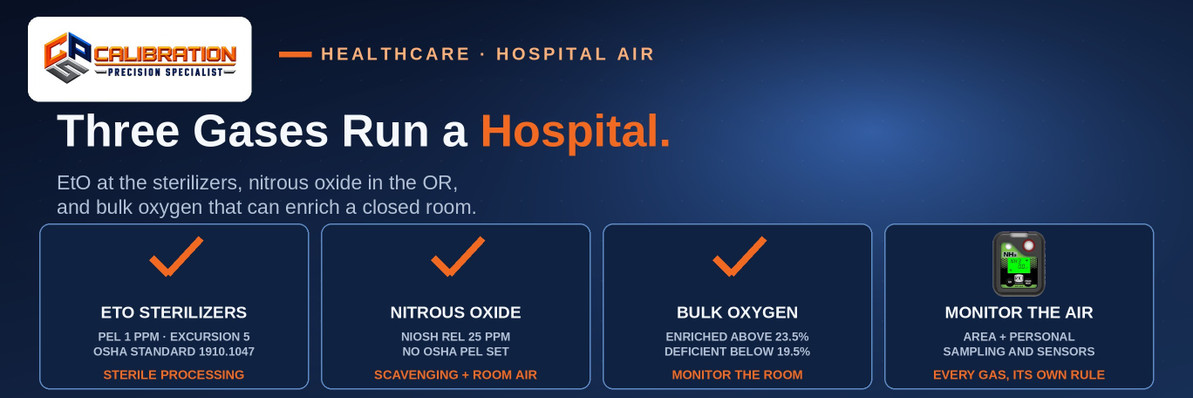
Hospitals run three distinct gas jobs: ethylene oxide (EtO) at the sterilizers — OSHA limit 1 ppm as an 8-hour average with a 5 ppm excursion limit, under its own standard, 1910.1047; nitrous oxide in operating and procedure rooms — NIOSH recommends 25 ppm and OSHA has set no limit for it at all; and bulk oxygen storage, where a leak can push room air above 23.5% oxygen, the oxygen-enriched level at which ordinary materials burn faster and hotter.
None of these three looks like an industrial gas hazard. There is no plant floor, no process line — there is a sterile processing department, an OR suite, and a fenced pad or a manifold room with green cylinders and a bulk tank. But the gases are real, the limits are low, and each of the three is governed by a different kind of rule. Treating them as one "hospital air" problem is how each one gets under-managed.
Why Is Ethylene Oxide the Sterile Processing Problem?
Because EtO does the sterilizing nothing else can do. Heat- and moisture-sensitive instruments — scopes, plastics, powered devices — cannot go through steam, so sterile processing departments run ethylene oxide sterilizers, and EtO follows a dedicated OSHA standard, 29 CFR 1910.1047, with numbers to match its potency: a permissible exposure limit of 1 ppm as an 8-hour time-weighted average, an excursion limit of 5 ppm averaged over a 15-minute sampling period, and an action level of 0.5 ppm that triggers exposure monitoring duties.
The exposure pattern is a cycle, not a cloud. The chamber itself is sealed; the peaks come at the human moments — opening the sterilizer door at cycle end, transferring the load, and the aeration phase, when sterilized goods off-gas EtO in the aeration room or cabinet. That is why EtO programs pair engineering controls (ventilation at the door, aeration time) with measurement: personal exposure monitoring for the staff who run the cycle, and area awareness in the rooms where loads are opened and aerated. A 1 ppm average limit is not a number anyone estimates — it is a number a program measures, on a schedule, with records.
Where Does Nitrous Oxide Exposure Happen?
Everywhere anesthesia is delivered: operating rooms, labor and delivery, dental and oral surgery suites, and procedure rooms. Nitrous oxide escapes at the mask and the circuit — around imperfect mask seals, through scavenging systems that are disconnected, misadjusted, or simply overwhelmed — and the staff member closest to the patient's airway works in that air for the length of every case.
Here is the fact that shapes the whole job: OSHA has set no PEL for nitrous oxide. The number that governs a serious program is the NIOSH recommended exposure limit of 25 ppm, averaged over the period anesthetic is administered. A compliance program that only asks "what does OSHA require?" will find no requirement and stop — while NIOSH's recommendation, the scavenging maintenance, and the room-air checks go undone. The control set is practical: scavenging systems connected and verified, mask fit attended to, room ventilation doing its share, and periodic air measurement that proves the controls work rather than assuming they do. Where a hospital wants a permanent record, personal and area sampling for nitrous oxide is the standard tool — see the range of approaches in single-gas monitors and talk through which method fits a compliance file before buying instruments.
Why Is Bulk Oxygen a Gas Detection Problem?
Because oxygen misbehaves by helping. Oxygen itself does not burn — it makes other things burn with a speed and intensity they never show in normal air. OSHA's confined-space definitions draw the line: an atmosphere above 23.5% oxygen is oxygen-enriched (and below 19.5% it is oxygen-deficient). In enriched air, materials that smolder in a ward ignite readily and burn fast, and the margin for error around flames, sparks, and hot work disappears.
Hospitals hold oxygen in bulk: liquid oxygen tanks, reserve cylinder banks, and manifold rooms where high-pressure oxygen is piped to the whole building. A leak in a manifold room, a transfer connection that vents indoors, or a storage room full of cylinders with one valve weeping can enrich a small room's air without a sound or a smell — oxygen gives no warning of its own. The detection answer is an oxygen sensor watching the room itself: fixed O2 monitoring in manifold and bulk storage rooms, alarming on enrichment (and on deficiency, where a nitrogen or other inert-gas leak in an adjacent system could displace air the other way). It is the one hospital gas job where the monitored gas is the air's main ingredient — and where the instrument watches a percentage, not parts per million.
Calibration and records are what make any of this defensible. A hospital's gas program is surveyed, accredited, and audited; readings that cannot be traced to a calibration are opinions. We calibrate every channel on the portable instruments hospitals and their service contractors carry, through calibration services — in-house in Rockwood, Tennessee, or shipped in from your facility.
Frequently Asked Questions
What gases do hospitals need to monitor?
Three lead the list: ethylene oxide at the sterilizers in sterile processing (OSHA limit 1 ppm as an 8-hour average, excursion limit 5 ppm over 15 minutes, under standard 1910.1047), nitrous oxide in operating, delivery, dental, and procedure rooms (NIOSH recommended limit 25 ppm; OSHA has set no PEL), and oxygen itself in bulk storage and manifold rooms, where leaks can enrich room air above 23.5% oxygen. Each gas has its own rulebook, which is why hospitals manage them as three programs, not one.
What is the OSHA limit for ethylene oxide?
One part per million as an 8-hour time-weighted average, with an excursion limit of 5 ppm averaged over a 15-minute sampling period, under OSHA's ethylene oxide standard, 29 CFR 1910.1047. The standard's action level is 0.5 ppm — at or above it, exposure monitoring and other duties are triggered. EtO is used in sterile processing to sterilize heat- and moisture-sensitive instruments that steam cannot handle.
When are sterile processing workers most exposed to EtO?
At the human moments of the cycle: opening the sterilizer door when a cycle ends, transferring the sterilized load, and the aeration phase, when goods off-gas ethylene oxide in the aeration room or cabinet. The sealed chamber is not the exposure; the door, the transfer, and the aerator are. That is why EtO programs combine door and aeration-room ventilation with scheduled personal exposure monitoring for the staff who run the sterilizers.
Is there an OSHA limit for nitrous oxide?
No. OSHA has set no permissible exposure limit for nitrous oxide. The number a serious program works to is the NIOSH recommended exposure limit of 25 ppm, averaged over the period the anesthetic is administered. The practical consequence: a hospital that only checks OSHA's tables will find no nitrous oxide requirement and may never build the scavenging checks and room-air measurement that keep operating and procedure room exposures at the NIOSH level.
How do hospitals control nitrous oxide exposure?
Primarily with scavenging — the vacuum system that captures waste anesthetic gas at the mask and circuit — backed by mask-fit attention and operating room ventilation. Scavenging only works when it is connected, adjusted, and verified, which is why periodic air measurement matters: it proves the controls are holding exposures near or below the NIOSH recommended limit of 25 ppm instead of assuming a silent system is a working one.
Why is oxygen enrichment dangerous?
Because oxygen makes other materials burn faster, hotter, and more easily — materials that merely smolder in normal air can ignite readily in enriched air. OSHA's confined-space definitions treat air above 23.5% oxygen as oxygen-enriched and below 19.5% as oxygen-deficient. A leaking bulk oxygen connection or manifold in a small room can enrich its air with no sound, smell, or visible sign, which is why those rooms get fixed oxygen monitoring.
Where should a hospital monitor oxygen levels?
Wherever oxygen is stored or piped in quantity: bulk liquid oxygen installations, cylinder storage rooms, and especially manifold rooms, where high-pressure oxygen is distributed to the building. The monitor watches the room air and alarms on enrichment above 23.5% — and on deficiency below 19.5%, which an inert-gas leak could cause in the other direction. Oxygen is the rare monitored gas measured in percent, not parts per million.
How is EtO exposure measured for compliance?
With personal exposure monitoring — sampling worn by the sterile processing staff who run the sterilizers, analyzed against the 1 ppm 8-hour average and the 5 ppm 15-minute excursion limit in 1910.1047 — supported by area checks at the sterilizer door and aeration spaces where the cycle's peaks occur. Area instruments and leak checks run operations day to day; the personal monitoring record is what documents compliance with the standard.
Do hospital gas detectors need calibration?
Yes — any instrument whose reading a hospital will act on or file needs calibration on the manufacturer's specified interval, with as-found and as-left readings documented. Hospital gas programs are surveyed and audited, and an untraceable reading is an opinion, not evidence. At CPS Calibrations, in-house calibration is $55 for a single-gas instrument and $90 for a 4- or 5-gas instrument; ship-in instruments are billed at the same rates, and on-site work is quoted in writing and costs more than bench work.
Who is responsible for gas safety in a hospital?
It is shared by design: sterile processing owns the EtO cycle, anesthesia and OR management own nitrous oxide scavenging, and facilities engineering owns the bulk oxygen system and its rooms — with environment-of-care and safety committees tying the three together. The common failure is a gas falling between departments: the sterilizer belongs to one budget, the manifold room to another, and nobody owns the air. Naming an owner per gas is the first step of a working program.
The Bottom Line
A hospital's gas program is three programs: EtO measured in single parts per million at the sterilizer door under its own OSHA standard, nitrous oxide held to NIOSH's 25 ppm recommendation because OSHA set no limit, and bulk oxygen watched in percent so a quiet leak never enriches a room past 23.5%. Give each gas an owner, a control, and a measurement — and keep the instruments behind all three calibrated.
Outfitting a hospital, surgery center, or sterile processing department? Call CPS Calibrations at 865-900-8844 — monitors, calibration, and the CPS Calibration Program behind them, from Rockwood, Tennessee.
CPS Calibrations · 109 S. Front Street, Rockwood, TN 37854 · Calibration Services · The CPS Calibration Program
Need a calibration you can file?
In-house calibration at CPS in Rockwood, Tennessee — $55 for single-gas instruments, $90 for 4- and 5-gas — every channel, as-found and as-left data, full certificate.
See Calibration Servicesor call 865-900-8844
Recent Posts
-

Which GfG Portable Gas Detector Is Best for You?
The right GfG portable is decided by three questions — how many gases, pumped or diffusion, and PID …Nov 24th 2026 -

What GfG Fixed Gas Detection Systems Are There? Every Transmitter and Controller Explained
GfG’s fixed gas detection line at CPS is 39 products in two layers: 23 transmitters and detection sy …Nov 24th 2026 -
What GfG Portable Gas Detectors Are There? Every Model Explained
GfG’s portable line at CPS is 14 products built around six instruments: the Micro IV single-gas dete …Nov 24th 2026