
Gas Detection in Ice Rinks: Ammonia, CO, and the Resurfacer
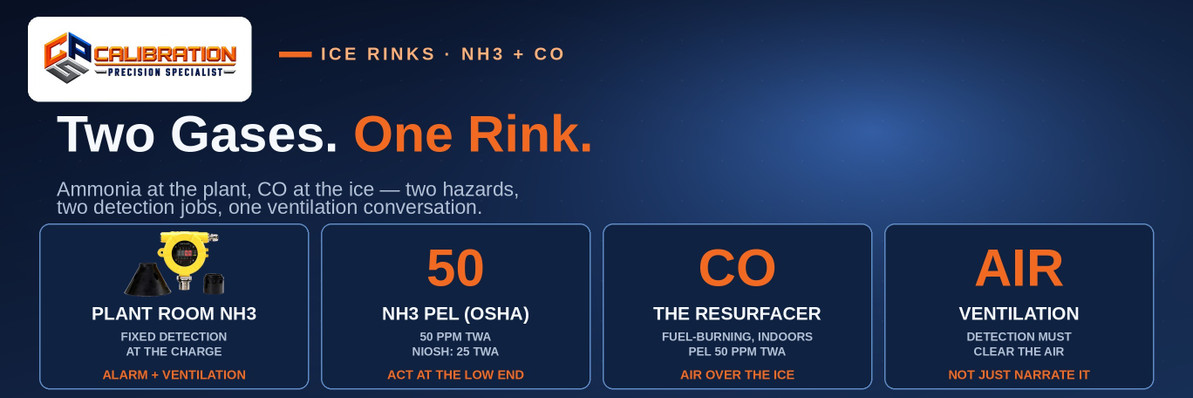
An ice rink runs two gas hazards under one roof: ammonia in the refrigeration plant — OSHA's permissible exposure limit is 50 ppm as an 8-hour TWA, and NIOSH recommends 25 ppm TWA with a 35 ppm short-term limit — and carbon monoxide from the fuel-burning resurfacer, working an enclosed sheet in front of a breathing-hard public, against a CO limit of 50 ppm TWA. The fix is two different detection jobs: fixed ammonia detection where the charge lives, and CO monitoring where the ice is made — with ventilation tied to both, because detection that cannot clear the air only narrates the problem.
Rinks get treated as benign public buildings, and mechanically they are not: they are industrial refrigeration plants with a crowd attached. The refrigeration side will be familiar to anyone who has read our ammonia detection in cold storage post — same refrigerant, same discipline, different building. The resurfacer side is the rink's own: a combustion engine doing slow, repeated passes over the ice, indoors, often with the building's ventilation set for temperature rather than for exhaust dilution. This post works both sides and the placement logic for each.
The Plant Room: Ammonia Where the Charge Lives
Most rinks of any age refrigerate with ammonia, and the charge sits in the machinery room with the compressors, vessels, and the piping joints that age, vibrate, and occasionally weep. Ammonia announces itself — it is pungent well below dangerous levels — but a warning property is not a detection system: the person who smells a significant leak is already standing in it, and the room is normally unoccupied, so the first 'detector' would otherwise be whoever opens the door. Fixed detection belongs at the plant: sensors where leaks start (compressor seals, valve groups, vessels) and where the gas goes, tied to alarm and ventilation.
A fixed head built for plant rooms — the SENKO SI-200E is the pattern, an explosion-proof diffusion detector with 4–20 mA and RS-485 output, alarm relays, and an IP66 enclosure rated −40°C to +60°C, configured $1,092.50–$2,300 by gas and range — reports to something that acts: local alarm, ventilation start, and a signal where staff actually are. Our SI-200E explainer covers the model itself. Set alarm thinking against the published limits: NIOSH's 25 ppm TWA recommendation is the early-warning neighborhood; OSHA's 50 ppm PEL is the compliance line; 300 ppm is IDLH territory, long past where anyone should be entering without respiratory protection.
The Ice Surface: CO From the Machine That Makes It
The resurfacer is a combustion engine working indoors at walking speed, pass after pass, in a bowl designed to hold cold air in. Its exhaust is rich in carbon monoxide, and the exposure pattern is ugly: skaters — many of them kids, all of them breathing hard — exercise in that air for an hour or more, and staff work in it all day. CO gives no warning of its own: colorless, odorless, and its early symptoms (headache, nausea, dizziness) read exactly like a hard skate or a stomach bug, which is how rink CO events historically got recognized late.
Monitoring belongs in the rink air itself, at breathing height over the ice and in the resurfacer's working areas, and portables belong on the people with the longest exposure: the operator and the ice crew. Single-gas monitors built for CO are the personal layer. The operational half matters as much: resurfacers are maintained engines or they are CO sources — a rich-running, poorly tuned machine can multiply its emissions — and ventilation during and after resurfacing is what the detection should be verifying, not replacing.
Two Systems, One Ventilation Conversation
The rink's two hazards want the same building habit: detection wired to response. In the plant room, the response is exhaust ventilation and alarm at ammonia levels far below the PEL's neighborhood of harm. In the bowl, the response is dilution air during resurfacing and maintenance discipline on the machine. Neither works as a detector screwed to a wall with its relays capped — a fixed system that only beeps in an empty room is a diary, not a safeguard.
Placement follows the gases. Ammonia is lighter than air and, in a leak, also behaves according to temperature and release energy — plant-room sensors go at the likely release points and in the breathing zone of anyone entering, per the system design. CO mixes freely with air, so rink CO sensing is about representative breathing-zone air over the ice and at the boards, not about hunting a layer. Both systems then need the unglamorous half: calibration on schedule, because a fixed head that has drifted is a false promise with a display.
What a Rink Should Actually Have, in One List
- Fixed NH3 detection in the machinery room — release points and entry, alarmed, tied to exhaust ventilation, reporting where staff are.
- CO monitoring in the rink air — breathing-zone placement over the ice, plus personal CO monitors for the resurfacer operator and ice crew.
- Ventilation that answers detection — plant-room exhaust on alarm; bowl dilution during and after resurfacing.
- A tuned resurfacer — engine maintenance treated as an emissions control, because it is one.
- Calibration on schedule for every head and portable — CPS calibrates in-house at $55 single-gas and $90 for 4- and 5-gas instruments, and fixed systems are serviced under calibration services.
None of this is exotic equipment. It is the standard kit of portable gas detection and fixed plant detection, pointed at the two rooms a rink actually has. The rinks that get in the news are the ones that treated a refrigeration plant and a combustion appliance as building furniture.
Frequently Asked Questions
What gases need detecting in an ice rink?
Two, in two places. Ammonia from the refrigeration plant — OSHA PEL 50 ppm TWA; NIOSH recommends 25 ppm TWA and a 35 ppm short-term limit — monitored with fixed detection in the machinery room. And carbon monoxide from fuel-burning resurfacers (and edgers), against a 50 ppm TWA limit, monitored in the rink air and on the ice crew. Same roof, different systems.
Why is the resurfacer a CO problem?
It is a combustion engine working indoors at walking speed, making repeated passes over the ice in a bowl built to hold cold air in. Its exhaust adds carbon monoxide to air that skaters — breathing hard, often children — exercise in for an hour-plus. CO is colorless and odorless, and its early symptoms mimic exertion or illness, which delays recognition.
Where do ammonia sensors go in a rink plant room?
Where leaks start and where people enter: compressor seals, valve groups, and vessels are the release points; the entry is where an unsuspecting person walks in. Fixed heads should alarm locally, start exhaust ventilation, and report where staff actually are — a beep in an empty room protects nobody. A detector like the SENKO SI-200E (configured $1,092.50–$2,300) is built for that plant-room duty.
What ammonia level should a rink alarm at?
Alarm thinking runs off the published limits: NIOSH recommends 25 ppm as an 8-hour TWA and 35 ppm short-term — the early-warning neighborhood for a first alarm and ventilation response. OSHA's PEL is 50 ppm TWA, the compliance line. 300 ppm is IDLH. Exact setpoints are a system-design decision for the facility and its refrigeration contractor; the principle is to act at the low end, not at the legal limit.
Do electric resurfacers remove the CO problem?
They remove the resurfacer's own exhaust — a genuine improvement for rink air. What remains is the rest of the CO inventory: fuel-fired heating, any remaining combustion appliances, and vehicle exhaust at loading areas. And the ammonia side is untouched by the choice: the refrigeration plant still needs fixed detection whatever makes the ice smooth.
How often do rink detectors need calibration?
On the schedule their manuals and your safety program set — fixed heads and portables alike. A drifted fixed head is worse than none, because it displays confidence. CPS calibrates portables in-house ($55 single-gas, $90 for 4- and 5-gas) with full certificates, and fixed-system service is arranged through our calibration services page.
Can one detector cover both the plant room and the ice?
No — they are different gases, different rooms, and different response systems. Ammonia detection is a fixed plant-room system tied to ventilation; CO protection is rink-air monitoring plus personal monitors on the ice crew. A portable carried between the two is a survey tool, not coverage for either space.
What should happen when the rink CO monitor alarms?
People off the ice and into fresh air, ventilation up, and the source found before anyone resumes — with symptomatic people treated as CO exposures, not as tired skaters. Then the unglamorous follow-through: the resurfacer's tune and the ventilation sequence get fixed, because an alarm that recurs on schedule is a maintenance finding, not a nuisance.
Is ammonia's smell enough warning in the plant room?
No. Ammonia is pungent at low levels, which helps a person already in the room notice a small leak — but the plant room is normally empty, so smell-based detection means the first sensor is whoever opens the door on a large one. Fixed detection watches the room when nobody is in it, which is most of the time and all of the dangerous time.
Who should spec a rink's detection system?
The facility with its refrigeration contractor — the people who know the charge, the machinery room, and the local code — with detection supplied and serviced by a gas-detection shop. CPS sells and calibrates the fixed and portable equipment (call 865-900-8844) and services what it sells; design and code compliance sit with the rink and its contractors.
The Bottom Line
A rink is a refrigeration plant with a crowd attached: fixed ammonia detection where the charge lives, CO monitoring where the ice is made, ventilation wired to answer both, and every head calibrated on schedule. Treat the two rooms as what they are, and the rink's gas story becomes boring — which is the goal.
Outfitting or calibrating a rink's detection? Call CPS Calibrations at 865-900-8844 — 109 S. Front Street, Rockwood, TN 37854.
--- CPS Calibrations · 109 S. Front Street, Rockwood, TN 37854 · Ammonia Detection in Cold Storage · Single-Gas Monitors · Calibration Services
Need a calibration you can file?
In-house calibration at CPS in Rockwood, Tennessee — $55 for single-gas instruments, $90 for 4- and 5-gas — every channel, as-found and as-left data, full certificate.
See Calibration Servicesor call 865-900-8844
Recent Posts
-

What Is Remote Monitoring for Fixed Gas Detection?
Remote monitoring for fixed gas detection means a fixed system's live readings, trends, and alarm hi …Nov 23rd 2026 -

What Are the Key Differences Between the GX-6000 and GX-6100?
The RKI GX-6100 is the current replacement for the discontinued GX-6000: both are pumped 6-gas monit …Nov 22nd 2026 -

How to Read a PID Correction Factor Chart
To read a PID correction factor chart, find your vapor’s row, take the factor under your own lamp en …Nov 21st 2026