
Gas Detection in Indoor Pools and Aquatic Centers
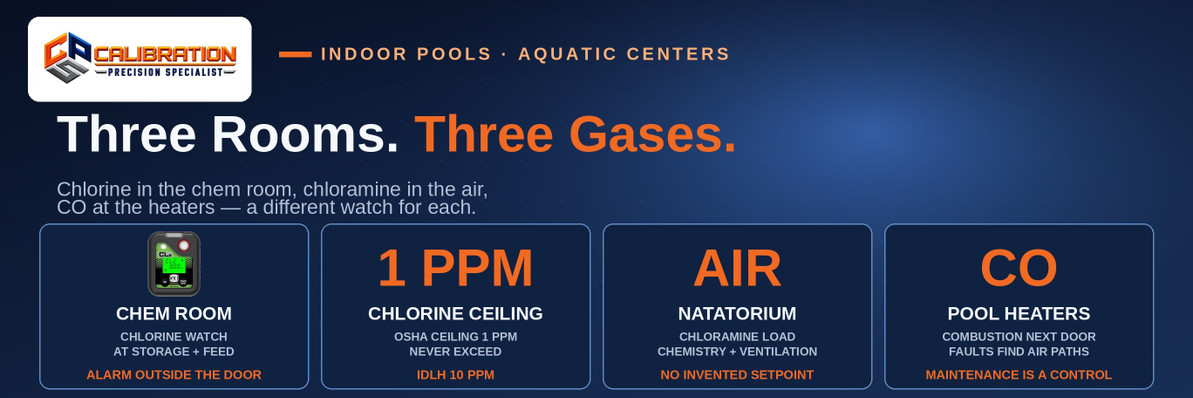
An indoor pool building runs three separate gas stories: chlorine in the chemical room — where OSHA's ceiling limit is 1 ppm, a concentration never to be exceeded, and where the chlorine may be stored as gas or created accidentally when acid meets hypochlorite; chloramine loading the natatorium air that swimmers and guards breathe for hours, a ventilation and water-chemistry problem with no detector setpoint to hide behind; and carbon monoxide from the pool heaters and boilers burning fuel a wall away. Each room earns a different watch, and confusing them is how aquatic centers end up monitoring the wrong air.
The chlorine discipline here will be familiar from the water-treatment world — our fixed gas detection for water treatment plants post covers the same gas at plant scale. The aquatic center shrinks the chemical inventory but adds something a treatment plant does not have: a room full of the public, breathing hard, directly downstream of the chemistry. That difference drives the whole layout.
The Chemical Room: Chlorine Where It's Stored and Mixed
Start where the hazard is concentrated. Facilities disinfecting with gas chlorine store cylinders whose contents are unforgiving — chlorine's OSHA ceiling is 1 ppm and its IDLH is 10 ppm, numbers that describe a gas to be caught at the fitting, not at the door. Facilities on liquid systems store the hazard in two parts: sodium hypochlorite and acid (for pH control) are each manageable alone and a chlorine generator if they meet — in a shared containment, a mis-plumbed feed, or a well-meant mixing mistake. Either way, the chemical room is the room that earns fixed chlorine detection: sensor at the storage and feed equipment, alarm that reports outside the room before entry, and ventilation that runs as part of the response.
The entry rule follows from the ceiling number: nobody opens a chemical-room door on a hunch. The detector's display and alarm state are the door's information, and portables — single-gas monitors for chlorine duty — are how staff verify air when the fixed system says anything but normal.
The Natatorium: Chloramine Is an Air-Quality Load, Not a Setpoint
The smell everyone calls 'chlorine' at an indoor pool is mostly chloramine — formed when chlorine meets the nitrogen load swimmers bring — and it collects in the air layer right at the water surface, where swimmers breathe and guards work whole shifts. Honesty first: there is no OSHA PEL for chloramine to set a detector by, and this post will not invent one. Chloramine is managed by the two systems that actually control it — water chemistry (chlorine demand, breakpoint discipline, water replacement) and ventilation designed to sweep the surface layer and exhaust it, rather than stirring it into the stands.
What monitoring contributes here is verification and vigilance: air-quality complaints, guard symptoms, and event loads (a swim meet packs the chemistry of a hundred swimmers into an afternoon) are data, and periodic air assessment tells the facility whether its chemistry-plus-ventilation is winning. When it is not, the fix is in the water and the air handling — a detector on the wall cannot scrub a chloramine, and pretending the natatorium's problem is a sensing problem delays the real one.
Mechanical Rooms: Heaters, Boilers, and CO
The pool's water is warm because something burns fuel to heat it, and heat exchangers, boilers, and water heaters age, soot, and crack in mechanical rooms adjacent to occupied space. Carbon monoxide from a faulting heater does not respect the mechanical room's door — it follows air paths into the natatorium and locker rooms. CO detection belongs in the mechanical room and in the occupied spaces its air can reach, and the appliance maintenance schedule belongs on the gas-safety list, not just the comfort list: a heater tuned and inspected is a CO control; a detector is how you learn the control failed.
The same room often holds the building's other quiet inventory — CO₂ for pH control in some facilities, refrigerant for dehumidification plant — each worth a line on the facility's gas map, walked the same way: what is stored here, what does a leak do, who would know, and what does the alarm make happen.
The Aquatic Center, Mapped
- Chemical room: fixed chlorine detection at storage and feed, alarm outside the door, ventilation interlocked with the response — for gas systems and hypochlorite/acid systems alike.
- Natatorium: chloramine managed by water chemistry + surface-sweep ventilation; air assessed honestly rather than alarmed against an invented number.
- Mechanical room: CO detection at combustion plant and in the occupied air it can reach; heater maintenance treated as a gas control.
- People layer: portables for chemical-room entry and verification, and every instrument — fixed and portable — on a calibration schedule.
CPS calibrates portables in-house at $55 single-gas and $90 for 4- and 5-gas instruments with full certificates — see calibration services — and supplies the fixed and personal layers across portable gas detection. Three rooms, three gases, three different kinds of watch: that is the entire map.
Frequently Asked Questions
What gases need monitoring at an indoor pool?
Chlorine in the chemical room (fixed detection — OSHA's ceiling for chlorine is 1 ppm), carbon monoxide from pool heaters and boilers (mechanical room and the occupied air beyond it), and chloramine in the natatorium air — which is managed by water chemistry and ventilation rather than a detector setpoint, because no published exposure limit exists for it. Three rooms, three different kinds of watch.
Why is chlorine detection needed if we use liquid chemicals?
Because the liquid system stores chlorine in two parts: hypochlorite plus acid. If they meet — shared containment failure, a feed mix-up, manual mixing error — they generate chlorine gas in the room. Fixed detection at the storage and feed equipment, alarming outside the door, covers both the gas-cylinder facility and the liquid facility; the chemistry differs, the room's job doesn't.
What is chlorine's exposure limit?
OSHA sets chlorine's PEL as a ceiling of 1 ppm — a concentration that must never be exceeded, not an average to be managed. NIOSH's IDLH is 10 ppm. Those numbers are why the chemical room's detection alarms outside the door and why entry on a hunch is the facility's forbidden move: by the time a person is the sensor, the ceiling is already spent.
Can a detector control chloramine in the pool air?
No — and be skeptical of anyone who sells it that way. Chloramine forms in the water from chlorine plus swimmer load, and it is controlled by water chemistry and by ventilation that sweeps the surface layer where it collects. Monitoring can verify conditions and track complaints, but there is no OSHA chloramine limit to alarm against, and no sensor scrubs the air. The fix lives in the water and the air handling.
Where does pool-heater CO actually threaten people?
Mechanical-room CO follows air paths. A faulting heater or boiler can push carbon monoxide into the natatorium, locker rooms, and offices its air reaches — occupied by the public, including kids, with no reason to suspect an odorless gas. Detection in the mechanical room and in reachable occupied space, plus appliance maintenance as a gas control, is the matched pair.
Should lifeguards or operators wear monitors?
Operators working the chemical room should have personal verification — chlorine-capable portables for entry and for checking air when the fixed system reports anything but normal. Guards' protection is the natatorium system itself: chemistry, ventilation, and air assessment. Personal monitors follow the chemical work, not the deck chairs.
How often do pool facility detectors need calibration?
On their manuals' and the facility's schedule, without exception for the chemical-room head: it guards the room nobody should enter blind, and a drifted sensor there is a false all-clear at the door. CPS calibrates portables in-house at $55 single-gas and $90 for 4- and 5-gas instruments, with as-found/as-left certificates.
What should happen when the chemical-room chlorine alarm sounds?
Nobody enters; the room's ventilation response runs; trained staff with proper respiratory protection and personal monitoring assess from outside the hazard, and the leak source is found and fixed before the room returns to normal entry. The alarm is an entry prohibition with a sound, not a suggestion to hold your breath and look.
Does the health department care about pool gas detection?
Pool codes and health inspections vary by state and locality — this post deliberately cites none — but chemical storage and ventilation are standard inspection territory, and detection with calibration records is the facility's evidence that its chemical room is managed. Confirm your code specifics with your health department; keep the calibration paper regardless.
What about CO2 used for pH control at pools?
Some facilities feed CO₂ for pH, which adds bulk CO₂ storage to the gas map: CO₂ pools low and displaces oxygen, so storage areas earn the low-level, oxygen-displacement watch described for CO₂ storage generally. Walk it like any stored gas: what is here, where does a leak go, who would know, what does the alarm do.
The Bottom Line
An aquatic center's gas safety is a three-room map: chlorine fixed and alarmed in the chemical room against a 1 ppm ceiling, chloramine beaten honestly in the water and the ventilation rather than wished away with a sensor, and CO watched wherever the heaters burn and their air can travel. Monitor the room that's actually at risk, with the tool that actually fits it.
Outfitting or calibrating an aquatic center's detection? Call CPS Calibrations at 865-900-8844 — 109 S. Front Street, Rockwood, TN 37854.
--- CPS Calibrations · 109 S. Front Street, Rockwood, TN 37854 · Water Treatment Gas Detection · Single-Gas Monitors · Calibration Services
Need a calibration you can file?
In-house calibration at CPS in Rockwood, Tennessee — $55 for single-gas instruments, $90 for 4- and 5-gas — every channel, as-found and as-left data, full certificate.
See Calibration Servicesor call 865-900-8844
Recent Posts
-

What Is Remote Monitoring for Fixed Gas Detection?
Remote monitoring for fixed gas detection means a fixed system's live readings, trends, and alarm hi …Nov 23rd 2026 -

What Are the Key Differences Between the GX-6000 and GX-6100?
The RKI GX-6100 is the current replacement for the discontinued GX-6000: both are pumped 6-gas monit …Nov 22nd 2026 -

How to Read a PID Correction Factor Chart
To read a PID correction factor chart, find your vapor’s row, take the factor under your own lamp en …Nov 21st 2026