
Fixed Gas Detection for Water Treatment Plants: Chlorine, Ozone, and the Rooms That Need Watching
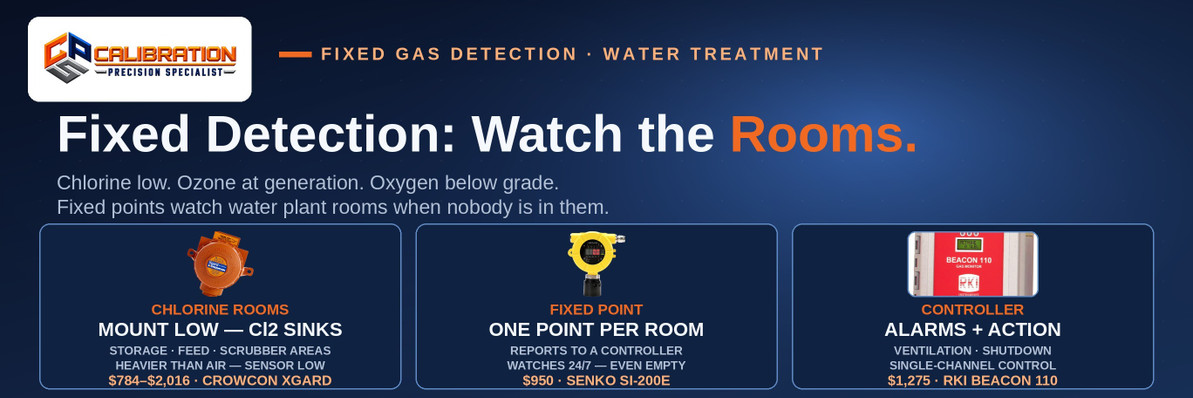
Fixed gas detection in a water treatment plant watches the rooms that hold a continuous hazard — chlorine storage and feed rooms, ozone generation rooms, and below-grade galleries — 24/7, whether anyone is in them or not. Chlorine points mount low, because chlorine is heavier than air; a typical point costs $950 (SENKO SI-200E) to $784–$2,016 (Crowcon Xgard family), reporting to a controller such as the $1,275 single-channel RKI Beacon 110 that alarms, starts ventilation, and can shut equipment down.
Portable detectors protect the people — the companion post, what gas detectors do water treatment plant workers need?, covers that kit. This post covers the other half: the places. A water plant's chemical rooms do not stop being hazardous when the shift ends, and the leak that matters most is often the one that starts in an empty room.
Which Rooms in a Water Treatment Plant Need Fixed Gas Detection?
Use this list as the walk-through. Start with every room that stores, feeds, or generates a gas, then add every below-grade space:
- Chlorine storage rooms — cylinders or ton containers. The largest chlorine inventory in the plant, in one room.
- Chlorine feed rooms — evaporators, chlorinators, feed lines, and the connections that are opened and remade during container change-outs.
- Scrubber areas — the emergency scrubber exists for a release; the detection in the room it protects is what tells it, and everyone else, that a release is happening.
- Ozone generation rooms — ozone is generated on site, used immediately, and destroyed in off-gas destruct; it is never stored, so the hazard lives exactly where it is made.
- Ammonia storage and feed areas, where chloramination is used — only plants that feed ammonia need ammonia points; if your plant does not chloraminate, this room is not on your list.
- Carbon dioxide storage areas, where CO₂ is stored or fed — for pH control and similar processes.
- Below-grade galleries, vaults, and clear-well areas — oxygen points, because air down there can be displaced or depleted whether or not any chemical is present.
The fixed systems range — detector heads, stand-alone detectors, and controllers — is how those rooms get built out, point by point.
Where Do Chlorine Sensors Go — and Why Low?
Chlorine is heavier than air, so a chlorine leak sinks, spreads at floor level, and collects in low spots, sumps, and pits. A chlorine sensor mounted at ceiling height can sit in clean air above a dangerous floor layer. Standard practice for chlorine rooms is therefore:
- Mount the sensor low — near the floor, at the height the gas actually occupies, following the detector manufacturer's placement guidance for the specific room.
- Mount it near the likely leak sources — container valves and connections, the feed equipment, and the piping runs — not in a far corner chosen for easy wiring.
- Keep it out of dead corners and direct air streams. A sensor in stagnant air reads late; a sensor in the direct blast of a supply vent reads diluted air that is not the room's air.
- Put an alarm where the next person will see it before entering — at the controller and, through it, horns and strobes outside the room entrance. The most valuable fixed alarm in a chlorine room is the one that stops someone at the door.
The general placement method — height by gas density, distance from source, and room airflow — is covered in where should fixed gas detectors be placed? and the system signal path in how does a fixed gas detection system work?.
What About Ozone, Ammonia, and Carbon Dioxide?
Ozone (O₃). Ozone cannot be bottled and stored — it is generated on site from oxygen or air, piped a short distance to the contactors, and leftover ozone in the off-gas is destroyed before venting. So ozone watching concentrates in two places: the generation room itself, around the generators and piping, and the off-gas / destruct area. An ozone leak is a room problem, not a plant-wide one, and fixed points at those two locations are the standard answer — a worker on rounds may never enter the generation room on the shift when it leaks.
Ammonia (NH₃), where chloramination is used. Plants that form chloramines feed ammonia alongside chlorine, and ammonia storage and feed areas then belong on the fixed-detection list. Ammonia behaves the opposite way to chlorine: it is lighter than air and rises, so placement thinking flips with it — high, not low. If your plant does not use chloramination, do not buy ammonia detection out of habit; if it does, the ammonia room needs the same treatment as the chlorine room: a point at the gas's height, an alarm at the door, and a controller that can act.
Carbon dioxide (CO₂), where stored or fed. Bulk CO₂ is heavier than air and an oxygen-displacer: a leak fills a room or a pit from the floor up and pushes breathable air out. CO₂ storage rooms and any below-grade space a CO₂ line runs through should be considered for a point placed low — or for an oxygen point, which catches the displacement itself (see the next section).
Why Do Below-Grade Galleries Need Oxygen Points?
The below-grade gallery is the water plant room that fools people, because it may hold no stored chemical at all. It is long, low, poorly ventilated by nature, and it carries the plant's piping — including, in many plants, chlorine feed lines. Air down there can be oxygen-deficient from displacement or simple stagnation, and a fixed oxygen point is the only monitor on duty between rounds. Pair that thinking with the portable rule from the companion post: the fixed point watches the gallery continuously, and anyone entering a vault or tank off that gallery still tests with a pumped portable before entry. Fixed and portable are layers, not substitutes — fixed vs. portable gas detection draws that line in full.
What Does the Controller Do — Ventilation, Scrubber, and Shutdown Thinking?
A detector head alone only measures. The system becomes protection when its signal reaches a controller — the RKI Beacon 110 ($1,275) is the single-channel example — which can, at a general level:
- Alarm in the right places — at the controller, and at horns and strobes positioned where people will actually encounter them, including outside the entrance to the room in alarm.
- Start ventilation — exhaust fans that clear the room and keep a leak from building toward a worse concentration while nobody is inside.
- Interlock with the process — in chlorine rooms, the standard thinking is that detection ties into the emergency response the room was built with: the scrubber system that treats a release, and shutdown of the feed that is supplying the leak. What gets interlocked, and in what sequence, is an engineering decision for your plant and your scrubber design — but it can only happen at all if a fixed point detects the release and a controller is there to act on it. A portable detector, by design, triggers nothing.
That last point is the honest core of the fixed case in a water plant: the rooms are built with ventilation and scrubbing for a release, and fixed detection is what connects a real leak to that equipment in the minutes before a person would otherwise discover it by walking in.
What Does Fixed Detection for a Water Plant Cost?
| Piece | Example | Live price |
|---|---|---|
| Fixed point | SENKO SI-200E | $950 |
| Fixed point family | Crowcon Xgard | $784–$2,016 |
| Controller, single channel | RKI Beacon 110 | $1,275 |
That is the hardware. The installed total also includes cable or conduit runs, mounting, commissioning, and startup calibration, and those depend entirely on your building — room distances, construction, and how the controller ties into ventilation and alarms. Anyone who quotes a total installed fixed-system price for a chlorine room without walking the plant is guessing. CPS quotes fixed work in writing after a site review. After installation, budget the ongoing half: every point calibrated in place, on schedule, with calibration gas — CPS cylinders carry a QR code linking to their SDS and Certificate of Analysis, and CPS charges no hazmat fee on calibration gas. The count-and-layout method behind the quote is in how many gas detectors does a facility need?.
Frequently Asked Questions
Which rooms in a water treatment plant need fixed gas detectors? Start with chlorine storage rooms and chlorine feed rooms — the plant's main continuous hazard — plus the scrubber area those rooms are paired with. Add ozone points in the ozone generation room and at the off-gas destruct area if the plant ozonates. Add ammonia points in ammonia storage and feed areas only if the plant uses chloramination, and CO₂ points where carbon dioxide is stored or fed. Finally, add oxygen points in below-grade galleries, vaults, and clear-well areas, where air can be displaced or depleted between rounds.
Where should a chlorine gas detector be mounted in a water plant? Low. Chlorine is heavier than air, so leaked chlorine sinks and collects at floor level, in sumps, and in pits — a ceiling-mounted sensor can sit in clean air above a dangerous layer. Mount chlorine points near the floor, close to the likely leak sources (container connections, feed equipment, piping), following the manufacturer's guidance for the room, and place alarm indication outside the entrance so the next person is warned before walking in.
Do water treatment plants need fixed gas detection if workers wear portables? For the chemical rooms, yes, as standard practice. Portables only protect while they are charged, turned on, and worn — they give no coverage at night, on weekends, or in an empty chlorine room, and they cannot start ventilation, trigger a scrubber response, or warn the next operator at the door. Fixed points watch the room itself around the clock and act through a controller. Workers still need their portables — chlorine personal monitors and pumped 4-gas units — for rounds, cylinder work, and confined-space testing.
What fixed gas detector is used for chlorine rooms? A fixed point with a chlorine sensor, mounted low near the containers and feed equipment, reporting to a controller. In our range, typical points are the SENKO SI-200E ($950) and the Crowcon Xgard family ($784–$2,016 depending on configuration), reporting to a controller such as the single-channel RKI Beacon 110 ($1,275). The deciding factors are the gas, the room classification, and what the controller must trigger — ventilation, alarms at the door, and the room's emergency systems.
Does an ozone room need a gas detector? Yes — ozone is generated on site and used immediately; it is never stored, so the exposure risk concentrates in the generation room, around the generators and piping, and at the off-gas destruct where leftover ozone is destroyed. Fixed ozone points at those locations watch the room continuously, including the shifts when nobody enters it. An ozone leak discovered by a worker on rounds is a leak discovered late.
When does a water plant need ammonia detection? Only when the plant feeds ammonia — principally where chloramination is used to form chloramines. Then ammonia storage and feed areas get fixed points, placed high rather than low, because ammonia is lighter than air and rises — the opposite placement logic to chlorine. A plant that does not chloraminate has no ammonia inventory to monitor and should not buy ammonia points out of habit.
How does fixed gas detection work with a chlorine scrubber? At a general level, the fixed point is the trigger and the scrubber is part of the response. Detection in the chlorine room alarms at the controller, warns people outside the door, starts exhaust ventilation, and ties into the room's emergency systems — including the scrubber that treats a release and shutdown of the feed supplying it. The exact interlock sequence is an engineering decision for your plant's design, but none of it can happen on detection alone: without a fixed point and a controller, the scrubber waits for a person to discover the leak first.
How much does a fixed gas detection system cost for a water plant? Hardware runs $950 per point for a SENKO SI-200E, with the Crowcon Xgard family at $784–$2,016 per point depending on configuration, plus a controller — $1,275 for a single-channel RKI Beacon 110. On top of hardware come wiring or conduit, mounting, commissioning, and startup calibration, which depend on the building and are quoted in writing after a site review. There is no honest universal installed price per room; a total quoted without seeing the plant is a guess.
Do fixed gas detectors in water plants need calibration? Yes, every point, in place, at the manufacturer's recommended interval and after any sensor replacement. A fixed sensor drifts like any other, and a chlorine point that reads low is worse than no point, because the whole plant trusts it. Calibration uses certified calibration gas — CPS cylinders carry a QR code linking to their SDS and Certificate of Analysis — and CPS charges no hazmat fee on calibration gas. Skipped fixed calibrations fail silently and continuously, not just for one wearer on one shift.
Can a fixed system replace portable detectors at a water plant? No. A fixed system cannot test a clear well, vault, or tank before entry — that requires a pumped portable used at the space — and it cannot follow an operator on rounds or protect a worker changing a chlorine container at floor level the way a worn chlorine monitor does. The fixed system watches the rooms; the portables watch the people. Water plants with chlorine storage need both layers, which is why the portable kit has its own companion post.
The Bottom Line
Walk the plant and list the rooms, not the people: chlorine storage and feed rooms get chlorine points mounted low, ozone generation and off-gas areas get ozone points, ammonia and CO₂ rooms get points where those gases are actually used, and below-grade galleries get oxygen points — all reporting to a controller that alarms at the door and can start ventilation and the room's emergency response. Hardware starts at $950 a point plus a $1,275 single-channel controller; the installed system is quoted in writing after a site review, because the building, not the catalog, sets that price.
Planning fixed detection for a chlorine room, or not sure which of your rooms make the list? Call 865-900-8844 or reach us through Contact Us. We will walk the room list with you — fixed systems, detector heads, controllers, and the calibration gas and calibration services that keep every point honest.
CPS Calibrations · 109 S. Front Street, Rockwood, TN 37854 · Calibration Gas · Calibration Services · Contact Us
Need a calibration you can file?
In-house calibration at CPS in Rockwood, Tennessee — $55 for single-gas instruments, $90 for 4- and 5-gas — every channel, as-found and as-left data, full certificate.
See Calibration Servicesor call 865-900-8844
Recent Posts
-

What Is Remote Monitoring for Fixed Gas Detection?
Remote monitoring for fixed gas detection means a fixed system's live readings, trends, and alarm hi …Nov 23rd 2026 -

What Are the Key Differences Between the GX-6000 and GX-6100?
The RKI GX-6100 is the current replacement for the discontinued GX-6000: both are pumped 6-gas monit …Nov 22nd 2026 -

How to Read a PID Correction Factor Chart
To read a PID correction factor chart, find your vapor’s row, take the factor under your own lamp en …Nov 21st 2026