
What Gas Detectors Do Water Treatment Plant Workers Need?
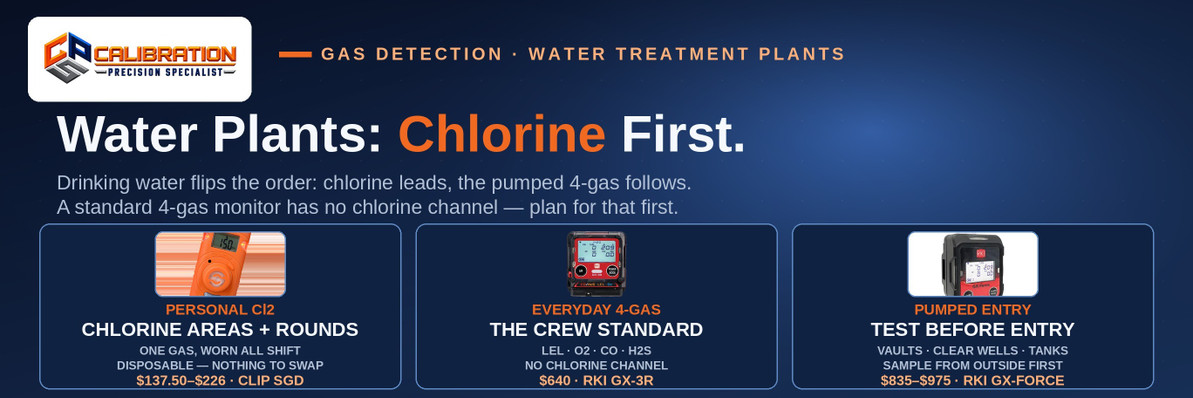
Water treatment plant workers need chlorine-first monitoring: a personal chlorine (Cl₂) monitor for chlorine storage and feed areas and for operator rounds — a disposable single-gas unit runs $137.50–$226 — plus a pumped 4-gas monitor ($835–$975) to test vaults, clear wells, filter galleries, and tanks from outside before entry. A standard 4-gas monitor alone is not enough, because its four channels — LEL, oxygen, carbon monoxide, and hydrogen sulfide — do not include chlorine.
That order — chlorine first, then the 4-gas — is what separates a drinking-water plant from most other industrial sites, including a wastewater plant. Wastewater leads with hydrogen sulfide; drinking water stores and feeds chlorine as its primary disinfectant, so chlorine is the gas the crew works around every shift. Everything below is the kit, room by room: who wears what, which instrument tests which space, and what each piece costs.
Why Does Chlorine Come First in a Drinking-Water Plant?
Chlorine is the working chemical of the plant. It arrives and is stored as liquefied gas in cylinders or ton containers, or generated and fed on site, and it is handled at the storage room, the feed room, and every dosing point in between. Three properties make it the lead hazard for personal monitoring:
- It is toxic at low concentrations. Chlorine is a respiratory hazard long before it is a flammable one — there is no LEL channel that covers it. It needs its own electrochemical sensor.
- It is heavier than air. Leaked chlorine sinks and collects at floor level, in sumps, and in below-grade spaces — exactly where a worker kneels to change a cylinder or service a feed line.
- The standard 4-gas monitor cannot see it. LEL, O₂, CO, and H₂S is the right set for many jobs, but chlorine is not one of those four channels. A crew can be fully equipped by wastewater standards and completely blind to chlorine.
The background explainer is in chlorine gas detection in water treatment. The fixed half of the same problem — the wall-mounted points that watch chlorine rooms when nobody is in them — is covered in fixed gas detection for water treatment plants.
What Should Operators Wear on Rounds and in Chlorine Areas?
Use this when: the worker's job takes them into chlorine storage, chlorine feed, or chemical areas, or on rounds through the whole plant.
- Chlorine personal monitor. Anyone who enters chlorine storage or feed areas, changes cylinders or ton containers, or services feed equipment should wear a detector with a chlorine channel, in the breathing zone. The simplest form is a disposable single-gas chlorine monitor such as the Crowcon Clip SGD ($137.50–$226) — it turns on, runs for its service life, and is replaced whole, with no sensors to swap. Plants that want one serviceable instrument with chlorine plus other channels step up to a configurable multi-gas unit such as the SENKO SP-MGTP ($850 base, up to six gases).
- Standard 4-gas for general plant work. For rounds and maintenance outside the chlorine areas, the standard crew instrument is a 4-gas monitor such as the RKI GX-3R ($640) — LEL, oxygen, CO, and H₂S in a compact, wearable unit. It is the right monitor for most of the plant; it is simply not a chlorine monitor, and it should never be treated as one in a chlorine room.
- Wear it in the breathing zone. Chest, collar, or shoulder — near the nose and mouth, inlet unobstructed. A monitor in a pocket or on a belt behind the body samples the wrong air, which matters most with a gas that pools low and is breathed at kneeling height during cylinder work.
Browse single-gas monitors for the chlorine personal options and portable multi-gas monitors for the 4-gas and configurable units.
Which Spaces Need a Pumped Monitor — Vaults, Clear Wells, Filter Galleries, and Tanks?
Use this when: anyone has to enter — or even lean into — a below-grade or enclosed space. In a water plant those spaces are everywhere: dry and wet vaults, clear wells, filter galleries below grade, contact basins, and storage tanks.
A pumped monitor pulls air through a hose from inside the space while the operator stays outside. That is the only honest way to test before entry: lower the probe, sample at different depths, and read oxygen, LEL, CO, and H₂S before a body goes in — and keep monitoring continuously while the entrant is inside. The RKI GX-Force ($835–$975) is built for exactly this role. A diffusion monitor waved over an open hatch is not a pre-entry test.
Two water-plant specifics drive this:
- Oxygen in below-grade spaces. Vaults, clear wells, galleries, and tanks can be oxygen-deficient — air displaced or consumed until it will not support life — even in a plant that handles no other obvious hazard in that space. Below 19.5% oxygen the atmosphere is oxygen-deficient by the confined-space standard, and the first symptom is impaired judgment, which is why the space is tested from outside, never by sending someone in to check. The definitions are in what is a confined space? and the full test sequence is in how to test a confined space before entry.
- Chlorine collects low. The same below-grade geometry that traps oxygen-poor air also collects chlorine that leaks from feed lines running through galleries and vaults. Testing at more than one depth is not a formality in a water plant — the gas and the hazard are stratified.
If the plant also runs a wastewater side, the companion kit — hydrogen sulfide first, chlorine second — is laid out in what gas detectors do wastewater workers need?.
What Does the Water Plant Kit Cost?
| Role | Instrument | Live price |
|---|---|---|
| Chlorine personal monitor, disposable single-gas | Crowcon Clip SGD | $137.50–$226 |
| Everyday crew 4-gas (LEL · O₂ · CO · H₂S) | RKI GX-3R | $640 |
| Pumped 4-gas for pre-entry testing | RKI GX-Force | $835–$975 |
| Configurable pumped multi-gas, up to 6 gases incl. a chlorine channel | SENKO SP-MGTP | $850 base |
Then budget the program behind the instruments: calibration gas for bump tests and calibrations — every CPS calibration gas cylinder carries a QR code that links to its SDS and Certificate of Analysis, and CPS charges no hazmat fee on calibration gas — plus scheduled full calibrations. Sent to us in-house, calibration runs $55 for a single-gas instrument and $90 for a four- or five-gas instrument, and we calibrate every channel on the instrument. On-site service is quoted in writing; the in-house rates do not apply on site, because site conditions set the real price. What calibration gas is and the Calibration Gas Finder match each instrument to its gas.
Portable, Fixed, or Both for a Water Plant?
Portables protect the person; fixed points protect the room. A personal chlorine monitor only warns a worker who is already wearing it, in that room, on that shift. The chlorine storage and feed rooms also need watching at night, on weekends, and in the hour before the first operator walks in — that is a fixed system's job, and it is the subject of fixed gas detection for water treatment plants. The general decision framework is in fixed vs. portable gas detection. Most water plants land, correctly, on both.
Frequently Asked Questions
What gas detectors do water treatment plant workers need? Two layers. First, a personal chlorine monitor for anyone entering chlorine storage or feed areas or making rounds — a disposable single-gas unit such as the Crowcon Clip SGD runs $137.50–$226. Second, a pumped 4-gas monitor such as the RKI GX-Force ($835–$975) to test vaults, clear wells, filter galleries, and tanks from outside before entry. A standard 4-gas monitor like the RKI GX-3R ($640) covers general plant work, but its LEL, oxygen, CO, and H₂S channels do not include chlorine.
Does a 4-gas monitor detect chlorine? No. A standard 4-gas monitor measures combustible gas (LEL), oxygen, carbon monoxide, and hydrogen sulfide. Chlorine requires its own electrochemical sensor, so chlorine protection means either a dedicated single-gas chlorine monitor or a configurable multi-gas instrument fitted with a chlorine channel, such as the SENKO SP-MGTP (from $850, up to six gases). A 4-gas monitor can be working perfectly and still read nothing in a chlorine leak.
Why is chlorine the main gas hazard in drinking water treatment? Because chlorine is the plant's primary disinfectant, stored and fed continuously — in cylinders or ton containers, or generated on site — at storage rooms, feed rooms, and dosing points the crew works around every shift. It is toxic at low concentrations and heavier than air, so leaks sink and collect at floor level and in below-grade spaces. That combination — constant presence, low-level toxicity, and low pooling — is why chlorine, not hydrogen sulfide, leads in drinking water. Wastewater is the reverse.
What gas detector should you use for a clear well, vault, or filter gallery? A pumped 4-gas monitor, used from outside the space before anyone enters. Lower the sampling probe and test at different depths for oxygen, combustible gas, carbon monoxide, and hydrogen sulfide, then monitor continuously during entry. The RKI GX-Force ($835–$975) is built for this work. A diffusion-only personal monitor cannot sample a space the wearer has not entered yet, so it cannot perform a pre-entry test.
Why is oxygen monitored in below-grade water plant spaces? Because enclosed and below-grade spaces — vaults, clear wells, galleries, tanks, and basins — can become oxygen-deficient as air is displaced or consumed, even when no toxic gas is present. Below 19.5% oxygen an atmosphere is oxygen-deficient under the confined-space standard, and the early effect is impaired judgment, so the entrant cannot reliably rescue themselves. That is why oxygen is tested first, from outside, with a pumped instrument before every entry.
How much does a chlorine gas detector cost? A disposable single-gas chlorine monitor costs $137.50–$226 (Crowcon Clip SGD). A configurable serviceable instrument that includes a chlorine channel among up to six gases starts at $850 (SENKO SP-MGTP). For comparison, the plant's other portables run $640 for a standard 4-gas RKI GX-3R and $835–$975 for a pumped RKI GX-Force. Ownership adds calibration gas and scheduled calibrations — $55 in-house for a single-gas instrument and $90 for a four- or five-gas instrument at CPS.
Where should a portable gas detector be worn? In the breathing zone — on the chest, collar, or shoulder strap, near the nose and mouth, with the sensor inlet unobstructed. The monitor can only sample the air where it sits, so a detector in a pocket, on a back belt loop, or inside a jacket reads different air than the worker breathes. Placement matters most during chlorine cylinder and feed work, where the worker is kneeling in the low layer where chlorine collects.
Do water treatment workers need both chlorine and 4-gas monitors? Usually, yes — for different jobs. The chlorine monitor covers the plant's chemical hazard in storage, feed, and dosing areas. The 4-gas monitor covers combustible gas, oxygen deficiency, carbon monoxide, and hydrogen sulfide for general work and, in its pumped form, for confined-space testing. Neither instrument covers the other's gases: a chlorine single-gas unit does not test a vault for oxygen, and a 4-gas unit does not detect chlorine.
How often do water plant gas detectors need calibration? Bump test before each day's use, and a full calibration at the manufacturer's recommended interval and whenever an instrument fails a bump test. Chlorine sensors in particular work in a corrosive service, so a skipped calibration does not announce itself — the reading simply drifts. At CPS, in-house calibration is $55 for single-gas and $90 for four- or five-gas instruments, every channel is calibrated, and calibration gas cylinders carry a QR code linking to their SDS and Certificate of Analysis.
What is the difference between water treatment and wastewater gas detection? The lead hazard flips. Wastewater monitoring is hydrogen sulfide first — sewers, wet wells, and headworks generate H₂S continuously — with chlorine as a secondary chemical hazard. Drinking-water monitoring is chlorine first, because chlorine storage and feed is the daily chemical exposure, with the standard 4-gas set covering vaults, clear wells, galleries, and tanks. Plants that run both sides need both kits; the wastewater portable kit is detailed in the companion wastewater post.
The Bottom Line
Equip a water treatment plant chlorine-first: a chlorine personal monitor ($137.50–$226 disposable) on everyone who enters chlorine areas or makes rounds, a standard 4-gas monitor ($640) for general crew work, and a pumped 4-gas monitor ($835–$975) that tests every vault, clear well, filter gallery, and tank from outside before entry. The one purchase that fails this plant is the standard 4-gas monitor bought alone — it is a good instrument that simply cannot see chlorine.
Outfitting a water plant crew, or replacing a kit that has no chlorine channel? Call 865-900-8844 or reach us through Contact Us. We will match the monitors to your rooms and spaces — portable multi-gas monitors, single-gas monitors, calibration gas, and the calibration services that keep every channel honest.
CPS Calibrations · 109 S. Front Street, Rockwood, TN 37854 · Calibration Gas · Calibration Services · Contact Us
Need a calibration you can file?
In-house calibration at CPS in Rockwood, Tennessee — $55 for single-gas instruments, $90 for 4- and 5-gas — every channel, as-found and as-left data, full certificate.
See Calibration Servicesor call 865-900-8844
Recent Posts
-

What Is Remote Monitoring for Fixed Gas Detection?
Remote monitoring for fixed gas detection means a fixed system's live readings, trends, and alarm hi …Nov 23rd 2026 -

What Are the Key Differences Between the GX-6000 and GX-6100?
The RKI GX-6100 is the current replacement for the discontinued GX-6000: both are pumped 6-gas monit …Nov 22nd 2026 -

How to Read a PID Correction Factor Chart
To read a PID correction factor chart, find your vapor’s row, take the factor under your own lamp en …Nov 21st 2026