
What Gas Detectors Do Wastewater Workers Need?
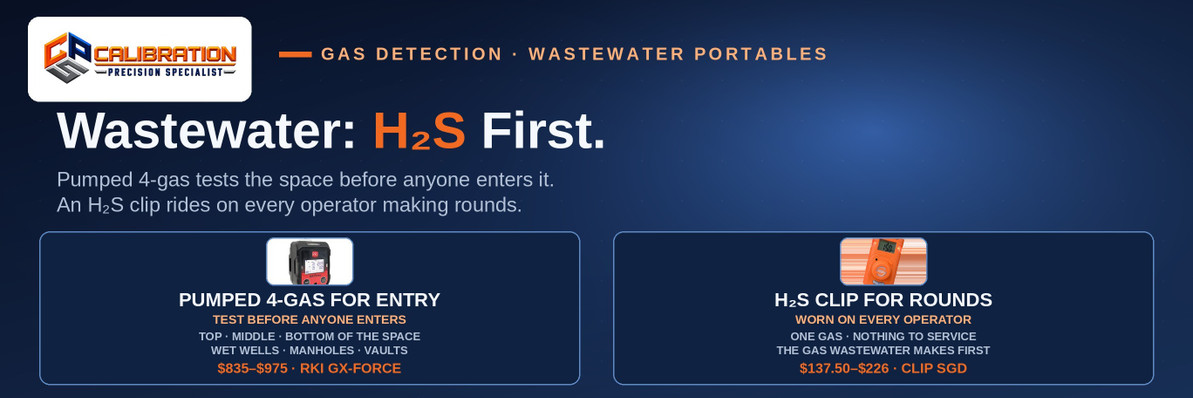
Wastewater workers need a pumped 4-gas detector — LEL, oxygen, CO, and H₂S — to test wet wells, manholes, and vaults before and during permit-required confined-space entry, and a single-gas H₂S detector on every operator making rounds. The pumped entry instrument runs $835–$975 (RKI GX-Force), and the rounds clip runs $137.50–$226 (Crowcon Clip SGD, disposable) — because H₂S is the gas wastewater produces first, and it deadens the sense of smell that workers instinctively rely on.
One detector cannot do both jobs well. The entry instrument has to sample a space the tester is not standing in yet. The rounds detector has to be so small and simple that it is actually worn, every round, every shift. This post builds the kit job by job.
Why Does H₂S Come First in Wastewater?
Sewage is decomposing organic material, and decomposition in low-oxygen water and sludge produces hydrogen sulfide. It collects exactly where wastewater workers work: wet wells, manholes, lift stations, headworks, sumps, and sludge-handling areas. Three properties make it the first gas to plan around:
- It is heavier than the air around it and pools low — in the bottom of a wet well, below a manhole cover, and in sumps and pits, which is why testing has to reach the bottom of the space, not just the opening.
- It deadens the sense of smell. At hazardous concentrations H₂S fatigues the nose, so the rotten-egg smell seems to fade. A worker who concludes "it's clearing up" may be losing the only warning they were trusting. The detector does not get tired; the nose does.
- It turns lethal in the places nobody enters casually. Most wastewater H₂S deaths happen in confined spaces — and a share of them happen to would-be rescuers who followed a collapsed coworker in. That history is why the entry procedure, the pumped test, and the attendant below are not paperwork.
H₂S is first, not only. Oxygen depletion follows it into every sealed space, and methane appears wherever wastewater solids are digested. The kit below is built in that order.
Which Detector Does Each Wastewater Job Need?
| The job | The detector | Why |
|---|---|---|
| Testing a wet well, manhole, or vault before entry | Pumped 4-gas — RKI GX-Force ($835–$975) or SENKO SP-MGTP ($850 base) | The pump draws a sample from inside the space — top, middle, and bottom — while the tester stays outside |
| The entrant, during a permit-required entry | The pumped 4-gas, carried into the space, testing continuously | Conditions in a disturbed wet well change while the work is happening; a pre-entry reading is a snapshot, not a promise |
| Operators on rounds — plants, lift stations, collections | Single-gas H₂S clip — Crowcon Clip SGD ($137.50–$226) | One known gas, worn every round, nothing to service or swap; the honest cheap layer for the most common wastewater gas |
| Crew work where all four gases are plausible all day | Diffusion 4-gas — RKI GX-3R ($640) | Full 4-gas personal protection in the breathing zone for workers whose whole shift is in gas areas |
| The attendant at the top of an entry | Their own detector at the opening, plus sight of the entrant's readings | Gas exiting the space reaches the attendant first topside — and the attendant is the person who has to act on a bad reading |
The general buying sequence behind this table — gases first, then pump, then disposable vs. serviceable — is laid out in how to choose a portable gas detector.
What Does a Confined-Space Entry Crew Actually Need?
Most wastewater entries are permit-required confined spaces: wet wells, manholes, vaults, tanks, and digesters meet the definition in what is a confined space. The monitoring part of a lawful, survivable entry is specific:
- Test before entry, from outside, with a pumped instrument. Draw samples at different depths — oxygen, combustible gas, and toxics including H₂S — before anyone's body breaks the plane of the opening. The step-by-step is in how to test a confined space before entry.
- Keep testing during the entry. Agitating sludge, breaking a line, or starting a pump can release H₂S that the pre-entry test never saw. The entrant carries the detector; continuous testing is what catches the change.
- Bump test before the day's use, calibrate on schedule. A pumped detector that has not been bump tested is an opinion, not a measurement.
A diffusion monitor waved at an open manhole is not a pre-entry test. If the instrument cannot pull air from the bottom of the space while the tester stays on the surface, it is the wrong instrument for entry work — whatever its sensor list says. Crews that only own diffusion units need one pumped unit in the entry kit; that single pumped monitor is the difference between testing a space and guessing at it.
Why Does the Attendant at the Top Need Readings Too?
The attendant is usually drawn as the person with the radio and the paperwork. In gas terms the attendant has two exposures the plan often forgets:
- The attendant stands in the exhaust path. Whatever is in the space comes out of the opening — to the attendant first. An attendant leaning over a wet-well opening to watch the entrant is breathing the top of that atmosphere with, in many crews, no detector at all.
- The attendant is the decision-maker. Evacuation, ventilation changes, and the call for rescue all run through the attendant. "The entrant said it smelled fine" is not a reading. The attendant needs the entrant's readings visible or reported on a schedule, and their own detector at the opening so a rising topside reading triggers action before it triggers a collapse.
One rule rides on top of both: the attendant never enters for rescue. An attendant who follows a downed entrant into an H₂S atmosphere becomes the second casualty in the classic wastewater sequence. The attendant's detector, retrieval equipment, and phone are the rescue plan — not their body.
What About Methane and Oxygen at a Wastewater Plant?
H₂S gets the headlines; two other gases shape the rest of the kit:
- Methane (LEL) at digesters. Digester gas is mostly methane, so around digesters, gas-handling equipment, and sludge processing the combustible channel matters as much as the toxic ones. This is one reason the entry and crew instruments are 4-gas units with an LEL sensor rather than H₂S-only devices: the same wet well that holds H₂S can hold a flammable atmosphere, and only the 4-gas instrument sees both.
- Oxygen depletion everywhere sealed. Any space where decomposition, rust, or displacement has been working undisturbed can be low on oxygen — and low oxygen produces no smell, no color, and no warning short of collapse. The O₂ channel on the 4-gas is the only layer that sees it. A single-gas H₂S clip is the right detector for rounds in open plant areas; it is not an entry instrument, precisely because it cannot see oxygen, LEL, or CO.
That is also why fixed detection has its own job at a plant — wet wells and digester areas need watching when nobody is standing there at all. The fixed side is covered in fixed gas detection for wastewater treatment plants, and the portable/fixed line in general is drawn in fixed vs. portable gas detection.
What Does Keeping Wastewater Detectors Honest Cost?
- Bump and calibration gas. Every instrument in the kit gets bump tested before use and calibrated at the manufacturer's interval with certified gas matched to its sensors. CPS calibration gas bottles carry a QR code that pulls up the bottle's SDS and certificate of analysis, and CPS charges no hazmat fee on calibration gas — we absorb it rather than adding it at checkout.
- Calibration service. Sent to us in-house, calibration runs $55 for a single-gas instrument and $90 for a four- or five-gas instrument — and we calibrate every channel on the instrument, not a sample of them. On-site service is quoted in writing, because site conditions set the real price; the $55/$90 figures are in-house rates.
- The disposable math. A Clip SGD at $137.50–$226 is replaced whole at the end of its service life — no sensor swaps, no repair decisions. Divided by its years of service, that is the honest cost of the rounds layer, and for high-turnover crews it is usually the right one.
Browse the ranges this kit is built from: portable multi-gas monitors and single-gas monitors.
Frequently Asked Questions
What gas detectors do wastewater workers need?
Two portable layers: a pumped 4-gas detector (LEL, O₂, CO, H₂S) for testing wet wells, manholes, and vaults before and during confined-space entry — the RKI GX-Force at $835–$975 is built for that role — and a single-gas H₂S detector on every operator making rounds, such as the disposable Crowcon Clip SGD at $137.50–$226. Crews who work in gas areas all shift add a diffusion 4-gas personal monitor like the RKI GX-3R at $640.
Why is hydrogen sulfide so dangerous in wastewater?
H₂S is produced by decomposing sewage, it is heavier than air so it pools in wet wells, manholes, and sumps, and at hazardous concentrations it deadens the sense of smell — so the rotten-egg odor seems to fade exactly when the danger rises. Workers cannot trust their noses; they need a detector that keeps reading after their smell has fatigued, and a pumped test before entering any space where H₂S can collect.
Do wastewater workers need a 4-gas detector or a single-gas detector?
Both, for different jobs. Entry testing and crew work where oxygen, combustible gas, CO, and H₂S are all plausible call for the 4-gas instrument — a single-gas unit cannot see oxygen depletion or a flammable atmosphere. Rounds in open plant areas, where H₂S is the one known hazard, are exactly what a single-gas H₂S clip is for: cheaper, smaller, and simple enough to be worn every round. Guessing low on sensor count is the expensive direction to be wrong.
What gas detector should be used for a wet well or manhole entry?
A pumped 4-gas detector. The pump and hose draw air from inside the space — tested at different depths — while the tester stays outside, which a diffusion monitor cannot do. The RKI GX-Force ($835–$975) and the SENKO SP-MGTP ($850 base, up to six gases) are built for pre-entry testing; the entrant then carries a detector in the space so testing continues during the work, not just before it.
Does the attendant at a confined space entry need a gas detector?
Yes. Gas leaving the space reaches the attendant at the opening first, and the attendant is the person who must order evacuation and call for rescue — decisions that need real readings, not the entrant's impressions. The attendant should have their own detector at the opening and a way to follow the entrant's readings, and must never enter the space to attempt a rescue.
Do wastewater workers need a methane detector?
Around digesters and sludge-gas equipment, yes — digester gas is mostly methane, which is why the combustible (LEL) channel of a 4-gas detector matters at a wastewater plant and why H₂S-only instruments are not entry instruments. In collections and general plant areas the toxic risk (H₂S) usually leads, but any worker whose job touches digester gas needs LEL coverage on the instrument they carry.
Can you smell H₂S and tell if it is safe?
No. H₂S has a strong rotten-egg smell at low concentrations, but at hazardous concentrations it fatigues the sense of smell, so the odor seems to go away while the gas is still there — or rising. A fading smell is a reason to leave and test with an instrument, never a sign that a space has cleared. Only a calibrated detector reading is evidence about the atmosphere.
How often do wastewater gas detectors need bump testing and calibration?
Bump test before each day's use — a quick exposure to gas that confirms the sensors respond and the alarms fire — and perform a full calibration when an instrument fails a bump test and at the manufacturer's recommended interval. Wastewater service is hard on sensors: H₂S exposure, humidity, and washdowns are exactly the conditions under which a skipped bump test hides a dead sensor until the day it matters.
How much do gas detectors for wastewater work cost?
The rounds layer is $137.50–$226 per operator for a disposable Crowcon Clip SGD single-gas H₂S detector. The standard personal 4-gas monitor, the RKI GX-3R, is $640. The pumped entry instrument runs $835–$975 for the RKI GX-Force, or $850 base for the SENKO SP-MGTP (up to six gases). Ownership adds calibration gas and calibration — $55 single-gas / $90 four- or five-gas in-house at CPS, with every channel calibrated.
Can one pumped detector be shared by a whole entry crew?
It can be shared as the entry-testing instrument — one pumped unit tests the space, and entrants carry detectors during the work — but it cannot be the crew's only detector. The attendant needs a reading at the opening, the entrant needs continuous testing in the space, and operators on rounds elsewhere in the plant need their own H₂S coverage at the same time. One instrument can only be in one of those places; the kit is sized by simultaneous jobs, not by headcount alone.
The Bottom Line
Build the wastewater kit H₂S-first, in layers: a pumped 4-gas detector tests every wet well, manhole, and vault before and during entry; a single-gas H₂S clip rides on every operator making rounds; the attendant at the top gets their own readings at the opening; and the LEL and O₂ channels stay in the kit because digesters make methane and sealed spaces lose oxygen. Skip a layer and you have not saved the money — you have chosen which job goes unmonitored.
Not sure which layer your plant is missing? Call 865-900-8844 or reach us through Contact Us. Tell us the entries you make and the rounds you walk, and we will spec the kit the way this post does — portable multi-gas monitors, single-gas monitors, calibration gas, and the calibration services that keep every channel honest.
CPS Calibrations · 109 S. Front Street, Rockwood, TN 37854 · Calibration Gas · Calibration Services · Contact Us
Need a calibration you can file?
In-house calibration at CPS in Rockwood, Tennessee — $55 for single-gas instruments, $90 for 4- and 5-gas — every channel, as-found and as-left data, full certificate.
See Calibration Servicesor call 865-900-8844
Recent Posts
-

What Is Remote Monitoring for Fixed Gas Detection?
Remote monitoring for fixed gas detection means a fixed system's live readings, trends, and alarm hi …Nov 23rd 2026 -

What Are the Key Differences Between the GX-6000 and GX-6100?
The RKI GX-6100 is the current replacement for the discontinued GX-6000: both are pumped 6-gas monit …Nov 22nd 2026 -

How to Read a PID Correction Factor Chart
To read a PID correction factor chart, find your vapor’s row, take the factor under your own lamp en …Nov 21st 2026