
Fixed Gas Detection for Wastewater Treatment Plants: Where the Sensors Go
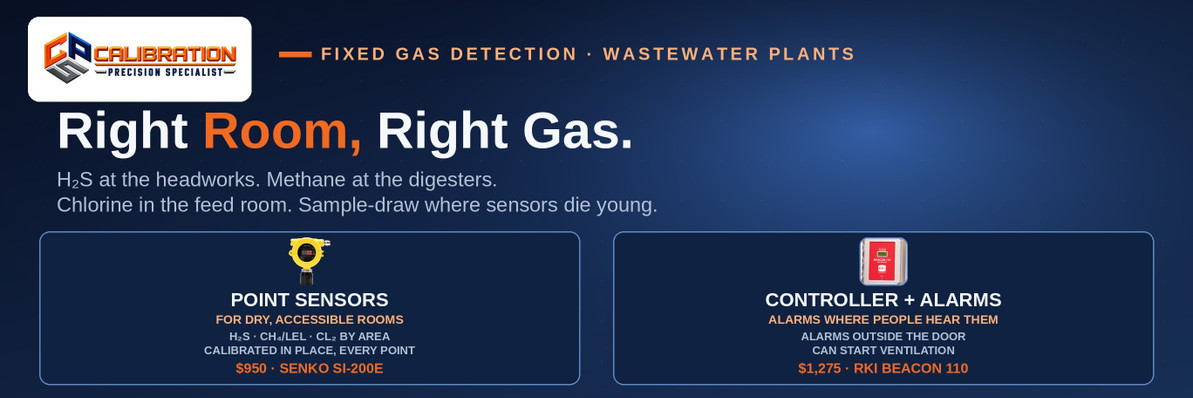
In a wastewater treatment plant, fixed gas sensors belong where each gas is actually made: H₂S points at the headworks, wet wells, and grit and screening rooms, methane (LEL) points in digester areas, and chlorine points in chlorine storage and feed rooms — with sample-draw systems instead of bare point sensors in the wet, corrosive areas where point sensors die young. Every point reports to a controller — $1,275 for a single-channel RKI Beacon 110 — that sounds alarms where people will hear them and can start ventilation, because a detector nobody hears protects nothing.
A wastewater plant is not one hazard with one sensor type. It is several different gas hazards sharing a fence line, and the fixed system has to be drawn room by room. This post is that drawing.
What Gases Does a Wastewater Plant Need Fixed Detection For?
| Plant area | Gas to detect | Why there |
|---|---|---|
| Headworks / influent | H₂S | Incoming sewage releases hydrogen sulfide where it arrives, is screened, and is first agitated |
| Wet wells | H₂S (and O₂/LEL awareness on entry) | Sewage collects and sits; H₂S pools low in the well and the room above it |
| Grit and screening rooms | H₂S | Solids separated from the flow carry the same decomposition gases into an enclosed room |
| Digester areas | Methane / LEL (CH₄) | Digester gas is mostly methane; leaks around gas handling, covers, and piping are a fire and explosion hazard |
| Chlorine storage and feed rooms | Chlorine (Cl₂) | Cylinders, ton containers, and feed equipment are a toxic-gas leak source in a small enclosed room |
| Sludge handling / dewatering buildings | H₂S | Stored and processed solids keep generating H₂S inside buildings people work in |
Portable detectors for the people who move between these areas — the rounds, entries, and maintenance work — are covered in what gas detectors wastewater workers need. Fixed points watch the rooms themselves, including the hours when no person is in them. The general fixed-vs-portable split is in fixed vs. portable gas detection.
Where Do H₂S Sensors Go — Headworks, Wet Wells, and Screening Rooms?
H₂S is the plant-wide fixed-detection priority, and its placement follows the sewage, not the building plan:
- Headworks. Put points where the influent arrives and is first disturbed — channels, bar screens, and influent structures — because agitation of incoming sewage is what drives H₂S out of the water and into the room air.
- Wet wells. The room and structure above a wet well need coverage: H₂S generated in the collected sewage rises out of the well and pools low in the surrounding space. A point in the wet-well area watches it continuously — including overnight, when a rising concentration would otherwise meet the first operator through the door in the morning.
- Grit and screening rooms. These are enclosed rooms doing a dirty, gas-producing job. They are easy to under-instrument because people pass through them quickly — but fixed detection is precisely for rooms people pass through quickly and nobody watches: the alarm has to be at the door and at the controller, not dependent on someone standing in the room smelling trouble. Remember that H₂S deadens the sense of smell; a room that "smells fine" is not a monitored room.
A typical point is a fixed detector such as the SENKO SI-200E ($950) or a member of the Crowcon Xgard family ($784–$2,016) — browse the detector heads and the wider fixed systems range to see how a point is built. Mounting heights and source-by-source placement method are covered in where fixed gas detectors should be placed.
Where Do Methane Sensors Go in Digester Areas?
Digester gas is mostly methane, so digester buildings, gas-handling areas, and the spaces around covers, mixers, and piping get combustible-gas (LEL) points:
- High, not low. Methane is lighter than air and rises, so LEL points belong above and around the likely leak sources — the opposite end of the room from where a heavy gas like H₂S collects.
- At the equipment, not just in the room. Gas trains, compressors, flares' feed equipment, and piping runs are the identifiable leak sources. A point near the source alarms while the leak is still small.
- Paired with the entry rules. A fixed LEL point watching a digester area does not test a digester, a tank, or a vault for entry — that is still a pumped portable test under the confined-space program, as the portable companion post explains.
Where Do Chlorine Sensors Go in Storage and Feed Rooms?
Chlorine rooms are the opposite problem from the headworks: a small, enclosed room, a stored toxic gas, and equipment that gets connected and disconnected as cylinders change. Placement follows the storage and the feed gear:
- At the cylinders and feed equipment. Storage, manifolds, and feed lines are the leak sources; points belong near them, at the height chlorine occupies as it leaves a leak and collects.
- Alarming outside the door. A chlorine leak in a closed room must announce itself before the next operator opens the door and walks in. The controller's horns and strobes belong where people approach the room, not only inside it.
- Tied to the room's response. Through the controller, a chlorine point can start the room's ventilation — the difference between an alarm that reports a growing problem and a system that is already diluting it when help arrives.
Use this when: any plant storing or feeding chlorine gas should treat the chlorine room as a fixed-detection room by default, and treat a portable-only program there as a gap — the room is hazardous in exactly the hours nobody is wearing a detector in it.
When Does Sample-Draw Beat a Point Sensor?
Some wastewater rooms eat point sensors. Constant humidity, corrosive H₂S atmospheres, washdowns, and condensing air shorten sensor life and turn a fixed point into a maintenance subscription. That is what sample-draw is for:
- How it works. Instead of mounting the sensor in the hostile room, a sample-draw system pulls air from the room through tubing to a sensor housed somewhere survivable, and analyzes the drawn sample. The room gets monitored; the sensor gets a survivable life.
- Use this when the area is wet, corrosive, condensing, or hard to access for calibration — wet-well structures and similarly harsh spaces are the classic wastewater cases. A point sensor that has to be replaced constantly is not cheaper than sample-draw; it is sample-draw paid for in sensors, one failure at a time.
- The honest trade-off. Sample-draw adds a pump, tubing, and a transport delay while the sample travels, and the sample path itself needs maintenance. It is the right answer where point sensors die young — not a default for dry, accessible rooms where a point sensor lives a normal life and can be calibrated in place.
What Ties It Together — Controllers, Alarms, and Plant Systems?
Points without a controller are just readings on a wall nobody may be watching. The system layer is what makes fixed detection act:
- One reporting point. Detectors report to a controller by 4–20 mA and/or Modbus — a single-channel RKI Beacon 110 is $1,275, and larger controllers aggregate more points — so alarms, trends, and faults land in one place and can feed plant systems. The full signal path is explained in how a fixed gas detection system works.
- Alarms where people are. Horns and strobes at the room entrance and at staffed locations — outside the chlorine room door, at the wet-well entrance — so the warning arrives before the exposure does.
- Relays that do work. Through controller relays the system starts exhaust ventilation and can shut down equipment, instead of only announcing a hazard it does nothing about.
What Does Fixed Detection at a Wastewater Plant Cost?
Per point, detector hardware runs $950 for a SENKO SI-200E, with the Crowcon Xgard family spanning $784–$2,016 depending on gas and configuration, plus a controller — $1,275 for a single-channel Beacon 110 — plus the part no catalog can price honestly: cable or conduit runs, sample lines where sample-draw is used, mounting, commissioning, and startup calibration, all of which depend on the plant. Anyone who quotes a total installed price for a wastewater plant without walking it is guessing. CPS quotes fixed work in writing after a site review.
Then budget the upkeep with the purchase: every fixed point is a measuring instrument living in a hostile atmosphere, and it must be calibrated in place, at every point, on the manufacturer's schedule. A fixed sensor that has drifted is worse than no sensor, because the whole plant trusts it. When portable instruments come in for service, CPS calibration is $55 single-gas / $90 four- or five-gas in-house, and we calibrate every channel — the same every-channel standard is the one to hold a fixed program to.
Frequently Asked Questions
Where should fixed gas detectors be placed in a wastewater treatment plant?
Where each gas is made: H₂S points at the headworks and influent structures, in wet-well areas, and in grit and screening rooms; methane (LEL) points high in digester and gas-handling areas; chlorine points at the cylinders and feed equipment in chlorine storage and feed rooms; and H₂S coverage in sludge-handling and dewatering buildings. Each point belongs near its likely leak source, at the height the gas occupies, reporting to a controller.
What fixed gases should a wastewater plant monitor?
Primarily three: hydrogen sulfide (H₂S) in the sewage-side areas — headworks, wet wells, screening, and sludge handling; methane, read as combustible gas (LEL), around digesters and digester-gas equipment; and chlorine (Cl₂) in chlorine storage and feed rooms. The plant's own process decides the final list, but a wastewater fixed system with no H₂S point, or a chlorine room with no Cl₂ point, has a named gap in it.
Does a wet well need fixed H₂S detection?
In most plants, yes. Sewage sitting in a wet well generates H₂S continuously, and the gas leaves the well into the surrounding structure — including overnight and on weekends, when no operator is standing there with a portable. A fixed point in the wet-well area watches that accumulation around the clock and alarms at the controller and the entrance. It does not replace the pumped portable test required before a person enters the well itself.
Where do methane sensors go in a digester area?
High and near the sources. Methane is lighter than air, so LEL points belong above and around digester-gas equipment — piping, compressors, covers, and gas-handling gear — where a leak rises and collects. That is the opposite placement from H₂S, which pools low, which is why a single "gas sensor height" for a whole plant is always wrong: height follows the gas.
How are chlorine leaks in a storage or feed room detected?
With a fixed chlorine point near the cylinders, manifold, and feed equipment, reporting to a controller that alarms outside the room's door as well as at staffed locations, and that can start the room's ventilation through its relays. A portable detector only finds a chlorine leak when a person walks into the room wearing one — into the leak. The fixed point is what warns that person before they open the door.
What is a sample-draw gas detection system, and when does a wastewater plant need one?
A sample-draw system pulls air from the monitored area through tubing to a sensor housed in a survivable location, instead of mounting the sensor in the area itself. A wastewater plant needs one where point sensors die young — wet, corrosive, condensing, hard-to-access spaces such as wet-well structures — because a point sensor replaced over and over costs more than the sample-draw system that would have outlived it. The trade-off is the pump, tubing, and sample-path maintenance sample-draw adds.
How much does a fixed gas detection system for a wastewater plant cost?
Detector hardware runs $950 per point for a SENKO SI-200E, or $784–$2,016 across the Crowcon Xgard family, plus a controller — $1,275 for a single-channel RKI Beacon 110 — plus wiring or conduit, sample lines if used, mounting, commissioning, and startup calibration, which depend on the plant and are quoted in writing after a site review. There is no honest universal installed price per point; a total quoted without seeing the plant is a guess.
Can fixed gas detection replace portable detectors at a wastewater plant?
No. Fixed points watch rooms; they cannot test a wet well, manhole, or digester before a person enters it — confined-space entry requires a pumped portable test at the space — and they cannot follow operators on rounds between buildings. Fixed and portable cover different jobs at the same plant: fixed watches the places 24/7, portables protect the people wherever they go. Most wastewater plants need both, layered.
Do fixed gas detectors in a wastewater plant need calibration?
Yes — in place, at every point, at the manufacturer's recommended interval, and after any sensor replacement. Wastewater atmospheres are hard on sensors, and drift in a fixed point fails silently and continuously while everyone trusts the reading. Calibration is part of the system's cost from the day it is designed, not an optional extra discovered later.
What happens when a fixed gas detector alarms at a wastewater plant?
The point reports to the controller, which sounds alarms at the entrance to the affected room and at staffed locations — warning the next person before they walk in — and, through its relays, can start exhaust ventilation and shut down equipment. What it cannot do is rescue or test: an alarm is the start of the plant's response procedure, and entry into the alarmed space still waits for a pumped portable test and the confined-space program.
The Bottom Line
Draw the wastewater fixed system as a map, not a shopping list: H₂S where the sewage arrives, sits, and is screened; methane high where digester gas is handled; chlorine at the cylinders and feed gear, alarming outside the door; sample-draw wherever the room would kill a point sensor young; and every point reporting to a controller that alarms where people are and starts ventilation. Then keep every point calibrated in place — a fixed system is only as honest as its worst-kept sensor.
Want a second set of eyes on your plant's map? Call 865-900-8844 or reach us through Contact Us. We will walk the areas with you — fixed systems, detector heads, controllers, portable monitors for your crews, and the calibration services behind both.
CPS Calibrations · 109 S. Front Street, Rockwood, TN 37854 · Calibration Gas · Calibration Services · Contact Us
Need a calibration you can file?
In-house calibration at CPS in Rockwood, Tennessee — $55 for single-gas instruments, $90 for 4- and 5-gas — every channel, as-found and as-left data, full certificate.
See Calibration Servicesor call 865-900-8844
Recent Posts
-

What Is Remote Monitoring for Fixed Gas Detection?
Remote monitoring for fixed gas detection means a fixed system's live readings, trends, and alarm hi …Nov 23rd 2026 -

What Are the Key Differences Between the GX-6000 and GX-6100?
The RKI GX-6100 is the current replacement for the discontinued GX-6000: both are pumped 6-gas monit …Nov 22nd 2026 -

How to Read a PID Correction Factor Chart
To read a PID correction factor chart, find your vapor’s row, take the factor under your own lamp en …Nov 21st 2026