
Gas Detection in Underground Coal Mines: How MSHA Monitoring Works
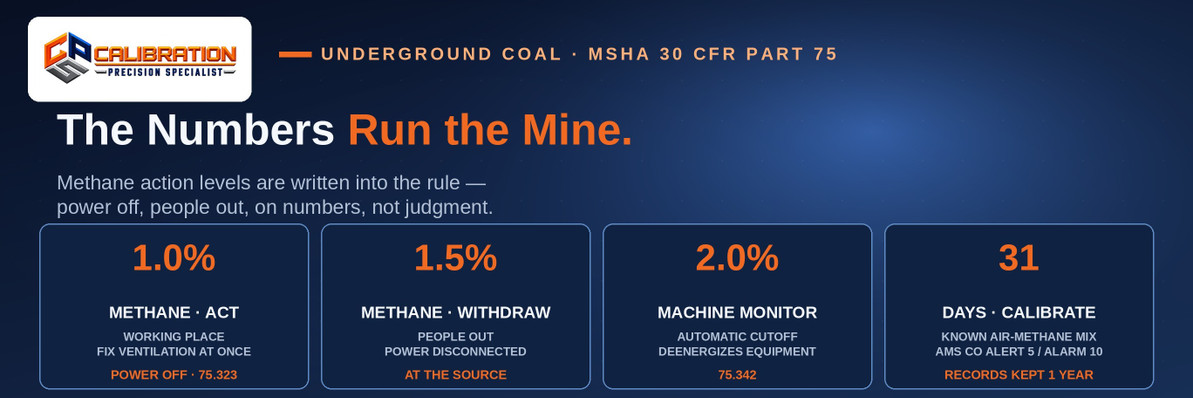
Gas detection in an underground coal mine is a statutory system run by MSHA under 30 CFR Part 75 — not OSHA — built on ventilation plus layered monitoring: MSHA-approved methane monitors on mining machines warn at 1.0% methane and automatically cut power at 2.0% (30 CFR 75.342); at 1.0% methane in a working place, equipment is deenergized, ventilation is fixed at once, and other work stops, and at 1.5% people are withdrawn (30 CFR 75.323); and belt entries are watched continuously by atmospheric monitoring systems that alert at 5 ppm carbon monoxide above ambient and alarm at 10 ppm (30 CFR 75.351). Every methane monitor in the system is calibrated with a known air-methane mixture at least once every 31 days.
Plant gas detection answers to OSHA. Underground coal answers to a different agency, a different title of the Code of Federal Regulations, and a different philosophy: the numbers, the actions they trigger, and the paperwork are all written into the rule itself. This post is the hub explainer — the gases, the layers of monitoring, the exact action levels verified against the current eCFR text, and where a shop like ours does and does not fit.
Why Is Coal Mine Gas Detection Its Own Rulebook?
Because the hazard is generated by the workplace itself. Cutting coal liberates methane that was adsorbed in the seam and trapped in the surrounding strata, so gas production rises and falls with production. Methane is odorless, colorless, and lighter than air: MSHA's ventilation guidance notes that it layers in the roof of an entry unless air velocity is high enough to disperse it, and methane-air mixtures ignite between 5% and 15% — most violently at about 9.5%. Suspended coal dust can carry an ignition into a far larger explosion, which is why the system pairs gas monitoring with ventilation and rock dusting rather than treating detection as a stand-alone answer.
The governing text is the Mine Safety and Health Administration's mandatory standards for underground coal mines, 30 CFR Part 75, enforced by MSHA under the Mine Act. OSHA's general-industry exposure tables do not run this workplace, and a safety manager moving from a plant to a mine will find the logic familiar but the numbers, titles, and duties all different.
What Gases Does a Coal Mine Monitor?
- Methane (CH₄) — the headline gas, monitored continuously at the face and measured in percent by volume (not ppm, and not %LEL — see the scale note below).
- Carbon monoxide (CO) — the fire gas. Belt drives, electrical installations, and conveyor entries are watched for CO because a heating or fire on a belt shows up as CO in the air course long before it is visible.
- Oxygen deficiency — tested as part of examinations, because methane and other gases displace and dilute the air itself.
- Smoke — AMS smoke sensors share the belt-monitoring job with CO sensors, with their own alarm criterion in the rule.
How Do Machine-Mounted Methane Monitors Work?
30 CFR 75.342 requires MSHA-approved methane monitors on all face cutting machines, continuous miners, longwall face equipment, loading machines, and other mechanized equipment used to extract or load coal within the working place. The sensing device sits as close to the working face as practicable — on a longwall shearer, one sensor at the return air end of the face and an additional sensor downwind, as close to the cutting head as practicable. The monitor is an automatic layer, not an advisory instrument:
- At 1.0% methane, the monitor must give a warning signal, visible to a person who can deenergize the electric equipment or shut down the diesel equipment it is mounted on.
- At 2.0% methane — or whenever the monitor is not operating properly — it must automatically deenergize the electric equipment or shut down the diesel equipment on which it is mounted.
- Monitors must be kept in permissible and proper operating condition and calibrated with a known air-methane mixture at least once every 31 days, by persons properly trained in their maintenance, calibration, and permissibility, with a record of every calibration test kept for 1 year at a surface location.
What Happens at 1.0% and 1.5% Methane in a Working Place?
Separately from the machine monitors, 30 CFR 75.323 sets the actions for methane found by examination in working places and intake air courses (tests are made at least 12 inches from the roof, face, ribs, and floor — a detail that matters, because roof-layered methane hides against the roof):
| Methane found | Required action (30 CFR 75.323) |
|---|---|
| 1.0% or more in a working place or intake air course | Electrically powered equipment deenergized (intrinsically safe AMS excepted), other mechanized equipment shut off, ventilation changes made at once to reduce methane below 1.0%, and no other work permitted until it is below 1.0% |
| 1.5% or more in a working place or intake air course | Everyone withdrawn from the affected area (except the persons referenced in §104(c) of the Mine Act), and electrically powered equipment disconnected at the power source |
| Return air courses (outside the split provisions) | Methane concentration shall not exceed 2.0% |
Note the scale. These percentages are percent methane by volume. Because methane's lower explosive limit is 5% by volume, 1.0% methane is 20% of the LEL — the mine acts at one-fifth of the explosive threshold, applies a second, harder action at 1.5%, and the machine monitor cuts power at 2.0%, still well below ignition range. The margins are the point.
What Does the Preshift Examination Require?
Monitoring machines do not replace human examination. Under 30 CFR 75.360, a certified person designated by the operator must make a preshift examination within 3 hours preceding the beginning of any 8-hour interval during which anyone is scheduled to work or travel underground — and no one else may enter or remain in an underground area until that examination is complete for the interval. The examiner tests for methane and oxygen deficiency and determines that air is moving in its proper direction at working sections, travelways, belt conveyors used to transport persons, and the other locations the section lists. Results — including methane recorded as the percentage measured — are recorded on the surface before anyone else goes underground, and the records are retained for at least 1 year.
How Does CO Monitoring Work on Belt Entries?
Fires on conveyor belts are the scenario the atmospheric monitoring system (AMS) exists to catch. Under 30 CFR 75.351, where an AMS is used to meet the belt-air-course and related requirements:
- CO sensors are installed along each belt entry at intervals not exceeding 1,000 feet — tightened to 500 feet where air velocity is 50–100 feet per minute and 350 feet where it is below 50 — and not more than 100 feet downwind of each belt drive, tailpiece, transfer point, and take-up.
- The system alerts at 5 ppm CO above the ambient level and alarms at 10 ppm above ambient (ambient is established under the mine's approved ventilation plan). Smoke sensors, where used, alarm at an optical density of 0.022 per meter. For return-air-split methane monitoring, the AMS alerts at 1.0% methane and alarms at 1.5%.
- A designated AMS operator must be on duty on the surface whenever the system is relied on, at a location where the signals can be seen and heard and promptly answered, with a current map of sensor locations and airflow direction.
- CO and methane AMS sensors are calibrated at intervals not exceeding 31 days, with calibration gases traceable to NIST and within ±2.0% of the indicated concentration.
Those CO numbers are system alert and alarm signal levels set against the mine's own ambient — early-warning triggers for investigation and response — not occupational exposure limits, and the post treats them as exactly that.
How Is This Different From OSHA Plant Monitoring?
Three structural differences. First, the regulator and the book: MSHA and 30 CFR Part 75, with mine-specific duties (certified examiners, approved ventilation plans, permissibility) that have no plant equivalent. Second, the actions are statutory: in a plant, an alarm setpoint is the employer's program choice; in a coal mine, 1.0%, 1.5%, and 2.0% methane each carry a response the rule itself commands, up to automatic power cutoff and withdrawal of people. Third, the instruments are approved for the environment: machine monitors must be MSHA-approved and maintained as permissible equipment — an ordinary industrial portable, however good, is not a substitute, and nothing in our store is represented as MSHA mine equipment. Handheld portables still have their place in the wider mining world — surface shops, preparation plants, and non-coal work — and that is the world our calibration services serve: we calibrate every channel on the portables we sell and service, in-house at $55 single-gas / $90 for 4- & 5-gas instruments. Calibration of Part 75 machine monitors and AMS sensors underground is done under the mine's own program by properly trained persons, exactly as 75.342 and 75.351 require — this post explains that system; it does not offer to replace it.
Frequently Asked Questions
Who regulates gas detection in underground coal mines — OSHA or MSHA?
MSHA, the Mine Safety and Health Administration, under 30 CFR Part 75, its mandatory safety standards for underground coal mines. OSHA's general-industry rules, including the 29 CFR 1910.1000 exposure tables that govern plant monitoring, do not run underground coal. The practical consequence is that setpoints, examinations, approvals, and records in a coal mine follow Part 75's text — machine monitors, preshift examinations, ventilation plans, and AMS requirements — not an employer's OSHA program.
At what methane percentage do miners have to stop work?
At 1.0% methane or more in a working place or intake air course, 30 CFR 75.323 requires electrically powered equipment to be deenergized, other mechanized equipment shut off, ventilation changes made at once, and no other work permitted until methane is below 1.0%. At 1.5% or more, everyone is withdrawn from the affected area and power is disconnected at the source. Separately, a machine-mounted monitor automatically deenergizes its machine at 2.0%.
What does a machine-mounted methane monitor do at 1% and 2%?
Under 30 CFR 75.342, at 1.0% methane the monitor must give a warning signal visible to a person who can deenergize or shut down the equipment. At 2.0% methane — or if the monitor is not operating properly — it must automatically deenergize the electric equipment or shut down the diesel equipment on which it is mounted. MSHA-approved monitors of this kind are required on face cutting machines, continuous miners, longwall equipment, loading machines, and other mechanized extraction and loading equipment in the working place.
How often are methane monitors calibrated in a coal mine?
At least once every 31 days. Section 75.342 requires machine-mounted methane monitors to be calibrated with a known air-methane mixture at that interval by persons properly trained in maintenance, calibration, and permissibility, with records kept for 1 year at a surface location. AMS methane and CO sensors carry the same 31-day maximum calibration interval under 30 CFR 75.351, with calibration gases traceable to NIST within ±2.0% of the indicated concentration.
What is a preshift examination for methane?
A certified examiner's inspection, required by 30 CFR 75.360 within the 3 hours preceding any 8-hour interval in which anyone is scheduled to work or travel underground. The examiner tests for methane and oxygen deficiency, confirms air is moving in its proper direction, and covers working sections, travelways, and other listed locations. No one else may enter until the examination is complete; results, including methane percentages, are recorded on the surface and kept at least 1 year.
Why is methane measured in percent instead of ppm or %LEL in mines?
Because Part 75 writes its action levels in percent methane by volume — 1.0%, 1.5%, 2.0% — and examinations record the percentage measured. The scales convert cleanly: methane's lower explosive limit is 5% by volume, so 1.0% methane equals 20% LEL, and the mine's first action level sits at one-fifth of the explosive threshold. Percent volume is also the natural scale for a gas that can reach percent-level concentrations at a coal face, where ppm would run to five figures.
What CO level triggers an alarm in a coal mine belt entry?
For an atmospheric monitoring system used under 30 CFR 75.351, the alert signal comes at 5 ppm carbon monoxide above the mine's ambient level and the alarm at 10 ppm above ambient; the ambient level itself is established under the approved ventilation plan. These are early-warning system signal levels designed to catch a belt heating or fire while it is small — they are not occupational exposure limits. A designated AMS operator on the surface must be on duty to receive and respond to the signals.
Can a regular 4-gas monitor be used in an underground coal mine?
Not as a substitute for the mine's Part 75 equipment. Machine-mounted methane monitors must be MSHA-approved and maintained as permissible equipment under 30 CFR 75.342, and AMS sensors must meet 75.351's approval and installation requirements. Ordinary industrial portables serve surface facilities, preparation plants, and other non-Part-75 work. Nothing CPS sells is represented as MSHA-approved mine equipment, and this post makes no such claim for any portable instrument.
Why does methane collect at the roof of a mine entry?
Methane is lighter than air, so released gas rises and layers against the roof unless the ventilating air velocity is high enough to mix and dilute it — MSHA's ventilation guidance makes exactly this point. That is why Part 75 examination practice tests close to the roofline (75.323 specifies tests at least 12 inches from the roof, face, ribs, and floor) and why machine-monitor sensing devices sit as close to the working face as practicable, where the gas is liberated.
How much does it cost to calibrate a portable gas detector?
For the portable instruments CPS sells and services — the surface and plant side of the industry — in-house calibration at CPS Calibrations is $55 for a single-gas instrument and $90 for a 4- or 5-gas instrument, with ship-in service at the same rates and on-site work quoted in writing at a higher rate. Calibration of underground Part 75 machine monitors and AMS sensors is a separate matter: it is performed under the mine's own program, by properly trained persons, on the 31-day cycle the rule sets.
The Bottom Line
Underground coal runs the most prescriptive gas-detection system in American industry: MSHA's Part 75 fixes the numbers (warn at 1.0% methane, withdraw at 1.5%, machine power cut at 2.0%), the cadence (preshift examinations within 3 hours, calibration every 31 days, records kept a year), and the architecture (machine monitors, certified examiners, and a surface-watched AMS alerting at 5 ppm CO above ambient). Ventilation is the control, monitoring is the proof — and none of it is OSHA.
On the surface side of the industry — plants, preparation facilities, and portable instruments — call CPS Calibrations at 865-900-8844 for monitors, calibration, and the CPS Calibration Program, from Rockwood, Tennessee.
CPS Calibrations · 109 S. Front Street, Rockwood, TN 37854 · Calibration Services · The CPS Calibration Program
Need a calibration you can file?
In-house calibration at CPS in Rockwood, Tennessee — $55 for single-gas instruments, $90 for 4- and 5-gas — every channel, as-found and as-left data, full certificate.
See Calibration Servicesor call 865-900-8844
Recent Posts
-

What Is Remote Monitoring for Fixed Gas Detection?
Remote monitoring for fixed gas detection means a fixed system's live readings, trends, and alarm hi …Nov 23rd 2026 -

What Are the Key Differences Between the GX-6000 and GX-6100?
The RKI GX-6100 is the current replacement for the discontinued GX-6000: both are pumped 6-gas monit …Nov 22nd 2026 -

How to Read a PID Correction Factor Chart
To read a PID correction factor chart, find your vapor’s row, take the factor under your own lamp en …Nov 21st 2026