
How Do You Read a Calibration Gas Certificate of Analysis?
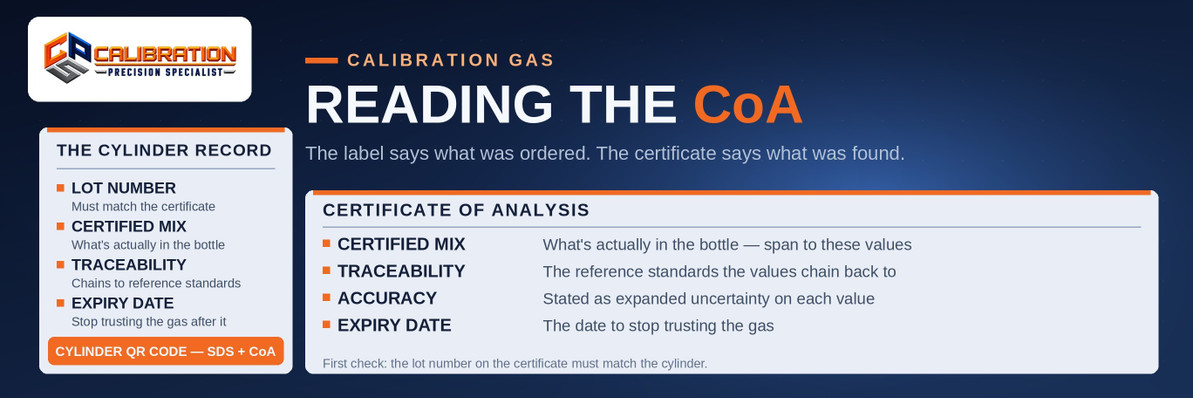
You read a calibration gas Certificate of Analysis (CoA) by matching the cylinder in your hand to the certificate line by line: the lot number must match, and you calibrate to each component's certified (actual) concentration — not the nominal concentration the blend was ordered at. Finish with the dates and the traceability statement: the expiry date must be in the future, and the certificate should state what its values are traceable to — on CPS's ISG cylinders the gas is NIST-traceable, and scanning the QR code on the cylinder opens that cylinder's own CoA and Safety Data Sheet.
That is the whole discipline. Everything below is the field-by-field version: what each line on the certificate means, which number actually sets your instrument's span, and the checks that catch a wrong, expired, or mismatched cylinder before it quietly calibrates a fleet wrong.
What Is a Calibration Gas Certificate of Analysis?
A calibration gas Certificate of Analysis is the gas manufacturer's own test report for the gas in a specific cylinder or lot. The manufacturer blends the mixture, analyzes it, compares the measured results against the maximum deviation the mixture is allowed to have, and approves or rejects the batch — a CoA is drawn up for each approved batch. Gas CoAs are produced in accordance with ISO 6141, the standard that governs what these certificates contain.
Two properties make the document matter. First, it is specific: a CoA belongs to a lot, not to a product line — Calgaz, for example, provides the Certificate of Analysis for each cylinder lot, and states that the lot CoA is the document to use in audit cases. Second, it reports actual analytical results, not just the recipe: GASCO states it plainly — a Certificate of Analysis accompanies every cylinder it ships, with the actual analytical results. The label on the bottle tells you what was ordered. The certificate tells you what the analysis found.
Gas Certificate vs. Instrument Certificate: What's the Difference?
These two documents sound alike and prove opposite ends of the same chain, so do not file one where the other belongs. An instrument calibration certificate — the subject of our post on what a calibration certificate actually proves — proves that one specific instrument, identified by serial number, read correctly against a known standard on a given day, and records its as-found and as-left results. A gas Certificate of Analysis proves the standard itself: it certifies what is actually in the bottle the instrument was calibrated with. The gas certificate sits upstream of every instrument certificate — if the gas was wrong, expired, or matched to the wrong lot, every instrument calibrated with it inherits that error, no matter how clean its own certificate looks. Auditors know this, which is why the gas lot behind a calibration belongs in the calibration record alongside the instrument's paperwork.
Where Do You Get the Certificate for the Cylinder in Your Hand?
On a modern cylinder, start with the bottle itself. Intermountain Specialty Gases (ISG) — the maker of the calibration gas CPS sells — puts it this way on its own site: the QR codes on its cylinders provide direct access to Safety Data Sheets and Certificates of Analysis sheets with the use of any smart device. CPS's listings say the same in product terms — for example, our 4-Gas Calibration Gas – RKI Equivalent listing states that each cylinder includes a QR code for access from a smartphone to the cylinder-specific SDS and Certificate of Analysis.
If a cylinder arrives with a paper certificate instead, keep it with the cylinder's records. And if a cylinder has neither a QR code nor paperwork, ask the supplier for the CoA by lot number before you use it — a traceable certificate for the gas is part of what you bought, and the lot number is the key that retrieves it.
What Does Each Field on the CoA Mean?
Field names vary slightly between makers, but an ISO 6141 certificate and the CoAs major manufacturers describe carry the same core set. Read them in this order — identity first, values second, validity last:
| Field on the certificate | What it tells you | What you check |
|---|---|---|
| Supplier information | Who made and certified the gas | It is the manufacturer or supplier of record for this cylinder |
| Product description / product number | Which mixture this certificate covers | It matches the product on the cylinder label and on your order |
| Lot number | The specific production lot the analysis belongs to | It matches the lot number printed on the cylinder — the single most important match on the page |
| Components and balance gas | Every gas in the mixture, including the balance (nitrogen or air) | Every component your instrument measures is present, and the balance gas is the one your sensors require |
| Nominal concentration (per component) | The concentration the blend was requested / ordered at | It is the mix you intended to buy |
| Certified (actual) concentration (per component) | The concentration the manufacturer's analysis actually measured | This is the value your instrument's span is set to |
| Unit of measure | The unit each value is expressed in (ppm, % by volume, % LEL) | You are reading each component in its own unit — LEL and volume percent are not interchangeable |
| Expanded uncertainty | How accurate the certified values are stated to be | It is present; a certificate with no uncertainty statement tells you less about its own values |
| Analytical method | How the mixture was analyzed | It is stated; manufacturers analyze comparatively against a reference gas mixture on the same instrument |
| Reference standards / traceability statement | What the analysis was compared against | It names the chain — for example NIST Standard Reference Materials (SRM) or NIST Traceable Reference Materials (NTRM) |
| Production date | When the gas was produced (blended and filled) | It sits before the analysis date and well before the expiry date |
| Analysis date | When this lot was analyzed | It is the analysis these certified values came from |
| Certificate issue date | When the certificate itself was issued | You are holding the current certificate for this lot |
| Expiry date | The date after which the certified values are no longer guaranteed | It is in the future — every time, before every calibration |
| Cylinder and valve specifications; volume and pressure | The container the gas was certified in | The connection (for example C-10) matches your regulator, and the volume/pressure match the cylinder in hand |
| Authorizing signature | Who authorized the certificate for the manufacturer | The certificate is a signed-off document, not a printout of raw readings |
Not every maker's certificate prints every row above in the same words — Global Calibration Gases, for example, describes its CoA as detailing the results of the analysis, the method of analysis, the accuracy of the analysis, and the reference standards used, plus cylinder and valve specifications, the volume and pressure contained, expiration dating, and signatures of authorization. The set is the same; the layout is the maker's own.
Nominal vs. Certified: Which Number Do You Calibrate To?
The certified number — always. The two-number system exists because blending is a physical process: the nominal value is the target the blend was made to, and the certified value is what the analysis measured in the finished lot. Before a batch is approved, the manufacturer compares the measured results against the maximum deviation that mixture is allowed to have; batches outside it are rejected, not shipped with a warning. What reaches you has passed — but it has passed at its certified values, which can sit slightly off the nominal ones.
So the working rule is simple: whatever span values are entered in your instrument or docking station should be the certified concentrations from the CoA for the lot in hand, not the nominal concentrations from the label or the purchase order. If the two happen to agree, nothing changes. When they differ, the certificate wins — it is the measured one.
The expanded uncertainty printed with the certified values is the maker's statement of how accurate that measurement is. It is part of the value, not fine print: a certified concentration is only as useful as the uncertainty attached to it, and a certificate that states its uncertainty, its analytical method, and its reference standards is a certificate you can defend. One that lists values with none of the three deserves questions before its gas sets anyone's spans.
What Does the Traceability Statement Actually Promise?
Traceability is the chain that connects the numbers on the certificate to national standards. Gas analysis is comparative: a mixture's concentrations are determined by comparing the detector response it generates against the response of a reference gas mixture on the same instrument, in a range that instrument measures well. The accuracy of the analysis therefore depends directly on the accuracy of the reference standard used — which is why the certificate names those standards. Global Calibration Gases lists the reference standards behind its analyses as NIST Standard Reference Materials (SRM), NIST Traceable Reference Materials (NTRM), Gas Manufacturer's Intermediate Standards (GMIS), or its own primary laboratory standards; ISO 6141 frames the same idea as results traceable to gas reference materials or to mass traceable to national standards.
On CPS's ISG gas the chain is stated on the product page. The RKI-equivalent 4-gas listing states the calibration gas is NIST traceable, and its specifications list traceability as NIST traceable, produced under ISO/IEC 17025:2017 (chemical testing) and ISO 17034:2016 (reference material production) quality systems.
One honest limit belongs here: what you hold is the manufacturer's CoA for your lot — not NIST's own certificates for the reference materials behind it. Calgaz states this arrangement plainly through Honeywell support: NIST certificates are not provided by Calgaz; the Certificate of Analysis for each cylinder lot is the document used in audit cases. That is not a weakness — the lot CoA is the audit document — but it is what "NIST traceable" on a gas certificate actually means: a documented chain, ending at the certificate in your hand.
How Do You Check a Cylinder Against Its Certificate Before Calibrating?
Run these seven checks, in order, before the gas touches an instrument. They take about a minute, and the first two catch most real-world failures:
- Lot number. The lot on the certificate is the lot on the cylinder. Any mismatch means you are holding the wrong document — stop and retrieve the right one (on an ISG/CPS cylinder, scan the QR code rather than trusting a loose paper copy).
- Product and components. The product description and component list match the cylinder label and the blend your instrument expects — every channel you intend to calibrate is in the bottle.
- Balance gas. The balance named on the certificate (nitrogen or air) is the balance your instrument's calibration requires for those sensors.
- Certified values. The certified concentration of each component is the value entered as the span value in the instrument or dock — not the nominal value, not last cylinder's values.
- Expiry date. The expiry date on the certificate is in the future. Expired gas is gas of unknown concentration, however much pressure remains.
- Cylinder details. The cylinder and valve specifications, volume, and connection on the certificate match the physical cylinder and your regulator.
- File it. Keep the CoA (or its lot number) with the calibration record, so the gas behind each instrument calibration can be produced in an audit.
How Does This Look on a Real CPS Cylinder?
Take the cylinder most of our customers actually hold: the 4-Gas Calibration Gas – RKI Equivalent — H₂S 25 ppm / CO 50 ppm / CH₄ 50% LEL / O₂ 12%, nitrogen balance, C-10 connection. Its listing gives you the nominal mix and the logistics: cylinder variants run from the 11L at $90 (minimum order of 6) through the standard 34L aluminum cylinder at $195, the 44L at $210, the 60L at $245, and the 66L at $275, up to the 120L at $295, with a 24-month shelf life for this mix. The certificate then adds what the listing cannot: the certified values for your cylinder's lot, its uncertainty, its analysis and production dates, and its exact expiry date — the same expiry discipline we work through in our post on calibration gas shelf life. The full range of mixes is in our calibration gas category; whichever one you buy, the reading routine above is identical.
The Honest Limits
- A CoA certifies the gas as analyzed — not as stored. The certified values describe the lot when it was analyzed. Heat, time, and poor storage spend a mixture's certified life faster, and no certificate can see how a cylinder was treated after it shipped.
- Past the expiry date, the certificate stops speaking. The concentrations of calibration gas — reactive gases such as hydrogen sulfide and chlorine most of all — remain stable only for a finite period. After the printed date, the concentration is unknown, and calibrating with it sets instruments to an unknown standard.
- A lot certificate describes the lot. That is the normal arrangement (a CoA per cylinder lot). Cylinder-specific access, like the ISG QR system CPS cylinders carry, ties the document to the individual bottle — tighter, and worth preferring when you can get it.
- The right certificate cannot rescue the wrong blend. If the mixture itself does not match your instrument's sensor set and span settings, a perfect CoA only documents the mismatch precisely. Match the blend first; then read its certificate.
- A gas CoA proves the gas — nothing more. It does not prove any instrument was calibrated correctly, or at all. That proof lives in the instrument's own calibration records; the CoA is the supporting evidence for the standard those records relied on.
The Bottom Line
Reading a calibration gas Certificate of Analysis is a matching exercise: identity (supplier, product, lot), values (nominal for the order, certified for the span), quality (uncertainty, method, traceability), and validity (production, analysis, and above all expiry dates) — checked against the physical cylinder before the gas is trusted. Do it every time and the weakest link in most calibration programs quietly becomes one of the strongest: a documented standard behind every reading.
Checking a cylinder, or not sure the certificate you have is the right one for the bottle in hand? Send us the lot numbers from both and we will walk the match with you — call 865-900-8844 or reach us through Contact Us. And if the instruments themselves are due, our calibration services cover them — we calibrate every channel, on the gas whose certificates we can show you.
Frequently Asked Questions
What is a Certificate of Analysis for calibration gas? A Certificate of Analysis (CoA) is the gas manufacturer's test report for a specific cylinder or lot: it lists the components and balance gas, the nominal concentrations the blend was ordered at and the certified concentrations the analysis actually measured, the expanded uncertainty and analytical method behind those values, the reference standards they are traceable to, and the production, analysis, and expiry dates. Gas CoAs are produced in accordance with ISO 6141, and the certificate for your lot is the document used to prove the gas in audit cases.
Where do I find the Certificate of Analysis for my calibration gas cylinder? Start with the cylinder. ISG cylinders — including the calibration gas CPS sells — carry a QR code that opens that cylinder's Safety Data Sheet and Certificate of Analysis on a smartphone or other smart device. Some makers ship a paper CoA with the cylinder instead. If you have neither, ask your supplier for the CoA by the lot number printed on the cylinder; the lot number is the key the certificate is filed under.
How do I know the certificate matches my cylinder? Match the identifiers, in this order: the lot number on the certificate must be the lot number on the cylinder, the product description and component list must match the cylinder label, and the cylinder and valve specifications and connection must match the physical bottle. If any of those disagree, you are holding the wrong certificate or the wrong cylinder — do not calibrate until the pair matches, ideally by pulling the cylinder's own certificate (by QR code, where fitted) rather than a loose paper copy.
What is the difference between nominal and certified concentration on a CoA? The nominal concentration is the target the blend was requested and made to — the number on the label and the purchase order. The certified concentration is what the manufacturer's analysis actually measured in the finished lot, after the batch passed comparison against the maximum deviation allowed for that mixture. Calibrate to the certified values: they are the measured truth for that lot, and they can sit slightly off the nominal values.
What does expanded uncertainty mean on a calibration gas certificate? Expanded uncertainty is the manufacturer's statement of how accurate its certified concentrations are — the band around each certified value within which the analysis places the true value. It travels with the analytical method and the reference standards on the same certificate: together they tell you how much trust the certified numbers have earned. A certificate that states its uncertainty is giving you more to rely on than one that prints values alone.
What does NIST traceable mean on a calibration gas certificate? It means the certified values were established by analysis compared against reference standards whose own values chain back to the National Institute of Standards and Technology — reference standards such as NIST Standard Reference Materials (SRM) or NIST Traceable Reference Materials (NTRM). The document you hold is the manufacturer's CoA for your lot, not a NIST certificate; makers state this plainly, and the lot CoA is the audit evidence for the gas. CPS's ISG calibration gas is listed as NIST traceable, produced under ISO/IEC 17025:2017 and ISO 17034:2016 quality systems.
Can I calibrate with gas after the expiration date on its certificate? No. A calibration gas's concentration remains stable only for a finite period — reactive gases such as hydrogen sulfide and chlorine degrade fastest — and the expiry date on the certificate is the end of the period the certified values are guaranteed for. Past that date the concentration is unknown, so a calibration done with it sets the instrument against an unknown standard. Retire the cylinder and replace it, however much gas seems to remain.
What is the difference between a calibration gas CoA and an instrument calibration certificate? The gas CoA certifies the standard: what is in the bottle, at what certified concentrations, traceable to what, and until when. An instrument calibration certificate certifies a device: that one instrument, by serial number, read correctly against a known standard on a given day. The gas certificate sits upstream — every instrument calibrated with that gas depends on it — which is why the gas lot belongs in the instrument's calibration record.
Does every calibration gas cylinder come with a Certificate of Analysis? From a reputable manufacturer, the gas should always be covered by one — issued per cylinder lot at minimum, and on ISG/CPS cylinders retrievable per individual cylinder by QR code. Some makers include a paper copy with every cylinder shipped. If your cylinder has no certificate and no way to retrieve one by lot number, ask the supplier before you use the gas: without a CoA, the calibration it produces has no documented standard behind it.
What should I do if a field on the CoA doesn't match my cylinder? Do not calibrate with that cylinder. A lot-number mismatch, a component or balance gas that differs from the label, certified values that differ from what you ordered, or an expiry date that has passed all mean the same thing: the document and the bottle do not prove each other. Set the cylinder aside, note the lot numbers from both the label and the certificate, and contact the supplier — CPS is at 865-900-8844 — to pull the correct certificate or replace the cylinder before any instrument is spanned on it.
CPS Calibrations · 109 S. Front Street, Rockwood, TN 37854 · Calibration Gas · Calibration Services · Contact Us
Need a calibration you can file?
In-house calibration at CPS in Rockwood, Tennessee — $55 for single-gas instruments, $90 for 4- and 5-gas — every channel, as-found and as-left data, full certificate.
See Calibration Servicesor call 865-900-8844
Recent Posts
-

What Is Remote Monitoring for Fixed Gas Detection?
Remote monitoring for fixed gas detection means a fixed system's live readings, trends, and alarm hi …Nov 23rd 2026 -

What Are the Key Differences Between the GX-6000 and GX-6100?
The RKI GX-6100 is the current replacement for the discontinued GX-6000: both are pumped 6-gas monit …Nov 22nd 2026 -

How to Read a PID Correction Factor Chart
To read a PID correction factor chart, find your vapor’s row, take the factor under your own lamp en …Nov 21st 2026