
How Long Do Gas Detector Sensors Last?
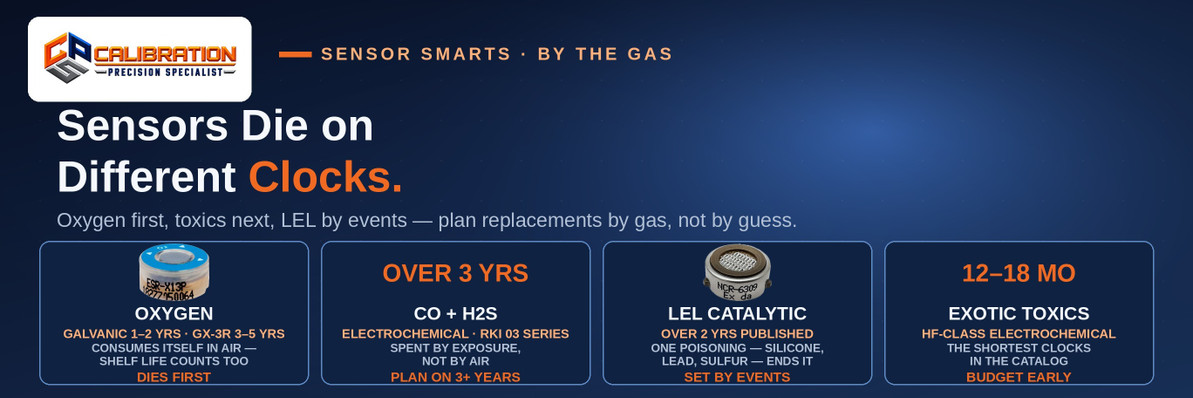
Gas detector sensors do not share one lifespan: a traditional galvanic oxygen sensor typically lasts 1–2 years, RKI publishes a life expectancy of over 3 years for its 03 Series carbon monoxide and hydrogen sulfide sensors and over 2 years for oxygen and LEL, and the current RKI GX-3R oxygen sensor is published at 3–5 years — while a single poisoning or over-range exposure can end a catalytic LEL sensor at any age.
Ask how long a gas detector lasts and you get one number. Ask how long its sensors last and you get four different answers inside the same instrument — because each sensor type spends itself a different way. The oxygen cell consumes itself reacting with air. The toxic cells spend themselves mainly on exposure. The combustible sensor can be killed in a single bad shift. This post is the sensor-by-gas reference: the published life expectancies for the lines CPS sells and services, what actually shortens each life, and the signs that tell you a sensor is finished before a failed bump test does. For the instrument itself — housing, electronics, battery, and warranty clocks — see how long a gas detector lasts.
Sensor Life at a Glance, by Gas and Type
| Sensor | Published life expectancy | What ends it |
|---|---|---|
| Oxygen — traditional galvanic cell | 1–2 years | The cell consumes its own anode reacting with air — in service and on the shelf |
| Oxygen — current RKI GX-3R electrochemical | 3–5 years (published life span) | Age and cumulative exposure; a longer clock, not an infinite one |
| Carbon monoxide (CO) — electrochemical | Over 3 years (RKI 03 Series) | Cumulative exposure, corrosive gases, age |
| Hydrogen sulfide (H2S) — electrochemical | Over 3 years (RKI 03 Series) | Cumulative exposure — H2S service is hard service — plus age |
| LEL — catalytic bead | Over 2 years (RKI 03 Series) | Poisoning (silicones, lead, sulfur compounds) and over-range exposure — can end at any age |
| Exotic toxics (HF and similar) — electrochemical | Commonly 12–18 months for HF-class cells | Reactive chemistry; the shortest-lived cells in the catalog |
| Disposable single-gas monitor (whole unit) | 24 months (SENKO SP-SGT) | One fixed clock — when it ends, you replace the unit, not the sensor |
Read the table the right way: these are life expectancies under normal conditions, not guarantees and not expiry dates printed on the sensor. A sensor can outlive its published figure in clean, mild service — and fall well short of it in hot, wet, corrosive, or poison-heavy service. The number tells you when to start expecting replacement and budgeting for it. The instrument's behaviour tells you when replacement is actually due.
Why Does the Oxygen Sensor Die First?
In most 4-gas instruments, oxygen is the shortest clock — and the reason is built into how the common galvanic cell works. It measures oxygen by reacting with it: a lead anode inside the cell is consumed by that reaction continuously, whenever the cell is exposed to air. That means a galvanic oxygen sensor is spending itself on the shelf as well as on the job — a spare sitting in a drawer in its opened packaging is aging, and an instrument stored powered or unpowered still has its cell breathing room air. Traditional cells deliver 1–2 years on that basis. Newer electrochemical designs stretch the clock considerably: RKI publishes a 3–5 year life span for the current GX-3R's oxygen sensor, and backs the GX-3R with a 3-year warranty covering the instrument and its sensors. The buying lesson is direct: when you compare instruments, compare the oxygen sensor's published life and warranty — it is the replacement you will buy first and most often.
How Long Do CO and H2S Sensors Last?
Longer than oxygen — because electrochemical toxic cells spend themselves mainly on exposure to their target gas, not on air itself. RKI's 03 Series literature gives both carbon monoxide and hydrogen sulfide sensors a life expectancy of over 3 years. Two qualifications matter in the field. First, exposure is cumulative: a CO sensor on a furnace crew that sees gas every shift ages faster than the same sensor on a meter that rarely alarms. Second, the environment rides along — corrosive gases, extreme heat or cold, and very dry or saturated air all shorten electrochemical life. H2S deserves a specific warning: hydrogen sulfide service is often wet and corrosive by nature (wastewater, oil and gas, pulp), so plan on the honest end of the range there rather than the optimistic end.
What About LEL, Infrared, and PID Sensors?
Catalytic bead LEL: a life set by events, not just time
RKI's 03 Series figure for LEL is a life expectancy of over 2 years — but a catalytic bead's real lifespan is hostage to poisoning. Silicones (lubricants, sealants, release sprays), lead compounds, and sulfur compounds coat or react with the catalyst and permanently reduce sensitivity. True poisoning cannot be calibrated away: span adjustment can mask early loss for a while, until the sensor no longer has enough output left to calibrate at all. A bead in clean service can run for years; a bead in a silicone-heavy plant can be finished in one exposure. That is why a sudden LEL calibration failure after known silicone or sealant work should be read as a sensor event, not a gas problem.
Infrared LEL and CO2: no catalyst to poison
Infrared sensors measure absorption of infrared light rather than burning gas on a catalyst, so they do not poison the way a bead does and they can work in oxygen-poor atmospheres where a catalytic bead cannot burn its sample properly. Their failure modes are different — optics fouled by dirt or condensation, and electronics aging — which is why infrared combustible and CO2 sensing is chosen for harsh or poison-heavy service despite the higher sensor price. The trade-off to remember: a standard infrared hydrocarbon sensor does not see hydrogen, so the gas list — not just the lifespan — decides whether infrared is even an option.
PID: the lamp is a consumable inside the sensor
A photoionization detector adds a second clock: the ultraviolet lamp. Lamps foul and weaken with use and humidity, response falls, and cleaning restores a lamp only so many times before replacement. Treat a PID as a premium sensor with a lamp-maintenance habit — keep the lamp clean, watch response on known gas at bump time, and budget for lamp and sensor service instead of expecting electrochemical-style life from it.
What Shortens a Gas Detector Sensor's Life?
Across every technology, the same short list does most of the damage. Poisons and inhibitors — silicones, lead, sulfur compounds, and heavy solvent exposure — attack catalytic beads and stress electrochemical cells. Over-range exposure — a sensor soaked far above its range, or a combustible sensor exposed to gas well above 100% LEL — can permanently shift or kill a cell in one event. Temperature and humidity extremes dry out or flood electrochemical electrolytes. Storage ages oxygen cells in air and ages every electrochemical cell on the calendar even unused, which is why a "new" spare bought years ago may arrive at the instrument already old — check the sensor's manufacture date when you fit it. And neglect finishes the job quietly: a sensor that is never bump-tested gives no warning while its output shrinks, which is why bump testing before each day's use and calibration on the manufacturer's interval are lifespan tools, not just compliance habits — they are how you see the end coming.
How Do You Know a Sensor Is at End of Life?
Sensors rarely stop dead; they fade, and the fade has recognizable signs. Calibration will not hold — the sensor calibrates, then drifts out again in days instead of months. Span output keeps shrinking — each calibration needs more adjustment to reach the same reading, until the instrument reports a calibration failure because there is not enough signal left to adjust. Response gets slow — the reading climbs lazily toward the applied gas instead of stepping up. Bump tests start failing intermittently, then consistently. And an oxygen sensor has its own tell: a fresh-air reading that will not settle at 20.9%, or an air adjustment that fails outright. Any one of these means plan the replacement now; a failed calibration means the sensor is done — replace it, do not keep re-zeroing a dying cell and sending it back into service. When you order, match the replacement by model, gas, and sensor generation — our guide to how to order the right replacement sensor walks through the matching — and keep bump and calibration gas in date while you troubleshoot, because expired calibration gas can make a healthy sensor look dead.
Frequently Asked Questions
How long do gas detector sensors last?
It depends on the gas and the sensor type: a traditional galvanic oxygen sensor typically lasts 1–2 years, RKI publishes over 3 years for its 03 Series CO and H2S sensors and over 2 years for O2 and LEL, and the current RKI GX-3R oxygen sensor is published at 3–5 years. Poisoning or over-range exposure can end a catalytic LEL sensor at any age.
Which gas detector sensor wears out first?
Usually the oxygen sensor. A traditional galvanic O2 cell consumes its own anode reacting with air continuously — in service and on the shelf — which is why its typical 1–2 year life is shorter than the over-3-year published life expectancy of RKI 03 Series CO and H2S sensors in the same instrument.
Do gas detector sensors expire on the shelf?
Yes — shelf aging is real, especially for oxygen. A galvanic oxygen cell reacts with air whether or not it is installed, and electrochemical cells age on the calendar as well. Check a spare sensor's manufacture date before fitting it, and do not stockpile oxygen sensors years ahead of need.
Can a gas detector sensor be poisoned?
Yes. Catalytic bead LEL sensors are permanently poisoned by silicones, lead compounds, and sulfur compounds, which coat or react with the catalyst and destroy sensitivity. Poisoning cannot be reversed by calibration — a truly poisoned sensor must be replaced, and it can be ruined by a single heavy exposure at any age.
How do you know when a gas sensor needs replacing?
Watch for calibration that will not hold for more than a few days, shrinking span output at each calibration, slow response to applied gas, repeated bump-test failures, and — on oxygen — a fresh-air reading that will not settle at 20.9%. A sensor that fails calibration for low output is at end of life and should be replaced, not re-zeroed and returned to service.
Does calibration extend a sensor's life?
No — calibration adjusts the instrument to the sensor's current output; it does not restore lost sensitivity. Regular bump testing and calibration protect you by revealing decline early, and correct calibration gas and flow keep you from misdiagnosing a healthy sensor, but no calibration brings a spent or poisoned sensor back.
How long do disposable gas detectors last?
A disposable single-gas monitor runs one fixed clock and is then replaced whole. The SENKO SP-SGT, for example, is built for 24 months of operation, after which you replace the unit rather than fitting a new sensor — the economics work when you price the whole 24 months, not the purchase day.
Do infrared gas sensors last longer than catalytic bead sensors?
Infrared sensors avoid the catalytic bead's main killer — they have no catalyst to poison and do not need oxygen to measure — so in poison-heavy or oxygen-poor service they commonly outlast a bead. They cost more, their optics can foul, and a standard infrared hydrocarbon sensor does not detect hydrogen, so the gas list decides first and lifespan second.
What shortens a gas detector sensor's life the most?
Poisoning and over-range exposure do the fastest damage — either can end a sensor in one event. After that come cumulative target-gas exposure for electrochemical cells, temperature and humidity extremes that dry or flood electrolytes, corrosive atmospheres, and simple calendar aging, which runs even on a stored spare oxygen sensor.
Can CPS replace a worn-out sensor, or do I need a new detector?
In most cases you need the sensor, not a new detector — the instrument's housing, electronics, and alarms are not consumables. CPS calibrates instruments in-house in Rockwood, Tennessee and by ship-in, checks sensor health on the bench, and can tell you whether a channel needs a sensor or the instrument itself has a fault. Start with calibration services or the ship-in request.
The Bottom Line
Budget gas detector sensors as consumables with different clocks: oxygen first (1–2 years in a traditional galvanic cell, 3–5 years in the current GX-3R design), CO and H2S next (over 3 years published for RKI's 03 Series), LEL on an events budget rather than a calendar (over 2 years published, but one poisoning can end it today), and exotic toxics shortest of all. Then manage to behaviour, not just birthdays: bump before each day's use, calibrate on interval, watch span and response, and replace on the end-of-life signs. That habit — not any single lifespan number — is what keeps a reading trustworthy.
Need a calibration you can file?
In-house calibration at CPS in Rockwood, Tennessee — $55 for single-gas instruments, $90 for 4- and 5-gas — every channel, as-found and as-left data, full certificate.
See Calibration Servicesor call 865-900-8844
Recent Posts
-

How Long Do Gas Detector Sensors Last?
Gas detector sensors do not share one lifespan: a traditional galvanic oxygen sensor typically lasts …Nov 16th 2026 -

The 15-Minute Weekly Gas Detection Checklist for Supervisors
A weekly gas detection check takes a supervisor about 15 minutes and covers four things: every instr …Nov 15th 2026 -

Calibration Gas for PID Instruments: Isobutylene and the 100 ppm Standard
A PID is calibrated on 100 ppm isobutylene — not on the gas you are measuring — because the instrume …Nov 14th 2026