
How to Order the Right Replacement Sensor
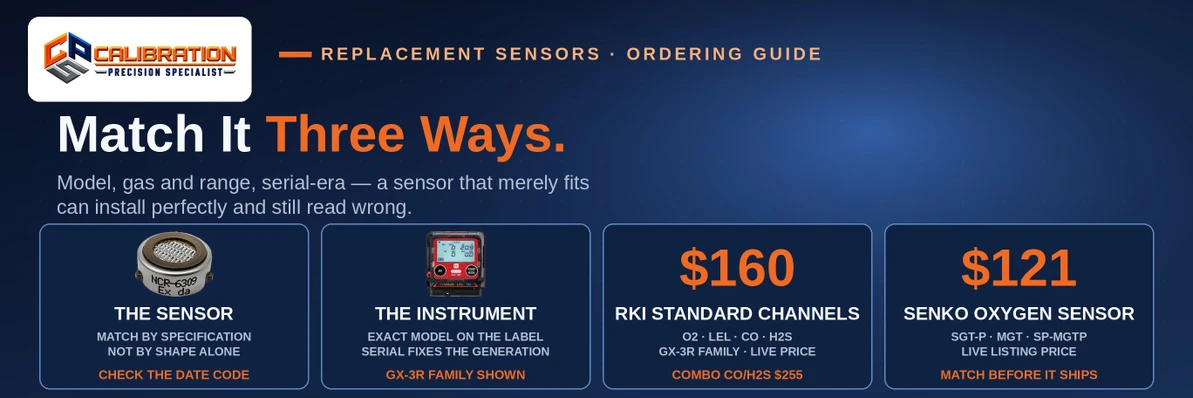
Order the right replacement sensor by matching three things — the instrument model, the gas and its measurement range, and the serial-era or generation of the instrument — because a sensor that fits the socket but belongs to a different range or generation can install perfectly and still read wrong. Real examples from our shelves: genuine RKI standard-channel sensors for the GX-3R family are $160 each, the RKI CO/H2S combo sensor is $255, and a SENKO oxygen sensor for the SGT-P, MGT, and SP-MGTP is $121.
A replacement sensor looks like the simplest purchase in gas detection: pull the old cell, drop in a new one, calibrate, done. It goes wrong in a specific and expensive way — the new sensor fits, the instrument accepts it, the calibration appears to take, and the channel then reads wrong in the field because the sensor was matched by shape instead of by specification. This post is the matching discipline we use on our own bench, with live store examples. If you are still deciding whether a sensor is actually due, start with when should you replace a gas detector sensor — then order its replacement this way.
The Three Matches: Model, Gas and Range, Serial-Era
- Match 1 — the model, exactly. Not the brand, not the family nickname: the full model on the instrument's label. Sensor ranges, form factors, and firmware support differ between models that share a brand and a similar shape, and a listing's fits-list is the authority — our RKI oxygen sensor listing, for example, names the GX-3R, GX-3R Pro, GX-Force, GX-6100, and GX-9000, and it is not listed for anything else.
- Match 2 — the gas and its range. 'A CO sensor' is not a specification. The range printed in the listing is part of the sensor's identity: a channel spanned for one range and fitted with a sensor built for another will display confidently wrong numbers. Combo channels count too — see the CO/H2S example below.
- Match 3 — the serial-era or generation. Manufacturers revise instruments over a production run, and sensors change with them. Two instruments with the same model name can take different sensor generations depending on when they were built. The serial number dates the instrument; give it when you order, and a listing or a person can check the generation before the sensor ships instead of after it fails to behave.
Live Examples From Our Shelves
Every price below was pulled live from the store for this post. They show what correct matching looks like in practice — each listing names its instruments, its gas, and its range:
| Replacement sensor (live listing) | Fits | Price |
|---|---|---|
| RKI Oxygen (O2), 0–25% volume | GX-3R, GX-3R Pro, GX-Force, GX-6100, GX-9000 | $160 |
| RKI Combustible Gas (LEL), 0–100% LEL, catalytic | GX-3R, GX-3R Pro, GX-Force, GX-6100 | $160 |
| RKI Carbon Monoxide (CO), 0–2,000 ppm | GX-3R family, GasWatch 3, CO-04, GX-6100, GX-9000 | $160 |
| RKI Hydrogen Sulfide (H2S), 0–200 ppm | GX-3R family, GasWatch 3, HS-04, GX-6100, GX-9000 | $160 |
| RKI CO / H2S combo, 0–2,000 / 0–200 ppm | GX-3R family, GasWatch 3, 04 Series, GX-6100 | $255 |
| SENKO Oxygen (O2) sensor | SGT-P, MGT, SP-MGTP | $121 |
| SENKO Carbon Monoxide (CO) sensor | SGT-P | $121 |
| SENKO Hydrogen Sulfide (H2S) sensor | SGT-P | $121 |
| SENKO LEL sensor (IR) | MGT, SP-MGTP | $380 |
Two lessons hide in that table. First, standard channels are affordable — $121–$160 — so there is rarely a budget reason to gamble on a sensor that merely looks right. Second, the variants are real: RKI also lists an H2-compensated CO sensor for the same instrument family at $255, a different sensor for the same gas in the same instruments, built for atmospheres where plain CO cells cross-read hydrogen. Same model, same gas, different correct answer depending on where the instrument works.
Why a Sensor That Looks Right Can Read Wrong
- Different range. The instrument's channel is configured and spanned for a stated range. Fit a sensor built for a different range and the electronics will still produce a number — scaled wrong. The reading is not noisy or obviously broken; it is quietly inaccurate, which is the dangerous kind.
- Different cross-sensitivity. Electrochemical cells respond to more than their target gas, and manufacturers build variants — like the H2-compensated CO sensor above — to manage a specific interference. The un-compensated twin installs identically and misreads in exactly the atmosphere the compensated one was built for.
- Combo versus single channels. Some instruments read two gases through one combo sensor position. Ordering two single-gas sensors for a combo channel — or a combo for singles — leaves you with parts that cannot do the instrument's job, however genuine they are.
- Different generation. A sensor from the wrong serial-era may fit the housing while the instrument's firmware expects a different sensor type, giving unstable readings, failed calibrations, or a channel that drifts no adjustment will hold.
Sensor Shelf Life and Storage: the Quiet Half of the Order
Electrochemical cells age on the shelf, not just in the instrument — the chemistry that senses gas is spending itself slowly from manufacture, and an oxygen cell goes further: as our sensor-replacement post notes, the common galvanic O2 cell consumes itself in air whether the instrument is working or sitting in a drawer. Practical consequences: check the date code on any sensor you buy or pull from your own spares; store spares cool and dry and sealed as supplied until fitting; and do not stockpile — a spare bought for an emergency should be a recently dated sensor from stock that turns over, not the cheapest cell of unknown age. A sensor that arrives at end of shelf life will calibrate weakly, drift early, and cost a second replacement inside the year. When you order from CPS, the model, gas, and serial information you give us is also what lets us send a sensor whose dating suits an instrument going straight back into service.
What to Send Us If You Are Not Sure
Four things settle any sensor match: the instrument model from its label, the gas channel being replaced, the serial number (which fixes the generation), and, if the old sensor is out, the part number printed on the old sensor. Call 865-900-8844 with those, or read them off while you are looking at the listing, and the order is right the first time. CPS sells replacement sensors for the brands it carries — RKI, SENKO, and Crowcon among them — matched by model, gas, and serial-era, which is the only basis on which a sensor should ever be sold.
Frequently Asked Questions
How do I know which replacement sensor my gas detector needs?
Match three things: the exact instrument model from its label, the gas and measurement range of the channel you are replacing, and the instrument's serial-era or generation, which the serial number establishes. Then buy the listing whose fits-list names your model at that gas and range — for example, the RKI oxygen sensor listing names the GX-3R, GX-3R Pro, GX-Force, GX-6100, and GX-9000 at 0–25% volume. If any of the three is uncertain, call 865-900-8844 before ordering.
Can I use a replacement sensor that fits but has a different range?
No. Fit is only the mechanical half of the match. A sensor built for a different range than the channel is configured for will install and produce readings that are scaled wrong — quietly, without an error message. Always match the range printed in the sensor listing to the channel specification for your model.
Why is my new sensor reading wrong after I installed it?
The usual causes are matching failures, not defective parts: a sensor for the wrong range, a plain cell fitted where the atmosphere needs a compensated variant (RKI lists an H2-compensated CO sensor at $255 for the same family whose standard CO sensor is $160), a combo channel fitted with singles or the reverse, or a sensor from the wrong generation for the instrument's serial-era. Recheck model, gas, range, and serial against the listing — and calibrate with the correct gas after any sensor change.
What information do you need to match a replacement sensor?
Four things: the instrument model from its label, the gas channel being replaced, the instrument's serial number, and the part number on the old sensor if you have it out. Those fix the model, the gas and range, and the generation. With them, a match takes a minute on the phone — 865-900-8844 — instead of a return shipment.
How much do replacement gas detector sensors cost?
From live CPS listings pulled for this post: RKI standard channels for the GX-3R family — oxygen, LEL, CO, and H2S — are $160 each; the RKI CO/H2S combo sensor is $255; a SENKO oxygen sensor for the SGT-P, MGT, and SP-MGTP is $121, and SENKO CO and H2S sensors for the SGT-P are $121 each; and a SENKO IR LEL sensor for the MGT and SP-MGTP is $380. Specialty and infrared channels cost more than standard electrochemical channels, which is normal.
Do replacement sensors expire on the shelf?
Yes. Electrochemical sensors age from manufacture whether they are fitted or shelved, and galvanic oxygen cells consume themselves in air even in a drawer. Check the date code when a sensor arrives and when you pull a spare, and treat an old-dated sensor as a short-life part: it may calibrate, but expect it to drift and fail sooner than a fresh one.
How should I store a spare gas detector sensor?
Cool, dry, and sealed as supplied until the day it is fitted, with its date code visible so the oldest stock is used first. Do not stockpile deeply — one fresh spare per critical channel beats a drawer of ageing cells — and record the fitting date when it goes in, so the next replacement is planned from data instead of from a failed bump test.
Is a combo CO/H2S sensor the same as two single sensors?
No — they are different parts for different instrument architectures. Instruments with a combo channel read both gases through one combo sensor position (the RKI CO/H2S combo is $255 for the GX-3R family and related models); instruments with separate channels take a CO sensor and an H2S sensor at $160 each. Order for the channel design your model actually has, which the serial and the old sensor's part number confirm.
Can CPS supply sensors for a detector brand you did not sell me?
CPS sells replacement sensors for the brands it carries — RKI, SENKO, and Crowcon are the lines on our store — and the match is made by model, gas, and serial-era regardless of where the instrument was originally bought. If your instrument is a brand or model outside those lines, call 865-900-8844 and we will tell you honestly whether we can source the correct sensor rather than sell you a near miss.
Should I replace the sensor or the whole instrument?
Usually the sensor — at $121–$160 for standard channels, a sensor restores an otherwise sound instrument for a fraction of replacement cost. Replacement of the instrument enters the picture when several channels are spent at once, the instrument itself is damaged or obsolete, or sensors for its generation are no longer available. Our post on when to replace a sensor works through the signs and the maths in detail.
The Bottom Line
A replacement sensor is right when three matches line up — model, gas and range, and serial-era — and wrong in ways that fit perfectly when any one of them is guessed. The parts themselves are not expensive: $160 for RKI standard channels, $255 for the CO/H2S combo, $121 for a SENKO oxygen sensor. The expensive version of this purchase is the second one, after the first reads wrong in the field.
Not sure which sensor your instrument takes? Call CPS Calibrations at 865-900-8844 with the model, gas, and serial number, and we will match it before it ships.
CPS Calibrations · 109 S. Front Street, Rockwood, TN 37854 · When Should You Replace a Gas Detector Sensor?
Need a calibration you can file?
In-house calibration at CPS in Rockwood, Tennessee — $55 for single-gas instruments, $90 for 4- and 5-gas — every channel, as-found and as-left data, full certificate.
See Calibration Servicesor call 865-900-8844
Recent Posts
-

How Long Do Gas Detector Sensors Last?
Gas detector sensors do not share one lifespan: a traditional galvanic oxygen sensor typically lasts …Nov 16th 2026 -

The 15-Minute Weekly Gas Detection Checklist for Supervisors
A weekly gas detection check takes a supervisor about 15 minutes and covers four things: every instr …Nov 15th 2026 -

Calibration Gas for PID Instruments: Isobutylene and the 100 ppm Standard
A PID is calibrated on 100 ppm isobutylene — not on the gas you are measuring — because the instrume …Nov 14th 2026