
The 15-Minute Weekly Gas Detection Checklist for Supervisors
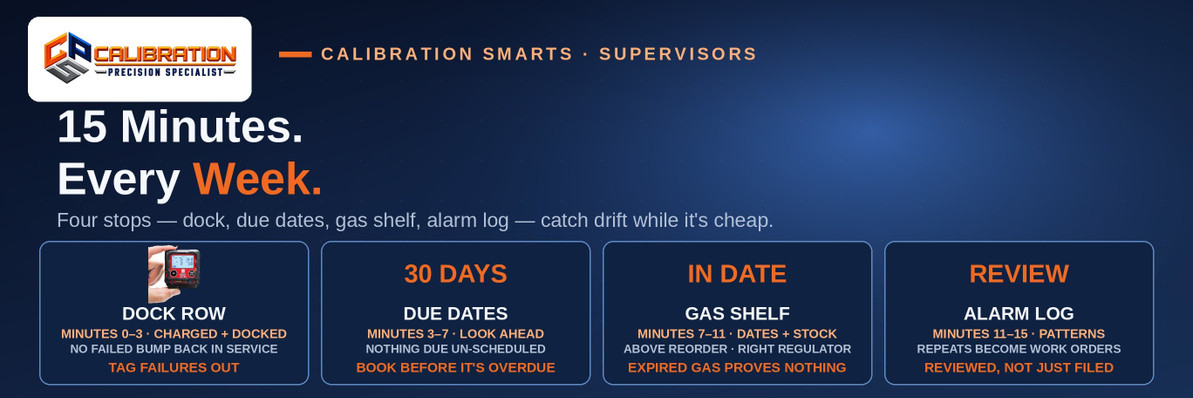
A weekly gas detection check takes a supervisor about 15 minutes and covers four things: every instrument docked, charged, and bump-tested with no unresolved failures; no calibration due date inside the next 30 days left unscheduled; calibration gas in date, above its reorder point, with the right regulator on it; and last week's alarm log reviewed, not just filed. Done every week, those four checks turn calibration from an audit scramble into a standing habit.
Most gas detection programs do not fail in a dramatic moment. They fail quietly, one week at a time: a meter that failed its bump test on Tuesday and went back on the rack, a calibration due date that slipped past while the instrument stayed in service, a cylinder that expired on the shelf, an alarm that was acknowledged and never looked at again. None of those takes long to catch. All of them are expensive to explain after an incident — or to an auditor asking for records you cannot produce. This checklist is the supervisor's counter-move: one short walk, the same four stops, every week.
Why Weekly — and Why Only 15 Minutes?
Daily bump tests belong to the user, before each day's use. Full calibration belongs to the bench, on the manufacturer's interval. The weekly supervisor check sits between them, and its job is different: not to test instruments again, but to catch the system drifting — the failures, dates, stock, and records that no single user sees whole. Fifteen minutes is deliberate. A check that takes an hour gets skipped in a busy week; a check that takes fifteen minutes, at the same time, on the same route, survives busy weeks. That consistency is the point — it is the same discipline behind building a full program from scratch in how to build a gas detection program.
Minutes 0–3: The Dock Row — Charged, Docked, No Unresolved Failures
Start where the instruments live. Walk the dock or charging rack and look for three things. First, every instrument is actually there — a meter missing from the rack on check day is a meter whose status nobody knows. Second, charge state: instruments docked and charging, no unit sitting dead because it was never seated properly. Third, and most important, bump failures: check the dock lights and the station log for any failed bump since your last walk. A failed bump is not a nuisance to clear — it means that instrument did not prove it could respond to gas, and it stays out of service until it passes or goes for calibration. The weekly question is blunt: is there any failed instrument back in circulation because clearing the light was easier than tagging it out? If yes, that is the week's first action item, before anything else on this list.
Minutes 3–7: The Due-Date Board — Nothing Inside 30 Days Left Unscheduled
Next, the calibration due dates. You are not looking for what is overdue — if the weekly habit is working, nothing should be. You are looking 30 days ahead: every instrument coming due in the next month should already have a plan — a bench slot, a ship-in box, or a spare rotated in so the crew is never short a meter. Thirty days matters because calibration has logistics: shipping time if you mail instruments in, turnaround at the bench, and the simple fact that a due date that lands during a shutdown or a turnaround will lose to the shutdown every time. CPS customers get calibration due-date reminders before instruments come due for exactly this reason — but the reminder only works if someone acts on it, and this four-minute stop is where that happens. Anything already overdue gets tagged out or scheduled that day, not noted for next week.
Minutes 7–11: The Gas Shelf — In Date, In Stock, Right Regulator
Calibration and bump gas is a consumable with an expiry date printed on the cylinder, and an expired cylinder cannot prove anything — a bump performed with out-of-date gas is a record an auditor can throw out. Check three things on the shelf. Dates: every cylinder in date, with the soonest expiry visible at the front; reactive mixes carry shorter shelf lives than stable ones, so the date on the label — not memory — governs. Level and reorder point: a cylinder that runs empty mid-week turns every bump test into a skipped bump test, so order when you hit the reorder point, not when the gauge reads zero — CPS sells calibration gas with no hazmat fee added. The regulator: the right regulator for the job — fixed-flow for manual bump and calibration at the rate your instrument manual specifies, demand-flow for pumped docking stations — present, undamaged, and with the cylinder it belongs to. Wrong or missing hardware is how a five-minute bump becomes a postponed one.
Minutes 11–15: The Alarm Log — Reviewed, Not Just Filed
Finish with the record of what the instruments actually saw. Glance through the week's alarms and events: which instruments alarmed, on which gas, and what was found. You are looking for patterns, not paperwork — the same location alarming twice, the same instrument alarming on the same channel, alarms in a place nobody expected gas. A single alarm with a known cause is operations. A repeating alarm is a leak, a process change, or a sensor telling you something, and it deserves a work order, not another acknowledgement. This is also the stop that keeps your records audit-ready all year: what an auditor wants is exactly this trail — bump and calibration records, gas lot traceability, and evidence that failures and alarms led to action, as set out in what an auditor looks for in your bump test and calibration records. Four minutes a week beats a weekend of reconstruction before an audit.
The Checklist on One Page
Print this and keep it at the dock. Same order, every week:
- Dock row (0–3 min): every instrument present, docked, and charging; dock/station log checked; no failed bump unresolved; failed instruments tagged out of service.
- Due dates (3–7 min): nothing overdue; everything due within 30 days scheduled — bench slot or ship-in planned, spare coverage confirmed.
- Gas shelf (7–11 min): every cylinder in date, soonest expiry at the front; stock above the reorder point; correct regulator present and sound for each cylinder in use.
- Alarm log (11–15 min): the week's alarms reviewed by instrument, gas, and location; repeats turned into work orders; the week's actions noted in the record.
That weekly loop is the supervisor layer of the CPS Calibration Program idea: every instrument, every date, one record. Whether CPS calibrates your fleet or your own bench does, the record is what proves the program exists — and CPS customers can pull their whole fleet's history behind one calibration-history link when an auditor, insurer, or corporate safety review asks.
What Do You Do When the Check Finds Something?
Act the same day, in this order. A failed or suspect instrument comes out of service first — tagged, not just noted — because every other fix is paperwork and this one is protection. An unscheduled due date gets scheduled second: book the bench time or start a ship-in calibration request while you are standing there, and rotate a spare in so the crew is not tempted to run short. A gas problem gets ordered third: replacement cylinders ordered the day the check finds them low or expired, not at the next purchase cycle. A repeating alarm gets a work order fourth — owned by a named person, not by the log. The checklist's value is not the looking; it is that each of its four stops ends in a decision made that day.
Frequently Asked Questions
What should a supervisor check on gas detectors every week?
Four things, in about 15 minutes: (1) the dock row — every instrument present, docked, charging, with no unresolved bump-test failure and failed instruments tagged out; (2) calibration due dates — nothing overdue, and everything due within the next 30 days already scheduled; (3) the calibration gas shelf — every cylinder in date, stock above its reorder point, and the correct regulator with each cylinder; (4) the alarm log — the week's alarms reviewed by instrument, gas, and location, with repeats turned into work orders.
How often should gas detectors be checked?
On three different cycles, because each check does a different job: users bump test before each day's use to prove the sensors respond; supervisors run a short weekly system check — docks, due dates, gas stock, and alarm records — to catch drift in the program itself; and instruments receive a full calibration on the manufacturer's specified interval, or sooner after a failed bump, a sensor replacement, or a high-gas event. Skipping the weekly layer is how the other two quietly fall apart.
What happens if a bump test fails?
The instrument comes out of service. A failed bump means the detector did not prove it responds to gas within its required response and alarm behavior, so it cannot be trusted to protect anyone until the cause is found — commonly a blocked filter or sample path, a spent or poisoned sensor, wrong or expired gas, or a flow problem. The next step is a full calibration; an instrument that cannot pass calibration needs service or a sensor, not another bump attempt. It returns to service only after it passes.
How far ahead should you schedule gas detector calibration?
About 30 days ahead. That window covers the real logistics: shipping time if instruments are mailed in, bench turnaround, and rotating spares so the crew is never short a working meter. Scheduling at the due date — or after it — guarantees the instrument either runs overdue or the crew runs short. A weekly check that always looks 30 days forward is what keeps 'due' from ever becoming 'overdue.'
How do you know if calibration gas is expired?
Read the expiry date printed on the cylinder's label — that date, not the purchase date or memory, governs. Reactive gas mixtures carry shorter shelf lives than stable mixtures, which is why two cylinders bought the same day can expire months apart. Store cylinders so the soonest expiry is at the front of the shelf, check dates weekly, and treat a cylinder past its printed date as unusable for bump tests and calibration.
Can you use expired calibration gas?
No — not for a bump test or calibration you intend to rely on. The certified concentration is only warranted to the printed expiry; past it, the gas may no longer be at its labeled concentration, so a 'pass' proves nothing and the record will not stand up to an auditor. Expired cylinders should be removed from the working shelf so nobody grabs one by habit, and replaced before the stock runs short.
What should you do when a gas detector is overdue for calibration?
Take it out of service or calibrate it that day — those are the only two honest options. An overdue instrument has no current proof that its readings are accurate, and 'it still turns on and bumped fine last month' is not a substitute. Schedule the calibration immediately, rotate a calibrated spare into its place, and record what happened; a pattern of overdue instruments is a scheduling problem, fixed by booking 30 days ahead, not a paperwork problem to explain later.
Should gas detector alarms be reviewed, or is filing the log enough?
Reviewed. Filing proves an alarm happened; reviewing is how you find out why. Look weekly for patterns — the same location alarming repeatedly, the same instrument on the same channel, alarms where no gas was expected. A single alarm with a known cause is normal operations; a repeating alarm is a leak, a process change, or a failing sensor asking for a work order. Acknowledging and filing without reviewing trains a crew to treat every alarm as noise.
How long should a weekly gas detection check take?
About 15 minutes for a typical fleet, if it follows a fixed route: roughly 3 minutes on the dock row, 4 on due dates, 4 on the gas shelf, and 4 on the alarm log. The time stays short because the check looks for exceptions — failures, dates inside 30 days, expired or low gas, repeating alarms — rather than re-testing instruments. If the check regularly takes much longer, the fleet's records or layout need fixing, which is itself a finding worth acting on.
Who should own the weekly gas detection checklist?
One named supervisor — the person who can tag an instrument out, schedule a calibration, order gas, and raise a work order without asking permission first. Rotating the duty dilutes it, and assigning it to someone without that authority turns findings into messages instead of actions. The owner runs the same route at the same time each week and keeps the one-page record; in a CPS-supported fleet, that record lines up with the calibration history CPS keeps for every instrument.
The Bottom Line
Gas detection programs rarely fail all at once — they drift, one skipped bump, one slipped due date, one expired cylinder, one unreviewed alarm at a time. A supervisor's 15-minute weekly walk — dock row, due dates 30 days out, gas shelf, alarm log — catches that drift while it is still cheap. Same route, same day, every week, and each stop ends in a decision made that day.
Need a calibration you can file?
In-house calibration at CPS in Rockwood, Tennessee — $55 for single-gas instruments, $90 for 4- and 5-gas — every channel, as-found and as-left data, full certificate.
See Calibration Servicesor call 865-900-8844
Recent Posts
-

How Long Do Gas Detector Sensors Last?
Gas detector sensors do not share one lifespan: a traditional galvanic oxygen sensor typically lasts …Nov 16th 2026 -

The 15-Minute Weekly Gas Detection Checklist for Supervisors
A weekly gas detection check takes a supervisor about 15 minutes and covers four things: every instr …Nov 15th 2026 -

Calibration Gas for PID Instruments: Isobutylene and the 100 ppm Standard
A PID is calibrated on 100 ppm isobutylene — not on the gas you are measuring — because the instrume …Nov 14th 2026