
How to Build a Gas Detection Program From Scratch
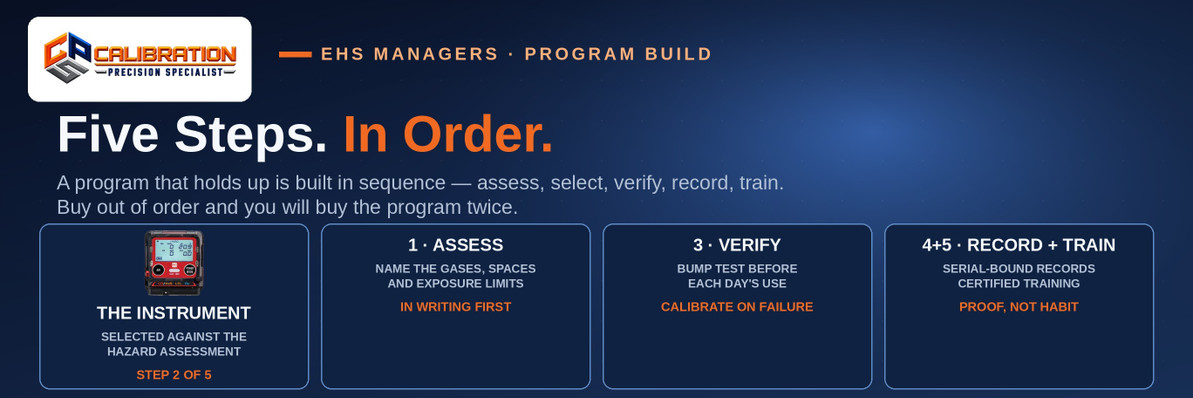
Build a gas detection program in five steps, in this order: (1) a written hazard assessment that names the gases, spaces, and exposure limits; (2) instruments selected against that assessment — portable or fixed, pumped or diffusion; (3) a verification discipline of a bump test or calibration check before each day's use, with a full calibration whenever a check fails; (4) records that tie every test to an instrument serial number and a calibration-gas lot; and (5) training for users and maintainers, certified in writing. Programs fail when the steps are bought out of order — monitors first, paperwork later.
Every weak gas detection program we see has the same biography: somebody bought detectors after an incident or an inspection, the detectors went into service, and everything else — assessment, records, training — was going to be "sorted out later." Later rarely comes. The instruments drift, the bump tests happen when someone remembers, and the first real test of the program is an auditor or an injury. This post is the build in the right order, written for the EHS manager starting from a blank page. Each step names the standard or guidance behind it, because a program you cannot cite is a program you cannot defend.
Step 1: How Do You Assess the Hazard Before You Buy Anything?
Start with paper, not products. A hazard assessment is a written inventory of where gas can hurt someone at your facility, and it answers four questions:
- Which gases? Walk the processes, not the catalog. Fuel-fired equipment and vehicle exhaust point to carbon monoxide. Wastewater, sumps, and decaying organics point to hydrogen sulfide. Fuel storage and process piping point to combustible gas (read as %LEL). Enclosed and below-grade spaces point to oxygen displacement by whatever is stored or generated nearby. Refrigeration adds ammonia or refrigerant gases; battery charging adds hydrogen.
- Where? Name the spaces: confined spaces your people enter, rooms with fixed sources, and routes workers travel. Federal OSHA requires the employer to evaluate the workplace and identify permit-required confined spaces (29 CFR 1910.146(c)(1)) — that evaluation is the spine of the assessment.
- How bad can it get, and how fast? Compare credible concentrations against the published limits. The numbers that drive most programs:
| Gas / condition | The number that matters |
|---|---|
| Oxygen | Deficient below 19.5%; enriched above 23.5% (OSHA definitions, 1910.146(b)) |
| Carbon monoxide | OSHA PEL 50 ppm TWA; NIOSH REL 35 ppm TWA, 200 ppm ceiling |
| Hydrogen sulfide | NIOSH REL ceiling 10 ppm (10 min); IDLH 100 ppm |
| Combustible gas | Hazardous above 10% of the lower flammable limit (1910.146 App. B) |
- Who is exposed, doing what, for how long? A maintenance tech entering a sump twice a year and an operator standing beside a compressor all shift are different programs wearing the same hard hat.
The assessment also decides placement physics. Gases behave by density: methane (0.55 relative to air) and hydrogen (0.07) rise; carbon monoxide (0.97) mixes evenly; hydrogen sulfide (1.19) and propane (1.52) settle low. The assessment records where each gas would go in each room — that sentence later determines where fixed sensors mount and where a portable gets clipped.
Step 2: How Do You Select Instruments Against the Assessment?
With the gases and places named, selection becomes matching instead of shopping:
- Portable vs. fixed. People who move through hazard areas carry portables; rooms with a continuous source get fixed detection. Most real programs need both, in different places, for different reasons — our guide to choosing a portable gas detector works through the portable half in depth, and the portable multi-gas monitors category shows the current field.
- Pumped vs. diffusion. Diffusion instruments sample the air around the wearer — right for personal monitoring. Any measurement taken before a person enters a space, or from outside it, needs a pump drawing a sample from inside the space: you test the atmosphere before it tests you. Confined-space pre-entry testing follows the order in OSHA's guidance — oxygen first, then flammable gases, then toxics — because a bad oxygen reading changes how the other readings are interpreted.
- Channels matched to the assessment — no more, no fewer. The standard 4-gas configuration (LEL, O2, CO, H2S) covers the classic confined-space set; a fifth channel (a PID for solvents, or a specialty toxic) is added when the assessment names that gas, not because the slot exists. A typical fleet anchor is a compact 4-gas unit like the RKI GX-3R — the point is the match, not the model.
- Alarm setpoints written down. Low and high alarms per channel, set against the limits in your assessment table, recorded in the program document — not left at whatever the factory shipped unless the factory settings match your limits and you have documented that they do.
Step 3: What Verification Discipline Keeps Detectors Honest?
A gas detector's sensor drifts and can be poisoned or damaged without any outward sign. Verification is how the program catches that before an exposure does. The discipline recognized by both OSHA and the industry association (ISEA) is short enough to print on a card:
- Bump test or calibration check before each day's use, following the manufacturer's instructions, with gas strong enough to trigger the alarms. ISEA's position statement — quoted in OSHA's information bulletin on calibrating portable monitors — sets exactly this frequency. Our step-by-step bump test guide walks the procedure.
- A check passes if the response is within the manufacturer's acceptable limits — typically ±10–20% of the test-gas concentration (OSHA's bulletin gives that typical band; your manual governs your instrument).
- Any instrument that fails gets a full calibration before further use. A full calibration adjusts the reading to a known, certified gas concentration.
- An instrument that fails full calibration comes out of service until repaired. No exceptions, no "use it and watch it."
- Calibration gas is a certified reference: OSHA's bulletin states calibration gas should always be certified using a standard traceable to the National Institute of Standards and Technology (NIST). The cylinder's Certificate of Analysis is that proof — keep it filed by lot number (Step 4), and respect shelf life: reactive blends run about 6–12 months, stable mixtures roughly 36, and the date on your cylinder's CoA is the one that governs.
Notice what is not in this step: a universal calibration calendar interval from OSHA. There isn't one — full-calibration intervals come from the manufacturer and from your check results. Anyone selling you a federal "calibrate every X days" rule for portables is inventing it; the daily check is the requirement-shaped practice, and the record of it is Step 4.
Step 4: What Records Does the Program Keep?
Records are where programs become provable. The minimum set, per instrument, tied together by serial number:
- Asset record: make, model, serial number, assigned user or location, in-service date.
- Bump/calibration-check log: date, result, gas lot used, who performed it.
- Calibration records: as-found and as-left readings, gas lot, technician, next due date.
- Failure-and-action records: every failed check, what was done (calibrated, repaired, retired), and when the instrument returned to service. A log with no failures in it is a log nobody believes — instruments fail checks in real fleets, and documenting the response is the point.
- Gas records: each cylinder's CoA filed by lot, so any calibration can be traced to the certified concentrations it was set with.
- Training certifications (Step 5).
How long to keep them is its own question — there is no single federal retention number for bump logs, and the honest answer is layered, which is why we gave it its own post: what an auditor looks for in your bump test and calibration records. This is also exactly the record set the CPS Calibration Program keeps for instruments we calibrate: one record per instrument, as-found/as-left certificates, and a reminder 30 days before the next calibration is due — no contract, no monthly fee.
Step 5: Who Gets Trained, and to What Level?
The last step is people, in three tiers (the companion post, gas detection training requirements, covers the regulatory detail):
- Every user: what the instrument measures, what normal readings look like, fresh-air zero, how to bump test, what each alarm means, and the one rule that outranks the rest — on alarm, leave, then report.
- Attendants, entrants, and entry supervisors on permit-space crews: the duties OSHA assigns each role under 1910.146, including pre-entry testing and evacuation triggers.
- Program maintainers: full calibration, sensor replacement recognition, record-keeping, and failure disposition — the people who run Steps 3 and 4.
Confined-space training must be certified in writing (employee name, trainer signature or initials, dates — 1910.146(g)(4)). Train before first assignment, before a change in duties, and whenever procedures change or performance slips — those triggers are in the standard itself.
What Does a From-Scratch Program Cost to Run?
Honest shape of the money: the instruments are the visible purchase; the recurring costs are calibration, calibration gas, and sensors. Budget for bump/check gas as a consumable (a cylinder's life is spent in seconds-long tests, but reactive blends also expire on their 6–12 month clock whether used or not), and for periodic full calibration. If you outsource the bench work, CPS's published in-house rates are $55 for a single-gas instrument and $90 for 4- and 5-gas instruments — we calibrate every channel, and the full certificate (as-found/as-left, gas CoA link, due date) is included. Ship-in service runs at the same rates; on-site work at your facility is quoted in writing for the job. The expensive version of a gas detection program is the one built out of order — instruments bought twice because the first purchase didn't match the hazard.
Frequently Asked Questions
What are the steps to build a gas detection program from scratch?
Five, in order: (1) a written hazard assessment naming the gases, spaces, and exposure limits; (2) instrument selection matched to that assessment — portable vs. fixed, pumped vs. diffusion, channels per named gas; (3) a verification discipline — bump test or calibration check before each day's use, full calibration on any failed check, removal from service on a failed calibration; (4) records tying every test to a serial number and a calibration-gas lot; and (5) tiered training for users, confined-space crews, and program maintainers, certified in writing.
Does OSHA require a written gas detection program?
OSHA does not publish a single standard titled "gas detection program." The written pieces arrive from the standards that apply to your work: permit-required confined space work requires a written permit-space program (29 CFR 1910.146(d)(1)), hazard communication requires a written program and chemical list (1910.1200(e)), and your atmospheric-testing and training duties sit inside those standards. Most EHS managers consolidate them into one gas detection program document because auditors, insurers, and customers ask for it as one document.
How often do gas detectors need to be bump tested?
Before each day's use. That is the ISEA position statement's frequency, quoted in OSHA's information bulletin on calibrating and testing portable gas monitors, and it is performed per the manufacturer's instructions with gas that triggers the alarms. A failed bump test means a full calibration before the instrument is used again; a failed full calibration means the instrument comes out of service until repaired.
How often do gas detectors need full calibration?
There is no universal federal interval. Full calibration is required whenever a bump test or calibration check fails, and otherwise on the interval the manufacturer specifies for the instrument and sensor type. The daily check is what makes a longer calibration interval defensible: it proves, every day of use, that the sensors and alarms still respond within the manufacturer's acceptable limits — typically ±10–20% of the test gas concentration.
What gases should a standard program monitor?
The ones your hazard assessment names — but the classic confined-space set is the starting point for most plants: oxygen (deficient below 19.5%, enriched above 23.5%), combustible gas as %LEL (hazardous above 10% of the lower flammable limit), carbon monoxide (OSHA PEL 50 ppm TWA), and hydrogen sulfide (NIOSH ceiling 10 ppm, IDLH 100 ppm). Processes add their own: ammonia at refrigeration plants, chlorine at water treatment, hydrogen at battery rooms, solvents (via PID) in coating and chemical work.
What is the difference between a bump test and a calibration?
A bump test (calibration check) verifies: you expose the instrument to a known gas and confirm the sensors respond within acceptable limits and the alarms fire — you change nothing. A full calibration adjusts: the instrument's readings are set to coincide with the certified concentration of the test gas. Checks are daily and take under a minute; calibration follows a failed check or the manufacturer's schedule. Calibration gas for either should be NIST-traceable, certified on the cylinder's Certificate of Analysis.
What records should a gas detection program keep?
Per instrument, keyed to serial number: the asset record; bump/calibration-check logs with dates, results, gas lot, and tester; calibration records with as-found and as-left readings and the next due date; failure-and-action records showing what was done after every failed check; the Certificates of Analysis for each calibration-gas lot; and training certifications. The test of the system is traceability — pick any instrument and any date, and the file should show it was verified, with what gas, by whom, and what happened when it failed.
Who needs training in a gas detection program?
Three tiers. Every user learns readings, zeroing, bump testing, alarm meanings, and the evacuate-on-alarm rule. Confined-space entrants, attendants, and entry supervisors learn the duties OSHA assigns their roles, including pre-entry testing in the order oxygen, then flammables, then toxics. Program maintainers learn full calibration, failure disposition, and record-keeping. For permit-space work, OSHA requires the training to be certified with the employee's name, the trainer's signature or initials, and the dates (29 CFR 1910.146(g)(4)).
Can a small facility run a compliant program without a full-time safety staff?
Yes — the five steps scale down. A small plant's assessment may be three pages, its fleet six instruments, and its maintainer one trained supervisor. What does not scale away is the daily check discipline and the records. Many small facilities outsource the bench work: CPS calibrates ship-in instruments at published in-house rates ($55 single-gas, $90 for 4- and 5-gas), returns a full certificate per instrument, and tracks due dates with a 30-day reminder — the facility keeps the daily bump tests and the file.
What is the most common mistake when starting a gas detection program?
Buying instruments first. The purchase feels like progress, but without the assessment the channels, alarm points, and pumped-vs.-diffusion choices are guesses — and the records and training steps get deferred until an auditor or an incident prices the deferral. The second most common mistake is a verification step with no failure path: a bump-test station where a failed instrument goes back on the rack because nobody wrote down what happens next. Write the failure path into the program before the first failure, not after it.
The Bottom Line
A gas detection program is not a purchase order — it is five steps in a fixed order: assess the gases and spaces in writing, select instruments against that assessment, verify every instrument before each day's use, record everything against serial numbers and gas lots, and train people in tiers with the certification to prove it. Get the order right and each step makes the next one cheap; get it backwards and you will buy the program twice.
Starting from zero — or rebuilding a program an auditor just took apart? Call CPS Calibrations at 865-900-8844. We will help you spec the instruments, set the discipline, and keep the calibration records from our bench in Rockwood, Tennessee.
CPS Calibrations · 109 S. Front Street, Rockwood, TN 37854 · Calibration Services · The CPS Calibration Program · Calibration Gas
Need a calibration you can file?
In-house calibration at CPS in Rockwood, Tennessee — $55 for single-gas instruments, $90 for 4- and 5-gas — every channel, as-found and as-left data, full certificate.
See Calibration Servicesor call 865-900-8844
Recent Posts
-

How Long Do Gas Detector Sensors Last?
Gas detector sensors do not share one lifespan: a traditional galvanic oxygen sensor typically lasts …Nov 16th 2026 -

The 15-Minute Weekly Gas Detection Checklist for Supervisors
A weekly gas detection check takes a supervisor about 15 minutes and covers four things: every instr …Nov 15th 2026 -

Calibration Gas for PID Instruments: Isobutylene and the 100 ppm Standard
A PID is calibrated on 100 ppm isobutylene — not on the gas you are measuring — because the instrume …Nov 14th 2026