
Gas Detection Training: Who Needs It, What It Covers, and How Often
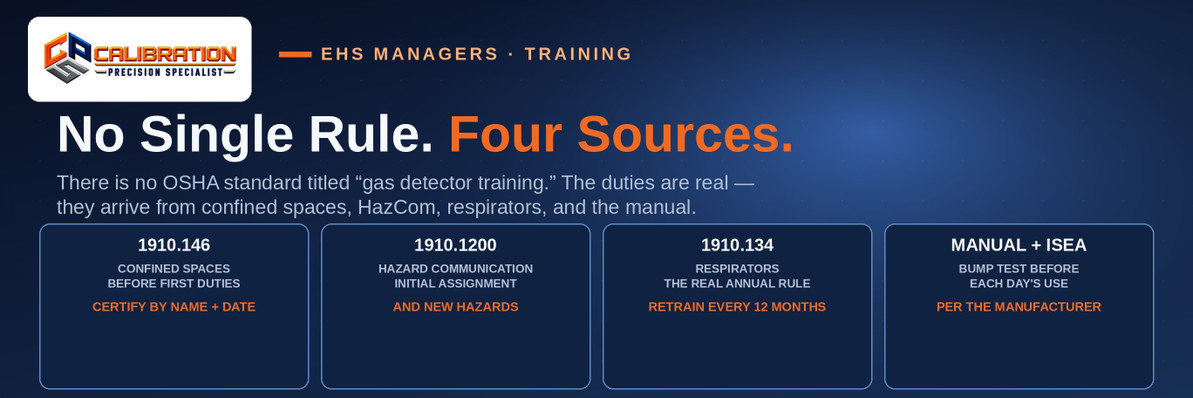
There is no single OSHA standard titled "gas detector training" — the duty to train gas detector users is real, but it flows from four sources: 29 CFR 1910.146 (permit-required confined spaces), which requires training before first assigned duties and certification with the employee's name, trainer's initials, and dates; 29 CFR 1910.1200 (Hazard Communication), which requires training at initial assignment and before new chemical hazards; 29 CFR 1910.134, which requires annual retraining where respirators are used; and the manufacturer's instructions, which govern bump testing and calibration. Anyone who quotes you one OSHA refresher interval for "gas detectors" is selling you a rule that does not exist.
This surprises people, because gas detector training feels like it should be a single line in a single standard. It isn't — and that gap between feeling and text is where training files get sloppy: annual certificates printed for a rule nobody can cite, or, worse, confined-space crews whose required training never happened because the program was waiting for a "gas detector course" to exist. This post maps the actual sources, level by level: who needs training, what each level covers, which intervals are law and which are policy, and how to document it.
Where Does the Duty to Train Gas Detector Users Actually Come From?
Four sources, each covering a different slice of the work:
| Source | Who it covers | When training is required |
|---|---|---|
| 29 CFR 1910.146(g) — confined spaces | Entrants, attendants, entry supervisors, testers on permit-space work | Before first assigned duties; before a change in duties; when operations change and present a new hazard; whenever knowledge or performance is inadequate |
| 29 CFR 1910.1200(h) — HazCom | Employees who work with or around hazardous chemicals (including the gases themselves and calibration gas) | At initial assignment, and before new chemical hazards are introduced |
| 29 CFR 1910.134(k) — respiratory protection | Employees required to wear respirators (the escalation layer when air is bad) | Before initial use; retraining annually |
| Manufacturer instructions + ISEA guidance | Anyone who bumps, calibrates, or maintains the instruments | Before performing the task; the bump test itself is required before each day's use, per the manual |
Read the table the way an auditor does: your program's training matrix is built by stacking the rows that apply to each job. A confined-space entrant who wears a respirator on entry sits under three of the four rows at once.
What Does User-Level Training Cover?
User level is everyone who wears or carries a detector. The content is practical, and most of it traces to the confined-space duties OSHA assigns entrants (§1910.146(h): know the hazards faced, including the mode, signs, symptoms, and consequences of exposure; properly use the equipment) plus the instrument manual:
- What the instrument measures — each channel, in plain units: oxygen in percent, combustibles in %LEL, toxics in ppm — and what a normal reading looks like in clean air.
- Fresh-air zero — where and how to zero (in known clean air), and why zeroing in contaminated air poisons every reading after it.
- The bump test — how to apply test gas and confirm every sensor responds and every alarm fires, before each day's use, per the manufacturer's instructions. A user who cannot bump test is not trained; they are carrying an unverified instrument.
- The alarm numbers — the low and high setpoints for each channel on their instrument, and what each one commands.
- The one rule that outranks the rest: on alarm, leave — evacuate first, report from clean air, never silence-and-stay, never "check one more thing."
- Limits of the instrument — what it does not measure, cross-sensitivities in plain terms, and the rule that a detector reading is a snapshot of where its sensor is, not a promise about the whole room.
Our companion post walks the hands-on version: how to train a new hire to use a gas detector is a 15-minute lesson plan covering exactly this list.
What Does Competent-Person-Level Training Add?
A precision first: general-industry OSHA (1910.146) does not use the title "competent person" for gas detection — it assigns duties by role. Plants borrow the term (it is a defined title in construction standards) for the people who test atmospheres and run the program. Whatever your program calls them, the added content is:
- Atmospheric testing as a discipline: pre-entry testing before any entry, in the order OSHA's guidance sets — oxygen first, then flammable gases and vapors, then toxic gases and vapors — because a low-oxygen reading changes the meaning (and the reliability) of the readings after it. Testing at levels where entrants will be, not just at the opening.
- Entry-role duties under 1910.146: the entrant's duties (h), the attendant's duties (i) — monitoring, communication, ordering evacuation — and the entry supervisor's duties (j) — verifying the permit, the testing, and the rescue arrangements before signing.
- Instrument maintenance: full calibration (not just checks), sensor-life judgment, failure disposition — the failed instrument comes out of service until repaired — and the record system: logs, gas lots, Certificates of Analysis, retention.
- Program judgment: alarm-setpoint rationale against exposure limits, when readings require ventilation or work stoppage, and how to brief a crew on a specific space's specific hazards.
These are the people a from-scratch program calls its maintainers — user training keeps individuals safe today; this level keeps the system honest across months.
How Often Is Refresher Training Actually Required?
This is the section to read carefully, because the honest answer is a list, not a number:
- 1910.146 confined spaces: no fixed calendar interval. The standard requires training at defined triggers — before first assignment, before a change in duties, when operations change and present a new hazard, and whenever the employer has reason to believe an employee's knowledge or use of procedures is inadequate. A plant that only retrains on a calendar and ignores the triggers is non-compliant on the days that matter; a plant that trains on every trigger and never on a calendar can be fully compliant.
- One real 12-month rule inside 1910.146: rescue practice. Employees who perform rescue duties must practice making permit-space rescues at least once every 12 months, in representative spaces (§1910.146(k)(2)(iv)). That is a drill requirement, not a classroom refresher — but it is a genuine annual clock, and files often miss it.
- 1910.1200 HazCom: no annual refresher. Training is required at initial assignment and before new chemical hazards are introduced. New gas, new process, new SDS — that is the trigger.
- 1910.134 respirators: annual retraining, in so many words. Where employees use respirators, retraining is required annually, within 12 months of the previous training (§1910.134(k)(5)). This is the rule most often misquoted as a "gas detector" requirement — it attaches to the respirator, not the detector, but on entry crews the two populations overlap heavily.
- HAZWOPER-covered emergency responders: an 8-hour annual refresher (§1910.120(q)(8)) — a real requirement, scoped to employees covered by the emergency-response paragraph, not to routine detector users.
- Company-policy refreshers are legitimate — labeled as policy. Many plants run an annual gas-detection refresher because insurers, customers, or their own program require it. Do it, and write "company policy" in the program document. The file problem arises only when policy is dressed as law and the actual legal triggers (a duty change, a performance lapse) go untrained because "the annual isn't due yet."
How Should Gas Detection Training Be Documented?
For permit-space work, the standard specifies the certificate's contents: the employee's name, the signatures or initials of the trainers, and the dates of training (§1910.146(g)(4)), available for inspection by employees and their representatives. Build every level's documentation to that template and it will satisfy the other sources as well:
- A roster entry per person per topic: user-level, testing/entry-role, maintainer — with the instrument models covered, because training on one model transfers imperfectly to another.
- The trigger recorded alongside the date ("initial assignment," "new duties — attendant," "procedure change 2026-…"), which is how you prove the 1910.146 timing rules were met, not merely that a class occurred.
- Hands-on verification noted for skills (bump test performed, zero performed, alarm response stated) — proficiency is the standard's word (§1910.146(g)(3)), and a signature on an attendance sheet does not demonstrate it.
Keep the training file next to the records file — auditors sample them together, as our records post describes: one instrument, one date, one trained person, all three documents agreeing.
Frequently Asked Questions
Is there an OSHA standard specifically for gas detector training?
No. No federal OSHA standard is titled or scoped as "gas detector training." The training duties that cover gas detector users flow from the standards governing the work around the detector: 29 CFR 1910.146(g) for permit-required confined spaces, 1910.1200(h) for hazard communication, 1910.134(k) where respirators are used, plus the manufacturer's instructions for the instrument itself and ISEA guidance on verification testing. A compliant program assembles its training matrix from those sources.
Who needs gas detection training?
Everyone who relies on or operates the instruments, in tiers. Every user needs readings, fresh-air zero, bump testing, alarm meanings, and the evacuate-on-alarm rule. Confined-space entrants, attendants, and entry supervisors need the role duties OSHA assigns them under 1910.146, including pre-entry atmospheric testing. The people who calibrate and maintain the instruments — the program's "competent person" layer, in most plants' language — need full calibration, failure disposition, and record-keeping. Supervisors who sign permits need enough of all three to verify the work.
What must confined-space training cover under 1910.146(g)?
Training sufficient for each employee to acquire the understanding, knowledge, and skills for safe performance of their assigned duties, establishing proficiency in those duties. For entrants that includes knowing the hazards that may be faced — mode, signs, symptoms, and consequences of exposure — and proper use of the equipment, which is where detector skills live. Attendants must know how to monitor entrants and order evacuation; entry supervisors must be able to verify that testing, permitting, and rescue arrangements are in place before entry begins.
How often must gas detection training be refreshed?
By trigger, not by calendar, under the confined-space standard: before first assigned duties, before a change in duties, when operations change and present a new hazard, and whenever the employer sees deviations or inadequacies in an employee's knowledge or procedure use. Two genuine calendar rules sit nearby: rescue-team members must practice permit-space rescues at least once every 12 months (1910.146(k)(2)(iv)), and respirator users must be retrained annually (1910.134(k)(5)). Many employers add an annual policy refresher — sound practice, correctly labeled as policy.
Does OSHA require annual gas detector refresher training?
No — not for gas detectors as such. The annual requirements people cite belong to adjacent duties: respirator training repeats annually under 1910.134(k)(5), confined-space rescue practice runs on a 12-month clock under 1910.146(k)(2)(iv), and HAZWOPER-covered emergency responders take an 8-hour annual refresher under 1910.120(q)(8). Neither 1910.146(g) nor HazCom's 1910.1200(h) contains an annual detector refresher. If your program runs one, it is company policy — often insurer- or customer-driven — and the file should say so.
What documentation proves gas detection training happened?
For confined-space training, OSHA names the contents: a certification containing each employee's name, the signatures or initials of the trainers, and the dates of training (1910.146(g)(4)), available to employees and their representatives. Strong files add the topic and instrument models covered, the trigger for the session (initial assignment, duty change, procedure change), and a hands-on proficiency check — because the standard requires proficiency, and an attendance signature alone does not evidence it.
Can gas detector training be done in-house, or must it be a certified course?
In-house training is permitted — none of the governing standards require an outside provider or a commercial certificate. What they require is content, proficiency, and documentation: the training must establish proficiency in the assigned duties, and for confined-space work the employer certifies it with names, trainer initials, and dates. Vendor and third-party courses are a delivery option, not a legal category; a well-run toolbox program with documented hands-on checks can satisfy the standards, and an expensive course with no proficiency verification may not.
What is the difference between user training and competent-person training for gas detectors?
Scope and responsibility. User training covers operating one instrument safely: readings, zero, bump test, alarms, evacuation. The competent-person layer — OSHA's general-industry standards assign the underlying duties by role (entrant, attendant, entry supervisor, tester) rather than by that title — adds atmospheric-testing discipline (test order: oxygen, then flammables, then toxics), entry-role duties, full calibration and maintenance, failure disposition, and the records system. Users keep themselves safe on a shift; the second layer keeps the program valid across the year.
Does HazCom training cover gas detectors?
Partly — it covers the chemicals, not the instruments. Section 1910.1200(h) requires training on the hazardous chemicals in the work area at initial assignment and before new hazards are introduced: the gases your people may be exposed to, and the gases in your calibration cylinders (which can include hydrogen sulfide and carbon monoxide mixtures). Instrument operation — zeroing, bump testing, alarm response — comes from the confined-space standard's duties and the manufacturer's instructions. A complete program trains both layers and files them separately.
When must a new hire be trained on gas detectors?
Before they are first assigned duties that rely on one. Under 1910.146(g)(2), confined-space training precedes the first assignment of regulated duties — not within a probationary window, not at the next scheduled class. Practically: the detector portion of onboarding happens before the first shift carrying an instrument, and the hands-on core (normal readings, fresh-air zero, bump test, alarm numbers, alarm-means-leave) fits in about 15 minutes, which is why there is rarely a scheduling excuse for skipping it.
The Bottom Line
Gas detection training has no single OSHA home — it is assembled from confined-space duties (train before first assignment and at every trigger, and certify it by name, trainer, and date), HazCom (initial assignment and new hazards), respirator rules (the real annual retraining), and the instrument manual (the bump test before each day's use). Programs get in trouble by inventing one interval and missing the triggers; get the sources right and the training file defends itself.
Building the training tier of a gas detection program — or pairing it with calibration your records can prove? Call CPS Calibrations at 865-900-8844. We calibrate every channel on every instrument we service and keep the certificates your trained people deserve to be backed by. 109 S. Front Street, Rockwood, TN 37854.
CPS Calibrations · 109 S. Front Street, Rockwood, TN 37854 · Calibration Services · The CPS Calibration Program
Need a calibration you can file?
In-house calibration at CPS in Rockwood, Tennessee — $55 for single-gas instruments, $90 for 4- and 5-gas — every channel, as-found and as-left data, full certificate.
See Calibration Servicesor call 865-900-8844
Recent Posts
-

How Long Do Gas Detector Sensors Last?
Gas detector sensors do not share one lifespan: a traditional galvanic oxygen sensor typically lasts …Nov 16th 2026 -

The 15-Minute Weekly Gas Detection Checklist for Supervisors
A weekly gas detection check takes a supervisor about 15 minutes and covers four things: every instr …Nov 15th 2026 -

Calibration Gas for PID Instruments: Isobutylene and the 100 ppm Standard
A PID is calibrated on 100 ppm isobutylene — not on the gas you are measuring — because the instrume …Nov 14th 2026