
What an Auditor Looks for in Your Bump Test and Calibration Records
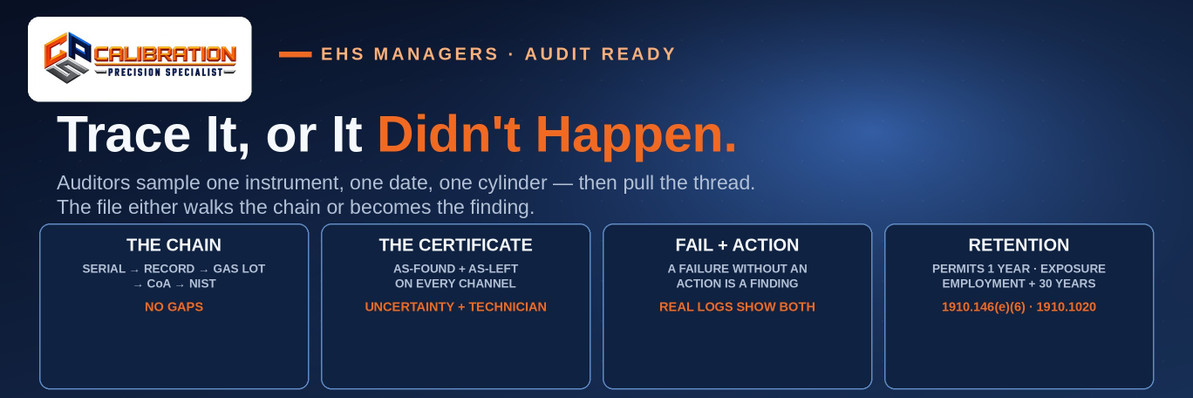
An auditor reviewing bump test and calibration records tests one thing: traceability. Pick any instrument and any date, and the file should show — by serial number — that it was verified before use, with calibration gas from a specific lot whose Certificate of Analysis certifies NIST-traceable concentrations, and that every failed check has a documented action after it. Records that cannot walk that chain, or a retention policy with no stated basis, are where findings come from.
Auditors — OSHA compliance officers, insurance inspectors, customer EHS teams, and internal reviewers all work the same way — rarely start by reading your whole log. They sample. One instrument off the rack, one date out of the quarter, one cylinder out of the cage. Then they pull the thread. This post walks the thread the way they pull it: the chain, the certificate, the failure file, and the retention question — with our own calibration certificate as the worked example, because it was designed against exactly these questions.
What Does Traceability Actually Mean in a Calibration Record?
Traceability means an unbroken, documented chain from a reading back to a national standard:
Instrument → calibration record → gas cylinder lot → Certificate of Analysis → NIST.
- The instrument end is identity: manufacturer, model, and serial number. A record that says "the 4-gas in the shop" traces to nothing. A record keyed to a serial number traces to one physical unit with one history.
- The middle is the event: date, technician, as-found and as-left readings on every channel, and the identity of the gas used — mixture and lot number, not just "cal gas."
- The far end is the gas's own proof. The cylinder's Certificate of Analysis certifies the measured concentration of each component in that lot, the lot number, the traceability of those measurements to the National Institute of Standards and Technology, and the expiration date. OSHA's guidance on calibrating portable monitors is explicit that calibration gas should be certified using a standard traceable to NIST — the CoA is the document that demonstrates it.
Break any link and the calibration becomes an assertion. Auditors know this, which is why "what gas did you use?" is followed immediately by "show me its certificate."
At CPS the chain is mechanical rather than clerical. When a calibration gas cylinder arrives, we scan the supplier QR code on the bottle and the CoA is stored on that bottle's record. When that bottle is used to calibrate an instrument, the instrument's certificate carries a clickable CoA link for that exact cylinder. Every cylinder we sell works the same way for your own program — the QR code on the cylinder pulls up its own SDS and CoA, so the lot's paperwork lives with the gas instead of in a shipping carton. Pick any CPS certificate and the far end of the chain is one click away.
What Fields Does an Auditor Expect on a Calibration Certificate?
Sample a certificate and an auditor reads it against a mental checklist. A record built to be audited carries:
| Field | Why the auditor wants it |
|---|---|
| Instrument identity (make, model, serial) | Binds the record to one physical unit |
| As-found readings, every channel | Shows the state the instrument was in when it arrived — whether its recent readings can be trusted |
| As-left readings, every channel | Shows the state it returned to service in |
| Calibration gas + lot + CoA | Proves what the readings were set against, traceable to NIST |
| Measurement uncertainty | States how tight the numbers are, so readings can be judged against accuracy requirements |
| Calibration date + due date | Establishes the interval and what "current" means |
| Technician identity | Accountability by name when a reading is questioned |
That is, field for field, what's on a CPS calibration certificate — one tier, the full breakdown on every job, never a detailed-certificate upsell. Two fields deserve emphasis because they are the ones most often missing elsewhere:
- As-found readings. An as-left-only certificate proves the instrument is right today and says nothing about the weeks it was working before it arrived. An instrument that arrives reading low has been under-reporting in the field, and the as-found line is the only evidence that lets a safety manager judge the readings it took. Auditors ask for as-found data precisely because its absence erases the question.
- The gas link. "Calibrated with certified gas" is a claim; a CoA link for the exact cylinder used is the evidence, one click from the claim.
What Does an Auditor Do With Your Bump Test Log?
Bump tests are the high-volume record — one per instrument per day of use — so auditors sample them differently. They are looking for three patterns:
- Continuity. The recognized discipline is a bump test or calibration check before each day's use (the ISEA position quoted in OSHA's bulletin). A log with weekday-shaped holes, or a fleet of instruments "in use" on days with no checks, tells its own story. Electronic logs from docking stations answer this best; a disciplined paper log answers it too. What fails is reconstruction — entries plainly written later, in one pen, in one sitting.
- Plausible results. A check passes when the response is within the manufacturer's acceptable limits, typically ±10–20% of the test-gas concentration. A log that records only "OK" with no gas lot, no tester, and no values is weaker than one that records the check against a named cylinder by a named person — because the auditor cannot tie the check to certified gas.
- The failure path — the subject of the next section, and the single richest source of findings.
What Happens When the Record Shows a Failure?
It should — real fleets fail checks. Sensors age, get poisoned, get dropped. An auditor who finds no failures in a year of bump logs does not conclude your fleet is perfect; they conclude the log is fiction. What they grade is what the record shows happened next, against the recognized sequence:
- Failed bump test or calibration check → full calibration before further use. Not "used it anyway," not "bumped it again until it passed."
- Failed full calibration → removed from service until repaired or replaced, and tagged or segregated so it cannot drift back onto the rack.
- The record closes the loop: the failure, the action, the re-verification, and the return-to-service date, all against the same serial number.
The finding is almost never "an instrument failed." The finding is "an instrument failed on March 3 and was issued on March 4 with no documented action." Build the failure-and-action line into the log format itself — a column, not a hope — and the auditor's favorite question answers itself.
How Long Do You Have to Keep Bump Test and Calibration Records?
Honestly: no federal standard sets a retention period for bump-test logs by name, and any post or consultant who gives you a single clean number for "gas detector records" is blending several different rules. The defensible approach is to anchor retention to the rules that do exist, by record type:
- Cancelled confined-space entry permits: at least 1 year. 29 CFR 1910.146(e)(6) requires the employer to retain each cancelled permit for at least a year so the permit-space program can be reviewed. Atmospheric testing records ride with the entry documentation in most programs.
- Employee exposure records: duration of employment plus 30 years. Under 29 CFR 1910.1020(d)(1), exposure records — which include monitoring data used to characterize employee exposure — carry the long retention. If your detector datalogs (TWA/STEL histories, alarm-event logs) serve as exposure records, treat them under this rule, not under a one-year habit.
- Training certifications: 1910.146(g)(4) specifies their content (employee name, trainer signature or initials, dates) but states no retention period — most programs keep them for employment plus a margin, and say so in writing.
- Calibration and bump records: set the period in your written program, informed by the anchors above, your insurer, and your customers' requirements — and keep it consistently. A stated, followed policy beats an impressive number applied unevenly.
The auditor's question is rarely "is it exactly N years?" It is "show me your retention rule and show me it working." Write the rule down, by record type, before they ask.
How CPS Records Are Built to Be Sampled
Everything above is the design brief behind our own paperwork. Every instrument calibrated at CPS — in-house, shipped in, or serviced on-site — gets the same certificate: serial-bound identity, as-found and as-left on every channel (we calibrate every channel), the gas with its clickable CoA, uncertainty, due date, and the technician's name. Certificates live on the instrument's record in the CPS Calibration Program, reachable through one fleet history link with per-location views, and the due date on the certificate is the date our reminder system watches — you get a reminder 30 days ahead. In-house calibration is $55 for a single-gas instrument and $90 for 4- and 5-gas instruments, certificate included; on-site work is quoted in writing. When your auditor samples, you open the history instead of opening a drawer.
Frequently Asked Questions
What does an auditor look for first in calibration records?
Traceability. The auditor picks one instrument and one date and asks the file to walk the chain: serial number → calibration record → calibration gas lot → that lot's Certificate of Analysis → NIST-traceable certified concentrations. Any gap — an unnumbered record, a gas identified only as "cal gas," a missing CoA — turns a calibration from evidence into assertion, and assertions are what findings are made of.
Does OSHA require bump test records?
OSHA's standards require the underlying work — atmospheric testing for confined-space entry, trained employees, instruments maintained per the manufacturer's instructions — and OSHA's bulletin endorses the ISEA discipline of a bump test or calibration check before each day's use. No federal standard says "keep a bump test log for N years" in those words. In practice, the record is how you prove the work happened: compliance officers, insurers, and customer auditors all ask for the log, and an unrecorded check is indistinguishable from an unperformed one.
How long must calibration records be kept?
There is no single federal number for calibration records as a class. Anchor by record type: cancelled confined-space entry permits must be retained at least 1 year (29 CFR 1910.146(e)(6)); employee exposure records must be retained for the duration of employment plus 30 years (29 CFR 1910.1020(d)(1)) — detector datalogs used as exposure documentation belong in that bucket; training certifications have specified content but no stated period in 1910.146(g)(4). Set the calibration/bump retention in your written program, using those anchors plus insurer and customer requirements, and apply it consistently.
What should a calibration certificate include to survive an audit?
Seven fields: the instrument's manufacturer, model, and serial number; as-found readings for every channel; as-left readings for every channel; the calibration gas used, identified by mixture and lot, with its Certificate of Analysis available; the stated measurement uncertainty; the calibration date and next due date; and the name of the technician who performed the work. That is the field set on every CPS certificate — one tier, full breakdown, no detailed-version upsell.
Why do auditors care about as-found readings?
Because as-left readings only prove the instrument is accurate now. As-found readings show how it was performing when it arrived — which is the condition it was in during the weeks it was taking field readings since its last calibration. An instrument that arrives reading significantly low has been under-reporting exposures, and the as-found data is what lets a safety manager judge those earlier readings. A certificate without as-found data cannot answer the auditor's real question: "was it right while it was out there?"
What should happen when a bump test fails, and how should it be documented?
The instrument gets a full calibration before any further use; if it fails full calibration, it is removed from service until repaired. The record should show, against the serial number: the failed check (date, tester, gas lot), the action taken, the result of the calibration or repair, the re-verification, and the return-to-service date. The failure itself is normal and expected in a real fleet — a year of logs with zero failures reads as fiction. The finding is a failure with no documented action after it.
What is NIST traceability, and how does an auditor verify it?
NIST traceability means the concentrations in your calibration gas were measured against standards chained back to the National Institute of Standards and Technology, so the values are verifiable rather than asserted. The auditor verifies it on paper: the calibration record names the gas lot, and that lot's Certificate of Analysis states the certified concentration of each component and its traceability. At CPS, the CoA is scanned from the cylinder's QR code onto the bottle's record when it arrives, and the instrument's certificate links to that exact cylinder's CoA — the chain is one click long.
Can an auditor ask for the Certificate of Analysis for gas used months ago?
Yes — that is a standard sampling move, and it is exactly why gas paperwork must be filed by lot number rather than kept with shipping boxes. On CPS cylinders, the QR code printed on the bottle pulls up that cylinder's own SDS and CoA — certified concentrations, lot number, NIST traceability, and expiration date — so the document for a lot used months ago is retrievable from any cylinder of that lot, or from the CoA link on the certificates of the instruments it calibrated.
Are electronic records acceptable, or does an auditor need paper?
Electronic records are acceptable and, for high-volume bump logs, usually stronger: docking-station and instrument datalog records are time-stamped by the device rather than written by hand, which removes the reconstruction problem auditors look for in paper logs. What matters in either medium is the same: serial-number binding, gas lot identification, named tester or technician, failure-and-action documentation, and retrievability — the ability to produce one instrument's complete history on request, promptly.
What is the most common records finding in gas detection programs?
The undocumented failure path. Programs usually have some bump and calibration records; what they lack is the connective tissue — a failed check with no recorded calibration after it, a calibration with no gas lot, a certificate with no as-found readings, or records kept "somewhere" under no stated retention rule. Each gap is small; together they tell the auditor the program runs on habit rather than system. The fix is format, not effort: log templates with fields for lot, tester, and action make the complete record the easy record.
The Bottom Line
Auditors don't grade your intentions; they sample your chain. An audit-ready gas detection file binds every record to a serial number, names the gas lot behind every calibration and produces that lot's NIST-traceable CoA on demand, documents a corrective action after every failure, and keeps it all under a written retention rule anchored to the standards that actually set periods — 1 year for cancelled entry permits, employment plus 30 years for exposure records.
Want certificates built to be sampled? Send your instruments to CPS Calibrations — 865-900-8844 — and every calibration comes back with as-found and as-left readings on every channel, the gas CoA one click away, and a due-date reminder before the next one. 109 S. Front Street, Rockwood, TN 37854.
CPS Calibrations · 109 S. Front Street, Rockwood, TN 37854 · Calibration Services · The CPS Calibration Program · Calibration Gas
Need a calibration you can file?
In-house calibration at CPS in Rockwood, Tennessee — $55 for single-gas instruments, $90 for 4- and 5-gas — every channel, as-found and as-left data, full certificate.
See Calibration Servicesor call 865-900-8844
Recent Posts
-

How Long Do Gas Detector Sensors Last?
Gas detector sensors do not share one lifespan: a traditional galvanic oxygen sensor typically lasts …Nov 16th 2026 -

The 15-Minute Weekly Gas Detection Checklist for Supervisors
A weekly gas detection check takes a supervisor about 15 minutes and covers four things: every instr …Nov 15th 2026 -

Calibration Gas for PID Instruments: Isobutylene and the 100 ppm Standard
A PID is calibrated on 100 ppm isobutylene — not on the gas you are measuring — because the instrume …Nov 14th 2026