
How Long Does a Gas Detector Last?
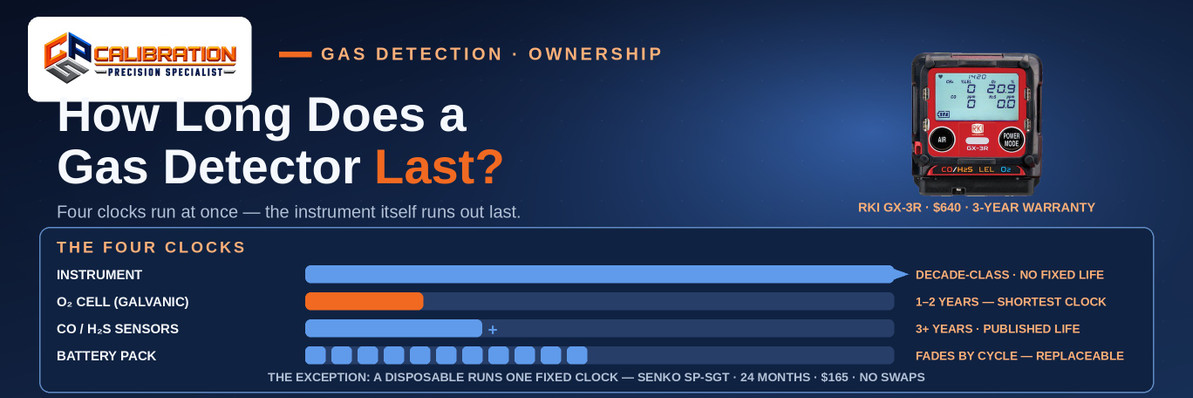
A gas detector doesn't have one lifespan — it has four clocks running at once. The instrument itself has no fixed expiration: kept calibrated and fed new sensors, a portable gas detector routinely gives a decade-class service life, and it usually dies only when its sensors are discontinued. The sensors are the consumable — a galvanic oxygen cell lasts 1–2 years, CO and H₂S electrochemical sensors carry published life expectancies of over 3 years, and the current RKI GX-3R's oxygen sensor is published at 3–5 years. The rechargeable battery pack fades gradually with charge cycles and is replaceable, and the calibration interval is the gauge that shows the sensor clock running down. The exception is a disposable monitor, which runs one fixed clock — the SENKO SP-SGT is built for 24 months, then you replace the whole unit.
Buyers ask the question as if a gas detector were a smoke alarm with a date printed on the back. It isn't built that way: a portable gas detector is a durable instrument wrapped around a set of consumable sensors, and almost everything people call "the detector dying" is one consumable reaching its end. This post separates the four clocks, puts the verified figures on each, explains what actually ends an instrument's life (rarely age), and runs the repair-or-replace maths with real prices. The sensor clock runs out first, so it gets the deepest treatment; its end-of-life signs and replacement costs are covered in full in our post on when you should replace a gas detector sensor.
How Long Does a Gas Detector Last? Four Clocks, Four Answers
| The clock | Typical life | What ends it |
|---|---|---|
| The instrument (case, electronics, display) | Decade-class in practice — no fixed expiration | Its sensors being discontinued; physical destruction; multi-channel failure |
| The O₂ sensor (galvanic cell) | 1–2 years | It consumes its own anode reacting with air — in service and on the shelf |
| Toxic sensors (CO, H₂S electrochemical) | Over 3 years (RKI 03 Series published life expectancy) | Cumulative exposure, corrosive gases, age |
| The battery pack | Runtime fades gradually over years of charge cycles | Capacity loss — fixed by a replacement pack, not a new detector |
| The exception: a disposable monitor | One fixed clock — 24 months for the SENKO SP-SGT | The clock itself: no sensor or battery replacement by design |
Read the table the way a maintenance budget should: you do not replace "a gas detector" on a cycle. You replace sensors on their clocks, a battery when its runtime stops covering a shift, and the instrument only when the platform underneath the consumables gives out.
Clock One: How Long Does the Instrument Itself Last?
The housing, electronics, pump (on pumped models), display, and alarm systems of a portable gas detector are not consumables, and no manufacturer prints an expiration date for them. In practice, an instrument that is kept calibrated, stored sensibly, and fed replacement sensors as they age routinely serves a decade-class life. RKI backs the GX-3R with a 3-year warranty on the instrument and its sensors, and SENKO backs the SP-MGT with a 2-year warranty — warranty periods are floors, not lifespans: they tell you the minimum the maker will stand behind, not the year the instrument stops.
What actually ends an instrument's life, in rough order of how often we see it:
- Its sensors get discontinued. This is the quiet killer. An instrument is only useful while replacement sensors exist for it; when the maker retires the sensor line, every sensor in the field is on borrowed time and the next failed calibration is the instrument's last. Buying for a fleet you intend to keep, long-term sensor availability matters more than any single specification.
- Several channels fail together. Sensors installed together age together. One failed channel is a parts bill; three channels failing calibration in the same season on an old instrument is the platform telling you the economics have flipped (the maths is below).
- Physical destruction. Crushed housings, cracked sensor membranes, a pump ingesting liquid, corrosion in the sensor block. Instruments are dropped, driven over, and dunked; the GX-3R's IP66/68 case shrugs off dust and water exposure that would end a lesser housing, but no rating covers everything a plant can do to a handheld instrument.
- Water or contamination past the rating. Immersion or exposure beyond what the ingress rating allows gets inside the electronics, and electronics that have been wet rarely come back trustworthy.
Notice what is missing from that list: age. A ten-year-old instrument with fresh sensors and a clean calibration record is a working instrument; a two-year-old instrument that has been poisoned and flooded is scrap. Condition and parts availability decide — the calendar doesn't.
Clock Two: How Long Do the Sensors Last?
This is the clock that actually runs your maintenance program, because sensors are consumables by design — each sensing technology spends something to make its measurement.
The oxygen sensor is the shortest clock. The common galvanic O₂ cell measures oxygen by reacting with it: a lead anode inside the cell is consumed by the reaction, continuously, whenever the cell is exposed to air — in the instrument, in a drawer, on a shelf. The clock starts at manufacture, not at installation, and a classic galvanic cell typically lasts 1–2 years. Heat runs the chemistry faster — a monitor stored in a hot truck cab ages its O₂ cell far faster than one kept at room temperature. The full story — fade pattern, storage habits, date codes on spares — is our post on why oxygen sensors die and how to make them last. Newer designs stretch this clock: RKI publishes a 3–5 year life span for the current GX-3R's electrochemical oxygen sensor, and its 03 Series literature gives O₂ a life expectancy of over 2 years. Either way, expect the O₂ channel to be the first sensor in the instrument you replace.
The toxic sensors run longer. Electrochemical CO and H₂S cells spend themselves mainly on exposure to their target gases rather than on air itself: RKI's 03 Series literature gives H₂S and CO sensors a life expectancy of over 3 years. Corrosive gases, solvent vapours, and heavy over-range exposures shorten that, but in normal service the toxics outlast the oxygen channel by a wide margin.
The LEL sensor's clock is set by events, not just time. RKI's 03 Series figure for LEL is a life expectancy of over 2 years, but a catalytic bead's real lifespan is hostage to poisoning: silicones, lead, and sulfur compounds coat or react with the catalyst, and true poisoning is permanent — no calibration restores the sensor, as we covered in what happens when a sensor is poisoned. A bead in clean service can run for years; a bead in a silicone-heavy plant can be finished in one bad exposure. Infrared LEL sensors don't burn gas on a catalyst and don't poison the same way — one reason the SENKO SP-MGT offers an NDIR combustible version alongside the pellistor.
PID sensors are the premium clock. A photoionization sensor is the most expensive consumable in portable gas detection — $848 at SENKO to $1,365 at RKI, from the verified price table in our sensor replacement post — and its lamp has its own service life. When a PID channel fades, the replace-or-retire decision deserves explicit maths rather than a reflex (more below).
Clock Three: How Long Does the Battery Last?
The battery question splits in two, and buyers regularly confuse them. Runtime — hours per charge — is the box specification: about 25 hours per charge for the GX-3R's rechargeable Li-ion pack, with roughly a 3-hour recharge; the SENKO SP-MGT's 2,000 mAh pack runs its pellistor version about 25 hours and its low-power NDIR version up to 60 days per charge under specified conditions. Pack life is the lifespan question, and it behaves like every rechargeable lithium pack: capacity declines gradually with charge cycles and age, so a pack that comfortably covered a shift when new eventually doesn't.
The point for lifespan planning is that a fading battery is the least fatal thing on this list: it announces itself honestly (shorter runtime, more frequent charging), it doesn't corrupt readings the way a fading sensor can, and on serviceable instruments the pack is replaceable. Budgeting a faded pack as a detector replacement is how fleets overspend. The instruments where the battery clock is the detector clock are the disposables, below.
Clock Four: Calibration Drift — the Gauge, Not a Clock
Calibration isn't a lifespan, but it is the instrument's own readout of the sensor clock. Every sensor drifts between calibrations; a healthy one drifts slowly, and the interval the instrument can hold is effectively its remaining-life gauge. The first end-of-life sign in our sensor replacement post is shrinking intervals — the detector that held for a full cycle drifts out early, then earlier. Bump tests get sluggish next, the baseline wanders, and the final stop is a full calibration the sensor cannot complete — OSHA's endpoint for taking the instrument out of service. Keep the calibration records: they are the lifespan chart, showing each clock running down instead of arriving as a surprise.
The Exception: Disposable Monitors Run One Fixed Clock
Everything above assumes a serviceable instrument whose consumables can be swapped. The maintenance-free class inverts the deal: one sealed unit, one fixed operating life, no sensor or battery swaps — when the clock runs out, you replace the detector. SENKO's SP-SGT is the example on our shelf at $165: its CO and H₂S models are designed for maintenance-free operation across a 24-month operating life. That trade suits a defined project or contract period — no bench overhead, a known cost per worker — and is the wrong trade where a fleet needs a decade from each instrument. The buying question is simply which clock you want to own: several staggered ones you manage, or one fixed one you don't.
When a Detector Dies Early: The Life-Shorteners
The published figures all carry the same footnote — under normal service — and abnormal service is common. The repeat offenders:
- Heat. Chemistry runs faster hot; O₂ cells age in storage and toxics age in service faster in hot environments and hot vehicles.
- Sensor poisons. Silicones, lead, sulfur, and phosphates permanently strip catalytic LEL sensitivity; one exposure can end a bead that had years left.
- Over-range and corrosive exposure. Pegging a sensor far past its range, or bathing electrochemical cells in corrosive gas or solvent vapour, spends life in minutes that normal service spends in months.
- Physical abuse and water. Drops, crush damage, and liquid past the ingress rating kill instruments and sensors outright rather than aging them.
- Shelf time before first use. An O₂ sensor's clock runs in the box. A "new" spare that sat in a warehouse for eighteen months arrives with much of its 1–2 year galvanic life already spent — check date codes when spares arrive.
Repair or Replace? The Lifespan Maths
Because the instrument and sensor clocks run independently, the replace decision is arithmetic; our sensor replacement post works it in full. The short version, on the GX-3R: genuine RKI sensors are $160 per standard channel with the CO/H₂S combo at $255 — $575 replaces every sensor in the instrument, against $640 for a new GX-3R with fresh sensors, a new battery, and a fresh 3-year warranty. Across the lines we sell, replacement sensors run $121–$1,365, PID at the top. The working rules:
- One sensor gone, instrument sound: replace the sensor. At $121–$255 for a standard channel, nothing else makes sense — the instrument clock still has years on it.
- Everything fading together: price the full sensor set against a new instrument first. Sensors installed together tend to die together, and a $575 set inside a tired housing with a fading battery is close enough to $640-new that the new instrument usually wins.
- The sensor is discontinued: the decision is made for you. That is the instrument's true end of life, whenever it arrives — which is why long-term sensor availability belongs in the original purchase decision.
- It's a disposable: there is no repair branch. At 24 months the SP-SGT's clock has run; the replacement is the new unit at $165.
If the maths is genuinely borderline, a calibration bench can settle it: a full calibration attempt shows exactly which channels are failing and what each path costs, before any money moves. That is part of what our calibration services bench does every day.
How Do You Make a Gas Detector Last Longer?
You can't stop the sensor clocks — chemistry spends itself — but the difference between the published life and a shortened one is mostly handling:
- Store instruments and spare sensors cool, and spares sealed. Heat is the accelerant for every chemical clock in the box, and an O₂ spare ages in open air; nitrogen-flushed packaging is its pause button, so keep the seal until install day.
- Bump test before use and calibrate on schedule. Testing doesn't extend sensor life — it tells you the truth about how much is left, which is what keeps a fading sensor from being trusted past its end.
- Keep silicone sealants, lubricants, and sprays away from LEL sensors. Poisoning is the one life-shortener that can take a sensor from years-left to finished in a single exposure.
- Treat the case ratings as limits, not challenges. Rinse and dry an instrument that has been in dirty water, and don't store it wet.
- Keep the calibration record. The drift history is your early-warning system for every clock in the instrument — and the evidence, when a replacement decision needs justifying, that the sensor earned it.
Frequently Asked Questions
How long does a gas detector last? There is no single number, because a gas detector runs four clocks at once. The instrument itself has no fixed expiration and routinely gives a decade-class service life if its sensors remain available. Its sensors are consumables — a galvanic oxygen cell typically lasts 1–2 years, electrochemical CO and H₂S sensors carry published life expectancies of over 3 years — and the battery pack fades gradually over years of charge cycles. A disposable monitor is the exception: one fixed clock, 24 months for the SENKO SP-SGT, then the unit is replaced.
How long do gas detector sensors last? By the manufacturers' published figures for the lines we sell: RKI's 03 Series literature gives a life expectancy of over 2 years for its O₂ and LEL sensors and over 3 years for H₂S and CO, and the current GX-3R's electrochemical oxygen sensor carries a published 3–5 year life span. A classic galvanic O₂ cell typically lasts 1–2 years. These are normal-service expectations — heat, poisons, corrosive gases, and over-range exposure shorten real life, sometimes drastically.
Which gas detector sensor wears out first? Almost always the oxygen sensor. The galvanic O₂ cell consumes its own lead anode by reacting with the oxygen it measures, and it does so continuously whenever it is exposed to air — in service, in storage, even sealed in a spare-parts drawer unless the packaging is nitrogen-flushed. Toxic electrochemical sensors spend themselves mainly on exposure to their target gases, so in normal service the O₂ channel fades first and is the first replacement in most multi-gas instruments.
How long does a disposable gas detector last? A disposable, maintenance-free monitor runs one fixed operating life and is then replaced whole — there is no sensor or battery to swap. The SENKO SP-SGT, for example, is designed for up to two years of continuous operation: its CO and H₂S models are maintenance-free across that 24-month period, at $165 per unit. When the period ends, the unit is done by design, which is the trade you accept for zero maintenance overhead.
How long does a gas detector battery last? Per charge: about 25 hours for the RKI GX-3R, roughly 25 hours for the pellistor SENKO SP-MGT, and up to 60 days for the SP-MGT's low-power NDIR version, under specified conditions. As a lifespan, a rechargeable lithium pack fades gradually over years of charge cycles — runtime shrinks rather than stopping outright — and on serviceable instruments the pack is replaceable: a parts bill, not the end of the detector.
Does a gas detector wear out if it isn't used? Part of it does. The oxygen sensor's clock runs whether the instrument is working or shelved, because a galvanic cell reacts with the air around it — a detector stored for a year can come back with a substantially spent O₂ cell, and a spare sensor ages the same way in its drawer. The instrument itself doesn't wear from sitting. Stored instruments still need a bump test and calibration check before use, and spare O₂ sensors should be bought fresh and kept sealed.
What shortens a gas detector's life the most? Heat, poisons, and abuse. Heat accelerates the chemistry that ages every sensor — a monitor stored in a hot vehicle ages its O₂ cell far faster than one kept at room temperature. Silicone, lead, and sulfur compounds permanently poison catalytic LEL sensors, sometimes in a single exposure. Over-range gas, corrosive atmospheres, drops, and water past the case rating finish the list. Published service lives assume none of these; real life is set by how many your instruments meet.
How long is a gas detector under warranty? For the lines we sell: RKI warrants the GX-3R for 3 years, covering the instrument and its sensors (with a shorter 1-year term on the ammonia sensor), and SENKO warrants the SP-MGT for 2 years. Treat warranty as a floor, not a lifespan — it is the period the manufacturer guarantees, and a well-kept instrument is expected to serve well beyond it, with sensor replacements along the way.
Is it worth replacing sensors in an old gas detector? Usually, if the failure is one channel and the instrument is sound: standard sensors run $121–$160, and $575 replaces every sensor in a GX-3R. The case weakens when several channels fade together on an old unit — compare the full set against a new instrument ($640 for a GX-3R, with new sensors, battery, and a fresh 3-year warranty) and account for the old unit's condition. Age alone doesn't settle it; condition and sensor availability do.
When should you replace the whole gas detector instead of a sensor? In three situations. First, when the instrument's sensors have been discontinued — no replacement sensors means the next failed channel ends the instrument regardless. Second, when multiple channels fail calibration together on an ageing instrument and the full sensor set approaches the price of a new unit. Third, when the instrument itself is damaged — crushed housing, water inside the electronics, a dead pump — beyond economical repair. Short of those, replacing the failed sensor is almost always the cheaper correct answer.
The Bottom Line
"How long does a gas detector last?" has four answers because a gas detector is four things wearing one case: an instrument built for a decade-class life, sensors spending themselves on published clocks — 1–2 years for a galvanic O₂ cell, over 3 years for the toxics, 3–5 years for the newest oxygen designs — a battery that fades politely and can be swapped, and a calibration record that tells you where every clock stands. Plan around the consumables, watch the drift, and the instrument will rarely force your hand — unless its sensors are discontinued, the one end no maintenance can postpone. Buy for sensor availability, and replace sensors on their clocks.
Not sure whether your detector needs a sensor, a battery, or a replacement? Send it to the bench — CPS calibrates every channel and tells you exactly what each path costs before any money moves. Call 865-900-8844 or reach us through Contact Us. Browse serviceable portables in Portable Multi-Gas Monitors, and see the sensor end-of-life signs in our sensor replacement guide.
CPS Calibrations · 109 S. Front Street, Rockwood, TN 37854 · Calibration Gas · Calibration Services · Contact Us
Need a calibration you can file?
In-house calibration at CPS in Rockwood, Tennessee — $55 for single-gas instruments, $90 for 4- and 5-gas — every channel, as-found and as-left data, full certificate.
See Calibration Servicesor call 865-900-8844
Recent Posts
-

How Long Do Gas Detector Sensors Last?
Gas detector sensors do not share one lifespan: a traditional galvanic oxygen sensor typically lasts …Nov 16th 2026 -

The 15-Minute Weekly Gas Detection Checklist for Supervisors
A weekly gas detection check takes a supervisor about 15 minutes and covers four things: every instr …Nov 15th 2026 -

Calibration Gas for PID Instruments: Isobutylene and the 100 ppm Standard
A PID is calibrated on 100 ppm isobutylene — not on the gas you are measuring — because the instrume …Nov 14th 2026