
Landfill and Biogas Gas Monitoring: Methane, H₂S, and Oxygen Together
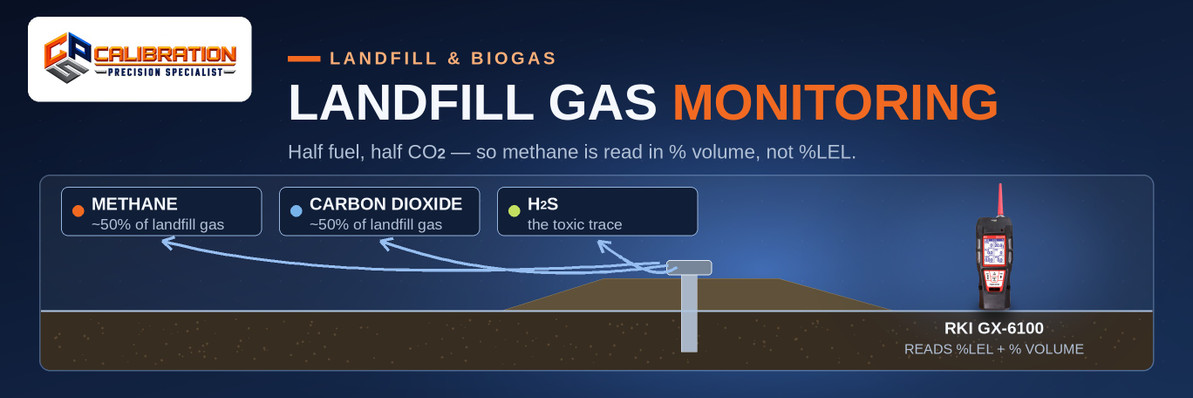
Landfill gas is roughly 50% methane and 50% carbon dioxide (EPA's Landfill Methane Outreach Program figure), and digester biogas runs 50–75% methane — concentrations thousands of times higher than a %LEL sensor is built to read, which is why landfill and biogas monitoring measures methane in % volume with infrared or thermal-conductivity sensors. Around those percentages sits the rest of the trio: hydrogen sulfide, from trace odor levels in landfill gas to thousands of ppm in raw biogas, and oxygen — watched in the gas system as the tell-tale of air leaking in, and in the plant's rooms as the first thing displaced gas takes away.
Every other application in gas detection is about contamination: a few ppm of this, a few percent of that, in air. Landfills and biogas plants run the problem backwards — the "contaminant" is the product, the background gas is itself flammable and oxygen-free, and the safety questions live at the boundaries: where the gas migrates, where it leaks into rooms, and where workers open it up. This guide covers the three gases together, the federal rule that sets the landfill numbers, and why the instrument choice for this work looks different from every other page of the catalog.
What's Actually in Landfill Gas and Biogas?
| Gas | Landfill gas | Raw digester biogas | Why it's monitored |
|---|---|---|---|
| Methane (CH₄) | ~50% | 50–75% | Flammable; migrates underground; the product itself |
| Carbon dioxide (CO₂) | ~50% | 25–50% | Displaces oxygen in rooms and low areas; process quality |
| Hydrogen sulfide (H₂S) | Trace — an odor and corrosion factor | A few hundred to several thousand ppm, feedstock-dependent | Toxic at ppm levels; corrodes engines and instruments |
| Oxygen (O₂) | Trace in the gas itself | Should stay under ~1–2% in the gas system | Air intrusion = explosion risk in pipework and a sick digester |
| NMOCs / VOCs | Under 1% (EPA) | Trace, varies | Odor, emissions and worker-exposure picture |
The landmark number is EPA's: landfill gas is "about 50 percent methane and 50 percent carbon dioxide," with less than 1% non-methane organic compounds and trace inorganics including hydrogen sulfide. Biogas from a purpose-built digester is richer — typically 50–75% methane against 25–50% carbon dioxide — and carries its signature impurity: H₂S generated from sulfur in the feedstock, which upgrading references put anywhere from near zero to several thousand ppm, with some streams far higher. Same three-gas problem, different proportions.
The Landfill Rule: 25% of LEL Inside, the Full LEL at the Fence
For municipal solid waste landfills, the federal floor is 40 CFR 258.23, EPA's explosive-gas criteria under RCRA Subtitle D. Owners and operators must ensure that:
- Methane does not exceed 25% of its lower explosive limit in facility structures (excluding the gas control and recovery equipment itself), and
- Methane does not exceed the lower explosive limit at the facility property boundary, and
- A routine methane monitoring program runs on a frequency set by soil, hydrogeologic and site conditions — with a minimum frequency of quarterly.
Put those in % volume, using methane's LEL of 5% by volume: the structure limit is 1.25% methane, the boundary limit is 5%. If a limit is exceeded, the rule requires immediate steps to protect human health, documentation in the operating record within seven days, and a remediation plan implemented within 60 days. States run approved programs that can be stricter, and the Clean Air Act layers its own collection-and-control requirements on larger landfills — but 258.23 is the number set every landfill operator's monitoring program is built around. In practice the quarterly program means probing the boundary monitoring wells and checking structures with a portable instrument — and the readings that matter there are in %LEL, because migrated gas at a boundary is gas already diluted a thousand-fold from its source.
Why %LEL Instruments Can't Do the Whole Job
A %LEL reading answers the question "how close to ignitable is this air?" Landfill gas asks a different question — "how much methane is in this gas?" — and the two scales only overlap at the dilute edge:
- Range. 50% methane is 1,000% of the LEL scale. A %LEL sensor driven there reads its maximum and stops being informative precisely where the process information lives.
- Oxygen. A catalytic bead burns the gas it's measuring, and below roughly 10% oxygen it can't — raw landfill gas and biogas carry almost no oxygen, so a catalytic sensor inside the gas stream under-reads or goes blind (the physics is covered in catalytic bead vs. infrared LEL sensors).
- The instruments that work here don't burn anything. An infrared methane sensor reads CH₄ by light absorption, indifferent to oxygen — and on RKI's GX-6100 platform it reads 0–100% LEL and 0–100% vol, so the same channel covers the boundary probe and the wellhead. A thermal-conductivity sensor goes further, reading combustible gas to 100% volume on a principle that doesn't care what the background gas is.
So the site runs both scales at once: % volume and %LEL by IR in the gas and at the wellfield, %LEL readings on diluted air at probes and in structures, and the standard four-gas core protecting the people doing the walking.
H₂S: The Toxic Passenger
Hydrogen sulfide is the gas that makes this industry respect ppm. In landfill gas it's a trace — the source of the rotten-egg signature around a site and a corrosion factor in gas handling. In raw biogas it is a headline component: commonly a few hundred to a few thousand ppm in the raw gas, against a worker-exposure world where OSHA's ceiling for H₂S is 20 ppm. The gap between those numbers is the monitoring plan:
- In the gas system, H₂S is measured at process scale — it drives scrubber sizing and engine warranties, because burning high-H₂S gas eats equipment.
- In the plant's rooms — engine halls, gas handling and upgrading skids, knockout and condensate points — H₂S is a fixed-detection gas at occupational scale: a leak from a flange in an enclosed hall is a worker-exposure event, monitored with fixed heads in the 0–100 or 0–500 ppm range.
- On the person, the standard four-gas portable covers H₂S alongside LEL and O₂ for wellfield rounds, flare and blower work, and any entry where landfill gas can collect — sumps, vaults and manholes around a site are confined spaces with a gas supply connected to them.
Oxygen Cuts Both Ways
Oxygen is the third channel because it fails in two directions. In the gas system, oxygen is the intruder: raw biogas should carry almost none, so a rising O₂ reading means air is being pulled in — through a wellfield under too much vacuum, a leaking seal, a cracked line — and air inside a pipe full of 60% methane builds an explosive mixture inside the equipment, on top of upsetting the anaerobic process itself. In the plant's air, oxygen is the victim: the gas stream is about half CO₂, and carbon dioxide is roughly 1.5 times as dense as air, so a raw-gas leak pools in pits, vaults and low rooms and pushes the breathable air out. A standard O₂ channel on the portable — and oxygen configurations on fixed heads in enclosed gas rooms — covers that second direction; the intrusion direction belongs to % volume instruments on the gas itself.
Which Instruments Fit Landfill and Biogas Work?
- RKI GX-6100 — the portable built for this split-scale work. Its infrared methane channel reads 0–100% LEL and 0–100% vol, a thermal-conductivity smart sensor reads combustible gas to 100% volume, and the standard core (LEL, O₂, CO, H₂S) still rides along for the worker-protection job. CPS lists 288 configurations from $2,040 for the standard 4-gas build to $5,207 fully loaded; the built-in pump pulls a sample from up to 100 ft away, which is how wells, probes and vaults get tested from the surface. Our GX-6100 spotlight notes landfill and perimeter monitoring as one of its design applications.
- SENKO SI-200E — the fixed layer for the plant's rooms: infrared methane 0–100% LEL for engine halls and gas rooms, H₂S at 0–100 or 0–500 ppm for treatment and handling areas, oxygen 0–30% vol where displacement is the risk — one gas per head, relays and 4–20 mA out to the plant system, from $950 (configured builds $1,092.50–$2,300). The full SI series comparison is in our SENKO fixed detector guide.
- Standard pumped portables for the quarterly boundary round — browse the pumped monitors range; the requirement that decides it is the %LEL reading at probe scale, on an instrument that gets bump-tested before it leaves the truck.
What Are the Honest Limits?
- This gas eats sensors. Landfill gas and raw biogas are saturated with water vapor, carry H₂S and siloxanes, and condense in sample lines. Catalytic beads get poisoned by sulfur and silicon compounds; every technology in the gas stream needs filtration, drainage and a calibration rhythm matched to abuse, not to the calendar alone.
- Quarterly readings are snapshots. The 258.23 program proves the boundary condition four times a year. Migration follows barometric pressure, soil moisture and wellfield balance between those snapshots — which is why structures get their own checks and why exceedances trigger the rule's documentation and remediation clock, not a note to check again next quarter.
- Fixed heads watch rooms, not wellfields. An engine hall SI-200E protects the hall. The wellfield, the flare yard and the boundary are portable-instrument territory — the two layers are complements, and neither substitutes for the gas collection system doing its job.
However the monitoring is instrumented, the calibration gas behind it has to match the scales in play — %LEL span gas for the safety channels, and instruments verified on the % volume ranges they report. Browse the calibration gas range, keep the boundary log with the same care as the readings themselves, and if your site's instruments are due, we calibrate every channel. Questions about landfill or biogas monitoring — call 865-900-8844.
Frequently Asked Questions
What gases are monitored at a landfill? Methane first — it's the explosive, migratory component, regulated at the boundary and in structures under 40 CFR 258.23. Alongside it: oxygen (displacement in vaults and structures, and air intrusion checks on the gas system), carbon dioxide (half the gas stream and a low-area asphyxiation factor), and hydrogen sulfide at ppm levels for worker protection, with VOC screening where the site requires it.
What is landfill gas made of? Roughly 50% methane and 50% carbon dioxide by volume, per EPA's Landfill Methane Outreach Program, with less than 1% non-methane organic compounds and trace amounts of nitrogen, oxygen and hydrogen sulfide. The near-even split is why landfill gas carries about half the heating value of natural gas — and why almost none of it can be measured on a %LEL scale.
What does 40 CFR 258.23 require for landfill methane? Two concentration limits and a monitoring program: methane must not exceed 25% of its lower explosive limit in facility structures, and must not exceed the lower explosive limit (100% LEL) at the facility property boundary. Monitoring must be routine, based on site conditions, and at minimum quarterly. An exceedance requires immediate protective steps, documentation in the operating record within 7 days, and a remediation plan within 60 days.
How often must landfill methane be monitored? At least quarterly, under 40 CFR 258.23 — the rule sets quarterly as the minimum frequency for the routine monitoring program, with the program's type and frequency adjusted for soil conditions, hydrogeology and the location of structures and boundaries. Individual state programs and site permits can require more.
Why is methane measured in % volume instead of %LEL at landfills and biogas plants? Because the gas itself is far above the %LEL scale: landfill gas at ~50% methane is 1,000% of LEL. %LEL answers "how close to ignitable is this air," which is the right question at a boundary probe or in a structure where gas has diluted. The process question — how much methane is in this stream — needs % volume, read by an infrared or thermal-conductivity sensor.
Can a catalytic LEL sensor measure landfill gas? Not the raw gas. A catalytic bead needs oxygen to burn the sample — below roughly 10% O₂ its readings collapse — and raw landfill gas and biogas carry almost none. Add H₂S and siloxanes, which poison catalytic beads, and the raw-gas measurement belongs to infrared and thermal-conductivity sensors. Catalytic %LEL still does its proper job on diluted gas in air: boundary rounds, structures and personal protection.
How much hydrogen sulfide is in biogas? It depends entirely on the feedstock's sulfur content. Published upgrading references put raw biogas H₂S anywhere from near zero to several thousand ppm, with some streams far higher — dairy and food-waste digesters commonly land in the hundreds-to-thousands of ppm. In landfill gas, by contrast, H₂S is a trace component — an odor and corrosion issue rather than a bulk constituent.
Why monitor oxygen at a biogas plant? For two opposite failures. Oxygen appearing in the raw gas means air is leaking in — an explosion risk inside the pipework and a poison to the anaerobic process. Oxygen disappearing from a room's air means the plant's own gas (CO₂ especially, which pools low) is displacing it — the asphyxiation risk in pits, vaults and enclosed gas rooms. One channel, two alarms' worth of meaning.
What instrument is used for landfill boundary monitoring? A pumped portable that reads methane in %LEL at probe scale — migrated gas at a boundary is already heavily diluted — and ideally % volume as well for wellfield work. The RKI GX-6100 is the fit in our line: infrared methane reading 0–100% LEL and 0–100% vol, a thermal-conductivity option to 100% volume, the standard O₂/CO/H₂S core, and a built-in pump drawing from up to 100 ft. CPS lists its configurations from $2,040.
Do biogas engine rooms need fixed gas detectors? Yes — an engine hall concentrates the plant's two leak hazards in one enclosed room: methane from gas train fittings (monitored with an infrared %LEL head) and hydrogen sulfide from any raw-gas leak (a toxic-gas head at 0–100 or 0–500 ppm). A SENKO SI-200E in either configuration lists from $950 at CPS, with relays to alarm and ventilate and 4–20 mA to the plant system. Raw-gas leaks in an unmonitored hall are discovered by people, which is the outcome fixed detection exists to prevent.
CPS Calibrations · 109 S. Front Street, Rockwood, TN 37854 · GX-6100 Spotlight · SI-200E · SENKO Fixed Gas Detectors · Catalytic vs. Infrared LEL · Calibration Gas · Contact Us
Need a calibration you can file?
In-house calibration at CPS in Rockwood, Tennessee — $55 for single-gas instruments, $90 for 4- and 5-gas — every channel, as-found and as-left data, full certificate.
See Calibration Servicesor call 865-900-8844
Recent Posts
-

What Is Remote Monitoring for Fixed Gas Detection?
Remote monitoring for fixed gas detection means a fixed system's live readings, trends, and alarm hi …Nov 23rd 2026 -

What Are the Key Differences Between the GX-6000 and GX-6100?
The RKI GX-6100 is the current replacement for the discontinued GX-6000: both are pumped 6-gas monit …Nov 22nd 2026 -

How to Read a PID Correction Factor Chart
To read a PID correction factor chart, find your vapor’s row, take the factor under your own lamp en …Nov 21st 2026