
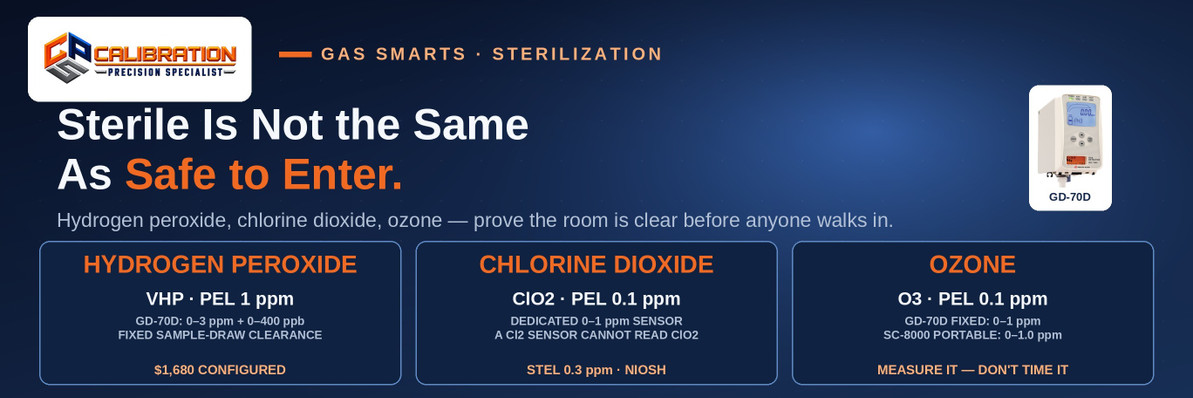
How Do You Monitor Hydrogen Peroxide, Chlorine Dioxide, and Ozone After Sterilization?
You monitor hydrogen peroxide, chlorine dioxide, and ozone after sterilization with dedicated low-ppm sensors — never a standard 4-gas meter — because the clearance job is proving the space has fallen back below the exposure limits: 1 ppm for hydrogen peroxide, 0.1 ppm for chlorine dioxide, and 0.1 ppm for ozone, after cycles that run at far higher concentrations.
Sterilization and disinfection cycles work because the gas is aggressive: vaporized hydrogen peroxide (VHP) fumigates cleanrooms, isolators, and medical-device chambers; chlorine dioxide decontaminates labs, food plants, and water systems; ozone disinfects rooms, water, and food-contact surfaces. Every one of those cycles ends the same way — with a room nobody should enter until the gas is gone. This post covers the three sterilant gases, the limits that define "gone," and the fixed and portable monitors that prove a space is safe to re-enter. It is a different subject from our look at gas detection in hospitals, which covered ethylene oxide sterilizers, nitrous oxide, and bulk oxygen — here the setting is pharmaceutical, device, and food sterilization and disinfection.
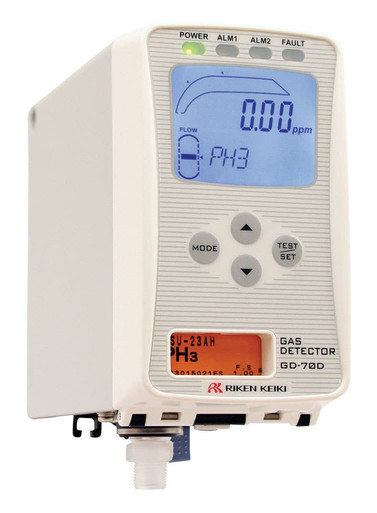
RKI GD-70D Sample Drawing Sensor / Transmitter For Toxic Gases
Sample-draw fixed transmitter with smart interchangeable sensors — hydrogen peroxide and ozone sterilant versions
$1,570–$4,460 configured
See the GD-70DWhy do sterilant gases need their own monitors?
Three reasons, and each one rules out the instruments already hanging in most plants. First, the gases are not on a standard monitor. A 4-gas meter measures combustible gas, oxygen, carbon monoxide, and hydrogen sulfide. Hydrogen peroxide, chlorine dioxide, and ozone are none of those — the meter will read a clean zero in a room that is still over the limit, which is worse than no reading at all. Second, the limits are low. The OSHA permissible exposure limits are 1 ppm for hydrogen peroxide and 0.1 ppm each for chlorine dioxide and ozone, as 8-hour averages. A sensor ranged for percent-level process gas cannot resolve tenths of a ppm at the clearance end, where the decision is actually made. Third, the cycle and the clearance are opposite measurements. During the cycle the concentration is deliberately far above the limit — that is what kills the microbes. The monitor's real job starts in aeration: tracking the fall, proving the endpoint, and documenting it. Specify the sensor for the clearance range first, and the cycle second.
The three sterilant gases, side by side
Hydrogen peroxide (H2O2), as VHP. Vaporized hydrogen peroxide is the workhorse of cleanroom and isolator decontamination and medical-device sterilization, and the GD-70D's own listing names the application: fumigation disinfection of medical facilities and pharmaceutical environments, including cleanrooms and production filling lines, plus chemical fogging for the food industry. OSHA PEL: 1 ppm. The clearance measurement needs a low-ppm electrochemical sensor; RKI's GD-70D line carries hydrogen peroxide versions at 0–3 ppm and a low-range 0–400 ppb version for proving very clean endpoints.
Chlorine dioxide (ClO2). A gas generated on site for decontamination of labs and biosafety areas, food-plant disinfection, and water treatment. It is a strong oxidizer that attacks the eyes and airways, and its limit is the lowest of the three: OSHA PEL 0.1 ppm, with a NIOSH short-term limit of 0.3 ppm. RKI publishes a 0–1.00 ppm chlorine dioxide range on its sterilant line — the right shape for the job, because the sensor range has to bracket 0.1 ppm with resolution to spare. One caution that matters at order time: chlorine dioxide is not chlorine. A Cl2 sensor does not measure ClO2, and the two are never interchangeable.
Ozone (O3). Generated on site for room disinfection, water treatment, and food storage and processing. Ozone does its work and then decays back to oxygen, which tempts people to trust the clock — but decay depends on temperature, humidity, and what the ozone is reacting with, so the safe endpoint is still a measurement. OSHA PEL: 0.1 ppm. RKI's GD-70D carries ozone versions at 0–1 ppm and 0–6 ppm, and the portable SC-8000 carries a 0–1.0 ppm ozone version for doorway checks.
Sterilize high, then prove it is safe: the aeration clearance check
Every sterilization cycle has the same four acts: condition, gas, dwell, aerate. Monitoring belongs to the fourth. During aeration the space is flushed with clean air — or, for ozone, simply allowed to decay under ventilation — and the concentration falls from cycle level toward the limit. The clearance check is the moment a reading at or below the exposure limit, taken where people will actually breathe, releases the room. Two disciplines make that check mean something. Measure, do not time. Aeration time varies with chamber size, load, temperature, and how much gas the load absorbed and is still giving back. A timer that was right for an empty chamber can be wrong for a full one; the sensor reading is the only version of "done" that accounts for the load. Document the endpoint. A logged clearance reading — gas, value, time, instrument — is the record that the re-entry was verified, and it is what a QA or EHS review will ask for. A fixed transmitter with data logging produces that record as a by-product of doing its job.
Fixed or portable: which monitor goes where?
Most sterilization areas end up with both, doing different jobs. A fixed sample-draw transmitter — the RKI GD-70D — watches the room itself. Its pump pulls a sample from inside the chamber, isolator, or room to the sensor at 0.5 L/min, so the transmitter, display, and sensor live outside the sterile space where they can be read and serviced. Its programmable low and high alarm relays and fault relay tie into the process: hold the door or the ventilation state until the reading clears, and alarm if aeration stalls. For hydrogen peroxide, the GD-70D's 0–3 ppm and 0–400 ppb versions are $1,680 configured, within a $1,570–$4,460 range across all 65 GD-70D configurations; the ozone 0–1 ppm version is also $1,680. A portable sample-draw monitor — the RKI SC-8000 — does the human check: sample from the doorway or through a port before entry, verify the breathing zone at working height, and spot-check adjacent areas where gas may have migrated. The SC-8000 carries hydrogen peroxide at 0–3 ppm and 0–0.500 ppm and ozone at 0–1.0 ppm, at $2,419 with alkaline batteries or $2,814 with the Li-ion pack. Our explainer on sample-draw gas detection with the GD-70D covers the sample-draw principle in depth. Use fixed when the same room cycles on a schedule and needs interlocks and records; use portable when one instrument must clear several rooms, or as the independent second check before a person goes in.
What about chlorine dioxide at CPS?
Plainly: the physics and the limits above are the same everywhere, but our current GD-70D and SC-8000 listings do not include a chlorine dioxide variant — we checked all 65 GD-70D and all 50 SC-8000 configurations before writing this post. If your process runs ClO2, you need a dedicated sensor specified for chlorine dioxide in the 0–1 ppm class (RKI publishes that range on its sterilant line), and you should confirm the exact instrument and sensor with us before ordering rather than assuming a chlorine version covers it. We would rather tell you that here than sell you a Cl2 instrument that cannot see your gas.
Placement, sampling, and the mistakes that read low
Sample where people breathe, and where gas pools. Hydrogen peroxide vapor and ozone are both heavier than air, and chlorine dioxide is much heavier — clearance samples belong at breathing height and at low points, door thresholds, and adjacent low areas, not only at the chamber exhaust. Respect the sample line. These are reactive gases: long, dirty, or wrong-material sample lines can absorb part of the sample on the way to the sensor, and the monitor will honestly report the lower number that arrived. Keep runs short, clean, and in the tubing material the manufacturer specifies, and allow for the transport delay before calling a reading final. Do not clear on the exhaust reading alone. The exhaust proves the flush is working; the room reading proves the room is safe. Watch the neighbors. Sterilant that migrates into a corridor, gowning room, or the space above a ceiling is the leak nobody sampled — a portable check of adjacent areas is cheap insurance.
How do you keep a sterilant sensor honest?
Electrochemical sterilant sensors work in a hard environment by design: the same reactivity that makes these gases sterilize also ages the sensor measuring them, and repeated high-concentration cycle exposure shortens sensor life compared with a sensor that only ever sees clearance levels. Practical rules: bump-check the clearance monitor on the schedule your program sets, calibrate with the correct gas at the correct concentration, and treat a sensor that is slow to recover after aeration as a sensor telling you it is tired. The GD-70D helps on the service side — its smart sensors retain their own calibration data and swap in seconds with no tools, and they can be calibrated away from the transmitter, so a sensor change does not mean opening up the sterile space. CPS calibrates gas detectors in-house in Rockwood, Tennessee — see calibration services for what a calibration includes.
Frequently Asked Questions
How do you monitor hydrogen peroxide vapor after sterilization?
With a dedicated low-ppm hydrogen peroxide sensor — fixed, portable, or both. A fixed sample-draw transmitter such as the RKI GD-70D (hydrogen peroxide versions 0–3 ppm and 0–400 ppb) watches the room through aeration and logs the endpoint; a portable sample-draw monitor such as the RKI SC-8000 checks the doorway and breathing zone before entry. The space is clear when the reading is at or below the 1 ppm OSHA limit where people will breathe.
What is the OSHA exposure limit for hydrogen peroxide vapor?
The OSHA permissible exposure limit for hydrogen peroxide is 1 ppm as an 8-hour time-weighted average. The ACGIH threshold limit value is also 1 ppm. Sterilization cycles run at concentrations far above that limit, which is why the aeration endpoint has to be measured rather than assumed.
What is the exposure limit for ozone?
The OSHA permissible exposure limit for ozone is 0.1 ppm as an 8-hour time-weighted average. Because ozone is generated on site and decays at a rate that depends on temperature, humidity, and the surfaces it reacts with, a fixed aeration time is not a safe substitute for a 0–1 ppm-range ozone reading at the point of entry.
What is the exposure limit for chlorine dioxide?
The OSHA permissible exposure limit for chlorine dioxide is 0.1 ppm as an 8-hour time-weighted average, and NIOSH sets a short-term exposure limit of 0.3 ppm. It is the lowest limit of the three common sterilant gases, so chlorine dioxide monitoring needs a dedicated low-range sensor — RKI publishes a 0–1.00 ppm range for it.
Can a standard 4-gas monitor detect hydrogen peroxide, chlorine dioxide, or ozone?
No. A standard 4-gas monitor measures combustible gas (%LEL), oxygen, carbon monoxide, and hydrogen sulfide. None of its four channels responds to hydrogen peroxide, chlorine dioxide, or ozone, so it will show no warning in a room that is still over the sterilant limit. Each sterilant gas needs its own dedicated sensor.
How long do you aerate after a VHP cycle before re-entering?
There is no universal safe time. Aeration depends on the chamber or room size, the load inside it, temperature, and how much peroxide the load absorbed and is still releasing. The correct clearance rule is a measurement, not a clock: re-enter when a hydrogen peroxide reading at breathing height is at or below the 1 ppm limit, and log that reading.
What sensor range do you need for sterilant gas monitoring?
A range that brackets the exposure limit with resolution below it. In practice that means 0–3 ppm or lower for hydrogen peroxide (limit 1 ppm), 0–1 ppm class for chlorine dioxide (limit 0.1 ppm), and 0–1 ppm for ozone (limit 0.1 ppm). A percent-level process sensor cannot resolve the tenths of a ppm where the re-entry decision is made.
Can you use a chlorine sensor to measure chlorine dioxide?
No. Chlorine (Cl2) and chlorine dioxide (ClO2) are different gases, and a sensor specified for one does not measure the other. Chlorine dioxide requires a sensor specified for ClO2 in a low range such as 0–1 ppm. Always confirm the exact target gas on the sensor specification before ordering.
Fixed or portable monitor for sterilization clearance — which do you need?
Fixed for a room that cycles on a schedule: it monitors through every aeration, drives door and ventilation relays, and logs the clearance record. Portable for clearing several rooms with one instrument and for the independent doorway check before entry. Many facilities use both — the RKI GD-70D fixed transmitter for the room and the RKI SC-8000 portable for the person about to walk in.
How much does a fixed hydrogen peroxide monitor cost?
The RKI GD-70D sample-draw transmitter in its hydrogen peroxide versions — 0–3 ppm and 0–400 ppb — is $1,680 configured on the CPS store. Across all 65 GD-70D gas configurations the configured range is $1,570–$4,460. The portable RKI SC-8000 with a hydrogen peroxide sensor is $2,814 in its Li-ion configuration.
The Bottom Line
A sterilization cycle is only finished when a sensor says so. Hydrogen peroxide clears to 1 ppm, chlorine dioxide and ozone to 0.1 ppm, and none of the three appears on a standard 4-gas meter — each needs a dedicated low-ppm sensor, ranged for the clearance decision rather than the cycle. Put a fixed sample-draw transmitter such as the GD-70D on the room for interlocks and a logged endpoint, back it with a portable SC-8000 doorway check, and be exact about chlorine dioxide: it needs its own ClO2 sensor, never a chlorine substitute. Measure the endpoint, log it, and the room is ready for people again.
Need a calibration you can file?
In-house calibration at CPS in Rockwood, Tennessee — $55 for single-gas instruments, $90 for 4- and 5-gas — every channel, as-found and as-left data, full certificate.
See Calibration Servicesor call 865-900-8844
Recent Posts
-

How Do You Monitor Hydrogen Peroxide, Chlorine Dioxide, and Ozone After Sterilization?
You monitor hydrogen peroxide, chlorine dioxide, and ozone after sterilization with dedicated low-pp …Nov 28th 2026 -

What Gas Detection Does a Semiconductor Fab Need? Exotic Toxics, Sample Draw, and the GD-70D
A semiconductor fab needs fixed gas detection that can measure its process toxics at and below their …Nov 27th 2026 -

What Is Connected Lone Worker Gas Detection? Live Readings, Man-Down, and Check-Ins
A connected lone worker gas detector does three things a stand-alone monitor cannot: it sends live g …Nov 26th 2026