
What Is Connected Lone Worker Gas Detection? Live Readings, Man-Down, and Check-Ins
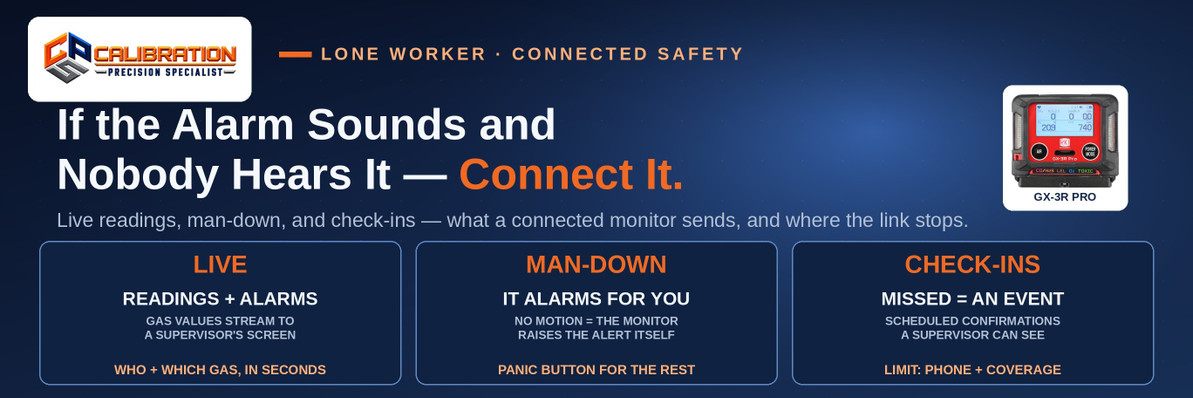
A connected lone worker gas detector does three things a stand-alone monitor cannot: it sends live gas readings and alarm events off the worker's body to a supervisor, it raises a man-down or panic alarm when the worker cannot, and it logs scheduled check-ins — on the RKI GX-3R Pro, that link is Bluetooth to a phone app, the instrument itself is a 5-gas monitor of about 4.58 oz with roughly 25 hours of rechargeable runtime, and the connection only works while the worker's phone is in Bluetooth range and has coverage.
A stand-alone gas monitor protects the person wearing it — it alarms, loudly, to an audience of one. That works until the one person who hears the alarm is the person the gas just took down. Connected lone worker detection exists for exactly that failure: the rounds operator in a far corner of the plant, the utility worker in a vault, the wastewater operator at a remote lift station at 2 a.m. This post explains what "connected" actually adds, what each feature does, and — just as important — where the connection stops working.
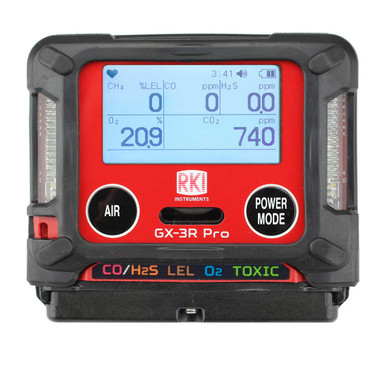
RKI GX-3R Pro 5-Gas Monitor – LEL, O2, CO, H2S + Toxic Gas
Bluetooth 5-gas personal monitor with man-down and panic alarms
$854.25–$1,338.75 configured
See the GX-3R ProWhat does a connected gas detector actually send?
Four things leave the instrument. Live readings: the current gas values stream to a supervisor's screen, so a rising H2S trend is visible before it becomes an alarm. Alarm events: when the monitor alarms, the alert goes out with the worker's identity — a supervisor learns who is in trouble and which gas did it, in seconds instead of at the next missed check-in. Man-down and panic alarms: covered below. Check-ins: the worker confirms they are all right on a schedule the program sets, and a missed check-in is itself an event someone sees. On RKI's Bluetooth instruments — the GX-3R Pro and the GX-6100 — the radio link is Bluetooth to a phone the worker carries, and the phone app (RKI's RK Link, and connected-worker platforms such as GuardHat on the GX-3R Pro) relays the data onward. The instrument's own job never changes: it still has to be bump tested, calibrated, and worn in the breathing zone, which is why the connected layer sits on top of the discipline in the GX-3R vs. GX-3R Pro comparison rather than replacing it.
How do man-down and panic alarms work?
They cover the two ways a worker ends up unable to call for help. A man-down alarm is automatic: the instrument watches for a period with no motion — the signature of a worker who has collapsed or been overcome — and raises the alarm itself, locally and through the connection. A panic alarm is deliberate: the worker presses and holds a button to summon help for a hazard the gas sensors cannot see — a fall, a medical event, a threatening situation, equipment trouble. The GX-3R Pro carries both, alongside its audible, visual, and vibration gas alarms. The honest detail: a man-down alarm is a motion inference, not a medical diagnosis. A worker who sets the instrument down, or works very still, can trip it — which is why programs tune the no-motion interval and train crews to cancel a false man-down promptly instead of learning to ignore it.
Connected portable vs. stand-alone portable vs. fixed wireless: which job is which?
Stand-alone portable — alarms to the wearer only. Right for crewed work where a buddy is always in earshot and a second set of lungs is the rescue plan. Connected portable — alarms to the wearer and reports to a supervisor. Right when anyone works alone, out of sight, or out of earshot, even for part of a shift. Fixed wireless detection — heads mounted on walls watch a space whether or not a person is in it; that is a different layer, covered in wireless fixed gas detection and RKI AirLink. Connected portables do not replace fixed points: the portable leaves with the worker, and the space is unwatched the moment they do — one of the gaps listed in the forgotten places plants forget to monitor.
What are the honest limits of connected gas detection?
Coverage is the chain, and the chain has two links. Bluetooth reaches from the instrument to the phone — a short-range link. The phone then needs cellular or Wi-Fi coverage to relay anything. Deep inside a steel structure, in a below-grade vault, or at a rural site with weak signal, the supervisor's screen can go quiet for reasons that have nothing to do with gas. The phone is part of the safety system now — it must be carried, charged, and have the app running; a dead phone battery ends the connection even though the monitor keeps protecting its wearer locally. Battery math changes: a GX-3R Pro runs about 25 hours on its rechargeable pack in normal monitoring; a radio that transmits all shift is part of that budget, so charging discipline matters more, not less. Location is phone-grade: the location context is the phone's position, which is weakest exactly where lone work often happens — indoors and below grade. Platforms cost money: connected-worker software is generally a subscription service on top of the instrument; price the program, not just the monitor, and ask what happens to your data and alerts if the subscription lapses. None of these limits argue against connecting lone workers. They argue for writing the dead-zone and dead-phone cases into the procedure before the first shift, not discovering them during an incident review.
Who actually needs connected lone worker monitoring?
Use this test: if this worker's monitor alarmed right now, who would know within a minute? If the honest answer is "nobody," the job is a connected-monitoring candidate. The classic cases: utility and wastewater rounds at unmanned stations, tank-farm and pipeline checks, a single operator on a night shift, maintenance in remote corners of a large plant, and any confined-space-adjacent work where the entrant is out of the attendant's direct sight. Crewed, line-of-sight work with a trained buddy system gains less — the second person is already the alarm relay. And connection is not a substitute for the rescue plan: an alert that reaches a supervisor who has no way to reach the worker, or no rescue capability when they get there, is a notification, not a rescue.
Frequently Asked Questions
What is connected lone worker gas detection?
Connected lone worker gas detection is a personal gas monitor that reports off the worker's body: live gas readings and alarm events go to a supervisor, man-down and panic alarms raise an alert when the worker cannot, and scheduled check-ins are logged. On the RKI GX-3R Pro the link is Bluetooth to a phone app; the monitor itself remains a full 5-gas personal instrument.
How does a man-down alarm work on a gas detector?
A man-down alarm watches the instrument's motion. If the monitor stays motionless for a set interval — the pattern of a worker who has collapsed or been overcome — it alarms locally and, on a connected instrument, sends the alert to a supervisor. It is a motion inference, not a medical sensor, so still work or a set-down instrument can trip it; programs tune the interval and train workers to cancel false alarms promptly.
What is a panic alarm on a gas monitor?
A panic alarm is a worker-triggered distress call: press and hold the button and the instrument sends a help alert through its connection. It covers emergencies the gas sensors cannot detect — falls, medical events, equipment accidents, or a threatening situation. The RKI GX-3R Pro includes both a panic alarm and an automatic man-down alarm.
Does OSHA require connected gas detectors for lone workers?
There is no OSHA standard that names connected or lone-worker gas detectors specifically. What exists is the underlying duty to protect employees from recognized hazards, plus industry guidance that a worker who cannot summon help is at greater risk when incapacitated. Connected monitoring is how many employers answer that duty for lone work — it is a program decision driven by the hazard assessment, not a product mandate.
How do supervisors see live gas readings from a worker?
On RKI's Bluetooth instruments, the monitor pairs to a phone the worker carries; the phone app relays readings and alarm events onward to the supervisor's view. The GX-3R Pro pairs over Bluetooth and works with RKI's RK Link app and connected-worker platforms such as GuardHat. The supervisor sees what the phone can send — which is why the phone's coverage and charge are part of the system.
What happens if the worker's phone dies or loses signal?
The gas monitor keeps working as a stand-alone instrument — it still senses gas and alarms audibly, visually, and by vibration to the wearer. What is lost is everything off-body: live readings, remote alarm alerts, man-down relay, and check-ins. Programs that rely on the connection treat a charged phone with the app running as part of the pre-shift check, alongside the bump test.
Does Bluetooth gas detection work in confined spaces?
The monitor works in the space; the connection is the question. Bluetooth is a short-range link to the worker's phone, and below-grade or steel-enclosed spaces can block both the Bluetooth relay and the phone's cellular signal. For permit entries, the attendant and the entry procedure remain the primary safeguard — treat any live remote view as a bonus layer, never as the attendant's replacement.
How much does connected gas detection cost?
The instrument side is the monitor itself: the RKI GX-3R Pro is $854.25–$1,338.75 configured on the CPS store, depending on the fifth-gas sensor and battery options chosen. Connected-worker software platforms are generally subscription services priced separately from the instrument, and terms vary by platform — get the platform cost in writing before comparing a connected program against stand-alone monitors on instrument price alone.
Which RKI monitors have Bluetooth?
Among the personal monitors CPS sells, the GX-3R Pro and the GX-6100 carry Bluetooth; the standard GX-3R does not — that radio, the fifth gas channel, and the man-down and panic alarms are exactly what separate the Pro from the base model. Both Bluetooth models still bump test and calibrate like any other RKI portable, including on the SDM-3R docking station.
Can a connected monitor replace a confined space attendant or a rescue plan?
No. A connected monitor notifies; it does not rescue. Confined space entries still require the attendant, the entry permit, and a retrieval or rescue plan under the entry procedure, and lone-worker programs still need a defined response — who gets the alert, how fast they can reach the worker, and what they can do when they arrive. The alert shortens the time to know. The plan decides what happens next.
The Bottom Line
A stand-alone monitor's alarm has an audience of one, and lone work is precisely where that one person may not be able to act on it. Connected detection fixes the audience problem — live readings, alarm events, man-down and panic alerts, and check-ins reaching a supervisor — at the honest price of depending on a phone, its coverage, and a platform subscription. Put connected monitors on the workers nobody would hear, write the dead-zone cases into the procedure, and keep the bump tests, calibrations, and rescue plans exactly as disciplined as they were before the radio arrived. CPS calibrates the GX-3R Pro and GX-6100 in-house like every other instrument we sell — see calibration services.
Need a calibration you can file?
In-house calibration at CPS in Rockwood, Tennessee — $55 for single-gas instruments, $90 for 4- and 5-gas — every channel, as-found and as-left data, full certificate.
See Calibration Servicesor call 865-900-8844
Recent Posts
-

How Do You Monitor Hydrogen Peroxide, Chlorine Dioxide, and Ozone After Sterilization?
You monitor hydrogen peroxide, chlorine dioxide, and ozone after sterilization with dedicated low-pp …Nov 28th 2026 -
What Gas Detection Does a Semiconductor Fab Need? Exotic Toxics, Sample Draw, and the GD-70D
A semiconductor fab needs fixed gas detection that can measure its process toxics at and below their …Nov 27th 2026 -

What Is Connected Lone Worker Gas Detection? Live Readings, Man-Down, and Check-Ins
A connected lone worker gas detector does three things a stand-alone monitor cannot: it sends live g …Nov 26th 2026