
The Forgotten Places: 7 Spots Plants Forget to Monitor
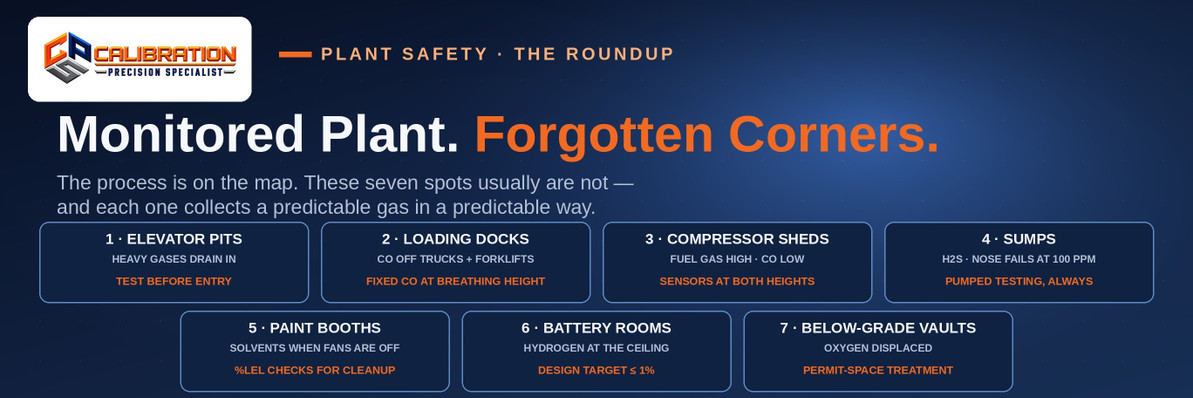
The seven spots plants most often forget to monitor are elevator pits, loading docks, compressor sheds, sumps, paint booths, battery rooms, and below-grade vaults — each with a predictable gas and a predictable failure: hydrogen sulfide settling into sumps and pits (NIOSH ceiling 10 ppm, IDLH 100 ppm), carbon monoxide building at docks (OSHA limit 50 ppm), hydrogen collecting at battery-room ceilings (flammable at 4%), and oxygen displaced in below-grade vaults (deficient below 19.5%). The pattern is identical in every spot: the gas follows its density, the people follow their routine, and no instrument is stationed where the two meet.
Plant gas detection maps are usually drawn around the process — the reactor, the tank farm, the compressor row. What they miss is the support geography: the below-grade, behind-the-door, entered-twice-a-year places where gas collects quietly and people arrive unannounced. This roundup walks the seven we find unmonitored most often, in the format that matters for each: the gas, why it collects there, who walks in, and the fix. If you are building the map from scratch, start with how to build a gas detection program — then check it against this list.
1. Elevator Pits — Where Everything Heavy Drains
The gas: whatever is heaviest in the building — CO2, refrigerant vapors, propane, solvent vapors, sewer gas with its hydrogen sulfide. Why it collects: a pit is the lowest enclosed point in its part of the plant, and gases denser than air (propane at 1.52 relative density, CO2 at 1.53, H2S at 1.19) flow downhill and stay. The pit also concentrates the ordinary hazards of below-grade work: displaced oxygen and whatever the sump pump was supposed to remove. Who walks in: elevator technicians and maintenance staff, on a work order, often alone, often treating it as a mechanical job rather than an atmospheric one. The fix: evaluate the pit as a confined space (many are permit-required), test before entry with a pumped instrument from outside — oxygen, %LEL, toxics — and treat any pit below a chemical or refrigeration area as a fixed-monitoring candidate. The rule that saves lives here is procedural: the pit gets tested like a vessel, because atmospherically, it is one.
2. Loading Docks — Carbon Monoxide With a Delivery Schedule
The gas: carbon monoxide from truck exhaust and propane-powered forklifts, plus propane itself at floor level from any forklift fuel leak. Why it collects: docks are semi-enclosed by design — trailers seal against the building, doors stay shut in winter, and engines idle at the door. CO (relative density 0.97) does not layer; it mixes through the breathing zone and builds with run time, worst on cold mornings when every door is closed and every engine is warming up. Who walks in: the highest-traffic population in the plant — shipping staff, drivers, pickers — almost none of whom carry a personal monitor. The fix: fixed CO detection at breathing height on the dock wall, alarmed against the real numbers — OSHA's 50 ppm TWA limit, NIOSH's 35 ppm recommended limit and 200 ppm ceiling — plus an idle policy the detectors exist to enforce. A dock is not a low-hazard area; it is an engine room with freight in it.
3. Compressor Sheds — Two Gases, Two Heights
The gas: the fuel or process gas the compressors move — natural gas in most plants — and carbon monoxide from any engine-driven unit. Why it collects: sheds are small, weather-tight, and ventilated (if at all) for temperature, not for gas. Methane (0.55) rises and collects at the roof peak and in the rafters; CO mixes at breathing height. A sensor at one height misses the other gas entirely. Who walks in: operators on rounds and mechanics on breakdowns — the breakdown visit being the dangerous one, because a shed full of gas and a mechanic with tools is an ignition source arriving on schedule. The fix: fixed detection at both heights — combustible sensing high for the fuel gas, CO at breathing level where engines run — with alarms that report outside the door, so the reading is known before the door opens. Compressor sheds are also the classic case for tying detection to ventilation and shutdown relays: the alarm should start the fan and drop the fuel solenoid, not just make noise inside a room nobody is in.
4. Sumps — Hydrogen Sulfide's Home Address
The gas: hydrogen sulfide from wastewater and decaying organics, plus oxygen displacement by CO2 and methane from the same biology. Why it collects: H2S (1.19) settles into the lowest point, and a sump is a gas generator with walls — agitation during pumping or cleaning releases dissolved H2S in bursts, which is why sumps kill during maintenance rather than during quiet standing. The cruel detail: H2S deadens the sense of smell at high concentrations — NIOSH warns that olfactory fatigue sets in around the IDLH of 100 ppm — so "it stopped smelling bad" at a sump is an emergency sign, not an improvement. The exposure numbers are tight: NIOSH ceiling 10 ppm, OSHA ceiling 20 ppm, IDLH 100 ppm. Who walks in: maintenance and wastewater staff, often for pump work that requires leaning into the space. The fix: treat every sump as a permit-space candidate; test from outside with a pumped instrument before and during entry work; fixed H2S sensing at low level where entries are frequent; and a standing rule that a sump is never entered on the evidence of a nose.
5. Paint Booths — Safe While Spraying, Forgotten While Cleaning
The gas: solvent vapors — combustible, read as %LEL — from coatings, thinners, and cleaning solvents. Why it collects: a booth under spray ventilation moves enormous air and is the safest version of itself; the forgotten exposures happen when the fans are off — gun cleaning, booth wash-down, filter changes, and maintenance entry — when evaporating solvent pools in the booth, its exhaust pit, and connected low spots, unventilated. Who walks in: painters doing cleanup (routine, unmonitored, often solo) and maintenance staff entering a booth that "hasn't sprayed in hours." The fix: portable %LEL verification before and during cleaning and entry tasks — combustible atmospheres are hazardous above 10% of the lower flammable limit — ventilation running for cleanup work, not just spray work, and fixed LEL detection where booths sit over pits or connect to enclosed rooms. The booth's engineered safety covers one mode of operation; the program has to cover the other modes by name.
6. Battery Rooms — Hydrogen at the Ceiling
The gas: hydrogen, off-gassed by lead-acid batteries on charge — hardest during equalize and end-of-charge. Why it collects: hydrogen (0.07) is the lightest gas in the plant and pools against the ceiling and in any unventilated pocket above the racks — precisely where nobody looks and where light fixtures and fan motors live. Hydrogen is flammable from 4% by volume; sound design keeps the room at or below 1% (25% of the flammable limit), with ventilation doing the work and detection supervising it. OSHA's powered-industrial-truck standard requires charging areas to have adequate ventilation for dispersal of fumes from gassing batteries — detection is how you prove the ventilation is keeping up, and catch the day it doesn't. Who walks in: forklift operators and battery technicians, usually briefly — but the ignition risk doesn't need a person present at all. The fix: hydrogen sensing at ceiling level, alarms that start exhaust fans (and can shut down chargers), and ventilation verified against the design target — we wrote the dedicated version of this one: hydrogen monitoring in battery rooms.
7. Below-Grade Vaults — The Permit Space Nobody Re-Evaluated
The gas: oxygen displacement first — by CO2, nitrogen, methane, or whatever the vault's pipes and soil contribute — with H2S and combustibles close behind in utility and wastewater vaults. Why it collects: a vault is a confined space by construction: limited entry, no continuous occupancy, no natural ventilation, and a direct connection to the underground systems most likely to leak gas into it. Levels change with weather, groundwater, and upstream work. Who walks in: utility, electrical, and instrumentation crews — frequently contractors, frequently on a schedule set by someone who has never been in the vault. The fix: the full confined-space treatment, refreshed rather than assumed — evaluate and classify the vault under 1910.146, test before entry (oxygen first, then flammables, then toxics) with a pumped instrument, ventilate, permit, attendant, rescue plan. Vaults are where the "we've entered it a hundred times" argument goes to die: the atmosphere on entry 101 owes nothing to the previous hundred.
What Do the Seven Spots Have in Common?
Three things. Gravity and geometry: every spot is low, high, small, sealed, or below grade — a place where a gas of some density can win against ventilation. Intermittent people: entries are brief, routine, and often solo, so nobody's personal monitor history covers the space, and a bad atmosphere meets an unaccompanied worker. Map blindness: the process hazard analysis drew the process; nobody walked the building asking "where would gas sit?" Do that walk — pit, dock, shed, sump, booth, battery room, vault — with this list in hand, and station fixed detection where entries are frequent, pumped pre-entry testing where they are rare, and a calibrated portable multi-gas monitor on the people who make them. Every instrument you place inherits the same discipline as the rest of your fleet — bump checked before use, calibrated on schedule — and if the bench work is the bottleneck, CPS calibrates ship-in instruments at $55 single-gas and $90 for 4- and 5-gas, and services installed fixed systems on-site, quoted in writing. Call 865-900-8844.
Frequently Asked Questions
What places do plants most commonly forget to monitor for gas?
The same seven recur across industries: elevator pits, loading docks, compressor sheds, sumps, paint booths, battery rooms, and below-grade vaults. They share a profile — physically suited to collecting gas (below grade, ceiling pockets, small sealed rooms), entered briefly and routinely by people who don't carry monitors, and absent from the process-centered hazard map. The gases are predictable per spot: H2S in sumps, CO at docks, hydrogen in battery rooms, displaced oxygen in vaults.
Why are elevator pits a gas hazard?
Because a pit is the lowest enclosed point around, and gases heavier than air — propane (1.52 relative density), CO2 (1.53), hydrogen sulfide (1.19), most refrigerant and solvent vapors — flow down and pool there, displacing oxygen as they accumulate. Elevator technicians enter pits on mechanical work orders, often alone and unmonitored. Pits should be evaluated as confined spaces, tested from outside with a pumped instrument before entry, and considered for fixed monitoring when they sit below chemical, refrigeration, or fuel areas.
How much carbon monoxide builds up at a loading dock?
Enough to matter on ordinary operations: idling trucks at sealed dock doors and propane forklifts working a closed dock in winter both feed CO into a semi-enclosed volume, and CO mixes through the breathing zone rather than layering. The limits it is judged against are OSHA's 50 ppm 8-hour limit and NIOSH's 35 ppm recommended limit with a 200 ppm ceiling. Fixed CO detection at breathing height — not a personal monitor on one employee — is the standard answer, paired with an enforced no-idle policy.
Why do sumps produce hydrogen sulfide?
Wastewater and decaying organic material generate H2S biologically, and it dissolves into the liquid and collects in the air space above it; pumping, agitation, and cleaning release it in bursts. H2S is heavier than air (1.19) and settles into the sump. The exposure limits are low — NIOSH ceiling 10 ppm, OSHA ceiling 20 ppm, IDLH 100 ppm — and at high concentrations H2S fatigues the sense of smell, so the odor fading is a danger sign. Sumps are tested from outside with a pumped instrument, never judged by nose.
Do paint booths need gas monitoring if they are ventilated?
While spraying, a booth's ventilation is its protection. The gap is every other mode: solvent cleaning, wash-down, filter changes, and maintenance entry, often with fans off, when evaporating solvent can build a combustible atmosphere in the booth and its low connected spaces. Programs cover those modes with portable %LEL verification (combustible atmospheres are hazardous above 10% of the lower flammable limit), ventilation running during cleanup, and fixed LEL detection where booths connect to pits or enclosed rooms.
Where should a hydrogen sensor be mounted in a battery room?
High — at ceiling level and over the racks. Hydrogen's relative density is 0.07, making it the lightest common industrial gas; it rises and pools against ceilings and in unventilated pockets above the batteries, which is also where fixtures that could ignite it tend to be. Room design targets hydrogen at or below 1% by volume (25% of its 4% flammable limit), with detection supervising the ventilation and alarming to start exhaust fans or shut down chargers.
Are below-grade vaults always permit-required confined spaces?
Not automatically — classification depends on the hazards the evaluation finds — but vaults should be presumed candidates and evaluated under 29 CFR 1910.146 rather than assumed safe. They are confined by construction (limited entry, no continuous occupancy, no natural ventilation) and connected to underground systems that can fill them with oxygen-displacing or toxic gas. Where a hazardous atmosphere can exist, the permit-space duties follow: pre-entry testing (oxygen, then flammables, then toxics), ventilation, attendant, and rescue arrangements.
How do you decide between fixed detection and portable testing for a forgotten spot?
By entry frequency and source continuity. A spot with a continuous source or frequent entries (battery rooms, compressor sheds, busy docks) earns fixed detection with alarms that report outside the space. A spot entered rarely under controlled conditions (vaults, pits, sumps) is usually covered by disciplined pumped pre-entry testing under a permit — provided the discipline is real: trained testers, calibrated instruments, documented results. The failure mode to avoid is the middle ground: rare entries with neither fixed detection nor a working permit habit.
What is the cheapest way to start monitoring a forgotten spot?
Start with the evaluation and the test, not the installation: classify the space, take pumped pre-entry readings across conditions (charging vs. idle, spraying vs. cleaning, winter doors-closed vs. summer), and let the data size the fix. Many spots resolve to a portable-testing procedure and signage; the ones with real readings get fixed instruments. Every instrument in the answer still needs calibration — CPS's published in-house rates are $55 for a single-gas instrument and $90 for 4- and 5-gas instruments, with ship-in service at the same rates.
How often should forgotten-spot monitoring be reviewed?
Whenever anything about the spot changes — new batteries or chargers, a new coating line, a changed dock routine, a vault's upstream process modified — and on the same review cycle as the rest of the gas detection program. Forgotten spots are forgotten precisely because nothing prompts a second look; tying them to the program's periodic review (and to confined-space program review, which uses a year's worth of entry permits) is what keeps them on the map.
The Bottom Line
Plants monitor their processes and forget their geography: elevator pits, loading docks, compressor sheds, sumps, paint booths, battery rooms, and below-grade vaults collect gas by density and design, and meet workers who arrive briefly, routinely, and unmonitored. Walk the building with this list, test what you find, and station the instrument — fixed or pumped-portable — where the gas and the people actually meet.
Want a second set of eyes on the walk? CPS Calibrations helps East Tennessee plants find the forgotten spots, spec the detection, and keep every instrument calibrated — call 865-900-8844. 109 S. Front Street, Rockwood, TN 37854.
CPS Calibrations · 109 S. Front Street, Rockwood, TN 37854 · Calibration Services · The CPS Calibration Program · Portable Multi-Gas Monitors
Need a calibration you can file?
In-house calibration at CPS in Rockwood, Tennessee — $55 for single-gas instruments, $90 for 4- and 5-gas — every channel, as-found and as-left data, full certificate.
See Calibration Servicesor call 865-900-8844
Recent Posts
-

What Is Remote Monitoring for Fixed Gas Detection?
Remote monitoring for fixed gas detection means a fixed system's live readings, trends, and alarm hi …Nov 23rd 2026 -

What Are the Key Differences Between the GX-6000 and GX-6100?
The RKI GX-6100 is the current replacement for the discontinued GX-6000: both are pumped 6-gas monit …Nov 22nd 2026 -

How to Read a PID Correction Factor Chart
To read a PID correction factor chart, find your vapor’s row, take the factor under your own lamp en …Nov 21st 2026