
RKI GX-3R vs. GX-3R Pro: Which One Fits Your Crew?
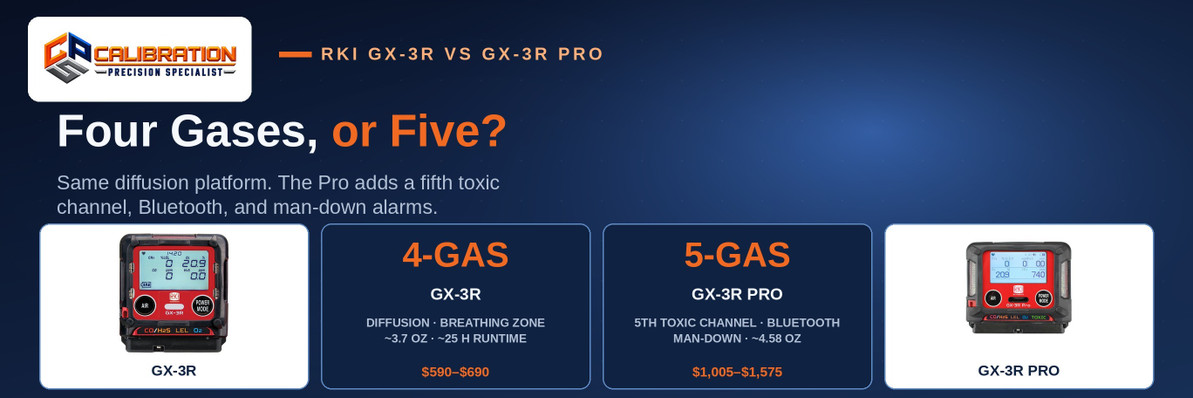
The GX-3R and GX-3R Pro are the same diffusion platform in the same size class — the difference is one channel and one radio: the GX-3R ($590–$690) reads the standard four gases (LEL, O₂, CO, H₂S), while the GX-3R Pro ($1,005–$1,575) adds a swappable fifth toxic-gas channel, Bluetooth live readings, and man-down and panic alarms. If your hazard assessment names only the standard four, the GX-3R is the complete instrument; if it names a fifth gas — or your crews work alone — the Pro is the one that fits, and there is no upgrade path from one to the other later.
RKI built these two as siblings, and on a spec sheet they look like a trim levels question. They are not: they are a hazard-assessment question. This comparison walks what is genuinely shared, what the Pro actually adds (with the configured prices, not the headline), and how to decide crew by crew. If your real question is diffusion versus a pumped instrument, that decision is separate — see GX-3R vs. GX-Force.
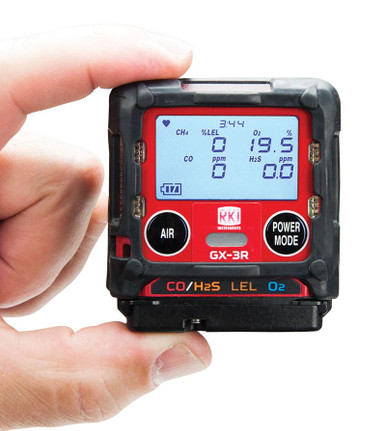
RKI GX-3R 4-Gas Monitor – LEL, O₂, CO & H₂S
Same shell, different instrument: GX-3R 4-gas diffusion is $590–$690; the GX-3R Pro adds a fifth toxic channel, Bluetooth, and man-down alarms at $1,005–$1,575. The crew-fit guide.
$590–$690 configured
See the GX-3RWhat Is the Same on the GX-3R and GX-3R Pro?
More than the price gap suggests. Both are diffusion instruments worn in the breathing zone, both read the standard confined-space four — LEL 0–100%, oxygen 0–40.0% vol., carbon monoxide 0–2,000 ppm, hydrogen sulfide 0–200.0 ppm — and both carry the same IP66/68 dust- and water-resistant case, the same roughly 25-hour rechargeable Li-ion runtime (about a 3-hour recharge), audible/visual/vibration alarms, and RKI's 3-year warranty. Both dock on the same SDM-3R docking and calibration station ($1,322), both take a clip-on pump for pre-entry sampling (RP-3R, $369 for the GX-3R; RP-3R Pro, $367 for the Pro), and both calibrate in-house at CPS for the same flat $90. Size is close, too: about 3.70 oz for the GX-3R with its boot, about 4.58 oz for the GX-3R Pro.
What Does the GX-3R Pro Add?
Three things, and only three — but each one is hardware, not a setting:
- A fifth, swappable toxic channel alongside the standard four: ammonia (0–400 ppm), hydrogen cyanide (0–30 ppm), nitrogen dioxide (0–20 ppm), phosphine (0–20 ppm), sulfur dioxide (0–100 ppm), or carbon dioxide by infrared (0–10,000 ppm or 0–10% vol.).
- Bluetooth wireless communication, sending live readings to RKI's phone app — a supervisor or attendant can watch the numbers without standing at the worker's shoulder.
- Man-down and panic alarms — the lone-worker layer: the instrument calls attention when a worker stops moving, and the worker can summon help with the panic function.
The Pro also offers an alkaline battery option alongside the rechargeable Li-ion pack. One honest cost of the fifth channel: fit the infrared CO₂ sensor and runtime drops from about 25 hours to about 16 hours, because the IR sensor draws more power.
What Do the GX-3R and GX-3R Pro Actually Cost?
Configured prices, read from the live variants on each product page — quote these, not the headline numbers:
| Build | Configured price | What moves it |
|---|---|---|
| GX-3R (4-gas) | $590–$690 | Charger package only: $590 no charger · $640 standard VAC charger · $690 VAC + 12 VDC combinations |
| GX-3R Pro, no fifth sensor | $1,005–$1,155 | Charger and battery package |
| GX-3R Pro, toxic fifth sensor | from $1,260 ($1,284 with standard VAC charger) | NH₃, HCN, NO₂, PH₃, or SO₂ channel fitted |
| GX-3R Pro, infrared CO₂ | from $1,425 ($1,449 with standard VAC charger) to $1,575 | CO₂ IR channel fitted |
Ownership costs stay close: the core sensors are shared (LEL and O₂ $160 each, the CO/H₂S combo sensor $255, all field-replaceable), the Pro's fifth toxic sensor is $255 and its CO₂ IR sensor $420, and calibration is $90 flat for either instrument in-house at CPS. Budget the fifth channel's consumable honestly: a Pro bought for ammonia readings will eventually need that $255 ammonia sensor replaced, on top of the standard four.
Which One Fits Your Crew?
Fit the GX-3R when the hazard assessment names the standard four gases and nothing else — the classic confined-space and personal-monitoring fleet. It is the lighter instrument (about 3.7 oz), the cheaper instrument by roughly $400–$900 a unit, and nothing about it is a compromise for four-gas work: same case rating, same runtime, same dock. Crews in diffusion monitors for routine entry and plant rounds are this instrument's home ground.
Fit the GX-3R Pro when any one of these is true: the assessment names a fifth gas (ammonia refrigeration, HCN, NO₂, PH₃, SO₂, or CO₂ in beverage/brewery and greenhouse work are the usual ones); crews work alone or out of sight, where man-down and panic alarms earn their keep; or a supervisor needs live readings off the instrument via Bluetooth. One caution that decides fleets: a GX-3R cannot be upgraded into a Pro — the fifth channel, radio, and alarms are Pro hardware, and RKI offers no conversion. If a fifth gas is even a likely future requirement, buy the Pro first; a fleet of GX-3Rs bought this year is a fleet that gets replaced, not upgraded, when the assessment changes.
Both sit in the wider portable multi-gas monitors range, and both are instruments we sell, calibrate, and repair. We calibrate every channel — including the Pro's fifth — through calibration services, in-house at Rockwood or shipped in.
Frequently Asked Questions
What is the difference between the RKI GX-3R and GX-3R Pro?
One channel and one radio. Both are diffusion monitors reading LEL (0–100%), O₂ (0–40.0% vol.), CO (0–2,000 ppm), and H₂S (0–200.0 ppm) in an IP66/68 case with about 25 hours of Li-ion runtime and a 3-year warranty. The Pro adds a swappable fifth toxic channel (NH₃, HCN, NO₂, PH₃, SO₂, or IR CO₂), Bluetooth live readings to RKI's app, and man-down and panic alarms. The GX-3R is about 3.70 oz; the Pro about 4.58 oz.
How much does the RKI GX-3R cost?
$590–$690 at CPS Calibrations, depending only on the charger package: $590 with the Li-ion pack and no charger, $640 with the standard 100–240 VAC charger, $690 with the VAC and 12 VDC vehicle charger combinations. The gas configuration is the standard four on every build.
How much does the RKI GX-3R Pro cost?
$1,005–$1,575 configured. A Pro with no fifth sensor fitted is $1,005–$1,155 depending on charger and battery package. With a toxic fifth sensor (NH₃, HCN, NO₂, PH₃, or SO₂), builds start at $1,260 ($1,284 with the standard VAC charger). With the infrared CO₂ sensor, builds start at $1,425 ($1,449 with the standard charger) and reach $1,575.
What fifth gases can the GX-3R Pro detect?
One swappable fifth channel alongside the standard four: ammonia 0–400 ppm, hydrogen cyanide 0–30 ppm, nitrogen dioxide 0–20 ppm, phosphine 0–20 ppm, sulfur dioxide 0–100 ppm, or carbon dioxide by infrared at 0–10,000 ppm or 0–10% volume. The instrument reads five gases at once — the four standard channels plus whichever fifth sensor is fitted.
Can a GX-3R be upgraded to a GX-3R Pro?
No. They are separate instruments and RKI offers no conversion kit — the fifth sensor channel, Bluetooth radio, and man-down/panic alarms are Pro hardware. If a fifth gas is a likely future requirement, buy the Pro first; a GX-3R fleet cannot be upgraded in place when the hazard assessment changes.
How long do the GX-3R and GX-3R Pro batteries last?
About 25 hours per charge on the rechargeable Li-ion pack for both, with about a 3-hour recharge. Two exceptions, stated honestly: a Pro fitted with the infrared CO₂ sensor runs about 16 hours, because the IR sensor draws more power, and the Pro also offers an alkaline battery option for crews that cannot always get to a charger.
Do the GX-3R and GX-3R Pro use the same docking station?
Yes — the SDM-3R docking and calibration station ($1,322) bump-tests and calibrates both models, so a mixed fleet needs one dock platform. For pumped pre-entry sampling, each takes its own clip-on pump: the RP-3R ($369) for the GX-3R and the RP-3R Pro ($367) for the Pro.
What do GX-3R and GX-3R Pro replacement sensors cost?
The core four are shared: LEL and O₂ sensors are $160 each and the combined CO/H₂S sensor is $255. The Pro's fifth channel costs $255 for any toxic sensor (NH₃, HCN, NO₂, PH₃, SO₂) and $420 for the infrared CO₂ sensor. All are field-replaceable — sensor swaps do not require sending the instrument in.
How much does it cost to calibrate a GX-3R or GX-3R Pro?
$90 flat, in-house at CPS Calibrations, for either instrument — the 4- and 5-gas rate covers the Pro's fifth channel too, with a 3–5 business-day turnaround. Ship-in calibration is billed at the same rate. On-site work at your facility is quoted in writing and costs more than bench work.
Which should I buy, the GX-3R or the GX-3R Pro?
Match the hazard assessment. If it names only LEL, O₂, CO, and H₂S, buy the GX-3R — it is lighter (about 3.7 oz vs. 4.58 oz) and $400–$900 less per unit with the same case, runtime, dock, and calibration cost. If it names a fifth gas, or your crews work alone and need man-down/panic alarms, or a supervisor needs Bluetooth live readings, buy the Pro — and buy it first, because the GX-3R cannot be upgraded later.
The Bottom Line
The GX-3R ($590–$690) is the complete four-gas diffusion monitor; the GX-3R Pro ($1,005–$1,575) is the same platform plus a swappable fifth toxic channel, Bluetooth, and man-down/panic alarms. Everything else — case, runtime, dock, calibration cost — is shared. Let the hazard assessment decide: four gases named, buy the 3R; a fifth gas or lone workers named, buy the Pro, because there is no upgrade path between them.
Outfitting a crew and not sure which side of that line you are on? Call CPS Calibrations at 865-900-8844 — monitors, calibration, and the CPS Calibration Program behind them, from Rockwood, Tennessee.
CPS Calibrations · 109 S. Front Street, Rockwood, TN 37854 · Calibration Services · The CPS Calibration Program
Need a calibration you can file?
In-house calibration at CPS in Rockwood, Tennessee — $55 for single-gas instruments, $90 for 4- and 5-gas — every channel, as-found and as-left data, full certificate.
See Calibration Servicesor call 865-900-8844
Recent Posts
-

How Long Do Gas Detector Sensors Last?
Gas detector sensors do not share one lifespan: a traditional galvanic oxygen sensor typically lasts …Nov 16th 2026 -

The 15-Minute Weekly Gas Detection Checklist for Supervisors
A weekly gas detection check takes a supervisor about 15 minutes and covers four things: every instr …Nov 15th 2026 -

Calibration Gas for PID Instruments: Isobutylene and the 100 ppm Standard
A PID is calibrated on 100 ppm isobutylene — not on the gas you are measuring — because the instrume …Nov 14th 2026