
RKI GX-3R vs. GX-Force: Diffusion on the Collar vs. Pumped in the Hand
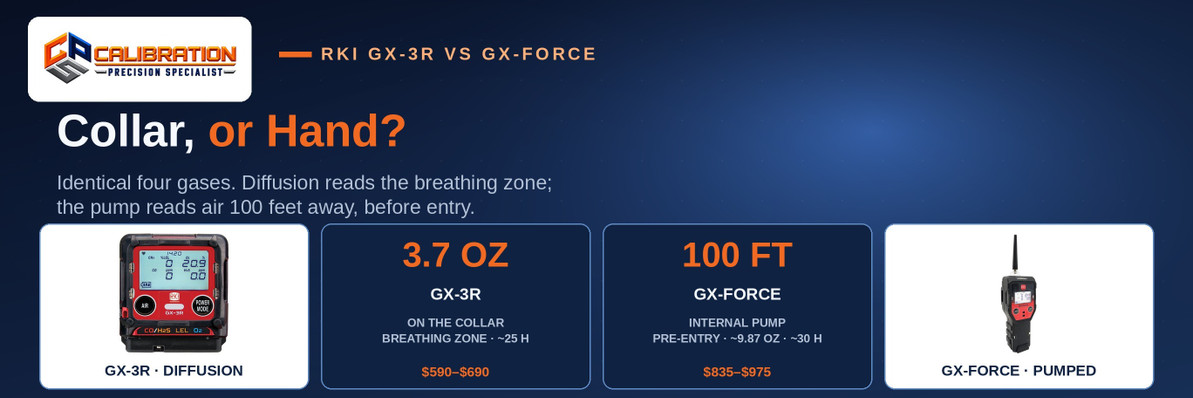
The GX-3R and GX-Force read the identical four gases at the identical ranges — what separates them is how the sample reaches the sensors: the GX-3R ($590–$690) is a diffusion monitor that rides on the collar at about 3.7 oz and reads the air in the worker's breathing zone, while the GX-Force ($835–$975) carries an internal pump that draws a sample from up to 100 feet away, so a space can be tested before anyone enters it. Personal monitoring all shift long is diffusion work; pre-entry testing and remote sampling are pumped work — and the two jobs are different enough that many crews own both.
This is the product-level version of the oldest decision in portable gas detection, laid out in full in pumped vs. diffusion gas detectors. Here it is narrowed to the two RKI instruments that embody it — the GX-3R and the GX-Force — with specs and configured prices from the live store records. (If instead you are choosing between the GX-3R and its five-gas sibling, that is GX-3R vs. GX-3R Pro.)
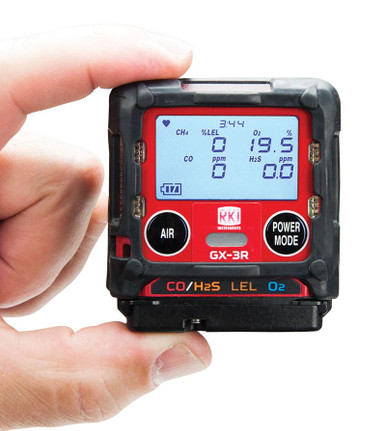
RKI GX-3R 4-Gas Monitor – LEL, O₂, CO & H₂S
Same four gases, opposite sampling: GX-3R diffusion rides the collar at 3.7 oz ($590–$690); GX-Force pumps from 100 ft in the hand ($835–$975). Which sampling job is yours?
$590–$690 configured
See the GX-3RWhat Is Identical on the GX-3R and GX-Force?
The measurement itself. Both read LEL 0–100%, oxygen 0–40.0% vol., carbon monoxide 0–2,000 ppm, and hydrogen sulfide 0–200.0 ppm, with response times in the same class (T90 within 30 seconds on the GX-3R; within 30 seconds for CH₄, O₂, CO, and H₂S on the GX-Force). Both log data, alarm audibly, visually, and by vibration, use field-replaceable sensors, carry a 3-year warranty, and calibrate in-house at CPS for the same flat $90. Choosing between them changes nothing about what the numbers mean — it changes where the air comes from.
How Does Diffusion Sampling Work on the GX-3R?
A diffusion instrument has no pump: gas reaches the sensors by natural movement through the sensor membrane, so the instrument reads the air immediately around it — which is why it is worn in the breathing zone, on the collar or chest. That design is what makes the GX-3R about 3.70 oz with its boot: no pump, no hose, nothing to carry in the hand, about 25 hours per Li-ion charge (about a 3-hour recharge), and an IP66/68 case. Its strength is honesty about exposure — it measures what the worker is actually breathing, continuously, all shift. Its limit is the same fact: it can only read air that has already reached the worker. Walked up to a manhole, a diffusion GX-3R tells you about the air at the rim where you are standing — not the air at the bottom where the work is.
How Does Pumped Sampling Work on the GX-Force?
The GX-Force's internal pump (nominal 0.5 L/min) pulls air through a hose and probe from up to 100 feet away and delivers it to the same four sensors. That inverts the sequence: the attendant tests the space first — top, middle, and bottom — and the entrant goes in only after the readings say the air is acceptable, then keeps monitoring with the instrument in hand. The pumped design costs size and weight (about 9.87 oz, IP67 case) and buys two extra abilities beyond pre-entry testing: sampling remote points a worker cannot wear an instrument into, and a Leak Check Mode for hunting combustible-gas leaks at valves and piping. Runtime is about 30 hours in Normal Mode (about 20 in Leak Check Mode), with about an 8-hour USB-C recharge. Configured prices run $835–$975, set by the charger package and the hose-and-probe length (none, or 5–20 feet).
Which Jobs Belong to Which Instrument?
Diffusion (GX-3R) jobs: all-day personal monitoring, routine plant rounds, entry work where a pumped pre-entry test has already been done by the attendant's instrument, and any fleet where a 3.7 oz collar instrument is the difference between a monitor that gets worn and one that gets left in the truck. It is the default diffusion monitor for a reason.
Pumped (GX-Force) jobs: confined-space pre-entry testing, sampling tanks, vaults, and manholes from outside, leak investigation, and any reading that has to come from somewhere the worker is not. A diffusion-only fleet cannot do this work with the instrument on someone's collar — the reading and the worker arrive at the hazard at the same time.
The honest middle: the GX-3R is not locked out of pumped work — RKI's RP-3R clip-on pump ($369) snaps onto it for occasional pre-entry sampling. But "occasional" is the operative word: a crew that pumps every day carries the pump, hose, and filters as separate pieces to charge, assemble, and lose. The GX-Force exists because daily pumped work wants the pump built in. Conversely, nothing stops a GX-Force serving as a personal monitor — it is simply 6 oz heavier and $245+ dearer per unit for a job the GX-3R does at 3.7 oz.
Both live in the portable multi-gas monitors range alongside the other pumped monitors, and we sell, calibrate, and repair both. We calibrate every channel through calibration services — $90 flat in-house for either instrument, shipped in or walked in.
Frequently Asked Questions
What is the difference between the RKI GX-3R and GX-Force?
Sampling. Both read LEL (0–100%), O₂ (0–40.0% vol.), CO (0–2,000 ppm), and H₂S (0–200.0 ppm). The GX-3R is a diffusion monitor — no pump, about 3.70 oz, worn in the breathing zone, $590–$690, about 25 hours per charge. The GX-Force has an internal pump that draws a sample from up to 100 feet away — about 9.87 oz, carried in the hand, $835–$975, about 30 hours in Normal Mode — for pre-entry testing, remote sampling, and leak checking.
Can a diffusion GX-3R test a confined space before entry?
Not by itself — a diffusion instrument reads only the air around it, so at the rim of a space it reports the rim's air, not the atmosphere inside. With RKI's RP-3R clip-on pump ($369) or a hand aspirator fitted, a GX-3R can draw a pre-entry sample. Crews that pump daily usually choose the GX-Force, whose pump is built in.
How far away can the GX-Force sample from?
Up to 100 feet, through its hose and probe, at a nominal pump flow of 0.5 L/min (minimum suction 0.35 L/min). Configured builds offer no hose, or 5, 10, 15, or 20 feet of hose and probe as standard options, and the pump is rated for the full 100-foot sampling range.
Which is better for personal monitoring, the GX-3R or GX-Force?
The GX-3R. Personal monitoring means wearing the instrument in the breathing zone for the whole shift, and at about 3.70 oz with no hose, the diffusion GX-3R is the one that stays on the collar. The GX-Force can monitor a worker, but it is about 9.87 oz of handheld instrument — the right tool when the pump is the point, extra weight when it is not.
Which is better for confined space entry, the GX-3R or GX-Force?
They split the job. The GX-Force does the pre-entry test from outside the space — that requires a pump, full stop. The GX-3R does continuous personal monitoring on the entrant once inside. A complete entry setup often uses both roles; a one-instrument crew doing entries should start with the pumped GX-Force, because the pre-entry test is the step that cannot be improvised.
How long do the GX-3R and GX-Force batteries last?
The GX-3R runs about 25 hours per Li-ion charge with about a 3-hour recharge. The GX-Force runs approximately 30 hours in Normal Mode and about 20 hours in Leak Check Mode, with about an 8-hour recharge over USB-C. The pump does not cost the GX-Force runtime — its larger pack more than covers the pump's draw.
How much do the GX-3R and GX-Force cost?
The GX-3R is $590–$690 configured — the spread is charger packages only. The GX-Force is $835–$975 configured — the spread is the charger package plus hose-and-probe length (adding a 5- to 20-foot hose and probe adds $70–$85). Both read the same four gases on every build.
Do the GX-3R and GX-Force measure the same gases?
Yes — identical channels at identical ranges: LEL 0–100%, O₂ 0–40.0% vol., CO 0–2,000 ppm, H₂S 0–200.0 ppm. Neither reads a fifth gas; if your assessment names one, the comparison changes entirely — see the GX-3R Pro (diffusion, five gases) or the GX-6100 (pumped, up to six).
How much does it cost to calibrate a GX-3R or GX-Force?
$90 flat, in-house at CPS Calibrations, for either instrument, with a 3–5 business-day turnaround; ship-in calibration is billed at the same rate. On-site work at your facility is quoted in writing and costs more than bench work. Pumped instruments earn a practical note: bring the hose and filters with the GX-Force, because a weak pump or clogged filter is a sampling fault a bench calibration alone will not catch.
Should I buy the GX-3R or the GX-Force?
Buy the job, not the instrument. If the instrument's work is riding a worker's collar all shift, buy the GX-3R — lighter, cheaper, same readings. If its work is testing spaces before entry, sampling remote points, or hunting leaks, buy the GX-Force — the pump is not optional for that work. If both jobs are daily work for the same crew, the honest answer is both instruments, one per role.
The Bottom Line
Same four gases, same ranges, same $90 calibration — opposite sampling. The GX-3R ($590–$690, ~3.7 oz) is diffusion: it reads the breathing zone it rides in, and nothing else. The GX-Force ($835–$975, ~9.87 oz) is pumped: it reads air up to 100 feet away, before anyone breathes it. Personal monitoring belongs on the collar; pre-entry testing belongs to the pump — and confusing the two is how a monitor ends up measuring the wrong air beautifully.
Deciding how your crew samples — or equipping for both roles? Call CPS Calibrations at 865-900-8844 — monitors, calibration, and the CPS Calibration Program behind them, from Rockwood, Tennessee.
CPS Calibrations · 109 S. Front Street, Rockwood, TN 37854 · Calibration Services · The CPS Calibration Program
Need a calibration you can file?
In-house calibration at CPS in Rockwood, Tennessee — $55 for single-gas instruments, $90 for 4- and 5-gas — every channel, as-found and as-left data, full certificate.
See Calibration Servicesor call 865-900-8844
Recent Posts
-

How Long Do Gas Detector Sensors Last?
Gas detector sensors do not share one lifespan: a traditional galvanic oxygen sensor typically lasts …Nov 16th 2026 -

The 15-Minute Weekly Gas Detection Checklist for Supervisors
A weekly gas detection check takes a supervisor about 15 minutes and covers four things: every instr …Nov 15th 2026 -

Calibration Gas for PID Instruments: Isobutylene and the 100 ppm Standard
A PID is calibrated on 100 ppm isobutylene — not on the gas you are measuring — because the instrume …Nov 14th 2026