
What Gas Detection Does a Semiconductor Fab Need? Exotic Toxics, Sample Draw, and the GD-70D
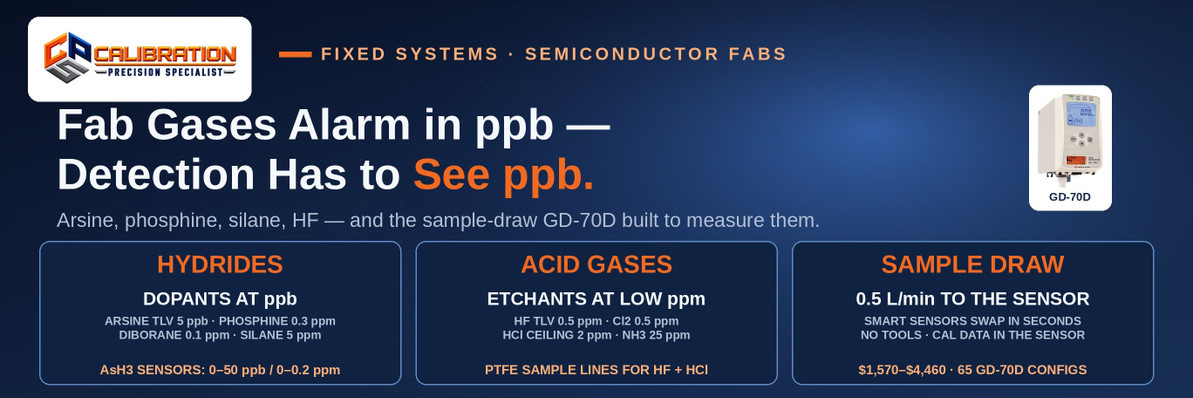
A semiconductor fab needs fixed gas detection that can measure its process toxics at and below their exposure limits — arsine at a 5 ppb TLV, phosphine at 0.3 ppm, diborane at 0.1 ppm, and hydrogen fluoride at 0.5 ppm — which is why fabs use sample-draw systems like the RKI GD-70D: its pump pulls air from the gas cabinet, tool, or duct to one smart sensor at 0.5 L/min, instead of waiting for a leak to reach a wall-mounted point sensor.
A wafer fab runs gases most plants never stock. The dopants, etchants, and deposition gases that make chips work are toxic at levels a standard 4-gas monitor cannot even resolve — and several of them are dangerous in parts per billion. This post lays out which gases a fab has to watch, why the limits sit so low, how sample-draw detection answers the problem, and how the RKI GD-70D is built for exactly this work. It is a companion to our look at PureAire universal gas detectors, a different fixed-detection approach for a different set of gases and spaces — this post stays on the semiconductor problem specifically.
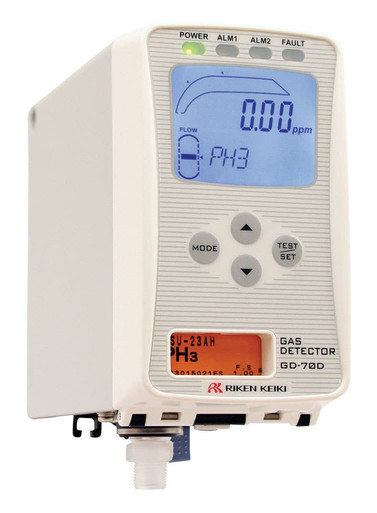
RKI GD-70D Sample Drawing Sensor / Transmitter For Toxic Gases
Sample-draw fixed transmitter with smart interchangeable sensors for ppm and ppb toxics
$1,570–$4,460 configured
See the GD-70DWhich gases does a semiconductor fab have to monitor — and why are the limits so low?
The fab gas list falls into families, and each family is there because a process step needs it. Hydride dopant and deposition gases: arsine (AsH3), phosphine (PH3), diborane (B2H6), silane (SiH4), and germane (GeH4) — used for doping and film deposition. Acid and etch gases: hydrogen fluoride (HF), hydrogen chloride (HCl), chlorine (Cl2), fluorine (F2), nitrogen trifluoride (NF3), and chlorine trifluoride (ClF3). Bases and others: ammonia (NH3) for nitride deposition, plus ozone, hydrogen cyanide, and a long tail of specialty chemicals. Now the limits, from RKI's GD-70D detectable-gas table, which lists the ACGIH TLV-TWA beside each range: arsine 5 ppb, diborane 0.1 ppm, hydrogen selenide 0.05 ppm, phosphine 0.3 ppm, chlorine 0.5 ppm, hydrogen fluoride 0.5 ppm, silane 5 ppm, ammonia 25 ppm, with hydrogen chloride carried as a ceiling limit of 2 ppm. Read that arsine number again: a detector that reads in whole ppm is a thousand times too coarse for the gas. Detection in a fab is not a scaled-down version of ordinary plant detection — it is a different measurement class, and the instrument has to be specified range-first: the sensor's range must bracket the TLV with resolution to spare, or the alarm can only sound after the limit is long past.
Sample draw vs. point diffusion: which belongs in a fab?
A point (diffusion) detector waits for gas to reach it. It is simple, has no pump or tubing to maintain, and works well in open areas where a leak will drift across the sensor. A sample-draw (extractive) detector goes and gets the air: a pump pulls a continuous sample through tubing from a chosen point to the sensor. Fabs lean on sample draw for four concrete reasons. The sample point can go where the sensor cannot — inside a gas cabinet, at a tool's exhaust or valve manifold box, or in a duct — while the transmitter sits outside at eye level, readable and serviceable without entering the controlled space. The measurement point is exact: you sample the cabinet or the tool, not the room the leak might eventually fill. Response is not left to air currents in a cleanroom engineered to move air in deliberate, filtered paths. One service point: the sensor lives in the transmitter, so calibration and sensor changes happen at the unit, not up a ladder inside a cabinet. The honest costs: tubing runs have to be installed correctly (RKI specifies 4 x 6 mm PTFE tubing for the GD-70D), the pump is a wear item, long runs add transport time between the leak and the reading, and reactive gases such as HF and HCl demand the right tubing material so the sample survives the trip. Our earlier post, RKI GD-70D sample-draw gas detection explained, covers the sample-draw principle in general; the sections below apply it to the fab.
How does the RKI GD-70D work?
The GD-70D is RKI's sample-draw smart transmitter. Its long-life, high-capacity pump draws the sample at 0.5 L/min with automatic flow adjustment, and pump flow is self-tuning. The sensing element is a smart sensor: it stores its own calibration and sensor-specific data in non-volatile memory, it can be replaced in seconds with no tools, and it can be hot-swapped in the field with no programming, because every GD-70D base unit is identical and the firmware automatically corrects for long-term zero and span drift. That sensor memory carries a practical maintenance dividend — a sensor can be calibrated separately from the transmitter, so calibration gas does not have to travel to the field location. RKI builds the platform on four sensor families: electrochemical (ESU) for the toxic-gas list, semiconductor (SGU), pyrolysis-particle (SSU), and catalytic combustion (NCU) for LEL versions, with hydrogen-specific versions in the range as well. On the CPS store the GD-70D is configured in 65 variants at $1,570–$4,460, most toxic-gas versions at $1,680 — arsine at 0–0.2 ppm and at 0–50 ppb, phosphine at 0–1 ppm, diborane at 0–0.3 ppm, silane at 0–2 ppm and 0–15 ppm, HF at 0.4–3 ppm and 0.4–9 ppm, HCl at 0–6 ppm and 0–15 ppm, chlorine at 0–1.5, 0–3, and 0–10 ppm, ammonia at 0–75 ppm, and NF3 at 0–30 ppm among them. The transmitter itself is compact — about 2.8 x 4.7 x 5.9 inches and roughly 2.0 lb, on 24 V DC — with a large integral LCD, a tri-color bar graph for alarm status, programmable low and high alarm relays plus a fault relay, and 4–20 mA communication on the base model. It runs stand-alone, ties into a PLC, or integrates with RKI's Beacon single- and multi-channel controllers. One transmitter carries one sensor and watches one sample point for one gas — fab coverage is built by deploying transmitters per gas and per point, not by asking one box to do everything.
Where do sample points go in a fab?
Place the draw point where the gas is contained, handled, or exhausted — in leak order. Gas cabinets and gas rooms: sample inside the cabinet and at the cylinder connection, where a fitting leak starts. Valve manifold boxes and gas distribution lines: the junctions where lines split toward tools. At the tool: the process chamber's foreline and exhaust interface, and the tool's gas box. Scrubbers and abatement: sample at the inlet to confirm what is arriving and downstream to confirm the abatement is actually removing it — a scrubber that has stopped scrubbing is silent without a sensor behind it. Breathing zone near the hazard: a point at working height near where technicians break lines or change cylinders covers the people, not just the plumbing. Two placement rules follow from the chemistry: keep tubing runs as short as the layout allows, because every foot adds delay, and use the specified PTFE tubing for the acid gases so HF and HCl are not absorbed on the way to the sensor. Phosphine deserves its own note because it shows up in both doping and fumigation work — our background post on what phosphine is covers the gas itself in depth.
How are sample-draw fab detectors calibrated and maintained?
The GD-70D was designed to shrink this workload. Because the smart sensor holds its own calibration data, a sensor can be calibrated away from the transmitter and then installed — the transmitter needs no programming to accept it, and a sensor swap in the field takes seconds with no tools. The firmware's automatic zero and span drift correction stretches stability between calibrations, and the self-tuning pump removes flow adjustment from the routine list. What remains on the maintenance schedule is real: verify pump flow and the fault relay path, inspect and periodically replace sample tubing and filters (fab air is clean, but acid-gas lines age), response-check each point end-to-end so a blocked line cannot hide behind a healthy sensor, and calibrate each sensor on its manufacturer's schedule with the correct span gas at the correct range — a 0–50 ppb arsine sensor is not calibrated with a ppm-range cylinder. Keep the records per point: in a fab, the calibration file is part of the life-safety system's audit trail, not paperwork for its own sake. CPS handles calibration in-house at Rockwood for the instruments we sell — see calibration services — and every channel is calibrated as configured, with as-found and as-left data on the certificate.
How do you choose fab gas detection? Selection criteria
Range against TLV, first. For each gas, the sensor range must sit close enough to the exposure limit to alarm at it — arsine at 0–50 ppb or 0–0.2 ppm against a 5 ppb TLV is the pattern to copy. One gas, one point, one transmitter: budget per monitored point, and put points at cabinets, tools, and scrubber outlets before open-room coverage. Sample draw where the gas is contained — cabinets, ducts, and enclosures — and point diffusion for open-area backstop coverage; most fabs run both layers. Outputs that reach the tool and the fab system: relays that shut the gas down and a 4–20 mA or controller signal the facility system can act on; a detector that only beeps in an empty gas room has not finished the job. Serviceability in a gowned environment: tool-free, seconds-long sensor swaps and bench-calibratable sensors cut the time technicians spend working on the safety system itself. Total cost per point: the GD-70D's $1,570–$4,460 configured range is the transmitter; tubing, installation, controller channels, and calibration gas belong in the same budget line.
Frequently Asked Questions
What gas detection does a semiconductor fab need?
A semiconductor fab needs fixed detection ranged to its process gases' exposure limits: sample-draw monitoring at gas cabinets, tools, and scrubber outlets for hydrides such as arsine (5 ppb TLV), phosphine (0.3 ppm), diborane (0.1 ppm), and silane (5 ppm), plus acid gases such as HF (0.5 ppm), HCl (2 ppm ceiling), and chlorine (0.5 ppm) — with relays and signals tied into the facility system so a detection shuts the gas down, not just sounds an alarm.
Which toxic gases are used in semiconductor manufacturing?
The core list is the hydrides — arsine, phosphine, diborane, silane, and germane — used in doping and deposition; acid and etch gases — hydrogen fluoride, hydrogen chloride, chlorine, fluorine, nitrogen trifluoride, and chlorine trifluoride; and ammonia for nitride deposition, alongside ozone, hydrogen, and process-specific specialty gases. Each is monitored where it is stored, distributed, used, and scrubbed.
Why does arsine need ppb gas detection?
Arsine's ACGIH TLV-TWA is 5 ppb — five parts per billion — as listed in RKI's GD-70D detectable-gas table. A detector ranged in whole ppm cannot alarm at that limit. That is why the GD-70D offers arsine sensors ranged 0–50 ppb and 0–0.2 ppm: the range has to bracket the TLV with resolution below it, or the instrument is decoration.
What is sample draw gas detection?
Sample-draw gas detection uses a pump to pull air continuously through tubing from a chosen point to a sensor in the transmitter, instead of waiting for gas to diffuse to the sensor. On the RKI GD-70D the draw is 0.5 L/min with automatic flow adjustment. It lets one transmitter sample inside a gas cabinet, tool, or duct while sitting outside the space at eye level for reading and service.
Is sample draw or diffusion better for semiconductor fabs?
Sample draw is better where the gas is contained — cabinets, valve manifold boxes, tool exhausts, and scrubber outlets — because the point is exact and the transmitter stays accessible. Diffusion points are better as open-area backstop coverage, with no pump or tubing to maintain. Most fabs run both: sample draw on the contained hazards, diffusion points watching the room.
What gases can the RKI GD-70D detect?
One smart sensor at a time, chosen from 65 configurations on the CPS store: arsine (0–50 ppb and 0–0.2 ppm), phosphine (0–1 ppm), diborane (0–0.3 ppm), silane (0–2 and 0–15 ppm), germane, hydrogen selenide, hydrazine, HF, HCl, HBr, chlorine, fluorine, NF3, ammonia, ozone, hydrogen peroxide, and more, plus hydrogen-specific and LEL versions. The sensor — electrochemical, semiconductor, pyrolysis-particle, or catalytic, by gas — stores its own calibration data and swaps in seconds with no tools.
How much does the RKI GD-70D cost?
The RKI GD-70D is $1,570–$4,460 configured on the CPS store across its 65 variants, with most toxic-gas versions at $1,680; the nitrous oxide infrared version sits at the top of the range at $4,460. That is the transmitter with its chosen sensor — tubing, installation, and any controller channels are separate, and coverage is one gas at one sample point per transmitter.
Where should gas detectors be placed in a semiconductor fab?
At the containment, in leak order: inside gas cabinets and at cylinder connections, at valve manifold boxes, at the tool's gas box and exhaust interface, and at scrubber inlets and outlets to prove abatement is working — plus breathing-zone points where technicians change cylinders or break lines. Sample-draw points should keep tubing runs short and use PTFE tubing for acid gases such as HF and HCl.
How often does a GD-70D need calibration?
On each sensor's manufacturer schedule — there is no honest single interval for a platform covering this many gases and sensor types. The GD-70D reduces the work around calibration: smart sensors retain their calibration data, can be calibrated separately from the transmitter, and swap in seconds with no tools or programming, and the firmware corrects long-term zero and span drift between calibrations. End-to-end response checks of each sample line belong on the same schedule.
Can one GD-70D monitor several gases at once?
No. One GD-70D carries one smart sensor and monitors one gas at one sample point. Fab-wide coverage is a system of transmitters — one per gas and point that matters — reporting to a PLC or a multi-channel controller such as RKI's Beacon series. That one-gas focus is also what allows ranges like 0–50 ppb arsine: the sensor is built and ranged for a single target.
The Bottom Line
Semiconductor gas detection is a measurement problem before it is an alarm problem: when the limit for arsine is 5 ppb and phosphine's is 0.3 ppm, the detector has to be ranged for the limit, placed at the containment, and able to prove itself on a calibration record. Sample draw is how fabs get the sensor's reach into cabinets, tools, and scrubber lines while keeping the transmitter where people can read and service it, and the GD-70D's smart-sensor design — hot-swappable in seconds, calibration data carried in the sensor, 65 configurations at $1,570–$4,460 — is built for that pattern. Start with the gas list and the TLVs, put a point on every cabinet, tool, and scrubber outlet that carries them, and tie every point to a shutdown the facility can act on.
Need a calibration you can file?
In-house calibration at CPS in Rockwood, Tennessee — $55 for single-gas instruments, $90 for 4- and 5-gas — every channel, as-found and as-left data, full certificate.
See Calibration Servicesor call 865-900-8844
Recent Posts
-

How Do You Monitor Hydrogen Peroxide, Chlorine Dioxide, and Ozone After Sterilization?
You monitor hydrogen peroxide, chlorine dioxide, and ozone after sterilization with dedicated low-pp …Nov 28th 2026 -

What Gas Detection Does a Semiconductor Fab Need? Exotic Toxics, Sample Draw, and the GD-70D
A semiconductor fab needs fixed gas detection that can measure its process toxics at and below their …Nov 27th 2026 -

What Is Connected Lone Worker Gas Detection? Live Readings, Man-Down, and Check-Ins
A connected lone worker gas detector does three things a stand-alone monitor cannot: it sends live g …Nov 26th 2026