
What Is Phosphine (PH3) and Why Do Fumigators Monitor It?
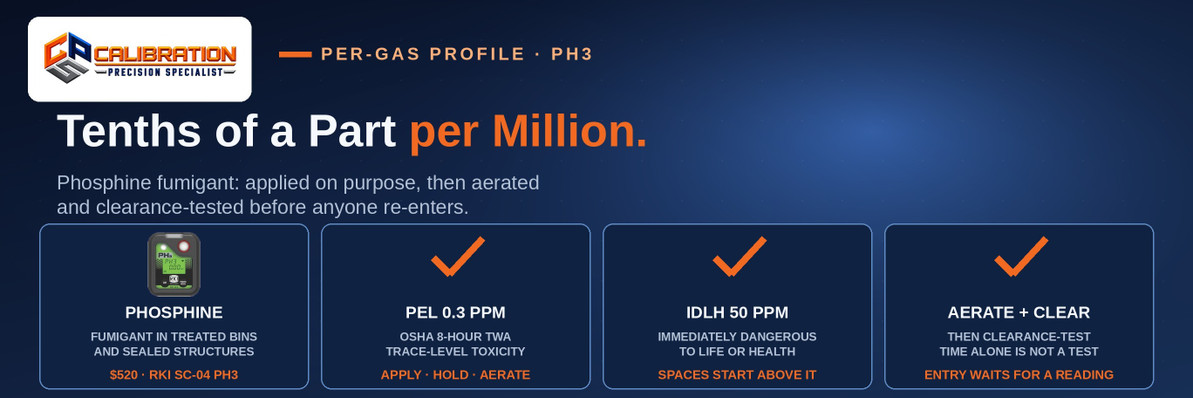
Phosphine (PH3) is a fumigant gas generated inside sealed bins, containers, and structures to kill insects in stored grain and commodities. It is monitored because it is toxic at trace levels: OSHA's exposure limit is 0.3 ppm as an 8-hour average and 50 ppm is immediately dangerous to life or health (IDLH) — so fumigators track it during application, through aeration, and in the clearance test that decides when a space can be re-entered.
Most workplace gases are accidents — leaks, byproducts, things that escape. Phosphine is the opposite: a professional applies it on purpose, seals the space, and lets chemistry do pest control no spray can match. That deliberate use is exactly why its monitoring discipline is the strictest in the single-gas world. When you put the hazard there yourself, you own proving it is gone.
Where Is Phosphine Used?
- Grain and commodity fumigation. Bins, silos, barges, railcars, containers, and warehouses holding stored grain and other commodities are sealed and fumigated with phosphine to kill insects at every life stage. This is the use most workers meet, and the one our grain-facility post covers end to end: grain elevator gas detection.
- Structural fumigation. Enclosed structures and spaces treated for pests follow the same pattern: seal, apply, hold, aerate, clearance-test.
- Semiconductor manufacturing. Phosphine also serves as a dopant gas in semiconductor production — a specialty industrial use in sealed process systems, monitored with the same seriousness because the gas does not care which industry released it.
Why Do Fumigators Monitor Phosphine?
Because every phase of the job has a different question, and only a reading answers any of them:
- During application: is any phosphine escaping the seal into the crew's air? The applicator works at the boundary between a treated space and ordinary air, at a gas whose limit is 0.3 ppm — tenths of a part per million, far below any human sense.
- During the hold and aeration: is the space clearing the way the plan says? Aeration is a process with a result, and the result is a concentration, not a date.
- At clearance: is the air at or below the level where people may re-enter and work? This is the decision the whole job turns on. A clearance test with a phosphine instrument — such as the RKI SC-04 phosphine monitor ($520) — converts "it has been aerating since Tuesday" into evidence. Time elapsed is not a measurement; bins, loads, and weather all aerate differently.
And the stakes sit in one comparison: the working limit is 0.3 ppm and the IDLH is 50 ppm. A fumigated space starts far above the IDLH and must come down past the limit — a drop of orders of magnitude that only an instrument ranged for phosphine can follow honestly. A standard 4-gas monitor cannot help: phosphine is not one of its four channels, and its normal readings say nothing about PH3.
How Do You Monitor Phosphine?
With a phosphine-specific electrochemical sensor, carried by the person whose air is in question and used at the space's openings, seals, and work positions. For grain work, the SC-04 above is the clearance instrument; entry into bins then layers the pumped 4-gas testing the grain post describes. The rest of the single-gas shelf — including the sister gases in this series, hydrogen cyanide, sulfur dioxide, and nitrogen dioxide — is in single-gas monitors. One gas, one sensor, one honest number: that is the pattern for every fumigant and toxic profile in this series.
Calibration is the clearance decision's foundation. A phosphine monitor reading low clears a space that is not clear — the single most dangerous instrument failure in fumigation work. We calibrate every channel on the instruments above through calibration services, with as-found and as-left readings documented, so the number on the clearance form traces to a verified instrument.
Frequently Asked Questions
What is phosphine?
Phosphine (PH3) is a fumigant gas generated inside sealed bins, containers, and structures to kill insects in stored grain and commodities. It works because it is toxic at trace levels, which is also why it is monitored so carefully: OSHA's exposure limit is 0.3 ppm as an 8-hour average, and 50 ppm is immediately dangerous to life or health (IDLH). It is also used as a dopant gas in semiconductor manufacturing.
Why do fumigators monitor phosphine?
Because the job has three questions only a reading can answer: during application, whether phosphine is escaping the seal into the crew's air; during aeration, whether the space is actually clearing; and at the end, whether the concentration is low enough for people to re-enter. A gas applied on purpose, at a limit of 0.3 ppm, is never managed by smell, schedule, or assumption.
What is the OSHA limit for phosphine?
0.3 ppm as an 8-hour time-weighted average. The NIOSH IDLH — the level immediately dangerous to life or health — is 50 ppm. A fumigated space starts far above the IDLH and must aerate down past the 0.3 ppm limit before re-entry, which is why the clearance instrument must read phosphine accurately at fumigant levels, in tenths of a part per million.
When can you re-enter a fumigated space?
After aeration and a clearance test — a phosphine measurement of the space's actual air showing the concentration is at a safe level. Never after a fixed time has passed: aeration rates vary with the space, the load, and the weather, so elapsed time is not evidence. The clearance reading is the re-entry ticket, and it takes a phosphine-specific instrument to issue it.
Can a 4-gas monitor detect phosphine?
No. A standard 4-gas monitor reads LEL, oxygen, carbon monoxide, and hydrogen sulfide; phosphine is not one of its channels. It can read normally on all four while phosphine is present above its 0.3 ppm limit. Fumigation work needs a phosphine instrument — such as the RKI SC-04 ($520) — in addition to whatever 4-gas testing the space entry itself requires.
Where is phosphine used besides grain bins?
In structural and commodity fumigation generally — containers, warehouses, railcars, and sealed structures treated for pests — and in semiconductor manufacturing, where phosphine serves as a dopant gas in sealed process systems. The monitoring logic is identical in every setting: the gas is limited at 0.3 ppm wherever it can reach a worker's air.
What happens during fumigation aeration?
The treated space is ventilated to bring the phosphine concentration down from working levels — far above the 50 ppm IDLH — to below the 0.3 ppm exposure limit. Aeration is verified, not assumed: the fumigator monitors during the process and finishes with a clearance test. Grain facilities work under OSHA's grain-handling standard (1910.272), and entry before clearance is the failure the whole procedure exists to prevent.
How is phosphine generated for fumigation?
Phosphine fumigation products are placed in the sealed space, where they release PH3 gas that permeates the commodity and kills insects at every life stage. The application details belong to licensed fumigation practice and the product label; the gas-detection point is what follows — monitoring the crew's air during application, tracking aeration, and clearance-testing before re-entry with a phosphine instrument.
What monitor do fumigators use for phosphine?
A phosphine-specific single-gas monitor ranged for fumigant work, such as the RKI SC-04 phosphine monitor ($520): carried during application rounds, used at seals and openings, and relied on for the clearance test. Its reading is a legal and safety decision, which is why the instrument's calibration record matters as much as the instrument itself.
How often does a phosphine monitor need calibration?
On the interval the manufacturer specifies for its sensor. The critical failure is a phosphine sensor reading low, because that reading clears spaces for re-entry — a low instrument certifies air that is not safe. Keep it on a written calibration schedule: in-house calibration at CPS Calibrations is $55 for a single-gas instrument, ship-in is billed at the same rate, and on-site work is quoted in writing and costs more than bench work.
The Bottom Line
Phosphine is applied on purpose, works at trace levels, and is limited at 0.3 ppm with an IDLH of 50. Fumigators monitor it because every decision in the job — protecting the crew, proving the aeration, clearing the space — is a concentration, and concentrations are measured, not scheduled. Aerate, clearance-test, and let a phosphine instrument make the call.
Fumigating grain or commodities, or clearing treated spaces? Call CPS Calibrations at 865-900-8844 — phosphine monitors, calibration, and the CPS Calibration Program behind them, from Rockwood, Tennessee.
CPS Calibrations · 109 S. Front Street, Rockwood, TN 37854 · Calibration Services · The CPS Calibration Program
Need a calibration you can file?
In-house calibration at CPS in Rockwood, Tennessee — $55 for single-gas instruments, $90 for 4- and 5-gas — every channel, as-found and as-left data, full certificate.
See Calibration Servicesor call 865-900-8844
Recent Posts
-

What Is Remote Monitoring for Fixed Gas Detection?
Remote monitoring for fixed gas detection means a fixed system's live readings, trends, and alarm hi …Nov 23rd 2026 -

What Are the Key Differences Between the GX-6000 and GX-6100?
The RKI GX-6100 is the current replacement for the discontinued GX-6000: both are pumped 6-gas monit …Nov 22nd 2026 -

How to Read a PID Correction Factor Chart
To read a PID correction factor chart, find your vapor’s row, take the factor under your own lamp en …Nov 21st 2026