
What Is Sulfur Dioxide (SO2) and Who Needs to Monitor It?
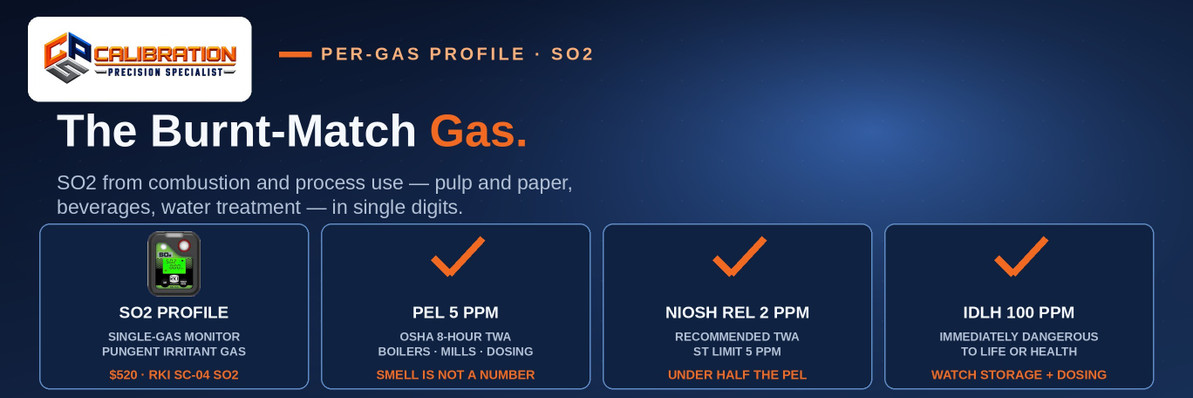
Sulfur dioxide (SO2) is a pungent, irritating gas produced whenever sulfur-containing fuels and materials burn — and used as a working chemical in pulp and paper, food and beverage preservation, and water treatment. OSHA's exposure limit is 5 ppm as an 8-hour average, NIOSH recommends 2 ppm, and 100 ppm is immediately dangerous to life or health (IDLH). Boilers, mills, wineries and breweries, and plants burning sulfur-bearing fuels are who needs to monitor it.
SO2 is one of the oldest industrial gases — the burnt-match smell of smelters, mills, and boiler rooms — and one of the most double-edged. Industry makes it accidentally every time sulfur burns, and uses it deliberately everywhere from paper mills to wine cellars. Both routes put the same irritant gas in workers' air at limits in the low single digits.
Where Does Sulfur Dioxide Come From?
Two families of sources cover nearly every encounter:
- Combustion of sulfur-containing materials. Coal, oil, and other sulfur-bearing fuels release SO2 when they burn — from utility and industrial boilers down to process heaters — and roasting or smelting sulfur-bearing ores does the same. Anywhere a stack, a boiler front, or a furnace is serviced, SO2 belongs on the gas list.
- Deliberate process use. Pulp and paper operations use SO2 in their process chemistry. Food and beverage producers — wineries and breweries prominently — use sulfur dioxide as a preservative and sanitizer, handling it at the point of dosing. Water and wastewater treatment use it to remove chlorine from treated water. And refrigeration-adjacent and chemical plants meet it as a stored, piped process gas. Deliberate use means cylinders, dosing systems, and transfer points — leak points with names and addresses.
What Are the Exposure Limits for SO2?
OSHA's permissible exposure limit is 5 ppm as an 8-hour time-weighted average. NIOSH recommends a tighter 2 ppm average, with a 5 ppm short-term limit — note what that pairing means: NIOSH's short-term value equals OSHA's all-day value, so a program built to NIOSH's recommendation runs at less than half the federal allowance. The IDLH is 100 ppm. SO2 is an irritant gas — eyes, nose, throat, and airways — and its pungent, burnt-match odor is genuinely noticeable at low levels. Treat that odor the way every gas profile in this series treats warning properties: as an alarm bell, never as a measurement. "I can smell it a little" cannot distinguish 2 ppm from 5 ppm, and the difference between those numbers is the difference between the NIOSH recommendation and the OSHA limit.
Who Needs to Monitor SO2 — and How?
The monitoring list follows the sources: boiler and combustion crews working around sulfur-bearing fuels; pulp and paper mill staff; food and beverage workers at preservative dosing and storage; water treatment operators running dechlorination; and maintenance crews opening any system that holds SO2. The instrument pattern is the same one-gas-one-sensor logic as the rest of this series — hydrogen cyanide, phosphine, and nitrogen dioxide — because a standard 4-gas monitor (LEL, O2, CO, H2S) has no SO2 channel and reads normally while SO2 climbs. The personal instrument is a single-gas monitor such as the RKI SC-04 sulfur dioxide monitor ($520), clipped on the worker at the boiler front, the dosing skid, or the mill line; the wider shelf is in single-gas monitors. Continuous processes add fixed points at storage and dosing; personal monitors cover the mobile worker either way.
Calibration keeps the low numbers honest. A sensor asked to distinguish 2 ppm from 5 ppm has no room for drift. We calibrate every channel on the instruments above through calibration services, with as-found and as-left readings documented on every certificate.
Frequently Asked Questions
What is sulfur dioxide?
Sulfur dioxide (SO2) is a colorless, pungent, irritating gas formed when sulfur-containing fuels and materials burn, and used deliberately in pulp and paper, food and beverage preservation, and water treatment. OSHA limits it to 5 ppm as an 8-hour average, NIOSH recommends 2 ppm, and 100 ppm is immediately dangerous to life or health.
Where does sulfur dioxide come from at work?
Two routes: combustion — boilers, furnaces, and smelters burning sulfur-bearing coal, oil, or ore — and deliberate process use, including pulp and paper chemistry, wine and beer preservation and sanitation, water-treatment dechlorination, and stored process gas in chemical and refrigeration-adjacent plants. Boiler crews, mill staff, beverage workers, and treatment operators are the people who meet it.
What is the OSHA limit for sulfur dioxide?
Five parts per million as an 8-hour time-weighted average. NIOSH recommends a stricter limit — 2 ppm as an average, with a 5 ppm short-term limit — and the NIOSH IDLH is 100 ppm. A plant working to the NIOSH recommendation runs at less than half the federal allowance, which is a deliberate choice many SO2 programs make.
Can you smell sulfur dioxide?
Yes — SO2 has a sharp, pungent, burnt-match odor that most people notice at low levels, and as an irritant it announces itself in the eyes and throat as well. But odor reports presence, not concentration: it cannot tell 2 ppm from 5 ppm, and those two numbers are the NIOSH recommendation and the OSHA limit. Odor is a reason to check with an instrument, never the check itself.
Does a 4-gas monitor detect sulfur dioxide?
No. A standard 4-gas monitor reads LEL, oxygen, carbon monoxide, and hydrogen sulfide — sulfur dioxide is not one of its channels. SO2 work takes a dedicated sensor, typically a single-gas monitor such as the RKI SC-04 sulfur dioxide monitor ($520) carried by the worker, or a multi-gas instrument built with an SO2 channel specified at purchase.
Why do wineries and breweries monitor SO2?
Because sulfur dioxide is a working tool in beverage production — used as a preservative and sanitizer — which means it is stored, handled, and dosed by cellar and brewhouse staff. The exposure point is the handling: connecting, dosing, and working around storage. A personal SO2 monitor turns that routine handling into a measured job against the 5 ppm OSHA limit and the 2 ppm NIOSH recommendation.
What does SO2 do in water treatment?
Water and wastewater plants use sulfur dioxide to remove chlorine from treated water before discharge or distribution — dechlorination. The gas is stored and fed on site, so treatment operators work around cylinders and feed equipment where a leak puts SO2 in the room air. That storage-and-feed pattern is what puts water treatment on the SO2 monitoring list.
How close is the SO2 limit to dangerous levels?
The working limits are 2–5 ppm and the IDLH is 100 ppm — about twenty times the OSHA limit. That gap closes fast around a leaking cylinder, a dosing-line failure, or a boiler-front release in a small room, which is why monitoring concentrates on storage, dosing, and combustion work positions rather than on general building air.
What monitor should you use for sulfur dioxide?
A single-gas SO2 instrument with an electrochemical sensor, such as the RKI SC-04 sulfur dioxide monitor ($520), for personal monitoring at boiler fronts, dosing skids, mill lines, and storage rooms — with fixed SO2 points added where a continuous process or stored quantity justifies watching a room around the clock. CPS can help match the form to the job at 865-900-8844.
How often does an SO2 monitor need calibration?
On the interval the manufacturer specifies for its sensor. SO2 decisions are made in single digits — 2 ppm recommended, 5 ppm allowed — so a drifting sensor erases exactly the margin the program exists to protect. Keep the instrument on a written calibration schedule: in-house calibration at CPS Calibrations is $55 for a single-gas instrument, ship-in is billed at the same rate, and on-site work is quoted in writing and costs more.
The Bottom Line
Sulfur dioxide comes off every sulfur fire and out of half the process industries in the region — pulp and paper, beverages, water treatment, boilers — and it is limited at 5 ppm by OSHA and 2 ppm by NIOSH, with 100 ppm immediately dangerous. Its famous smell tells you it is present and nothing about how much. Give the workers who handle it their own sensor, keep that sensor calibrated, and measure the single digits that decide the job.
Burning sulfur-bearing fuel, dosing SO2, or running a mill line? Call CPS Calibrations at 865-900-8844 — SO2 monitors, calibration, and the CPS Calibration Program behind them, from Rockwood, Tennessee.
CPS Calibrations · 109 S. Front Street, Rockwood, TN 37854 · Calibration Services · The CPS Calibration Program
Need a calibration you can file?
In-house calibration at CPS in Rockwood, Tennessee — $55 for single-gas instruments, $90 for 4- and 5-gas — every channel, as-found and as-left data, full certificate.
See Calibration Servicesor call 865-900-8844
Recent Posts
-

What Is Remote Monitoring for Fixed Gas Detection?
Remote monitoring for fixed gas detection means a fixed system's live readings, trends, and alarm hi …Nov 23rd 2026 -

What Are the Key Differences Between the GX-6000 and GX-6100?
The RKI GX-6100 is the current replacement for the discontinued GX-6000: both are pumped 6-gas monit …Nov 22nd 2026 -

How to Read a PID Correction Factor Chart
To read a PID correction factor chart, find your vapor’s row, take the factor under your own lamp en …Nov 21st 2026