
What Is Hydrogen Cyanide (HCN) and Where Does It Come From?
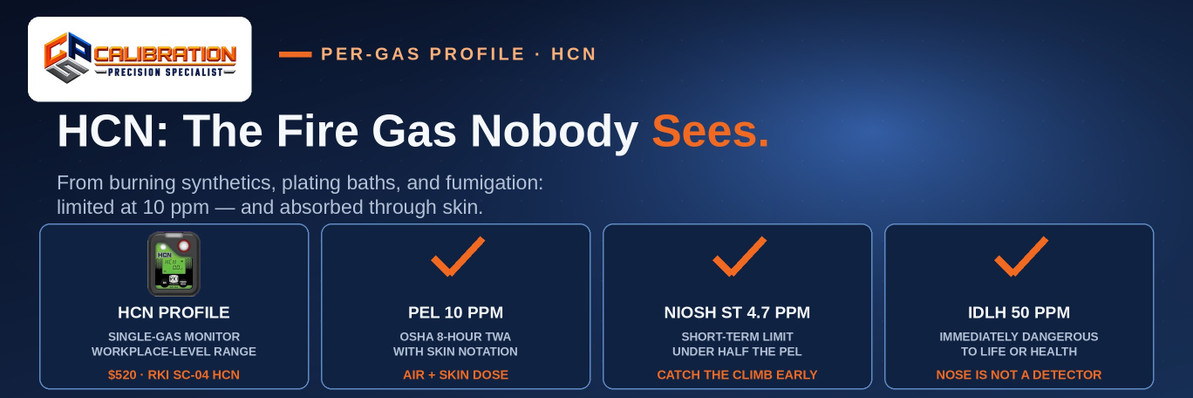
Hydrogen cyanide (HCN) is a fast-acting toxic gas produced when nitrogen-containing materials burn — and used deliberately in metal plating and fumigation. OSHA's exposure limit is 10 ppm as an 8-hour average with a skin notation, NIOSH's short-term limit is 4.7 ppm, and 50 ppm is immediately dangerous to life or health (IDLH). A standard 4-gas monitor does not read it; HCN takes its own sensor.
HCN has two lives. In one, nobody makes it on purpose: it cooks out of burning foam, synthetics, and other nitrogen-bearing materials, and rides the smoke into structure fires and overhaul. In the other, it is a process chemical, present because a plating line or a fumigation job put it there. Both lives end the same way — with a worker breathing a gas whose limits sit in single digits and whose warning properties cannot be trusted.
Where Does Hydrogen Cyanide Come From?
Three sources account for most workplace encounters:
- Combustion of nitrogen-containing materials. When foams, synthetic fabrics, plastics, and similar materials burn, their nitrogen content converts in part to HCN in the smoke. That makes HCN a fireground and overhaul gas — it is part of the toxic pair, with carbon monoxide, that smoke delivers — and a hazard in any enclosed burn, smolder, or post-fire space before the air has been proven clear.
- Metal plating and metal finishing. Cyanide compounds are working chemistry in electroplating baths. Acid contacting a cyanide bath, or process upset, can release HCN gas at the tank — a low, local, predictable source that shops monitor at the point of work.
- Fumigation. HCN has a long history as a fumigant for structures, commodities, and enclosed spaces. Like every fumigant, it is applied on purpose at working concentrations and must be aerated and clearance-tested before people re-enter — the same discipline the phosphine profile lays out in what is phosphine.
What Are the Exposure Limits for HCN?
Low, and tighter than most people expect. OSHA's permissible exposure limit is 10 ppm as an 8-hour time-weighted average, and it carries a skin notation: HCN absorbs through the skin as well as the lungs, so air concentration is not the whole dose. NIOSH's recommended short-term limit is 4.7 ppm — a short-term ceiling-style value less than half the OSHA average. And 50 ppm is the IDLH: immediately dangerous to life or health. The gap between the working limits (4.7–10 ppm) and the IDLH (50 ppm) is one order of magnitude — a small release in a small space crosses it quickly, which is why HCN monitoring is about catching the climb early, not confirming the emergency.
The famous bitter-almond odor deserves a direct answer: it is real chemistry and a useless instrument. Odor thresholds vary, smoke masks smells, and a worker who "can't smell anything" has learned nothing about a gas limited at 4.7 ppm short-term. Nobody's nose reads parts per million.
How Do You Monitor for Hydrogen Cyanide?
With a sensor that asks the HCN question. A standard 4-gas monitor reads LEL, oxygen, CO, and H2S — four honest answers, none of them about cyanide. HCN work takes a dedicated electrochemical channel: a single-gas instrument such as the RKI SC-04 hydrogen cyanide monitor ($520), carried by the worker whose air is in question — at the plating tank, in the fumigation clearance test, or during overhaul where smoldering synthetics are still off-gassing. The wider shelf is in single-gas monitors; its sister profiles in this series cover sulfur dioxide and nitrogen dioxide, which share the same one-gas-one-sensor logic.
Calibration is the difference between a reading and a guess. A toxic-gas sensor that drifts low reports a safe number for unsafe air — the worst failure mode an instrument has. We calibrate every channel on the monitors above through calibration services, with as-found and as-left readings documented on every certificate.
Frequently Asked Questions
What is hydrogen cyanide?
Hydrogen cyanide (HCN) is a fast-acting toxic gas. It forms when nitrogen-containing materials — foams, synthetics, many plastics and fabrics — burn, and it is also used deliberately in metal plating chemistry and fumigation. OSHA limits it to 10 ppm as an 8-hour average with a skin notation, NIOSH's short-term limit is 4.7 ppm, and 50 ppm is immediately dangerous to life or health.
Where does hydrogen cyanide come from?
Most encounters come from three sources: combustion of nitrogen-containing materials, which puts HCN in fire and overhaul smoke; metal plating and finishing, where cyanide bath chemistry can release HCN at the tank, especially if acid contacts the bath; and fumigation, where HCN is applied on purpose and spaces must be aerated and clearance-tested before re-entry.
What is the OSHA limit for hydrogen cyanide?
Ten parts per million as an 8-hour time-weighted average, with a skin notation — HCN absorbs through the skin, so air monitoring alone does not capture the whole exposure. NIOSH recommends a tighter short-term limit of 4.7 ppm, and the NIOSH IDLH — the level immediately dangerous to life or health — is 50 ppm.
Can you smell hydrogen cyanide?
HCN has a characteristic bitter, almond-like odor, but smell is not a detection method. Odor perception varies from person to person, smoke and other workplace smells mask it, and the limits that matter — 4.7 ppm short-term, 10 ppm averaged — are far below anything a nose can quantify. The only reliable answer is an HCN instrument reading the actual air.
Does a 4-gas monitor detect hydrogen cyanide?
No. A standard 4-gas monitor reads combustible gas (LEL), oxygen, carbon monoxide, and hydrogen sulfide. Hydrogen cyanide is not among its channels, so the instrument can read normally on all four while HCN sits above its limit. HCN takes a dedicated sensor — a single-gas HCN monitor such as the RKI SC-04 ($520) — carried by the worker whose exposure is in question.
Why is HCN dangerous at a fire scene after the fire is out?
Because smoldering nitrogen-containing materials — foam, synthetics, furnishings — keep releasing HCN during overhaul, in the same smoke that carries carbon monoxide. The visible emergency has ended but the toxic production has not, and overhaul is exactly when respiratory protection tends to come off. Air monitoring for HCN and CO is what turns "looks clear" into a measurement.
What does the skin notation on the HCN limit mean?
It means hydrogen cyanide absorbs through intact skin as well as through the lungs, so a worker's total dose is the air exposure plus the skin exposure. Air monitoring stays essential — it is the controllable, measurable route — but the notation is OSHA's signal that gloves, clothing discipline, and hygiene are part of the control set, not an afterthought.
How is a fumigated space cleared of HCN?
The same way any fumigated space is cleared: aeration followed by a clearance test with an instrument that reads the fumigant gas — elapsed time alone is never the test. For HCN that means an HCN-specific monitor reading the space's actual air before anyone re-enters, because a standard 4-gas instrument cannot see the gas the clearance decision depends on.
What monitor should you use for hydrogen cyanide?
A single-gas HCN instrument with an electrochemical sensor ranged for workplace levels, such as the RKI SC-04 hydrogen cyanide monitor ($520) — small enough to clip on the worker at a plating tank, on a fumigation clearance round, or during overhaul. Fixed HCN points exist for continuous process areas; CPS can talk through which form fits the job at 865-900-8844.
How often does an HCN monitor need calibration?
On the interval the manufacturer specifies for its sensor — HCN electrochemical sensors do not share one honest number with other gases. The failure that matters is a sensor reading low, because its number is the go/no-go for entry and work decisions. Keep the instrument on a written calibration schedule: in-house calibration at CPS Calibrations is $55 for a single-gas instrument, ship-in is billed at the same rate, and on-site work is quoted in writing and costs more.
The Bottom Line
Hydrogen cyanide comes out of burning synthetics, off plating baths, and out of fumigation jobs — and it is limited at 10 ppm averaged, 4.7 ppm short-term, with 50 ppm immediately dangerous. Its almond legend makes people trust their noses; its skin notation makes air only part of the dose. Give the gas its own sensor, keep that sensor calibrated, and let the instrument — not the smell — call the air clear.
Working around plating, fumigation, or overhaul air? Call CPS Calibrations at 865-900-8844 — HCN monitors, calibration, and the CPS Calibration Program behind them, from Rockwood, Tennessee.
CPS Calibrations · 109 S. Front Street, Rockwood, TN 37854 · Calibration Services · The CPS Calibration Program
Need a calibration you can file?
In-house calibration at CPS in Rockwood, Tennessee — $55 for single-gas instruments, $90 for 4- and 5-gas — every channel, as-found and as-left data, full certificate.
See Calibration Servicesor call 865-900-8844
Recent Posts
-

What Is Remote Monitoring for Fixed Gas Detection?
Remote monitoring for fixed gas detection means a fixed system's live readings, trends, and alarm hi …Nov 23rd 2026 -

What Are the Key Differences Between the GX-6000 and GX-6100?
The RKI GX-6100 is the current replacement for the discontinued GX-6000: both are pumped 6-gas monit …Nov 22nd 2026 -

How to Read a PID Correction Factor Chart
To read a PID correction factor chart, find your vapor’s row, take the factor under your own lamp en …Nov 21st 2026