
What Is Nitrogen Dioxide (NO2) and Where Does It Build Up?
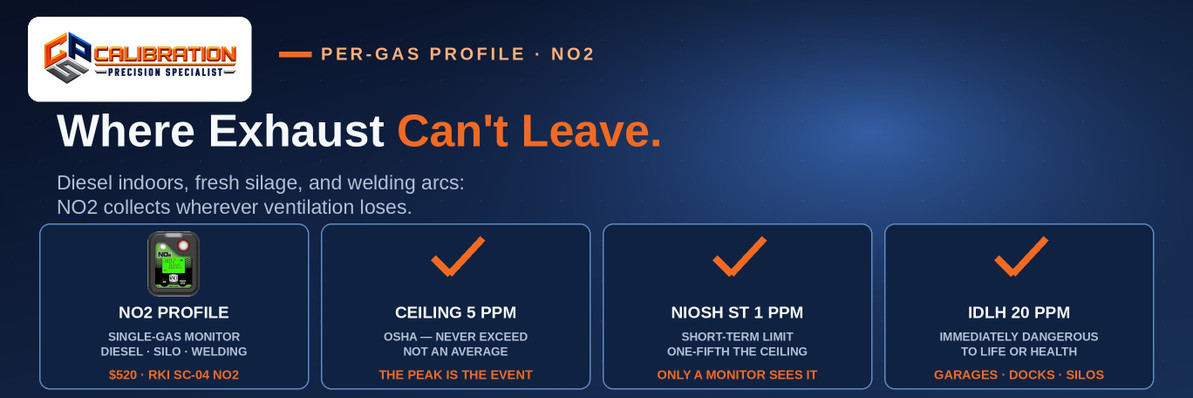
Nitrogen dioxide (NO2) is a reddish-brown, pungent combustion gas that builds up wherever exhaust is produced faster than ventilation removes it — around indoor diesel equipment, in parking garages and welding shops, and at the top of freshly filled silos. OSHA's limit is a 5 ppm ceiling that may never be exceeded at any moment, NIOSH's short-term limit is 1 ppm, and 20 ppm is immediately dangerous to life or health (IDLH).
NO2 is the gas of enclosed combustion. Outdoors, diesel exhaust dilutes into the sky and the problem mostly disappears. Bring the same engine under a roof — a warehouse, a dock, a garage, a maintenance bay — and the gas accumulates in the workers' air instead. Add two sources that need no engine at all, the welding arc and the fresh-filled silo, and NO2 turns up in more ordinary workplaces than almost any other toxic gas in this series.
Where Does NO2 Build Up?
- Diesel exhaust indoors. Forklifts, loaders, trucks at indoor docks, generators, and equipment in maintenance bays all emit NO2 as part of diesel exhaust. The build-up sites are the ones with roofs and routines: warehouses, distribution centers, bus and fleet garages, and parking structures — where fixed CO and NO2 detection staging the ventilation is a building system of its own, covered in what gases do you monitor in a parking garage.
- Silos after filling. Fresh silage generates nitrogen oxides, including NO2, in the days following filling; the heavy gas collects at the top of the silo and around the chute, exactly where a farmer climbs to check or level the fill. It is the farm's second invisible gas — the companion to manure pit gas, from a completely different source: the crop, not the waste.
- Welding and hot work. Welding arcs produce nitrogen oxides among their fumes, and the exposure concentrates where the work is enclosed or the ventilation is local and overwhelmed — fabrication in vessels, structural work inside buildings, and repair welding in pits and bays.
What Are the Exposure Limits for NO2?
Read OSHA's number carefully, because it is not the usual kind: the OSHA PEL for NO2 is a ceiling of 5 ppm — a concentration that may not be exceeded at any time, not an 8-hour average a worker can bank against a quiet afternoon. NIOSH's recommended short-term limit is 1 ppm. And 20 ppm is the IDLH. A ceiling limit changes the monitoring logic completely: the peak is the event. A shift can average beautifully and still contain the five minutes at a loading dock or a silo hatch that broke the rule — and only an instrument in that air, at that moment, knows. NO2's pungent, acrid odor and reddish-brown color are real, but by the time color is visible in room air the concentration is far past anything on this page; treat both as late news, not warnings.
How Do You Monitor Nitrogen Dioxide?
With an NO2 channel where the work happens. A standard 4-gas monitor (LEL, O2, CO, H2S) does not include NO2 — diesel crews in particular often assume the CO channel covers exhaust, and it covers only half the exhaust story. The personal instrument is a single-gas monitor such as the RKI SC-04 nitrogen dioxide monitor ($520), worn by the dock worker, the mechanic, the welder, or the farmer at the silo hatch; enclosed vehicle spaces add the fixed detection and ventilation staging the parking-garage post describes. The rest of the single-gas shelf — including the sister gases in this series, hydrogen cyanide, phosphine, and sulfur dioxide — is in single-gas monitors.
Calibration protects the peak reading. On a ceiling-limited gas, a slow or drifting sensor does not just blur an average — it misses the only moment that counted. We calibrate every channel on the instruments above through calibration services, with as-found and as-left readings documented on every certificate.
Frequently Asked Questions
What is nitrogen dioxide?
Nitrogen dioxide (NO2) is a reddish-brown, pungent gas produced by combustion — principally diesel and other engine exhaust — and generated by fresh silage and welding arcs. It builds up indoors where exhaust outruns ventilation. OSHA limits it with a 5 ppm ceiling, NIOSH's short-term limit is 1 ppm, and 20 ppm is immediately dangerous to life or health.
Where does nitrogen dioxide build up?
Wherever combustion exhaust is trapped: warehouses and loading docks with diesel equipment, fleet and maintenance garages, parking structures, welding work in enclosed spaces — and at the top of freshly filled farm silos, where silage generates nitrogen oxides in the days after filling. The pattern is always a source plus a roof, a wall, or a silo cap that keeps the gas in the workers' air.
What is the OSHA limit for nitrogen dioxide?
A ceiling of 5 ppm — the concentration may not be exceeded at any moment, which is stricter in kind than an 8-hour average limit. NIOSH recommends a short-term limit of 1 ppm, and the NIOSH IDLH is 20 ppm. Because the OSHA number is a ceiling, compliance is about peaks: a shift with a fine average and one bad five minutes is a shift over the limit.
What is silo gas?
Silo gas is the nitrogen oxide gas — principally nitrogen dioxide — generated by fresh silage in the days after a silo is filled. The heavy gas settles at the top of the silo and around the unloading chute, where a farmer climbs to check the fill. It is a different hazard from manure pit gas: the source is the stored crop itself, not the waste pit, and the dangerous window opens right after filling.
Does a 4-gas monitor detect nitrogen dioxide?
No. The standard four channels are LEL, oxygen, carbon monoxide, and hydrogen sulfide. Diesel crews often assume the CO channel covers engine exhaust, but NO2 is the exhaust gas it misses. NO2 takes its own sensor — a single-gas monitor such as the RKI SC-04 nitrogen dioxide monitor ($520) — or a multi-gas instrument specified with an NO2 channel.
Why do parking garages monitor NO2 as well as CO?
Because vehicle exhaust is a two-gas problem: gasoline vehicles are primarily a carbon monoxide source, while diesel vehicles add significant nitrogen dioxide. A garage ventilating on CO alone can hold its CO number while NO2 builds. That is why garage detection pairs CO and NO2 sensors and stages ventilation fans on whichever gas calls first.
Can you see or smell nitrogen dioxide?
NO2 is reddish-brown with a pungent, acrid odor — but neither property is a warning you can use. Color visible in room air means a concentration far beyond the 5 ppm ceiling, and odor cannot judge the difference between the 1 ppm NIOSH short-term limit and the ceiling. The senses report NO2 late; an instrument reports it on time.
How do warehouses control NO2 from diesel equipment?
With ventilation sized for the equipment actually run indoors, equipment maintenance that keeps engines from running dirty, and monitoring that verifies the result — personal NO2 monitors on dock and warehouse staff show whether the air at the worker, not just at the vent, stays under the limits. Where readings climb, the fix is airflow and engine time indoors, measured again afterward.
What monitor should you use for nitrogen dioxide?
A single-gas NO2 instrument with an electrochemical sensor, such as the RKI SC-04 nitrogen dioxide monitor ($520), for the dock worker, mechanic, welder, or farmer — applications where the person moves through the peaks a ceiling limit cares about. Enclosed vehicle spaces add fixed CO and NO2 detection tied to ventilation. CPS can help match the form to the job at 865-900-8844.
How often does an NO2 monitor need calibration?
On the interval the manufacturer specifies for its sensor. NO2 is ceiling-limited, so the reading that matters is a short peak — a slow or drifting sensor misses the exact moment the program exists to catch. Keep the instrument on a written calibration schedule: in-house calibration at CPS Calibrations is $55 for a single-gas instrument, ship-in is billed at the same rate, and on-site work is quoted in writing and costs more than bench work.
The Bottom Line
Nitrogen dioxide builds up wherever exhaust meets a roof — diesel docks and garages, welding bays, and the tops of fresh-filled silos. OSHA's 5 ppm is a ceiling, not an average; NIOSH's short-term limit is 1 ppm; 20 ppm is immediately dangerous. Peaks are the whole game on a ceiling-limited gas, and only an NO2 sensor in the worker's air sees the peak. Give it its own channel, and keep that channel calibrated.
Running diesel indoors, welding in enclosed spaces, or filling silos this season? Call CPS Calibrations at 865-900-8844 — NO2 monitors, calibration, and the CPS Calibration Program behind them, from Rockwood, Tennessee.
CPS Calibrations · 109 S. Front Street, Rockwood, TN 37854 · Calibration Services · The CPS Calibration Program
Need a calibration you can file?
In-house calibration at CPS in Rockwood, Tennessee — $55 for single-gas instruments, $90 for 4- and 5-gas — every channel, as-found and as-left data, full certificate.
See Calibration Servicesor call 865-900-8844
Recent Posts
-

What Is Remote Monitoring for Fixed Gas Detection?
Remote monitoring for fixed gas detection means a fixed system's live readings, trends, and alarm hi …Nov 23rd 2026 -

What Are the Key Differences Between the GX-6000 and GX-6100?
The RKI GX-6100 is the current replacement for the discontinued GX-6000: both are pumped 6-gas monit …Nov 22nd 2026 -

How to Read a PID Correction Factor Chart
To read a PID correction factor chart, find your vapor’s row, take the factor under your own lamp en …Nov 21st 2026