
OTIS Wired Controllers: OI-7432 (32-Channel Modbus) vs. OI-7480-12 (12-Channel 4-20mA)
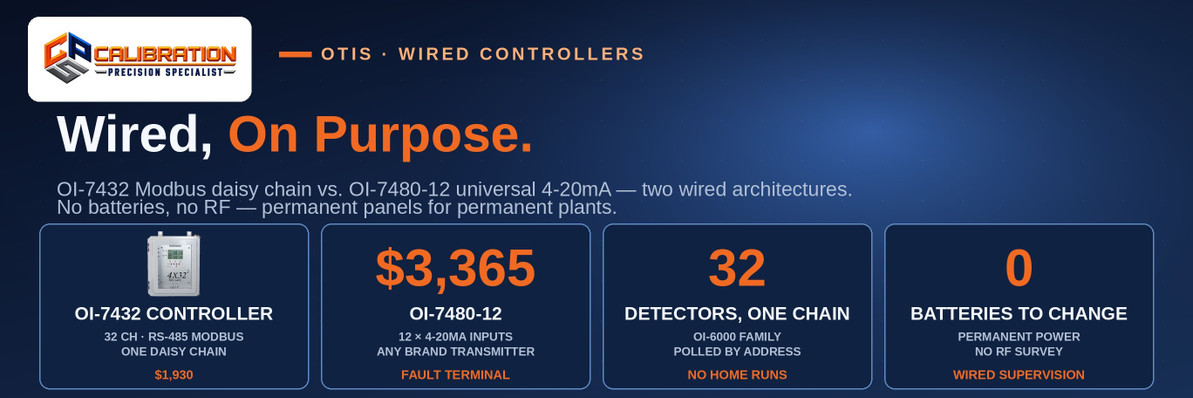
OTIS sells two wired controllers because 'wired' is two architectures: the OI-7432 ($1,930) polls up to 32 OI-6000-series detectors over a single RS-485 Modbus daisy chain — one cable run for the whole string — while the OI-7480-12 ($3,365) monitors 12 wired 4-20mA transmitter loops of any brand and unifies them under one panel with four relays, a fault terminal, and Modbus output. Digital chain or universal analog: that choice, and the cases where wired still beats wireless, are this guide's subject.
Every fixed-system design meeting now opens with wireless — and often should. But the installed world is wired, new construction pulls cable while the walls are open anyway, and some sites are simply hostile to radio. OTIS's wired controller pair covers the two ways wired systems are actually built: a digital daisy chain of same-family detectors, and analog home runs from whatever transmitters a site already owns. The detectors on the chain side are covered in CPS's post on OTIS wired detector heads; this guide is about the panels: the OI-7432 and the OI-7480-12.

OTIS OI-7432 Wired 32-Channel RS-485 Modbus Controller
Wired 32-channel controller polling OI-6000-series detectors on one RS-485 Modbus daisy chain.
$1,930
See the OI-7432What Is the Difference Between the Two Architectures?
- OI-7432 — the daisy chain ($1,930, 32 channels). One RS-485 Modbus run threads detector to detector — the OI-6000, OI-6200, and OI-6400 wired heads — and the controller polls all 32 digitally. Cabling collapses from 32 home runs to a single trunk with drops; the digital link carries more than a 4-20mA value can, and troubleshooting reads the chain as a system. Four dry-contact relays (replaceable 4A fuses) alarm locally, RS-485 Modbus output integrates the plant, and a 160×104 green-backlit display with five buttons runs commissioning. It is powered by 120/240 VAC — a permanent plant panel, sized for a new wired build or a 6000-family expansion designed as one system.
- OI-7480-12 — the universal analog panel ($3,365, 12 channels). Twelve wired 4-20mA inputs accepting OTIS or third-party transmitters — the panel for the real world's mixed installed base, and for standardizing alarming across existing loops without replacing sound detectors. Four programmable relays plus a dedicated fault terminal, a relay-disable option that simplifies maintenance and calibration without unwiring anything, RS-485 Modbus output, the same 160×104/five-button interface, and flexible 12-35 VDC or 120 VAC power in a larger 12 × 10 × 6 in. enclosure.
The price inversion surprises people — 12 channels costing more than 32 — until the architectures are priced honestly: the 7480's channels are twelve independent analog inputs with per-loop hardware and universal compatibility, while the 7432's are addresses on one digital chain inside one detector family. You are not buying channels; you are buying the input architecture your site needs.
When Does Wired Still Beat Wireless?
Wireless wins on retrofit pain; wired wins on these grounds, and they are not nostalgia:
- New construction and planned shutdowns. When conduit and cable go in with the build, wired's installation penalty mostly disappears — and what remains is decades of operation with no batteries and no RF survey.
- Permanent power, zero battery program. A wired detector never needs a battery swap, a low-battery fault chase, or a battery-life derating conversation. For a 30-year plant asset, that maintenance profile is the argument.
- RF-hostile or RF-forbidden environments. Dense steel, below-grade structures, heavy interference, or site policies that restrict transmitters — a cable does not care about any of them.
- Deterministic supervision. A wired loop announces its own faults on the wire — the 7480-12 even dedicates a fault terminal to it — and a daisy chain reports its members by address. The failure modes are known, immediate, and locatable.
- An installed analog base worth keeping. Sites with sound 4-20mA transmitters from several brands do not need a rip-and-replace to get unified alarming — the 7480-12 exists precisely for them.
The honest counterweight: retrofitting wired into an operating plant — trenching, conduit through classified areas, shutdown windows — is where wireless earns its premium, and OTIS's WireFree line (covered in CPS's controller guides) is the same company's answer. Architecture follows the site's constraints, not fashion. Either way, the installed system is designed, installed, and calibrated on site by CPS's fixed system installation team, quoted in writing.
What Does a Wired Installation Actually Involve?
Budgeting a wired system honestly means pricing the run, not just the panel. For the 7432's daisy chain, the work is one trunk route: cable and conduit along the detector string, a drop and address at each head, and commissioning that polls the chain member by member — simpler to install than home runs, and simpler to extend, since a future detector joins the chain rather than starting a new pull. For the 7480-12's analog loops, each transmitter keeps its own home run — more copper, but each loop is independently replaceable, and existing loops from a previous system often land on the new panel untouched. Both builds end the same way: relay actions proven against real alarm conditions, Modbus registers verified at the plant system, and a calibration baseline for every detector recorded at handover. CPS performs that design-install-commission sequence as its fixed system installation work, quoted in writing before it starts — the panel price in this guide is the beginning of a wired budget, never the whole of it.
Frequently Asked Questions
How much do the OTIS wired controllers cost?
The OI-7432 is $1,930 (32 channels, RS-485 Modbus daisy chain for OI-6000-series detectors). The OI-7480-12 is $3,365 (12 channels of wired 4-20mA, any brand). The smaller channel count costs more because its channels are independent universal analog inputs rather than addresses on one digital chain — you are buying input architecture, not a channel tally.
What detectors work with the OI-7432?
The OI-6000 family: OI-6000, OI-6200, and OI-6400 wired detectors, up to 32 of them on a single RS-485 Modbus daisy chain. CPS's post on OTIS wired detector heads covers those heads in detail. Detectors outside the 6000 family are not chain members — mixed-brand sites belong on the OI-7480-12's analog inputs instead.
Can the OI-7480-12 take third-party transmitters?
Yes — that is its defining feature. Its 12 inputs accept wired 4-20mA transmitters from OTIS or any other brand, which makes it the unification panel for mixed installed bases: keep the sound detectors you own, gain one panel, four relays plus a fault terminal, and one Modbus output.
What is a daisy chain, and why does it save money?
Instead of running a separate cable from the panel to every detector (32 home runs), one RS-485 cable threads from detector to detector and the controller polls each by address. Cable, conduit, glands, terminations, and labor all collapse to one trunk with drops — the largest installation saving available in a wired design, at the price of staying inside one detector family.
What does the relay-disable option on the 7480-12 do?
It lets technicians silence the panel's relay action during maintenance and calibration without unwiring anything — so a bump test or a loop check does not trip horns, beacons, or shutdowns downstream. When the work is done, relays re-enable as a setting, not a rewiring job. It is a small feature that anyone who has calibrated against live relays will appreciate immediately.
Why does the 7480-12 have a fault terminal?
So controller and loop faults get their own dedicated signaling path, separate from gas alarms. A fault — a broken loop, a failed transmitter — should announce itself as a fault, immediately and unambiguously, not hide inside the alarm logic. Supervision is half of what a controller is for.
Wired or wireless — which should my site choose?
Decide from constraints. New construction, permanent power preference, RF-hostile spaces, and a sound analog installed base argue wired. Operating-plant retrofits, long distances, trenching costs, and temporary or expanding coverage argue wireless. Many real sites land hybrid — which is why OTIS sells both, and why the design conversation (CPS does it as part of fixed system installation scoping) starts with the site, not the catalog.
What power do the wired controllers need?
The OI-7432 runs on 120/240 VAC — permanent plant power for a permanent panel. The OI-7480-12 accepts 12-35 VDC or 120 VAC, suiting both plant and panel-shop power schemes. Both operate from -20 to +70 °C in fiberglass enclosures with clear windows, carry four relays with replaceable 4A fuses, output RS-485 Modbus, and include a 1-year limited hardware warranty.
Can a wired system talk to our PLC or SCADA?
Yes — both controllers provide RS-485 Modbus output, the common denominator of plant integration, alongside their local relays and displays. The 7432's detector data is digital end-to-end (Modbus chain in, Modbus out); the 7480-12 converts twelve analog loops into the same digital picture.
Who installs and calibrates a wired OTIS system?
CPS designs, installs, and calibrates fixed gas detection on site at your facility, with on-site work quoted in writing — the published $55/$90 rates are in-house bench rates for portable instruments and never on-site prices. Start at the fixed system installation page or call 865-900-8844 to scope the system.
The Bottom Line
Two wired architectures, two honest tools: the OI-7432's Modbus daisy chain runs 32 same-family detectors on one cable for $1,930, and the OI-7480-12 unifies any twelve 4-20mA loops — any brand — for $3,365. Wired is not the old way; on the right site it is the low-maintenance, battery-free, RF-immune way. Choose the architecture your site's constraints dictate.
Designing a fixed system and torn between chain, analog, and wireless? Call CPS Calibrations at 865-900-8844 — bring the site constraints and we will architect it with you.
--- CPS Calibrations · 109 S. Front Street, Rockwood, TN 37854 · OTIS OI-7432 · OTIS Wired Detector Heads · Fixed System Installation
Need a calibration you can file?
In-house calibration at CPS in Rockwood, Tennessee — $55 for single-gas instruments, $90 for 4- and 5-gas — every channel, as-found and as-left data, full certificate.
See Calibration Servicesor call 865-900-8844
Recent Posts
-

Which GfG Portable Gas Detector Is Best for You?
The right GfG portable is decided by three questions — how many gases, pumped or diffusion, and PID …Nov 24th 2026 -

What GfG Fixed Gas Detection Systems Are There? Every Transmitter and Controller Explained
GfG’s fixed gas detection line at CPS is 39 products in two layers: 23 transmitters and detection sy …Nov 24th 2026 -

What GfG Portable Gas Detectors Are There? Every Model Explained
GfG’s portable line at CPS is 14 products built around six instruments: the Micro IV single-gas dete …Nov 24th 2026