
RKI M-Series and 35-3001: Sample-Draw Detection Explained
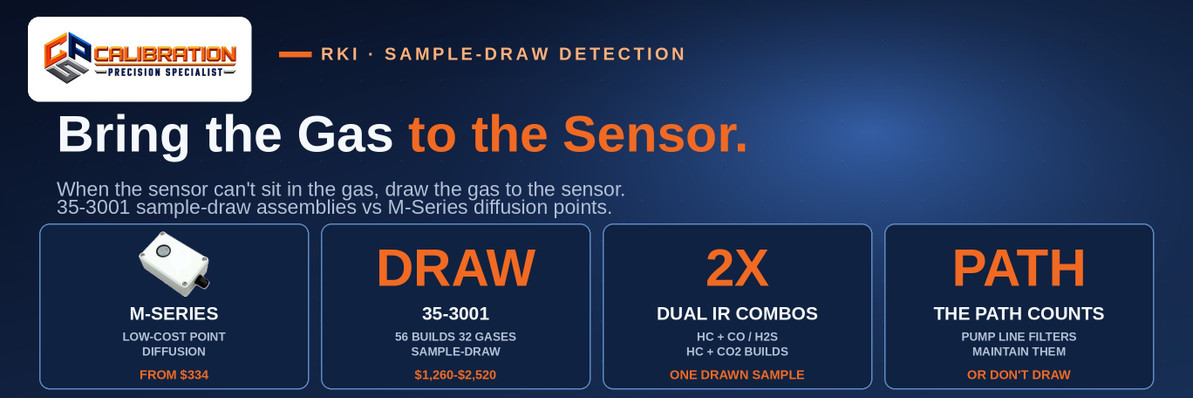
Sample-draw detection pulls gas through a tube to a sensor instead of placing the sensor in the gas: RKI's 35-3001 Sample Draw Detector Assembly does this in 56 factory configurations covering 32 gases — including dual-gas infrared combinations — at $1,260–$2,520 configured with a 4-20 mA output, while RKI's M-Series offers the opposite philosophy, a low-cost diffusion transmitter starting at $334, for the points where the sensor can simply sit in the atmosphere it watches.
Every fixed point starts with a placement question: can a sensor live where the gas appears? Heat, washdown, condensation, inaccessibility, and classified-area constraints all answer 'no' for real points in real plants. Sample-draw is the engineering answer to that 'no' — move the sensor, move the gas instead. The portable-scale version of the same idea is covered in RKI GD-70D sample-draw gas detection.

RKI M-Series Low Cost Gas Transmitter
Low-cost fixed 4-20 mA transmitter — the diffusion alternative when the sensor can sit in the gas.
$334–$5,060 configured
See the M-SeriesWhen Can't the Sensor Sit in the Gas?
- The point is too hot, wet, or corrosive for sensor life — draw the sample out to a conditioned location.
- The point is inaccessible — inside equipment, at height, or in a space entered rarely; the sensor should live where a technician can calibrate it without a permit and a lift.
- The gas must be taken from a specific spot — a duct, a process tap, a sump — and reported continuously, not just when a portable meter visits.
The 35-3001's configuration list shows how seriously RKI takes the category: 56 builds across 32 gases, including dual-gas infrared combinations such as IR hydrocarbon with CO, IR hydrocarbon with H2S, and IR hydrocarbon with CO2 at several ranges. A sample-draw point that reports two gases from one drawn sample is doing the work of two diffusion points without asking either sensor to live at the tap.
What Does the Sample Path Cost You?
Honesty about the trade: a drawn sample is only as current as its transport. The pump, the line, its filters, and its condition become part of the measurement — a partially blocked line or a tired pump stretches response time, and condensation in the line can scrub soluble gases before they reach the sensor. Diffusion has none of that path; it also has no choice about where it measures.
That is why sample-draw systems belong on a maintenance rhythm that includes the path, not just the sensor: flow checks, filter changes, and line inspection alongside calibration. A plant that will not maintain the path should not buy the architecture — a diffusion point it can reach beats a drawn point it neglects.
Where Does the M-Series Fit?
At the other end of the budget. The M-Series is RKI's low-cost transmitter line: 3 configurations covering carbon monoxide, hydrogen sulfide, and a specify-at-order option, with configurations from $334 to $5,060 — the wide top end reflects a configured build, so quote your exact configuration rather than the band. For the ordinary diffusion point — a CO point in a parking structure class of application, an H2S point where the sensor can live at the hazard — the M-Series is the plain, wired, 4-20 mA answer.
The pairing in this post is deliberate: most fixed systems mix both philosophies. Diffusion M-Series-class points where placement is easy, a 35-3001 drawn point where placement is impossible — one controller reading the same 4-20 mA from both. See fixed system installation for how CPS designs that mix.
Frequently Asked Questions
What is sample-draw gas detection?
Detection that pulls gas through a sample line with a pump to a remotely housed sensor, instead of exposing a diffusion sensor at the point. The sensor lives somewhere reachable and survivable; the sample travels. RKI's 35-3001 assembly is the fixed-system implementation covered here.
How much does the RKI 35-3001 cost?
$1,260–$2,520 configured at CPS, across 56 factory configurations covering 32 gases, including dual-gas infrared combinations. Each configuration is factory-built with its own part number and list price.
What gases can the 35-3001 detect?
32 gas options per the product record, including carbon monoxide, hydrogen sulfide, hydrogen-specific builds, IR carbon dioxide, IR hydrocarbon, and dual combinations such as IR hydrocarbon with CO (0-300 ppm), H2S (0-100 ppm), or CO2 at several ranges.
How much does the RKI M-Series cost?
Configurations run $334–$5,060 at CPS. The M-Series covers carbon monoxide, hydrogen sulfide, and a specify-at-order gas in 3 configurations — get the exact configured price for your gas rather than reading the band as a quote.
Sample-draw or diffusion — which is better?
Neither, universally. Diffusion is simpler and has no sample path to maintain, but the sensor must survive and be reachable at the point. Sample-draw frees the sensor's location but makes the pump, line, and filters part of the measurement. Placement decides.
What maintenance does a sample-draw system need beyond calibration?
Flow checks, filter replacement, and sample-line inspection — a blocked or condensing line degrades the reading before any sensor drifts. The path is a component; maintain it like one.
Can one 35-3001 point measure two gases?
Yes — the configuration list includes dual-gas infrared combinations (hydrocarbon paired with CO, H2S, or CO2). One drawn sample, two reported channels, one 4-20 mA output per channel plan — confirm the exact build in the configuration dropdown.
Does the 35-3001 output work with my controller?
It outputs 4-20 mA, the standard fixed-detection signal, for Beacon controllers, PLCs, and DCS systems — the same signal the M-Series produces, so drawn and diffusion points mix freely on one controller.
When should I choose the M-Series instead?
When the sensor can live at the point and the gas is CO or H2S (or the specify-at-order option fits): the M-Series is the low-cost, no-pump, no-line diffusion answer, starting at $334.
Who designs a mixed diffusion and sample-draw system?
CPS does — fixed-system design starts from where each gas appears and whether a sensor can live there, then assigns diffusion or drawn points accordingly. Call 865-900-8844 or see our fixed system installation page.
The Bottom Line
Place the sensor in the gas when you can — diffusion is simpler and the M-Series starts at $334. Draw the gas to the sensor when you must — the 35-3001's 56 configurations exist for the points where heat, access, or the tap itself forbids a resident sensor. The mistake is forcing either philosophy onto every point.
Need a calibration you can file?
In-house calibration at CPS in Rockwood, Tennessee — $55 for single-gas instruments, $90 for 4- and 5-gas — every channel, as-found and as-left data, full certificate.
See Calibration Servicesor call 865-900-8844
Recent Posts
-

What Is Remote Monitoring for Fixed Gas Detection?
Remote monitoring for fixed gas detection means a fixed system's live readings, trends, and alarm hi …Nov 23rd 2026 -

What Are the Key Differences Between the GX-6000 and GX-6100?
The RKI GX-6100 is the current replacement for the discontinued GX-6000: both are pumped 6-gas monit …Nov 22nd 2026 -

How to Read a PID Correction Factor Chart
To read a PID correction factor chart, find your vapor’s row, take the factor under your own lamp en …Nov 21st 2026