
RKI S2 Series Gas Sensor/Transmitter
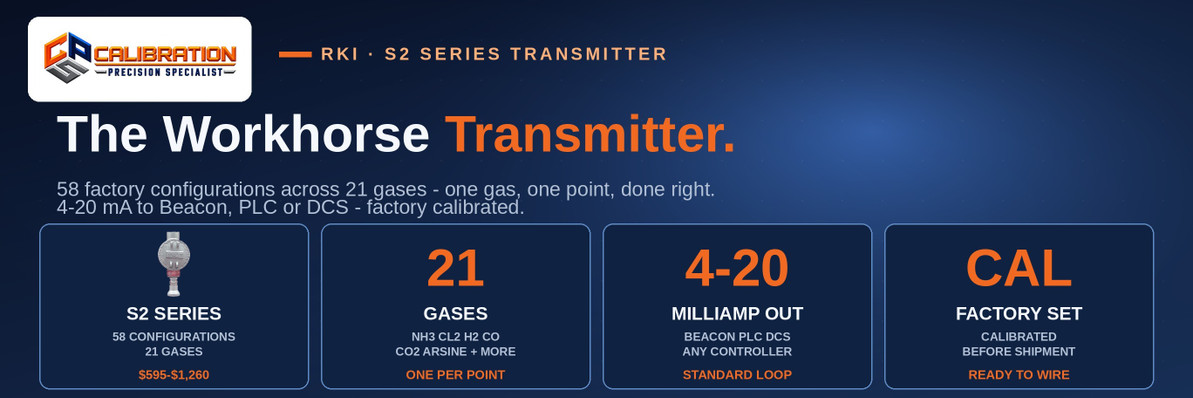
The RKI S2 Series is a fixed gas sensor/transmitter sold in 58 factory configurations covering 21 gases — including ammonia, arsine, carbon dioxide, carbon monoxide, chlorine, chlorine dioxide, hexane, hydrocarbon, hydrogen, and hydrogen chloride — at $595–$1,260 configured, every unit factory-calibrated with a 4-20 mA output that wires directly into an RKI Beacon controller, a PLC, or a DCS.
If the OTIS WireFree heads answer 'how do I watch a point I cannot wire,' the S2 answers the opposite and far more common question: 'how do I watch a point I can wire, permanently, without overbuying?' It is a sensor and transmitter in one housing: the sensor reads the gas, the transmitter turns that reading into the industry's standard 4-20 mA current signal, and any controller that speaks 4-20 mA — which is effectively all of them — can display it, alarm on it, and log it.
Each of the 58 configurations is a factory-built unit with its own part number and list price. You are not buying a generic box and a loose sensor; you are buying the gas, range, and housing combination built and calibrated as one instrument. CPS is an authorized RKI dealer, so the unit carries the full factory warranty with our calibration support behind it.
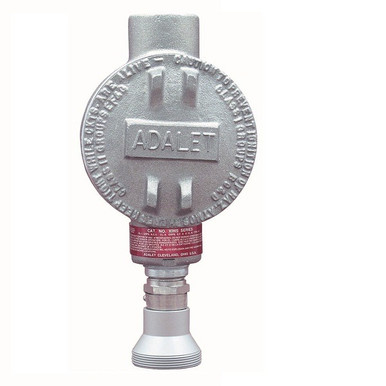
RKI S2 Series Gas Sensor/Transmitter
Fixed 4-20 mA sensor/transmitter in 58 factory configurations covering 21 gases.
$595–$1,260 configured
See the S2 SeriesWhich Gases Does the S2 Cover — and Why 21?
The product record lists 21 gas options. The named set tells the story: ammonia (NH3), arsine (AsH3), carbon dioxide (CO2), carbon monoxide (CO), chlorine (Cl2), chlorine dioxide (ClO2), hexane (C6H14), hydrocarbon (HC), hydrogen (H2), hydrogen chloride (HCl), and more. That is a toxic-and-process gas list, not just the confined-space four — the S2 is aimed at the fixed points in refrigeration machinery rooms, water treatment, semiconductor and chemical processes, battery rooms, and loading areas where one specific gas is the documented hazard.
Why the gas list matters more than any other spec: a transmitter is single-purpose. Unlike a portable multi-gas meter, a fixed S2 watches the one gas it was built for, continuously, for years. Choosing the gas and range correctly at order time — the actual expected background, the alarm levels the site plan calls for, the full-scale the controller will display — is the whole specification job. The 58 configurations exist because range and housing choices are part of that job, not accessories after it.
Display or Blind — What Does the Choice Buy?
Fixed transmitters come in two philosophies. A display unit shows the reading at the point: a technician walking the room can see the current concentration without going back to the controller, and calibration at the head is easier to follow. A blind (non-display) transmitter sends the same 4-20 mA signal but shows nothing locally — cheaper, simpler, and entirely dependent on the controller for every reading.
Neither is universally right. Put displays where people work near the point and need local awareness, and where your calibration crew services the head in place. Go blind where the point is inaccessible, the controller display is the real interface, or the budget is better spent on an additional point. What does not change between them is the signal: 4-20 mA either way, so the controller, alarms, and logging behave identically. Ask CPS which of the current S2 configurations carry a display for your gas before ordering — the configuration list, not a brochure, is the authority.
What Does the S2 Wire Into?
Anything that accepts 4-20 mA. In the RKI line that means the Beacon family — the controllers compared in RKI Beacon controllers: 110, 200, 410A, 800 — where the S2 is the standard field device. Outside it, the same loop lands on a PLC analog input or a DCS channel, which is why the S2 also fits plants standardizing on their own control system rather than a gas-detection controller.
That universality is the S2's real feature. It does not lock the site into a proprietary bus: the loop is a current signal any electrician can meter, any controller can scale, and any future controller swap can reuse. For installed-system design and service, see fixed system installation.
Frequently Asked Questions
How much does an RKI S2 transmitter cost?
$595–$1,260 configured at CPS Calibrations, across 58 factory configurations. Each configuration — gas, range, and housing — is a factory-built unit with its own part number and list price, so the exact figure follows the gas and options selected on the product page.
What gases can the S2 detect?
21 gas options, including ammonia, arsine, carbon dioxide, carbon monoxide, chlorine, chlorine dioxide, hexane, hydrocarbon, hydrogen, and hydrogen chloride, with the full list on the product page. Each S2 is built for one gas — pick the gas and range that match the documented hazard at that point.
What signal does the S2 output?
4-20 mA — the standard analog loop signal for fixed gas detection. It wires into RKI Beacon controllers, PLCs, and DCS systems, and can be metered with ordinary test equipment during troubleshooting.
Does the S2 come calibrated?
Yes — every S2 ships factory-calibrated and ready to wire in. Factory calibration is the starting point, not a lifetime condition: fixed transmitters belong on a documented calibration schedule after installation, which CPS provides for the systems it sells.
Should I buy the display or blind version?
Buy the display where staff work near the point and need the reading locally, or where your crew calibrates at the head. Go blind where the point is inaccessible or the controller is the only interface anyone uses — the 4-20 mA signal and controller behavior are identical either way. Call 865-900-8844 and we will confirm which current configurations offer a display for your gas.
What controller works with the S2?
Any controller with 4-20 mA inputs. In the RKI line, the Beacon 110, 200, 410A, and 800 are the natural pairings — our Beacon controllers post walks the channel counts and differences. A plant PLC or DCS works just as well.
Is the S2 a single-gas or multi-gas device?
Single-gas. Each S2 is built and calibrated for one gas at one range. A point that needs three gases needs three transmitters (or a multi-sensor head) — that per-point honesty is what makes fixed-system channel counts and budgets real.
How is an installed S2 calibrated later?
In place, at the head, against documented calibration gas, on the site's calibration schedule — fixed transmitters are not mailed in. CPS calibrates and services the fixed systems it installs; see our calibration services page or call 865-900-8844.
Why are there 58 configurations for one transmitter?
Because gas, range, and housing are real engineering choices, not trim levels. 21 gases multiplied by their ranges and housing options produces the 58 factory builds — each with its own part number, so what arrives is exactly the configuration that was specified.
Can the S2 go into an existing PLC system without an RKI controller?
Yes. The 4-20 mA loop is controller-agnostic: land it on a PLC or DCS analog input, scale it in the control system, and alarm and log there. The RKI Beacon pairing is a convenience, not a requirement.
The Bottom Line
The S2 is the fixed point done plainly and correctly: one gas, the right range, a 4-20 mA loop any controller can read, factory-calibrated, $595–$1,260 across 58 builds covering 21 gases. Most fixed systems are mostly S2-class points — the specification work is choosing each point's gas and range honestly, and the wiring work is a loop the industry standardized decades ago.
Need a calibration you can file?
In-house calibration at CPS in Rockwood, Tennessee — $55 for single-gas instruments, $90 for 4- and 5-gas — every channel, as-found and as-left data, full certificate.
See Calibration Servicesor call 865-900-8844
Recent Posts
-

What Is Remote Monitoring for Fixed Gas Detection?
Remote monitoring for fixed gas detection means a fixed system's live readings, trends, and alarm hi …Nov 23rd 2026 -

What Are the Key Differences Between the GX-6000 and GX-6100?
The RKI GX-6100 is the current replacement for the discontinued GX-6000: both are pumped 6-gas monit …Nov 22nd 2026 -

How to Read a PID Correction Factor Chart
To read a PID correction factor chart, find your vapor’s row, take the factor under your own lamp en …Nov 21st 2026