
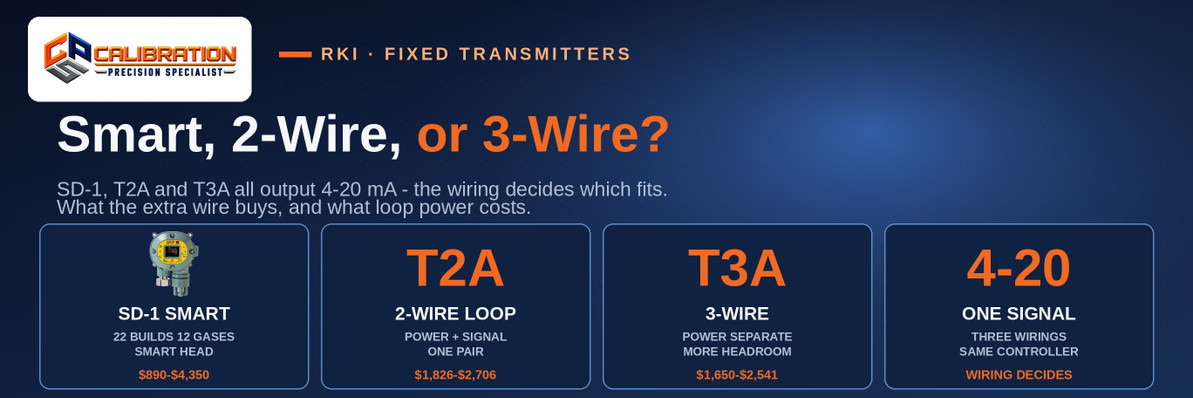
RKI SD-1, T2A, and T3A: Picking the RKI Transmitter Wiring
RKI sells three fixed transmitter architectures at three price bands — the SD-1 Smart Gas Detector Head in 22 configurations at $890–$4,350 across 12 gases, the T2A 2-wire loop-powered transmitter in 39 configurations at $1,826–$2,706 across 18 gases, and the T3A 3-wire transmitter in 37 configurations at $1,650–$2,541 across 21 gases — and all three deliver the same 4-20 mA signal to a Beacon controller, PLC, or DCS, so the choice is not about the signal; it is about power, wiring cost, and how much intelligence lives at the head.
Buyers often compare these three by price first, which misleads: the bands overlap because gas and sensor type move price more than architecture does. An SD-1 built for a specialty gas can cost more than a T3A built for a common one. Compare them by wiring situation instead — what cable already exists, where power is available, and who will stand at the head to calibrate it.
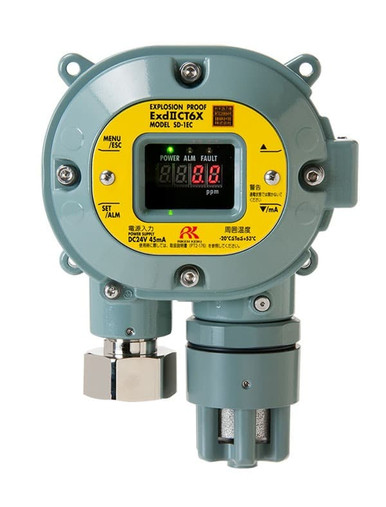
RKI SD-1 Smart Gas Detector Head
Smart detector head in 22 factory configurations covering 12 gases, 4-20 mA output.
$890–$4,350 configured
See the SD-1What Does 'Smart Head' Mean on the SD-1?
The SD-1 is a smart detector head: the intelligence — sensor identification, calibration data, and signal processing — lives in the head itself rather than being a dumb sensor feeding a separate transmitter. Its 22 configurations cover 12 gases, including acrylonitrile, carbon dioxide, carbon monoxide, ethylene oxide, hexane, hydrogen, hydrogen sulfide, isobutane, isopropyl alcohol, and methane. The wide $890–$4,350 spread is the gas list talking: specialty-gas smart heads cost what specialty sensors cost.
The practical buy: service and calibration behavior at the head, and a head that knows what it is. Where a site standardizes on smart heads, sensor swaps and calibration records follow the head's own configuration instead of a wiring closet's paperwork.
What Does a 2-Wire Loop-Powered Transmitter Buy? (T2A)
The T2A's two wires carry both power and signal: the same pair that powers the transmitter is the 4-20 mA loop the controller reads. That is the cheapest honest wiring in fixed gas detection — one pair per point, no separate power run, and natural compatibility with existing loop wiring and intrinsically safe loop design. Its 39 configurations cover 18 gases — ammonia, arsine, carbon monoxide, chlorine, chlorine dioxide, ethylene oxide, formaldehyde, hydrogen, hydrogen chloride, hydrogen cyanide, and more — at $1,826–$2,706.
The constraint is the power budget: a loop-powered device must run its sensor and electronics on the loop's limited current, which shapes which sensor types are practical. For the electrochemical toxic-gas points that dominate fixed systems, that budget is sufficient — which is why 2-wire transmitters dominate toxic-gas installations.
What Does the Third Wire Buy? (T3A)
The T3A separates the runs: power gets its own conductor and the 4-20 mA signal gets a clean run of its own. That buys power headroom — sensors and features that draw more than a loop can supply become available — and simpler troubleshooting, because power faults and signal faults stop sharing a pair. Its 37 configurations cover 21 gases at $1,650–$2,541 — note that its entry price sits below the T2A's, which surprises buyers who assume more wire means more money; gas selection, again, drives the final figure.
The cost is literal cable: a third conductor on every run, and power available at the transmitter location. On a new build with conduit already open, that cost is small. On a retrofit reusing existing pairs, it can be the whole project — which is exactly when the T2A earns its premium.
Which One Belongs on Your Site?
- Existing 2-wire loops or long runs: T2A — reuse the pairs, skip the power run.
- New construction, power nearby, hungrier sensors: T3A — headroom and cleaner troubleshooting.
- Specialty gases or smart-head service discipline: SD-1 — its 12-gas list covers builds the others do not, with the head carrying its own configuration.
All three land on the same controllers — the Beacon family or any PLC/DCS with analog inputs — and all three ship factory-calibrated. CPS specs fixed points against the site's actual wiring; see fixed system installation.
Frequently Asked Questions
How much do the SD-1, T2A, and T3A cost?
Configured at CPS: SD-1 $890–$4,350 (22 configurations), T2A $1,826–$2,706 (39 configurations), and T3A $1,650–$2,541 (37 configurations). Gas and sensor selection move the price more than the architecture does, so compare exact configurations, not band edges.
What is the difference between a 2-wire and a 3-wire transmitter?
A 2-wire transmitter is loop-powered: one pair carries both its power and its 4-20 mA signal. A 3-wire transmitter gives power its own conductor, separate from the signal — more power headroom and simpler fault isolation, at the cost of an extra conductor on every run and power at the head.
Do all three output the same signal?
Yes — 4-20 mA from all three, into an RKI Beacon controller, PLC, or DCS. Controllers cannot tell from the signal which architecture produced it; the difference is entirely in power, wiring, and what lives at the head.
What makes the SD-1 a 'smart' head?
The processing and configuration live in the head itself: it is a smart detector head rather than a passive sensor, in 22 factory configurations across 12 gases including specialty gases like acrylonitrile and ethylene oxide. Calibration and identity follow the head.
Which transmitter is cheapest to install?
Usually the T2A on a retrofit, because one existing pair per point does the whole job. On new construction the T3A's extra conductor is cheap while conduit is open. The SD-1's install cost depends on its mounting and gas build. Installation cost is a wiring question, not a shelf-price question.
Which gases can each model detect?
Per the product records: SD-1 covers 12 gases, T2A covers 18, and T3A covers 21 — with overlapping toxic-gas lists (CO, H2S, NH3, Cl2 and more) and model-specific specialty entries. The exact gas and range are selected in each product's configuration dropdown.
Can I mix SD-1, T2A, and T3A heads on one controller?
Yes — all three present a 4-20 mA channel, so a Beacon controller or PLC sees uniform channels. Mixed architectures on one site are normal: the wiring at each point decides which head belongs there.
Why does the SD-1 price range reach $4,350?
Specialty-gas smart heads. The SD-1's list includes gases whose sensors are intrinsically expensive, and a smart head carries its own processing. A methane SD-1 and a specialty-gas SD-1 are very different builds sharing one model name — the configured price reflects the gas.
Are these transmitters calibrated when they ship?
Yes — every configuration ships factory-calibrated and ready to wire in, per the product records. After installation they belong on the site's documented calibration schedule, serviced at the head.
How do I choose if I am not sure about my wiring?
Call 865-900-8844 with what is actually in the ground: existing cable, distance to the controller, and power availability. Those three facts usually decide the architecture before gas selection is even discussed — and CPS specs fixed systems against the site, not the catalog order.
The Bottom Line
The signal is the same from all three — 4-20 mA. What you are choosing is where power comes from and how much intelligence sits at the point: loop-powered simplicity (T2A, $1,826–$2,706), powered headroom (T3A, $1,650–$2,541), or a smart head that carries its own configuration (SD-1, $890–$4,350). Let the wiring you actually have make the call.
Need a calibration you can file?
In-house calibration at CPS in Rockwood, Tennessee — $55 for single-gas instruments, $90 for 4- and 5-gas — every channel, as-found and as-left data, full certificate.
See Calibration Servicesor call 865-900-8844
Recent Posts
-

What Is Remote Monitoring for Fixed Gas Detection?
Remote monitoring for fixed gas detection means a fixed system's live readings, trends, and alarm hi …Nov 23rd 2026 -

What Are the Key Differences Between the GX-6000 and GX-6100?
The RKI GX-6100 is the current replacement for the discontinued GX-6000: both are pumped 6-gas monit …Nov 22nd 2026 -

How to Read a PID Correction Factor Chart
To read a PID correction factor chart, find your vapor’s row, take the factor under your own lamp en …Nov 21st 2026