
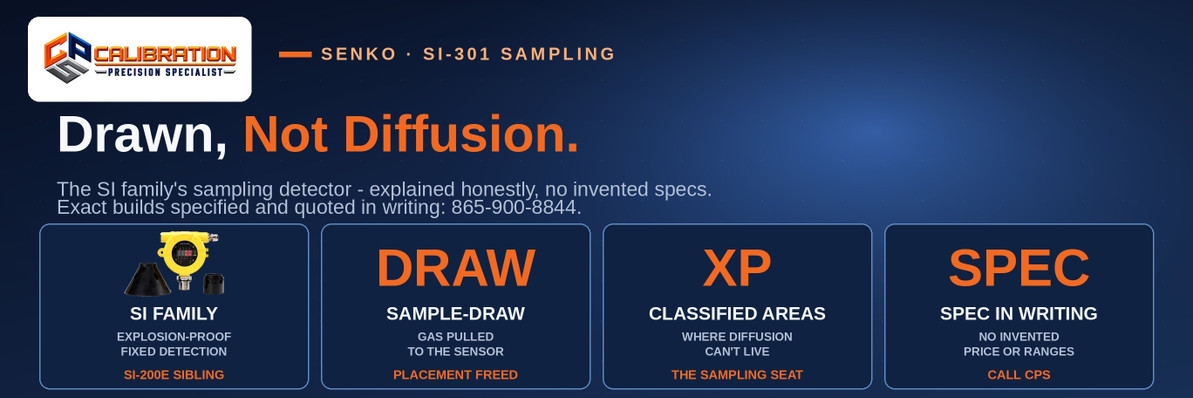
SENKO SI-301 Explosion-Proof Sampling Detector
Honesty first, because this post is about the instrument CPS can say the least about on paper: the SENKO SI-301 is the sampling member of SENKO's explosion-proof SI fixed-detector family — a sample-draw detector rather than a diffusion point — and its own store record is too garbled to quote a price, gas list, or range from responsibly, so this post does not invent one; it explains what a sampling detector in this family does, how it differs from the diffusion SI-200E we can document fully, and routes exact SI-301 specification to a written quote at 865-900-8844.
Why publish a spotlight with a hole in it? Because buyers searching for the SI-301 deserve the true shape of the answer: the instrument exists in SENKO's SI line as the sampling counterpart to point detection, the family context is verifiable, and the specifics must come from a clean specification — not from a corrupted listing repeated as fact. If a competitor's page quotes you SI-301 ranges today, ask which document they came from.
Sampling vs Diffusion — the SI Family's Two Shapes
The verifiable sibling defines the family. The SENKO SI-200E is a diffusion-type fixed detector in an explosion-proof enclosure: gas reaches its sensor where it stands, it displays concentration on a 4-digit display, and it reports by 4-20 mA and RS-485 Modbus with alarm relays, optional HART, IP66 sealing, and a -40°C to +60°C operating range, configured at $1,092.50–$2,300. That is the point-detector shape: the sensor lives at the point.
A sampling detector inverts the placement. Instead of the sensor standing in the atmosphere, a sampling system draws gas from the point to the detector — the architecture a plant chooses when the point itself is too hot, too wet, too inaccessible, or otherwise wrong for a resident sensor, while the location still demands explosion-proof, fixed, continuous detection. The SI-301 occupies that sampling seat in the SI family — the shape SENKO's own lineup, as documented in the SI-H100 sample-draw coverage, pairs against the SI-200E's diffusion point in our published SI-200E spotlight's FAQ.
What a Sampling Detector Buys — and What It Costs
The buy is placement freedom under a classified-area rating: the measurement point and the instrument no longer have to be the same place. The sample can be drawn from where gas actually appears — equipment interiors, sumps, ducts, hot process points — to a detector mounted where it survives and where a technician can reach it for calibration.
The cost is the sample path, always: pump, line, and filters become part of the measurement. Response includes transport time; soluble gases can be lost to a condensing line; a blocked line fails silently unless the system watches flow. None of that argues against sampling — it argues for specifying and maintaining it as a system, which is precisely why an SI-301 specification should happen in a conversation about your point, your gas, and your distances, not from a price scraped off a broken listing.
How to Specify an SI-301 Today
- Name the gas and the point: what is being watched, where it appears, and why a diffusion point cannot live there.
- Name the classification: the area rating that makes explosion-proof construction the requirement.
- Expect a written configuration: CPS will confirm the SI-301's exact build, gas, and price from a clean SENKO source before quoting — the standard we applied to this post itself.
Call CPS Calibrations at 865-900-8844. And if your point can take a resident sensor after all, the documented alternative is live today: the SI-200E at $1,092.50–$2,300 configured, with the family comparison in SENKO fixed gas detectors: which SI series monitor do you need?.
Frequently Asked Questions
What is the SENKO SI-301?
The sampling member of SENKO's explosion-proof SI fixed-detector family: a sample-draw detector that pulls gas from a measurement point to the instrument, for classified-area points where a resident diffusion sensor is the wrong fit. Its sibling, the SI-200E, is the family's diffusion point detector.
How much does the SI-301 cost?
We are not quoting a figure in this post, deliberately. The SI-301's current store record is garbled and cannot support an honest price. Call 865-900-8844 and CPS will confirm the exact configuration and price from a clean SENKO source, in writing, before you commit — the same standard this post holds itself to.
What gases does the SI-301 detect?
Not stated here, for the same reason: no clean, verifiable source available to this post enumerates the SI-301's gas list, and inventing one would be worse than omitting it. The SI family's documented breadth (oxygen, toxic, combustible, VOC and specialty gases on the SI-200E) is family context, not an SI-301 claim. Specification by phone will name the exact gas build.
How is the SI-301 different from the SI-200E?
Sampling versus diffusion. The SI-200E's sensor stands at the point and gas diffuses to it. A sampling detector draws gas through a line from the point to the instrument, freeing the instrument's placement — at the cost of maintaining the pump, line, and filters as part of the measurement.
Why would I choose a sampling detector over a point detector?
When the point is too hot, wet, corrosive, or inaccessible for a sensor to live and be serviced there, but continuous fixed detection is still required. Sampling moves the instrument, not the measurement.
What are the downsides of sample-draw detection?
Transport time adds to response; condensation in the line can scrub soluble gases; a blocked line or tired pump degrades the reading. The sample path must be flow-checked and maintained alongside calibration — it is a component of the instrument.
Is the SI-301 explosion-proof?
It is the explosion-proof family's sampling detector — explosion-proof construction is the SI line's defining trait, documented fully on the SI-200E (explosion-proof enclosure, IP66). Confirm the exact rating wording for your SI-301 configuration on the written quote.
Why doesn't this post link the SI-301 product page?
Because its current store record is garbled. Linking a corrupted listing as specification would repeat data we cannot verify. The post links the verified SI-200E product and the SI family comparison instead, and routes SI-301 specification to a call.
How often would an SI-301 need calibration?
On the interval SENKO specifies for the configured sensor — fixed sensors do not share one honest number across gases, and this post will not invent one for the SI-301. What is certain: the sample path belongs on the same written schedule, with flow checks beside the calibration.
What should I prepare before calling about an SI-301?
The gas, the point's location and conditions, why a diffusion point cannot live there, the area classification, and roughly the draw distance you expect. With those five facts, CPS can confirm the exact SI-301 build and price in writing — call 865-900-8844.
The Bottom Line
The SI-301 is the SI family's answer to the point a diffusion sensor cannot occupy: explosion-proof, fixed, and sampling. What this post will not do is dress a garbled listing up as a specification — no invented price, gas list, or range. Bring CPS the gas and the point, and the exact instrument gets specified and quoted in writing.
Need a calibration you can file?
In-house calibration at CPS in Rockwood, Tennessee — $55 for single-gas instruments, $90 for 4- and 5-gas — every channel, as-found and as-left data, full certificate.
See Calibration Servicesor call 865-900-8844
Recent Posts
-

What Is Remote Monitoring for Fixed Gas Detection?
Remote monitoring for fixed gas detection means a fixed system's live readings, trends, and alarm hi …Nov 23rd 2026 -

What Are the Key Differences Between the GX-6000 and GX-6100?
The RKI GX-6100 is the current replacement for the discontinued GX-6000: both are pumped 6-gas monit …Nov 22nd 2026 -

How to Read a PID Correction Factor Chart
To read a PID correction factor chart, find your vapor’s row, take the factor under your own lamp en …Nov 21st 2026