
SENSIT CO Analyzer: A Hand-Held Carbon Monoxide Analyzer for HVAC and Fire Service
The SENSIT CO is a hand-held carbon monoxide analyzer — an instrument for measuring CO, not merely alarming on it — whose included kit carries a hot-air (flue) probe for combustion-side checks alongside the hard carrying case, batteries, and manual. It serves the two CO jobs that need real numbers: HVAC combustion and appliance investigation, and fire-service CO calls. Configured, it runs $924.60–$1,167.60 at CPS Calibrations.
Carbon monoxide work splits into two disciplines that share a gas and nothing else. Protection is worn: a personal monitor alarms so a worker leaves. Investigation is carried: an analyzer measures — how much CO is in this room, is it rising, and is the furnace's flue producing it — so someone can make a decision and document it. The SENSIT CO is the second kind of instrument, and the flue probe in its box is the tell: this is a tool for going to the appliance, sampling the hot exhaust side, and coming back with a number a report can stand on. This spotlight covers what an analyzer does that an alarm cannot, the two services that use it, and what comes in the kit. The instrument itself is the SENSIT CO.
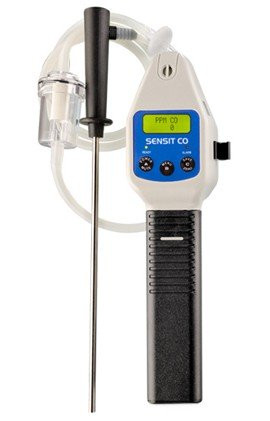
SENSIT CO Carbon Monoxide Analyzer
Hand-held carbon monoxide analyzer with a hot-air (flue) probe included for combustion-side checks.
$924.60–$1,167.60 configured
See the SENSIT COWhy an Analyzer, When CO Monitors Are Everywhere?
Because the questions on a CO call are quantitative. A personal monitor's display exists to trigger a decision — leave — at preset alarm points. An investigator's questions are finer: Is the ambient level 9 ppm or 90? Is it climbing while we stand here? After the appliance is shut down, is it falling at the rate that proves the source? And the source-side question no ambient instrument can answer at all: what is the CO concentration in the flue, where a cracked heat exchanger, a blocked vent, or a misadjusted burner announces itself in the exhaust before it announces itself in the living space? The SENSIT CO's hot-air (flue) probe is the sampling tool for that side of the appliance — built to take the hot sample a hand-held ambient reading never touches. Analyzer and alarm are not rivals; the alarm protects the investigator while the analyzer does the investigating.
How Do HVAC and Fire Service Each Use It?
HVAC: the combustion check. A technician evaluating a furnace, boiler, or water heater measures ambient CO around the appliance and samples the flue with the probe — the pair of numbers that separates 'the appliance is producing CO and spilling it' from 'the CO came from somewhere else' (the attached garage, the gas range, the fireplace). Those readings drive the red-tag decision and document it afterward; 'the analyzer read X in the flue and Y ambient' is a sentence a customer, an insurer, or a court can work with, and 'my alarm chirped' is not.
Fire service: the CO investigation call — the detector sounding in a home with no visible cause. Crews measure room by room, establish whether the level justifies evacuation and ventilation, and then hunt the source, appliance by appliance, flue probe included. A measured, logged sweep is also what closes the call: the building is cleared on numbers, not on a hunch, and the numbers go in the report. In both services the instrument's value is identical — a defensible CO concentration, taken where the question actually is.
What Is in the Kit — and What Does Ownership Look Like?
The ship kit is included in the configured price: hard carrying case, three C batteries, the hot-air (flue) probe, and the instruction manual. The case matters more than it looks — an analyzer lives in a service truck or an apparatus bay, and the probe travels with the instrument rather than in a separate bin that empties itself. The two configurations behind the $924.60–$1,167.60 range are enumerated on the product page; choose with your service's standard load-out in mind.
Ownership is calibration discipline. An analyzer's number is its testimony, and testimony needs a chain: CPS calibrates the SENSIT CO in-house at the published $55 single-gas rate, returning a certificate with as-found and as-left readings and the calibration gas's Certificate of Analysis link — the documentation that lets a reading taken in January be defended in June. The instrument joins the CPS Calibration Program, so the next due date is reminded, not remembered.
What Can a CO Reading Prove — and What Can It Not?
An analyzer number is powerful and narrow at once, and good investigators respect both edges. It can prove the concentration at the place and moment sampled — ambient in this room, flue gas at this appliance — and, taken in sequence, the trend: rising, falling, cleared. It cannot prove what the concentration was an hour before you arrived, or in the room you did not enter; ventilation changes the picture while you work, and an appliance cycles. That is why CO investigation is a *sweep and a sequence*, not a single reading: room by room, appliance by appliance, re-checked after ventilation and after shutdown. It is also why the analyzer's calibration certificate matters — the numbers are only as defensible as the instrument's last verified calibration. Hold both halves together — measured carefully, documented honestly — and a CO call closes with confidence instead of a callback.
Frequently Asked Questions
How much does the SENSIT CO analyzer cost?
Configured, $924.60–$1,167.60 at CPS Calibrations. The ship kit — hard carrying case, three C batteries, hot-air (flue) probe, and instruction manual — is included. The live configurations are on the SENSIT CO product page.
What is the difference between a CO analyzer and a CO personal monitor?
Purpose. A personal monitor is worn protection: it alarms at preset points so the wearer leaves. An analyzer is a measuring instrument for investigation — quantifying ambient CO room by room, tracking whether it rises or falls, and, with its flue probe, sampling the exhaust side of an appliance to find the source. Crews carry analyzers to answer questions; they wear monitors to stay safe while answering them.
What is the flue probe for?
Sampling hot exhaust gas. The hot-air (flue) probe lets the analyzer measure CO in the flue of a furnace, boiler, or water heater — the production side of the problem — instead of only the ambient air where the CO ends up. Pairing the flue reading with the ambient reading is how an investigator proves which appliance is the source.
Who uses the SENSIT CO?
Two services principally: HVAC technicians performing combustion and appliance CO checks, and fire departments running CO investigation calls — measuring, clearing, and documenting buildings. Any trade that must produce a defensible CO number rather than an alarm event is the analyzer's user.
What comes with the SENSIT CO?
A hard carrying case, three C batteries, the hot-air (flue) probe, and the instruction manual — included in the configured price. The probe is part of the kit, not a separate accessory purchase.
How much does it cost to calibrate a SENSIT CO?
$55 at CPS Calibrations — the published in-house rate for single-gas instruments, at our Rockwood, Tennessee bench and never an on-site price. The certificate shows as-found and as-left readings with the calibration gas's CoA link, and the analyzer is enrolled in the CPS Calibration Program. Details on the calibration services page.
Why does calibration matter so much for an analyzer?
Because its readings get written down and relied on — in service tickets, incident reports, and occasionally disputes. A calibration certificate with as-found/as-left data and traceable gas documentation is the chain that makes a field number defensible months later. An uncalibrated analyzer produces numbers with no chain behind them.
Can the SENSIT CO replace the CO monitor on my crew?
No — they do different jobs. The analyzer investigates; it is carried to the question. Personal monitors protect; they are worn continuously and alarm for evacuation. A fire crew or HVAC tech working a CO call properly has both: worn protection on the person, the analyzer in hand for the measurements.
Does the SENSIT CO find the source of a CO alarm in a home?
That is its fire-service job: measure the ambient levels room by room, ventilate and clear on numbers, then work the appliances — furnace, water heater, range — with ambient checks and the flue probe until one of them accounts for the readings. It turns 'the detector went off' into an identified source and a documented clearance.
Where can I get a SENSIT CO calibrated?
Mail it to CPS Calibrations in Rockwood, Tennessee, or bring it in — in-house calibration at the published $55 single-gas rate, with a full certificate returned with the instrument. Call 865-900-8844 to book, or start from the calibration services page.
The Bottom Line
The SENSIT CO is the measuring half of carbon monoxide work: a hand-held analyzer with its flue probe in the box, built for the HVAC combustion check and the fire-service CO call, at $924.60–$1,167.60 configured with the kit included. Its numbers end arguments — provided they are calibrated numbers, which is a $55 habit with a certificate behind it.
Equipping a truck or a department and want the configuration matched to your call load? Call CPS Calibrations at 865-900-8844.
--- CPS Calibrations · 109 S. Front Street, Rockwood, TN 37854 · SENSIT CO · Calibration Services · CPS Calibration Program
Need a calibration you can file?
In-house calibration at CPS in Rockwood, Tennessee — $55 for single-gas instruments, $90 for 4- and 5-gas — every channel, as-found and as-left data, full certificate.
See Calibration Servicesor call 865-900-8844
Recent Posts
-

What Is Remote Monitoring for Fixed Gas Detection?
Remote monitoring for fixed gas detection means a fixed system's live readings, trends, and alarm hi …Nov 23rd 2026 -

What Are the Key Differences Between the GX-6000 and GX-6100?
The RKI GX-6100 is the current replacement for the discontinued GX-6000: both are pumped 6-gas monit …Nov 22nd 2026 -

How to Read a PID Correction Factor Chart
To read a PID correction factor chart, find your vapor’s row, take the factor under your own lamp en …Nov 21st 2026