
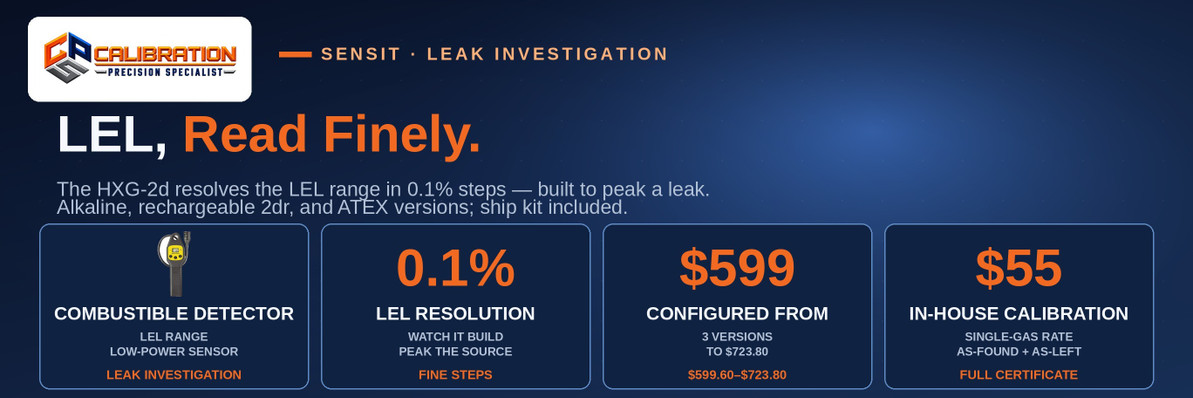
SENSIT HXG-2d: The LEL-Range Leak Investigation Detector
The SENSIT HXG-2d is a combustible gas detector that measures in the LEL range with 0.1% LEL resolution — fine enough steps to watch a reading build as you move across a fitting — which is why it has become a favorite for leak investigation. It comes in alkaline, rechargeable (2dr), and ATEX versions, runs $599.60–$723.80 configured at CPS Calibrations, and ships with its kit included: carry pouch, wrist strap, T10 wrench, manual, and batteries.
Resolution is the specification nobody brags about and everybody uses. A combustible detector that displays whole percent LEL tells you gas is present; one that resolves tenths tells you *where it is stronger* — and leak investigation is mostly the second question. Sweep a meter set with a coarse display and the number sits still, then jumps; sweep it with 0.1% steps and the reading breathes as you pass each joint, which is how a joint gets named as the source instead of the whole assembly getting condemned. The HXG-2d is SENSIT's LEL-range instrument built around that idea, with a low-power sensor and a three-version lineup. This spotlight covers what it measures, how the versions differ, and where it sits next to its ppm-reading sibling, the SENSIT HXG-3. The instrument itself is the SENSIT HXG-2d.

SENSIT HXG-2d Combustible Gas Detector
Combustible gas detector measuring the LEL range at 0.1% LEL resolution — a leak-investigation favorite.
$599.60–$723.80 configured
See the HXG-2dWhy Does 0.1% LEL Resolution Matter for Leak Investigation?
Because investigation is comparative. The absolute number at any one point matters less than the gradient — how the reading changes as the sensor moves. At 0.1% LEL resolution, a detector resolves the small differences between 'near the leak' and 'at the leak' while both are still well inside the LEL range, so the operator can peak the reading the way you peak a signal: move, watch, move again, and stop where it is strongest. That is a different working style from ppm sniffing — the HXG-3 family's approach — and the two coexist in the SENSIT line because crews genuinely split: ppm for the trace find at very low concentrations, fine LEL for working a known combustible atmosphere and judging it against flammability. The HXG-2d is the second tool, and its LEL scale is also the scale safety decisions are written in, so the investigation reading and the hazard reading are the same number.
What Are the Three HXG-2d Versions?
The lineup varies by power and market, not by sensor:
- The standard HXG-2d runs on alkaline batteries — the swap-and-go choice for occasional use and shared trucks, where a detector may sit between calls and must simply work when picked up.
- The HXG-2dr is the rechargeable model: it swaps the alkalines for a rechargeable pack with a wall charger. For a detector in daily service, the pack ends the battery drawer and the mid-call cell hunt; the trade is a charging routine to keep.
- The ATEX version is certified for the European market — the build to specify when the instrument's paperwork must satisfy EU hazardous-location requirements.
All three ship with the kit included in the configured price: carry pouch, wrist strap, T10 wrench, instruction manual, and batteries. The version choice is what spreads the configured price across $599.60–$723.80.
Where Does the HXG-2d Fit in a Leak Kit?
Use this when the call is 'find and judge the combustible leak': meter sets, regulators, piping joints, appliance connections, and the follow-up check that proves a repair. Its LEL-range readout doubles as the hazard judgment while you work, and its size and price make it a realistic one-per-technician instrument rather than a shared specialty tool.
Know its edges honestly: it is a combustible-only detector — no oxygen, no CO, no H₂S channels — so it does not replace the multi-gas monitor your entry and excavation procedures require, and an LEL-range instrument is not the trace-ppm sniffer for finding the faintest seep in a large space; that is the HXG-3's ppm game. A complete leak kit often carries both ideas. What the HXG-2d does, it does at the lowest configured price in SENSIT's dedicated leak line — under $725 in every version.
HXG-2d or a Pumped Investigator — Which Leak Tool?
The SENSIT line itself draws the line. The HXG-2d is the hand-carried fine-LEL instrument: arm's-reach work, instant-on simplicity, the lowest configured price in the dedicated leak line. The pumped investigators — the GOLD family — exist for the samples an arm cannot reach: bar holes over buried pipe, vaults, pits, and spaces sampled through a probe before anyone leans in. Crews sometimes try to make one tool do both jobs and end up served poorly at both: a pumped investigator is over-built and over-priced for a meter-set sweep, and a diffusion LEL detector cannot pull a bar-hole sample no matter how long you hold it there. The working rule: if your leak calls end at the customer's meter and appliances, the HXG-2d's kit is the right size. If your calls start with a drill and a probe pattern, you are in pumped territory — and CPS's GOLD spotlights cover that ground.
A Note on Reading LEL Honestly
One discipline separates investigators from alarm-carriers: an LEL-range reading is a statement about the atmosphere *at the sensor, at that moment*. Gas stratifies, pools in low spots, and thins near ventilation — so the fine scale's gift, its sensitivity to small differences, cuts both ways: it will faithfully report the clean layer of air at chest height while a flammable layer sits at the floor. Work the instrument at the height of the work and below it, re-check after conditions change, and let the 0.1% steps inform the judgment rather than replace it. The HXG-2d gives you the finest LEL information in its class of tool; the interpretation remains, as it should, a trained human's job.
Frequently Asked Questions
How much does the SENSIT HXG-2d cost?
Configured, $599.60–$723.80 at CPS Calibrations, depending on version — alkaline, rechargeable (2dr), or ATEX. The ship kit (carry pouch, wrist strap, T10 wrench, manual, batteries) is included with purchase. Live configurations are on the SENSIT HXG-2d product page.
What does the HXG-2d measure?
Combustible gas in the LEL range, with 0.1% LEL resolution, through a low-power sensor. The fine resolution is the point: it lets an investigator watch the reading build in small steps and peak it at the source, while reading on the same %LEL scale that safety decisions use.
What is the difference between the HXG-2d and the HXG-2dr?
Power. The 2dr is the rechargeable model — a rechargeable pack with wall charger in place of alkaline batteries. Daily-use detectors suit the rechargeable routine; occasional-use and shared-truck detectors often suit alkalines, which hold their charge on the shelf. The detector and its measurement are the same.
What is the ATEX version of the HXG-2d?
A build certified for the European market's hazardous-location requirements. Specify it when the instrument will work under EU rules or when your company's paperwork requires ATEX certification; the measurement — LEL range at 0.1% resolution — is unchanged.
Is the HXG-2d a pumped instrument?
The HXG-2d reads the atmosphere at the instrument, in the diffusion style of a handheld leak detector — the operator moves it across fittings and joints and watches the fine LEL scale respond. For drawn samples from bar holes or enclosed spaces, a pumped investigator from the GOLD line is the tool; the HXG-2d's work is at arm's reach.
HXG-2d or HXG-3 — which leak detector do I need?
They read different scales. The HXG-2d measures the LEL range finely (0.1% LEL) — best for working and judging a combustible atmosphere and peaking a leak within it. The HXG-3 reads in ppm as well as LEL — best for trace sensitivity at very low concentrations. Many leak crews carry the concepts together; if you buy one first, buy the scale your typical call starts in.
Does the HXG-2d detect carbon monoxide or other toxic gases?
No. It is a combustible-gas detector only. Carbon monoxide investigations and multi-gas protection are different instruments — SENSIT's GOLD line displays CO, O2, and H2S alongside LEL. The HXG-2d's job is the combustible measurement, done finely.
What comes with the SENSIT HXG-2d?
The ship kit is included with purchase: carry pouch, wrist strap, T10 wrench, instruction manual, and batteries (the 2dr substitutes its rechargeable pack and wall charger). Nothing on that list is a surprise add-on at checkout — it is in the configured price.
How much does it cost to calibrate an HXG-2d?
$55 at CPS Calibrations — the published in-house rate for single-gas instruments, performed at our Rockwood, Tennessee bench and never an on-site price. You get as-found and as-left readings on a full certificate with the calibration gas's CoA link, and enrollment in the CPS Calibration Program. The bench is described on the calibration services page.
How often should the HXG-2d be calibrated?
At the interval its manual specifies, and sooner after a failed function check, a hard drop, or readings that disagree with a second instrument. A leak investigator whose scale has drifted will misjudge both halves of its job — finding and judging — so calibration is not paperwork for this class of instrument; it is the measurement.
The Bottom Line
The HXG-2d does one measurement — combustible gas in the LEL range — at a resolution, 0.1% LEL, that turns the display into an investigative tool, in alkaline, rechargeable, and ATEX builds from $599.60 to $723.80 configured with the kit included. It is the lowest-cost door into SENSIT's dedicated leak line, and for arm's-reach leak investigation it is sized and priced like the everyday tool it is meant to be.
Deciding between the fine-LEL and ppm approaches for your leak work? Call CPS Calibrations at 865-900-8844 and walk us through a typical call — the right scale is usually obvious once the call is described.
--- CPS Calibrations · 109 S. Front Street, Rockwood, TN 37854 · SENSIT HXG-2d · SENSIT HXG-3 · Calibration Services
Need a calibration you can file?
In-house calibration at CPS in Rockwood, Tennessee — $55 for single-gas instruments, $90 for 4- and 5-gas — every channel, as-found and as-left data, full certificate.
See Calibration Servicesor call 865-900-8844
Recent Posts
-

Which GfG Portable Gas Detector Is Best for You?
The right GfG portable is decided by three questions — how many gases, pumped or diffusion, and PID …Nov 24th 2026 -
What GfG Fixed Gas Detection Systems Are There? Every Transmitter and Controller Explained
GfG’s fixed gas detection line at CPS is 39 products in two layers: 23 transmitters and detection sy …Nov 24th 2026 -
What GfG Portable Gas Detectors Are There? Every Model Explained
GfG’s portable line at CPS is 14 products built around six instruments: the Micro IV single-gas dete …Nov 24th 2026